← All women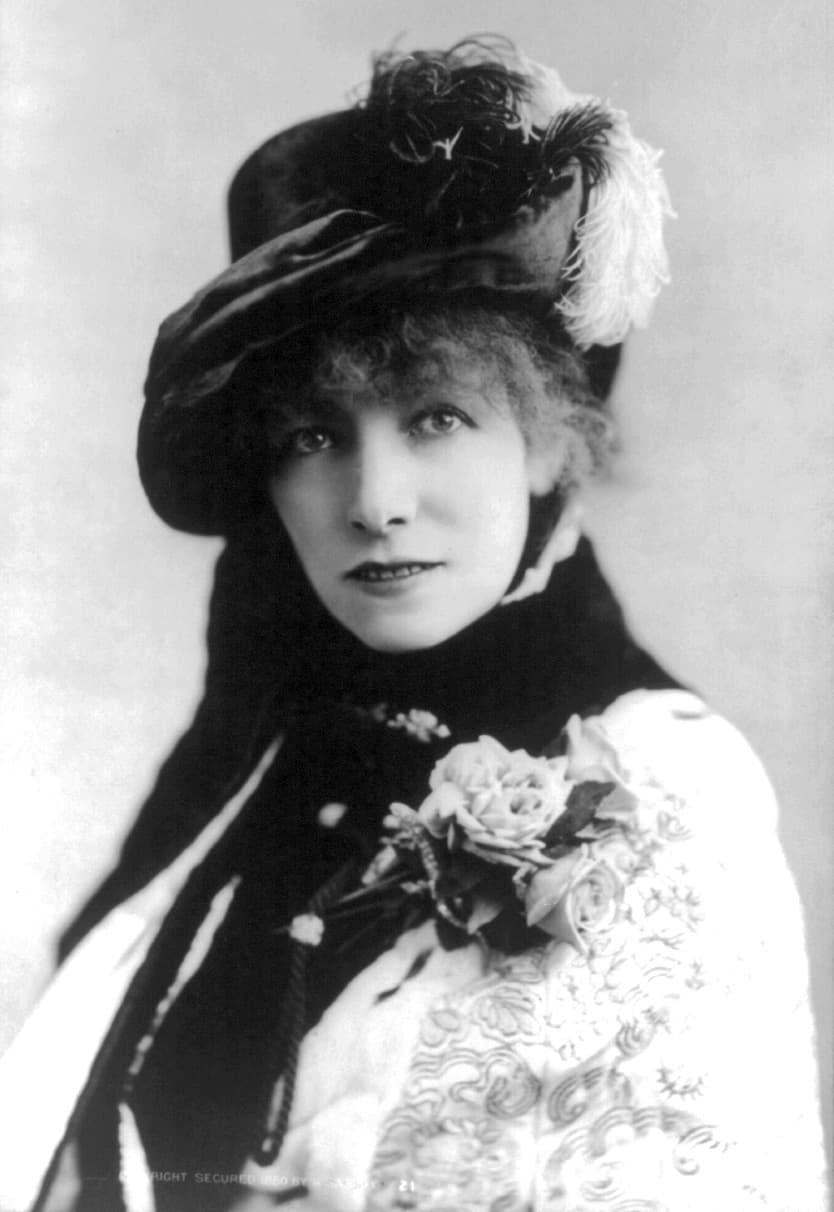
French · Arts
Sarah Bernhardt
October 22, 1844 – March 26, 1923
Early life and background
Sarah Bernhardt was born Henriette-Rosine Bernard in Paris on 22 October 1844, though some sources record her birth as 22 or 23 October. She was the daughter of Judith Bernard, a Jewish courtesan of Dutch origin, and a father usually identified as a lawyer who was largely absent from her life. Her childhood was unstable and divided between periods in Paris and time spent in convent education, experiences that would later shape her dramatic self-presentation and her fascination with religious and theatrical ritual.
Bernhardt’s early life has often been described as difficult, but it also placed her within the cultural world of Paris at a moment when the city was a center of elite taste, class performance, and artistic innovation. She reportedly considered becoming a nun before turning to the stage. With the support of her mother’s wealthy patron, she entered the Conservatoire de Paris at the age of sixteen, where she studied acting. This training connected her to the classical French tradition that would become the foundation of her reputation.
Her Jewish background and ambiguous social position mattered in the France of the mid-nineteenth century, a society in which actresses were often judged as morally suspect and Jewish women faced prejudice. Bernhardt would later use these pressures to help fashion a public identity marked by independence, glamour, and defiance.
Career beginnings
Bernhardt’s professional stage career began in 1862, when she made her debut at the Comédie-Française in Racine’s Iphigénie. The exact date is documented as 31 August 1862. The appearance did not immediately launch her into stardom, but it established her in the highest ranks of French classical theatre.
In the years that followed, Bernhardt worked through a range of roles and gradually developed the expressive voice, controlled gestures, and emotional directness that later became her trademarks. She appeared in Racine, Victor Hugo, Alexandre Dumas père, and contemporary dramatists, refining a style that combined classical discipline with vivid emotional projection. By the late 1860s and early 1870s, she had begun attracting attention for her versatility and intensity.
A major turning point came with Le Passant in 1869, where she played the young male page Zanetto, one of the first of several famous male roles she would undertake. The success of the performance helped establish a pattern that would recur throughout her career: Bernhardt repeatedly took roles that expanded the acceptable boundaries of femininity on stage.
Rise to international fame
By the 1870s, Bernhardt had become a major theatrical name. She won praise in roles such as Racine’s Phèdre and Victor Hugo’s Hernani, and she became associated with emotionally rich heroines in both classical and contemporary drama. Her performances were admired for their vocal beauty, precision, and the sense of intelligence she brought to suffering or morally complex characters.
In 1880, she starred in Adrienne Lecouvreur, Froufrou, and La Dame aux Camélias, performances that consolidated her image as one of the most compelling actresses in Europe. In 1882 she premiered in Victorien Sardou’s Fédora, a role that became closely associated with her name. She continued to shape her public identity through major parts in Théodora (1884), La Tosca (1887), Cléopatre (1890), and Gismonda (1894).
Bernhardt’s fame rested not only on her acting but also on her management of celebrity. She toured widely in Europe, the Americas, and elsewhere, and she became known internationally as “the Divine Sarah” and the “Voice of Gold.” Her tours brought French theatrical culture to audiences far beyond Paris and helped create one of the first truly global stage reputations. In an era when women performers were frequently confined by local boundaries and moral criticism, Bernhardt used mobility, self-branding, and repertoire choice to turn herself into a world figure.
Hamlet, gender, and theatrical innovation
One of the most famous examples of Bernhardt’s artistic daring was her performance as Hamlet. On 9 May 1899, she opened in the role at the Théâtre Sarah-Bernhardt in Paris. Casting a woman as Hamlet was not unprecedented in theatrical history, but Bernhardt’s version attracted exceptional attention because of her fame and the seriousness with which she approached the part.
Her Hamlet helped crystallize her reputation for crossing boundaries between masculine and feminine roles without diminishing the intellectual seriousness of either. The production also demonstrated her instinct for choosing parts that generated publicity while challenging assumptions about who could embody authority, melancholy, and philosophical depth on stage.
The role had further significance because a version of the Hamlet duel scene was later filmed in 1900, making Bernhardt part of early cinema history. Her association with Hamlet therefore connects nineteenth-century stage tradition with the emergent visual culture of the twentieth century.
Work in early film, sound recording, and theatre management
Bernhardt was among the early major stage actors to embrace new media. She made sound recordings and appeared in motion pictures at a time when many theatre stars remained skeptical of film’s artistic value. In 1900, during the Paris Exposition, she performed in the Phono-Cinéma-Théâtre program, one of the most famous early film documents of her work. Later, in 1912, her film Queen Elizabeth was released in the United States as the first release of Adolph Zukor’s Famous Players Company.
These film appearances were important because they extended Bernhardt’s fame into a new technological era. At a time when filmed performance was still developing its prestige, she helped establish that stage celebrity could migrate to the screen. Her participation also supported the cultural legitimacy of cinema by attaching it to an already celebrated dramatic tradition.
Bernhardt was not merely a performer; she was also an actor-manager and theatre owner. She took control of performance spaces and repertory choices, allowing her to shape her own artistic image with unusual independence for a woman of her era. That level of control was a significant barrier-breaking achievement in a field where institutional authority was overwhelmingly male.
Other artistic work
Bernhardt was also a sculptor, painter, and writer. She studied sculpture and exhibited artistic talent outside acting, reflecting a broader late nineteenth-century pattern in which some performers cultivated multiple public identities. Her creative life included memoirs and literary work, and she became known for a restless artistic curiosity that extended beyond the stage.
Her interest in visual art and literature helped reinforce the idea that she was not simply a performer but a full cultural presence. This multiplicity contributed to her aura of modernity and made her one of the rare women of her age to be recognized across several artistic domains.
Personal life
Bernhardt married only once, to the Greek actor Aristides Damala, and the marriage was brief and troubled. More broadly, her personal life was marked by independence, unconventional relationships, and public scrutiny. She had a son, Maurice Bernhardt, and much of her emotional life has been reconstructed through letters, memoirs, and biographical accounts rather than conventional domestic narratives.
Her life was shaped by the expectations placed on women in the nineteenth century and by the moral double standards applied to actresses. Rather than conforming to a model of domestic respectability, Bernhardt cultivated a public identity grounded in artistic autonomy, travel, and self-fashioning. That independence became part of her legend, though it also brought criticism and gossip.
Illness, injury, and later life
Bernhardt suffered serious injury to her right knee during a performance in Rio de Janeiro in 1905. The injury eventually led to the amputation of her right leg in 1915, after which she continued to perform. Her persistence in the face of disability became part of the mythology surrounding her career and demonstrated the extraordinary resilience that helped sustain her public image.
Even after major health setbacks, Bernhardt remained professionally active into the 1920s. She appeared in stage works such as Racine’s Athalie and Verneuil’s Daniel in 1920. Her continued performances despite pain and reduced mobility reflected both personal determination and a professional identity built over decades.
Death and legacy
Sarah Bernhardt died in Paris on 26 March 1923. Her death closed a career that had begun in the age of the Second Empire and extended into the modern age of film publicity and global celebrity. She was widely mourned as a theatrical legend and remembered as one of the greatest stage performers in history.
Her legacy is substantial. Bernhardt helped define the idea of the modern star performer, combining artistry, image-making, touring, publicity, and cross-media experimentation. She showed that a woman could dominate the stage internationally, take on male roles, lead productions, and shape a public persona that transcended national borders. She also helped establish a model of performance celebrity that influenced later generations of actors.
As a Jewish woman in a period of social constraint, Bernhardt negotiated multiple barriers while building a career of extraordinary visibility. Her life remains central to histories of theatre, women’s cultural labor, celebrity, and the early relationship between stage and screen.
Dated achievements
6 indexed.
- Oct221844Arts
Birth of Sarah Bernhardt
Sarah Bernhardt (born Henriette-Rosine Bernard) was born in Paris, France.
View details Wikipedia: Sarah Bernhardt - Aug311862Arts
Debut at the Comédie-Française
Bernhardt's major professional stage debut in Racine's Iphigénie.
View details