← All women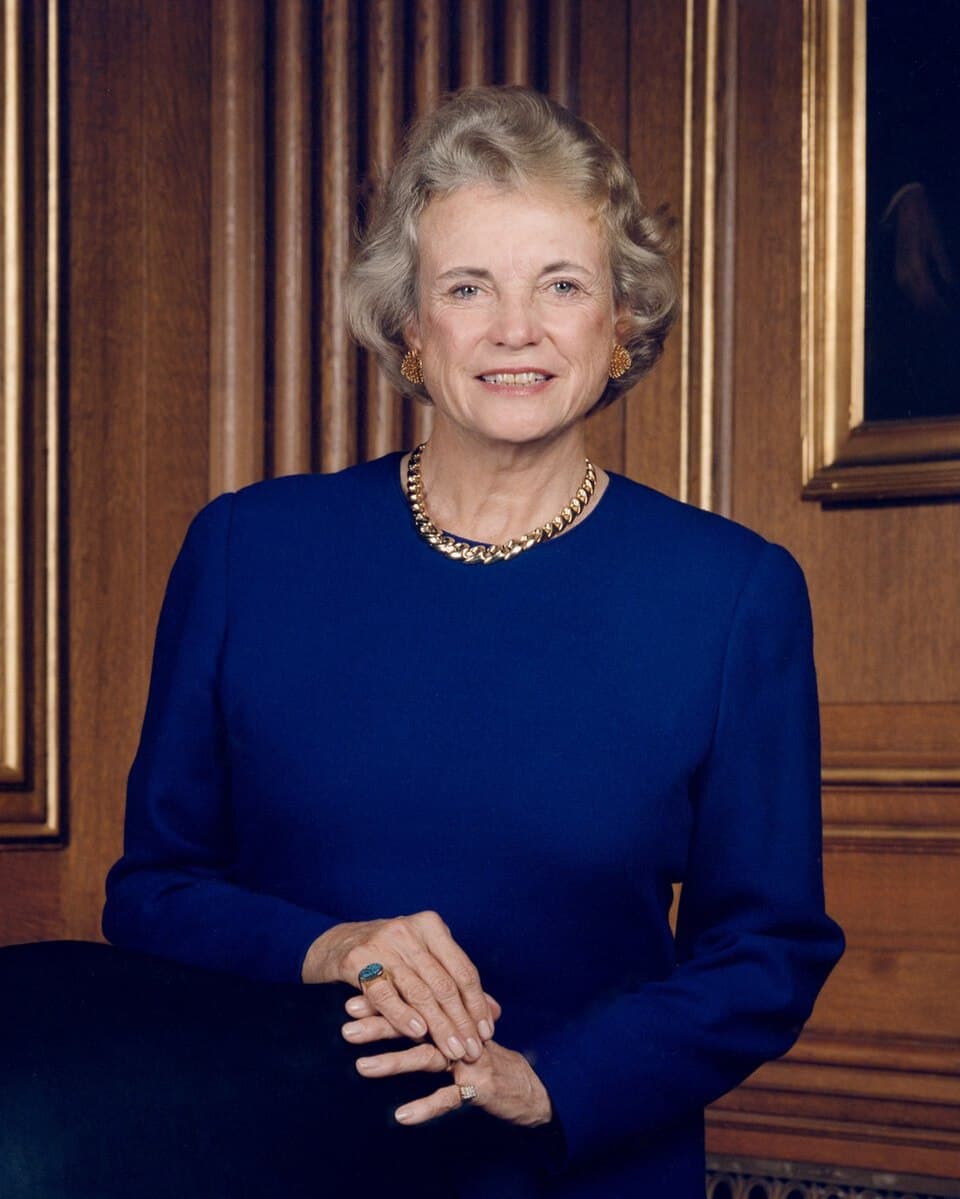
American · Politics · Law
Sandra Day O'Connor
March 26, 1930 – December 1, 2023
Early Life and Background
Sandra Day O’Connor was born on March 26, 1930, in El Paso, Texas, the first child of ranchers Harry Alfred "D.A." Day and Ada Mae "M.O." Day.[1][4][10][13] Shortly after her birth, the family returned to the Lazy B, a remote, 198,000‑acre cattle ranch straddling the Arizona–New Mexico border near Duncan.[1][10] Growing up on the ranch, she rode horses, branded cattle, and worked alongside cowboys, experiences that fostered resilience, self‑reliance, and a practical understanding of conflict—traits that later informed her judicial style.[1][3][10]
Because there were no nearby schools, her parents sent her to live with her grandmother in El Paso to attend grade school, illustrating the family’s strong commitment to education despite geographic isolation.[3][11] O’Connor excelled academically and, after high school, was admitted to Stanford University, where she earned a B.A. in economics in 1950 and then enrolled in Stanford Law School.[1][2][4] She completed her LL.B. (Bachelor of Laws) in 1952, graduating near the top of her class and serving on the Stanford Law Review alongside future Chief Justice William H. Rehnquist.[1][4][11]
Despite her credentials, O’Connor encountered overt gender discrimination when she entered the job market. Law firms in California were reluctant to hire a woman attorney; one Phoenix firm reportedly offered her a position only as a legal secretary.[4][11][12] She responded by accepting unpaid work in the San Mateo County Attorney’s Office, eventually proving her worth and being hired as a Deputy County Attorney from 1952 to 1953.[2][11] Early exposure to such barriers shaped her empathy for those facing discrimination and her pragmatic approach to overcoming it.
Career Beginnings and Development
After her marriage to John Jay O’Connor III in 1952, whom she met at Stanford Law School, Sandra and John moved to Europe when he was posted with the U.S. Army Judge Advocate General’s Corps.[1][2] From 1954 to 1957, she worked as a civilian attorney in Frankfurt, Germany, for the Quartermaster Market Center, handling contract and procurement issues.[2] This early experience with government operations broadened her understanding of administrative and commercial law.
The couple returned to Arizona in 1957, settling in the Phoenix area.[2][11] From 1958 to 1960, O’Connor engaged in private practice in the Maryvale community, building a small law office that served local clients.[2][11] Her reputation for competence and community service led to her appointment as Assistant Attorney General of Arizona, a role she held from 1965 to 1969.[2][11][18] In that capacity, she handled a range of civil matters for the state, gaining familiarity with regulatory and constitutional questions that would later surface in her judicial work.
In 1969, she was appointed to fill a vacancy in the Arizona State Senate, marking her formal entry into electoral politics.[2][18] She subsequently won election and reelection to the Senate, eventually rising to positions of leadership. In 1972, she became the first woman in the United States to serve as majority leader of a state senate, a pivotal barrier‑breaking achievement in legislative history.[1][11][15][18] This role required her to manage party strategy, negotiate across political lines, and oversee complex legislative processes, strengthening the consensus‑building skills that later became a hallmark of her judicial career.
O’Connor transitioned to the judiciary in the mid‑1970s. In 1975, she was elected a judge of the Maricopa County Superior Court, a major trial court in Arizona, where she served until 1979.[2][4][11] Known for efficiency and fairness, she oversaw a diverse docket, including criminal, civil, and family law cases. In 1979, she was appointed to the Arizona Court of Appeals, an intermediate appellate court serving the state.[2][4][11] Her performance there—combining clarity of reasoning with attention to real‑world consequences—brought her to the attention of national policymakers.
Appointment to the Supreme Court
By the late 1970s, O’Connor had built a record as a legislator, trial judge, and appellate judge. In 1981, President Ronald Reagan, fulfilling a campaign pledge to appoint a woman to the Supreme Court, selected her as his nominee to replace retiring Justice Potter Stewart.[4][5][11] On August 19, 1981, Reagan formally nominated her as an Associate Justice of the Supreme Court, making her the first woman ever chosen for the Court.[5][4]
Her confirmation hearings before the U.S. Senate Judiciary Committee drew intense national attention. Senators questioned her about her legislative record on issues such as abortion, the Equal Rights Amendment, and economic regulation. Despite initial opposition from some groups concerned about her positions, her performance during the hearings, marked by measured, pragmatic answers, won broad bipartisan respect.[3][11]
On September 21, 1981, the U.S. Senate unanimously confirmed O’Connor by a vote of 99–0, a rare show of unity that underscored her acceptability across party lines.[4][6][11] Four days later, on September 25, 1981, she was sworn in as the 102nd justice, becoming the first woman ever to serve on the Supreme Court.[1][2][5][6] She would serve from 1981 until her retirement in January 2006.[2][11][14]
Judicial Philosophy and Major Decisions
O’Connor quickly came to be regarded as a moderate conservative and a pragmatist, often serving as a pivotal swing vote in closely divided cases.[4][11] She preferred narrow rulings tailored to the facts, resisted sweeping doctrinal changes, and emphasized the importance of federalism and institutional competence.
One of her most significant early contributions came in the area of reproductive rights. In 1992, she co‑authored the controlling opinion in Planned Parenthood v. Casey, alongside Justices Anthony Kennedy and David Souter.[4][11] The joint opinion reaffirmed the core holding of Roe v. Wade that women have a constitutional right to choose abortion before viability, while replacing Roe’s trimester framework with the "undue burden" standard—holding that states may regulate abortion so long as they do not place a substantial obstacle in the path of a woman seeking the procedure.[4][11] This standard governed abortion jurisprudence for decades.
O’Connor also exerted major influence on workplace equality law. On November 8, 1993, in Harris v. Forklift Systems, Inc., she wrote the Court’s opinion clarifying the definition of a "hostile work environment" under Title VII of the Civil Rights Act.[4] She explained that plaintiffs do not need to show concrete psychological injury; instead, courts must assess whether the environment is objectively and subjectively abusive, considering the totality of circumstances. This framework strengthened protections against workplace harassment, especially for women.
Her concern for Native American rights appeared in cases such as Brendale v. Confederated Yakima Indian Nation (1989) and Oklahoma Tax Commission v. Sac & Fox Nation (1993). In Brendale, she supported significant tribal authority over land use in parts of the reservation.[3] In Sac & Fox Nation, she wrote the Court’s opinion limiting state taxation of tribal members living in "Indian Country," reinforcing tribal sovereignty and constraining state power.[3]
O’Connor was central to the Court’s reexamination of federal power under the Commerce Clause. In United States v. Lopez (decided April 26, 1995), she joined the 5–4 majority striking down the Gun‑Free School Zones Act of 1990 as beyond Congress’s commerce authority.[4] Lopez marked the first time in decades that the Court invalidated a federal statute on commerce grounds and signaled renewed enforcement of federalism limits.
Her role in election law is most famously associated with Bush v. Gore. On December 12, 2000, she joined the 5–4 majority in the per curiam opinion that halted Florida’s manual recount, citing Equal Protection concerns about inconsistent standards for evaluating ballots.[4] The decision effectively resolved the 2000 presidential election in favor of George W. Bush. The case has remained controversial, and O’Connor later expressed reservations about whether the Court should have accepted it, highlighting her awareness of the decision’s impact on public confidence in the judiciary.
In Zelman v. Simmons‑Harris (decided June 27, 2002), O’Connor joined the 5–4 majority upholding an Ohio school voucher program that allowed parents to use public funds at religious schools, so long as the program was neutral and benefits reached religious institutions only through private choice.[4] The ruling clarified the Establishment Clause’s application to school choice and helped shape education policy across the United States.
Perhaps her most influential civil‑rights decision came with Grutter v. Bollinger, announced June 23, 2003. O’Connor wrote the 5–4 majority opinion upholding the University of Michigan Law School’s race‑conscious admissions policy, which considered race as one factor in a holistic review.[4] She concluded that diversity in higher education was a compelling interest and that the law school’s program was narrowly tailored. Importantly, she wrote that race‑conscious measures should not be necessary indefinitely, expressing hope they would be unnecessary in 25 years. Grutter became a cornerstone of affirmative action law and profoundly influenced admissions practices nationwide.
Leadership on the Court and Historic Firsts
During her 24 years on the Supreme Court, O’Connor authored hundreds of opinions, shaping doctrine across fields including federalism, criminal procedure, gender equality, religion, and property rights.[9][11] She was widely known for building coalitions and favoring incremental change.
Beyond her jurisprudence, she broke additional institutional barriers. On February 22, 2005, during oral arguments in Kelo v. City of New London, she became the first woman ever to preside over Supreme Court oral arguments.[5] With both Chief Justice William Rehnquist and Senior Associate Justice John Paul Stevens absent, O’Connor, as the next most senior justice, took the center seat and led the session. Although she dissented from the Court’s eventual decision to permit broad use of eminent domain for economic development, her role that day symbolized the full integration of women into the Court’s leadership.
Earlier in her career, as noted, she had already been the first woman majority leader of any state senate, serving in the Arizona Senate.[1][11][15] These repeated "firsts"—in the legislature and on the Supreme Court—made her a visible icon of women’s progress in law and government.
Awards, Honors, and Recognition
O’Connor received numerous honors recognizing her trailblazing service. Among the most prominent was the Presidential Medal of Freedom, awarded by President Barack Obama on August 12, 2009.[14] The citation emphasized her status as the first woman justice, her pivotal role in major constitutional decisions, and her post‑retirement efforts to strengthen civic education and defend judicial independence.
She also received honorary degrees and awards from universities, bar associations, and civic organizations across the country. The law school at Arizona State University was renamed the Sandra Day O’Connor College of Law, making her the first woman to have a law school named in her honor.[11] This naming reflected both her Arizona roots and her national impact as a jurist.
Legal historians and journalists have chronicled her life and career in books and documentaries, including works such as First: Sandra Day O’Connor by Evan Thomas and the PBS American Experience film Sandra Day O’Connor: The First.[18][19] These portrayals underscore her significance not only as a legal figure but as a cultural symbol of women’s advancement.
Personal Life
O’Connor’s personal life played an important role in her public story. She married John Jay O’Connor III in 1952, and the couple had three sons: Scott (born 1957), Brian (born 1960), and Jay (born 1962).[1][2] Balancing motherhood with demanding legal and political roles, she managed child care and family responsibilities while working as a lawyer, legislator, and judge, often drawing attention to the practical challenges faced by professional women.
Her family background remained central to her identity. She spoke often of the Lazy B ranch and later co‑authored a memoir, Lazy B, with her brother Alan Day, reflecting on their upbringing and its influence on her character.[1][8] The ranch’s harsh conditions and self‑sufficiency fostered what she described as a "cowboy code" of responsibility and perseverance.
In later years, she faced personal challenges as her husband John developed Alzheimer’s disease. Concern for his health was a major factor in her decision to retire from the Court in 2005, effective January 31, 2006.[2][11][15] Her experience as a caregiver highlighted issues surrounding aging, dementia, and family support, and she spoke publicly about these concerns.
Retirement, Civic Education, and Legacy
After leaving the Court, O’Connor remained actively engaged in public life. She became a prominent advocate for judicial independence, warning against partisan attacks on courts and emphasizing the importance of merit‑based judicial selection.[11][14] She traveled domestically and internationally to speak on the rule of law and the role of an impartial judiciary in democratic societies.
Her most enduring post‑Court initiative was the founding of iCivics, a nonprofit organization dedicated to revitalizing civic education for young people.[17] Through online games, lesson plans, and teacher resources, iCivics aims to teach students about constitutional principles, government structure, and civic responsibilities. O’Connor believed that informed citizens are essential for democratic self‑government and that schools must equip students with practical civic knowledge.
By promoting civic literacy, O’Connor extended her influence beyond legal elites to the broader public. iCivics has been adopted in classrooms across the United States, and her vision of accessible, engaging civic education continues to shape debates about how best to prepare citizens for democratic participation.
Her legacy is multifaceted. As the first woman justice, she symbolized the breaking of gender barriers in law. As a pragmatic centrist, she shaped key areas of constitutional doctrine, including abortion, affirmative action, federalism, tribal sovereignty, and religious liberty. As a civic educator, she sought to strengthen the democratic fabric underlying the judiciary’s work.
Later Life and Death
In her later years, O’Connor’s public visibility decreased as she confronted health challenges, including early dementia
On December 1, 2023, Sandra Day O’Connor died in Phoenix, Arizona, at age 93, from complications related to advanced dementia and a respiratory illness.[2][4][6][11][15] The Supreme Court, the White House, and institutions nationwide issued statements honoring her service. The Court’s official resolution described her as a "peerless trailblazer" and emphasized her 24 years of service from September 1981 to January 2006.[13] Her death prompted renewed historical appraisal of her life: child of a remote ranch, top law student facing discrimination, legislator and first woman majority leader of a state senate, judge on two levels of the Arizona judiciary, and first woman justice who shaped doctrine in some of the era’s most contentious cases. For women’s history, O’Connor stands as a central figure demonstrating that gender barriers at the apex of law can be dismantled and that women’s perspectives can decisively influence constitutional meaning. Today, her name endures in institutions such as the Sandra Day O’Connor College of Law, in the educational work of iCivics, and in the ongoing lives and careers of the many lawyers, judges, and civic leaders she inspired. Her story remains a touchstone in the broader narrative of women’s struggle for full participation and leadership in American public life.
Dated achievements
12 indexed.
- Mar261930Law
Birth of Sandra Day O’Connor
Sandra Day O’Connor is born in El Paso, Texas, beginning the life of a future first woman justice of the U.S. Supreme Court.
View details Sandra Day O'Connor Biography – O’Connor Institute - Aug191981