← All women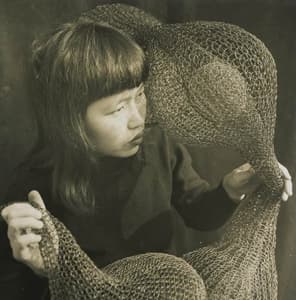
American · Arts
Ruth Asawa
January 24, 1926 – August 5, 2013
Early Life and Background
Ruth Aiko Asawa was born on January 24, 1926, in Norwalk, California, the daughter of Japanese immigrant truck farmers.[1][11] She was one of seven children in a family whose livelihood depended on intense manual labor and careful cultivation of the land.[11] Growing up in this rural environment, Asawa learned to value work done by hand and developed a keen sensitivity to natural forms, rhythms, and structures—sensibilities that later informed her sculptural vocabulary.
As a child, Asawa attended local schools in southern California while also working on the family farm. Her early education was abruptly disrupted by World War II and the U.S. government’s policies toward Japanese Americans. Following the attack on Pearl Harbor, her father was arrested by the FBI, and in 1942 the family was forcibly removed from their home and incarcerated.[1][3] Asawa spent time in wartime incarceration facilities, including assembly centers and internment camps, experiences that exposed her to harsh discrimination and instability at a formative age.[1][10]
Despite these conditions, Asawa continued her education in the camps, where she studied with displaced Japanese American artists and educators. This contact with working artists reinforced her desire to pursue art seriously. The trauma of incarceration and the resourcefulness required to make art with limited materials in camp settings would echo later in her commitment to accessible arts education and in her use of modest, everyday materials such as wire.
Education and Formative Influences
After the war, Asawa left California to pursue a teaching degree at Milwaukee State Teachers College (now the University of Wisconsin–Milwaukee).[13] While studying there in the mid-1940s, she encountered persistent racial discrimination that limited her opportunities for student teaching, a requirement for certification.[13] Unable to complete the practicum because local schools often refused to accept a Japanese American student teacher, she was effectively blocked from the teaching career she had originally envisioned.
This experience of exclusion pushed Asawa to reconsider her path. In 1946 she enrolled at Black Mountain College, an experimental art school in North Carolina known for progressive pedagogy and an openness to women and students of color despite the segregated context of the region.[1][10][16] At Black Mountain she studied under influential figures including Josef Albers, John Cage, Buckminster Fuller, and Merce Cunningham
During a 1947 trip to Mexico, Asawa encountered looped-wire basket-making techniques that became a crucial catalyst for her mature sculptural practice.[1] Learning from local artisans, she observed how a simple line of wire could be transformed into complex volumetric forms, an insight that aligned with Albers’s pedagogical focus on economy and transformation of materials. This encounter would later be recognized as a key turning point in her development as a sculptor. By 1948, Asawa had begun to produce the looped-wire sculptures that became her signature works.[16] Suspended from ceilings or arranged in clusters, these forms used continuous lines of industrial wire to create interlocking, transparent volumes inspired by natural shapes such as pods, shells, and plant structures.[1][5] Her sculptures challenged conventional expectations of solidity in sculpture, emphasizing lightness, permeability, and the interplay of interior and exterior spaces. In 1949, Asawa and fellow Black Mountain College student Albert Lanier, an architect, moved to San Francisco, where they settled and raised their family.[1][16] The Bay Area became the primary context for her artistic and civic work. In the 1950s, Asawa’s wire sculptures attracted growing attention from curators and critics. She exhibited in regional and national shows, including at the San Francisco Museum of Art (now SFMOMA) and other institutions, and her work began to be collected by major museums such as the Whitney Museum of American Art and the Guggenheim Museum.[1][4][5] In the mid-1950s, Asawa expanded her practice beyond studio sculpture to include public fountain commissions, integrating sculpture with architecture and urban design.[16] These works often involved textured bronze reliefs and cast forms created in collaboration with children and community members, reflecting her belief that public art should emerge from collective experience. Over time, she completed numerous fountains in San Francisco, earning the informal title of the city’s "fountain lady".[4][15] Asawa’s wire sculptures are widely regarded as her most significant contribution to modern art. Developed from the late 1940s onward, these works use galvanized or copper wire, looped by hand, to create nested and interpenetrating forms that appear to float in space.[1][2][13] The sculptures play with transparency and shadow, producing shifting visual effects as viewers move around them. Critics have noted that they redefined sculpture by emphasizing line and volume without mass, engaging ideas central to postwar abstraction.[2] Her public fountains in San Francisco constitute another major body of work. Examples include the Hyatt Union Square Fountain, often referred to as the "Oval Fountain," and the Japanese American Internment Memorial relief at the Buchanan Mall, among others.[1][5][16] These pieces frequently incorporate cast elements made from everyday objects and textured surfaces created with children’s contributions, making the works both communal and tactile. In the city’s urban fabric, they function as gathering places and visual landmarks. In 1968, Asawa created her mermaid fountain for Ghirardelli Square, recognized as her first representational work.[16] Unlike her abstract wire forms, this bronze fountain features figurative motifs. Its creation demonstrated her versatility and willingness to engage different idioms when the context called for it, while still maintaining her interest in participatory processes. Beyond individual works, Asawa made a lasting mark through her role in arts education. In 1977 she co-founded the Alvarado Arts Workshop, an innovative program that brought professional artists into public elementary schools to teach art.[10][16] The workshop used inexpensive and recycled materials, aligned with Asawa’s conviction that art should be accessible and rooted in everyday resources. In 1982, she was a driving force behind the establishment of the San Francisco School of the Arts, a public high school dedicated to intensive arts training, later renamed the Ruth Asawa San Francisco School of the Arts in 2010 in recognition of her impact.[6][11][15] Over the course of her career, Asawa received increasing recognition from artistic and civic institutions. In 1973, she was appointed to the California Arts Council, reflecting her growing prominence as an advocate for arts education in the state.[11] Her wire sculptures entered major museum collections, including the Museum of Modern Art in New York, the Whitney Museum, the J. Paul Getty Museum, and the de Young Museum in San Francisco.[2][5][13] In 2000, Asawa received the Edward MacDowell Medal, a prestigious award honoring outstanding contributions to the arts.[16] The recognition placed her among a distinguished group of artists across disciplines and underscored the significance of her sculptural practice and educational work. Seven years later, on November 19, 2007, she was awarded the National Medal of Arts, presented by President George W. Bush at the White House.[10] This federal honor acknowledged her achievements both as an innovative sculptor and as a champion of arts education and public art. Posthumously, Asawa’s reputation has continued to grow. Major exhibitions, including retrospectives and scholarly catalogues, have been organized by institutions such as SFMOMA and the de Young Museum, while commercial galleries and auction houses have presented her work to international audiences.[2][5][16] Publications such as the biography Everything She Touched have further documented her life and contributions.[7][17] On December 13, 1946, Asawa married Albert Lanier, an architect she met at Black Mountain College.[16][8] The couple eventually settled in San Francisco and raised six children together.[1][16] Their home functioned as both family space and working studio, with Asawa integrating art-making into daily life. She often worked on sculptures at the kitchen table or in communal areas, demonstrating to her children that creative practice could coexist with domestic responsibilities. Lanier’s architectural training contributed to an environment in which design, space, and structure were integral to family life. This partnership supported Asawa’s public commissions and her involvement in educational initiatives, with both parents committed to the idea that art should be present in schools and communities. Despite health challenges later in life, including lupus, Asawa remained active in her practice and civic engagement.[7] Friends and colleagues frequently described Asawa as disciplined, generous, and deeply committed to the belief that art is for everybody.[11] She cultivated relationships with artists, teachers, and community organizers, helping to build networks that sustained arts programs in San Francisco over decades. Asawa is now widely recognized as a pioneering American modernist sculptor and a key figure in the history of Asian American and women’s art.[1][4][5] Her looped-wire sculptures have been acclaimed for their formal innovation, combining influences from Mexican craft traditions, Bauhaus-influenced pedagogy, and organic natural forms to create works that challenge boundaries between "fine" and "applied" art.[2][16] Her legacy in arts education is equally significant. Through the Alvarado Arts Workshop and the San Francisco School of the Arts, Asawa helped institutionalize the idea that professional-level art instruction should be available in public schools.[10][11] These programs demonstrated how arts education could be integrated into curricula using inexpensive materials, community partnerships, and artist-led classes. The renaming of the School of the Arts in her honor in 2010 symbolized the city’s acknowledgment of her transformative role.[6][15] As a Japanese American woman who faced wartime incarceration and systemic discrimination, Asawa’s career also carries broader historical importance. Her success as an artist and educator challenged stereotypes and expanded visibility for Asian American artists in mainstream art institutions. Scholars and curators have noted that her work complicates standard narratives of postwar American art, which historically centered on male artists in New York and often overlooked West Coast and minority creators.[4][5][16] Since her death, renewed scholarly and curatorial interest has led to a reassessment of her place in art history, with her sculptures now featured prominently in museum displays and critical writing. Her example continues to inspire artists and educators who see in her life a model for integrating rigorous artistic practice with community engagement and social responsibility. In her later decades, Asawa remained active in San Francisco’s artistic and civic spheres. She continued to produce wire sculptures and drawings, mentor younger artists, and advocate for the arts in public policy discussions.[11][16] Even as museums and galleries outside the Bay Area increasingly collected and exhibited her work, she maintained a focus on local schools and neighborhoods, reinforcing her belief that art’s primary role was to enrich everyday life. Asawa died of natural causes on August 5, 2013, at her home in San Francisco.[1][6][15] She was eighty-seven years old. Obituaries and tributes from institutions and media outlets highlighted both her artistic achievements and her decades-long fight to make art education widely available.[5][16] In the years following her death, her children and collaborators worked to preserve her legacy through archives, exhibitions, and the continuation of educational programs inspired by her vision. Today, Asawa’s work is held in major museum collections and continues to appear in exhibitions that explore themes of abstraction, craft, identity, and community. Her life story—stretching from a childhood on a California farm, through wartime incarceration and experimental art education, to a mature career as a celebrated sculptor and arts activist—stands as a testament to resilience and to the transformative power of art in the face of social adversity.Career Beginnings and Development
Major Works and Accomplishments
Awards, Honors, and Recognition
Personal Life
Legacy and Historical Impact
Later Life and Death
Dated achievements
4 indexed.
- Jan241926Arts
Birth of Ruth Aiko Asawa
Ruth Aiko Asawa was born in Norwalk, California on January 24, 1926.
View details Whitney Museum of American Art - Dec131946Arts
Marriage to Albert Lanier
On December 13, 1946, Ruth Asawa and Albert Lanier were married.
View details