← All women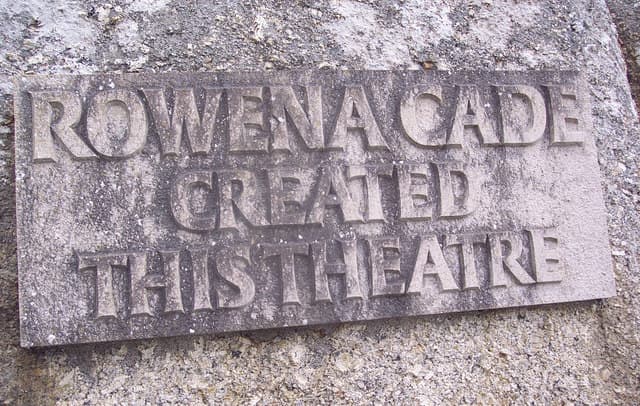
British · Arts
Rowena Cade
January 2, 1893 – March 26, 1983
Early Life and Family Background
Rowena Cade was born on 2 January 1893 in Kensington, London, into a family that had grown wealthy through the textile trade in the English Midlands. She was the daughter of a well-to-do family, and grew up alongside a sister, Bridget, and other siblings in a household that afforded her the comforts and educational opportunities typical of the English upper-middle class in the late Victorian and Edwardian eras. Little is documented of her formal schooling, but by all accounts she was raised with an appreciation for music, needlework, drawing, and amateur theatre — pastimes common among genteel young women of the period, yet ones that would later prove indispensable to the unlikely and extraordinary project that would define her life.
The Cade family's fortunes allowed them considerable independence. Following the disruption and losses of the First World War — during which Rowena's brother was killed in action — the family sought a change of scene, and in the early 1920s Rowena, her mother, and her sister relocated from the Midlands to the wild and dramatic coastline of West Cornwall, an area renowned for its rugged granite cliffs, fishing villages, and a burgeoning community of artists and bohemians centred around towns like St Ives and Newlyn.
Arrival in Cornwall and Purchase of Minack
In 1919, Rowena's mother purchased a small cliffside property overlooking Porthcurno Bay near Land's End, in the far southwest of Cornwall. The site, known as Minack Point, was a headland of dramatic granite outcrops plunging into the Atlantic Ocean, entirely undeveloped apart from a modest gully-side garden. Rowena took an active hand in developing the property, and after her mother's death she inherited the land, later building her own house — Minack House — perched on the cliff.
Cade quickly became known locally as an energetic, unconventional, and physically robust woman, unafraid of hard manual labour — she gardened, built rockeries, and generally shaped the rugged landscape around her home according to her own designs, developing carpentry, masonry and gardening skills largely through self-teaching and practical experimentation rather than any formal training. This hands-on resourcefulness, unusual for a woman of her class and era, would prove essential to what came next.
The Birth of the Minack Theatre
In 1929, a local drama group, the Minack Drama Group (associated with the village of St Levan), staged a production of Shakespeare's A Midsummer Night's Dream in a nearby meadow, Cade having supplied costumes and support for the production held in the "Rosemergy Cliff Field." The success of this experiment led the group to approach Cade the following year with an ambitious new idea: performing Shakespeare's The Tempest, a play set on a remote, magical island, with the sea itself as a natural backdrop.
Cade offered the gully below her house — the rocky headland of Minack Point — as a venue. Beginning in the winter of 1931–1932, she and her loyal gardener and handyman, Billy Rawlings, set about transforming the wild granite gully into a rudimentary open-air theatre. Working largely by hand, they cleared brush, dug into the earth and rock, and constructed a stage area and simple bench-style seating from turf and granite boulders hauled up from the beach below. There was no professional engineering input, no architect's plan — only Cade's vision, determination, and physical labour, aided by Rawlings and occasional local workers.
The first production of The Tempest was performed at Minack on 6 August 1932, illuminated by improvised lighting powered by car batteries and with the sea as its dramatic backdrop. The performance was a resounding success, and it planted the seed for what would become Cade's lifelong project.
Decades of Construction
Following the success of that first production, Cade resolved to continue improving the theatre, gradually adding more elaborate stone terraces, staircases carved directly into the cliff, and additional seating to accommodate growing audiences. She continued this work, on and off, for the rest of her long life — over fifty years in total.
Cade's construction methods were remarkable for their combination of ingenuity, resourcefulness and sheer physical toil. She mixed her own cement (often using sand carried up from the beach in sacks on her back), and personally carved decorative Celtic knots, mermaids, and other maritime and mythological motifs into the wet concrete of the terraces, balustrades and stage areas using kitchen tools, screwdrivers, and whatever implements came to hand. Many of these inscriptions can still be seen at the theatre today, commemorating specific productions, dates, and the names of actors or plays.
The Second World War brought a temporary halt to performances — the site was requisitioned and used to store barbed watch and mounted machine guns as part of coastal defences against potential invasion, given its clifftop position overlooking the sea approaches to Land's End. Undeterred, Cade resumed and expanded her work once the war ended, and performances at Minack recommenced in 1949 with a production of Twelfth Night.
Through the 1950s, 1960s and 1970s, Cade continued to physically labour on the theatre well into old age, defying the physical limitations that might have been expected of a woman in her seventies and eighties. She was famously photographed still working with a wheelbarrow and trowel into her later years, cementing her reputation as an indefatigable and eccentric figure in local Cornish life — equal parts patron, labourer, and visionary artist.
Recognition and the Theatre's Growth
Although Cade herself remained a relatively private and modest figure, avoiding significant publicity or self-promotion, the Minack Theatre steadily grew in reputation throughout the twentieth century, attracting increasingly professional and amateur theatre companies for its open-air summer season, staged against the unparalleled natural backdrop of the Atlantic Ocean and the granite cliffs of Porthcurno.
She established a charitable trust to secure the future of the theatre, ensuring that it would continue to operate and be maintained after her death, rather than falling into disrepair or being sold off for private development. This foresight proved crucial: today, the Minack Theatre operates as an independent charitable trust, staging an annual season of professional and amateur productions from May to September, and drawing over 80,000 visitors a year, including many who come simply to visit the site's visitor centre and gardens even outside performance times.
Personal Life
Rowena Cade never married and had no children, devoting her adult life almost entirely to the development and maintenance of Minack House and its theatre. She lived a famously simple, hardy and largely solitary existence at Minack House, known for her practical, unpretentious manner, her love of animals (she kept several dogs throughout her life), and her deep personal connection to the rugged Cornish landscape she had shaped with her own hands. Contemporaries and biographers have often remarked on her physical strength, self-reliance, and quiet, understated determination — qualities markedly at odds with prevailing expectations of femininity and gentility in the Britain of her time.
Death and Legacy
Rowena Cade died on 26 March 1983 at Minack House, at the age of 90, having continued to work on aspects of the theatre almost until the very end of her life. She was buried in the churchyard of St Levan, near the theatre she had created.
Her legacy is singular and enduring. The Minack Theatre stands today as one of the most extraordinary and photographed theatre venues in the world, celebrated not only for its breathtaking setting but for the remarkable story of the woman who built it, largely with her own hands, over more than fifty years. It has hosted countless productions of Shakespeare, opera, musicals and contemporary drama, and has become a cultural landmark and major tourist attraction for Cornwall.
Cade's life is frequently cited as an inspirational example of female self-determination, resourcefulness, and artistic vision unconstrained by the conventional gender roles of her era — a woman who, without formal training in architecture, engineering, or construction, created and sustained a work of enduring cultural significance through sheer will, imagination, and physical labour. She is commemorated today through the ongoing operation of the Minack Theatre and its associated visitor centre, which preserves memorabilia, photographs and stories relating to her life and the theatre's history.
Dated achievements
3 indexed.
- Jan021893Science
Birth of Rowena Cade
Rowena Cade was born on 2 January 1893 in Kensington, London, the daughter of a wealthy mill owner.
View details Rowena Cade - Wikipedia - Aug061932Arts
First performance staged at the Minack Theatre
The first play, 'The Tempest', was performed on the cliffside garden theatre Cade built at Minack, Cornwall, on 6 August 1932.