← All women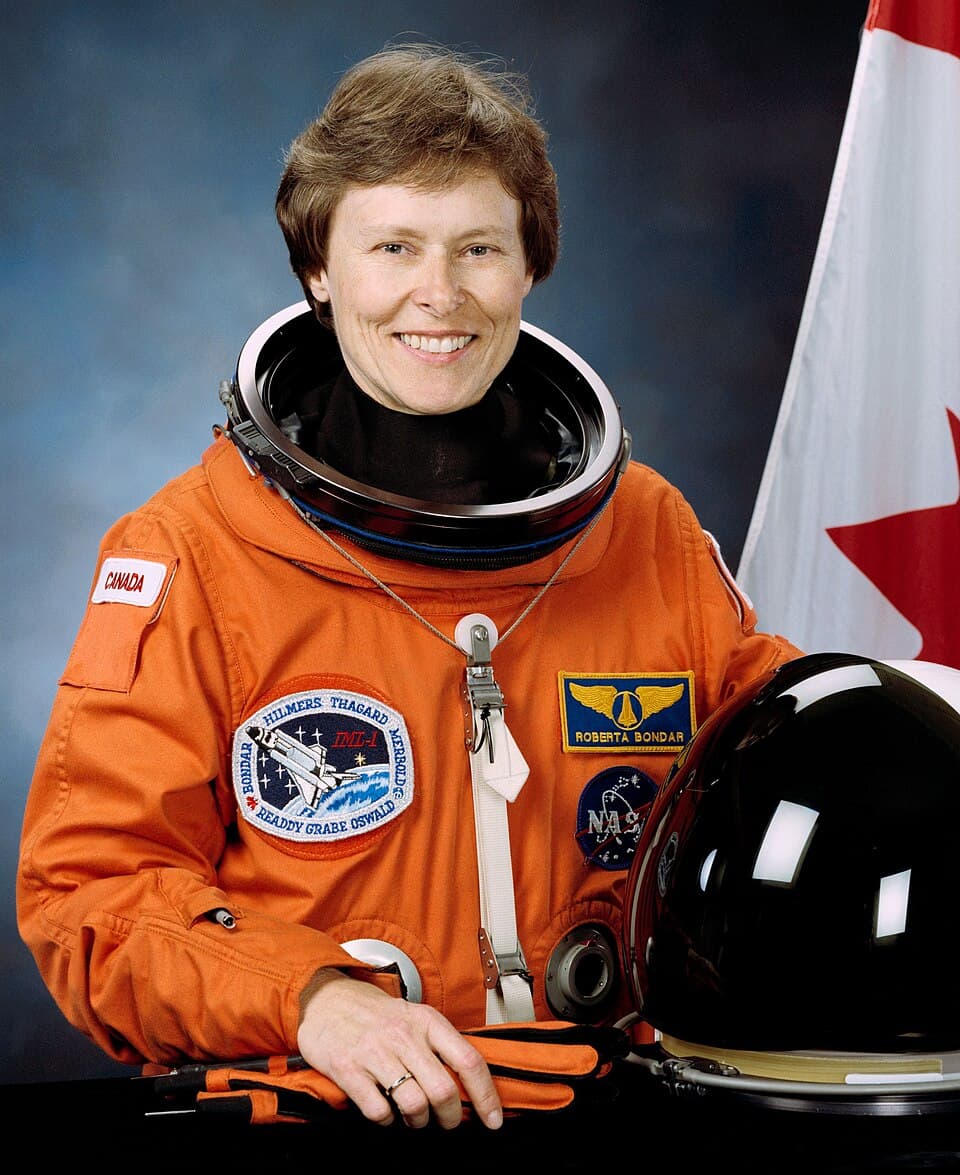
Canadian · Science · Exploration
Roberta Bondar
December 4, 1945 – present
Early Life and Background
Roberta Lynn Bondar was born on 4 December 1945 in Sault Ste. Marie, Ontario, Canada, an industrial city on the St. Marys River near the Canadian–U.S. border.[2][3][4][7] Her father, a Ukrainian-Canadian industrial electrician and amateur inventor, and her mother, a teacher, encouraged her curiosity, hands-on experimentation, and love of the outdoors.[4][8][11] As a child, Bondar built science projects in the basement and developed an early fascination with astronomy, aviation and photography, interests that would later converge in her career as a neurologist, astronaut, and fine art nature photographer.
Bondar attended elementary and secondary school in Sault Ste. Marie, where she excelled in science and mathematics despite limited expectations for girls in these fields in mid-20th-century Canada.[4][8] She reportedly began dreaming of becoming an astronaut as a young girl, following developments in the burgeoning Space Age and envisioning herself traveling beyond Earth.[14][15] Her formative experiences camping, exploring nature, and observing wildlife helped shape both her future environmental photography and her later work combining science with public education.
Education and Scientific Training
Bondar pursued an extensive and interdisciplinary scientific education. In 1968, she completed a Bachelor of Science degree in zoology and agriculture at the University of Guelph.[1][4][9][10] She then earned a Master of Science in experimental pathology from the University of Western Ontario in 1971, focusing on disease processes at the tissue level.[1][10][12] Continuing in research, she completed a Ph.D. in neurobiology at the University of Toronto in 1974, specializing in the structure and function of the nervous system.[1][2][10]
Recognizing the importance of clinical medicine alongside laboratory science, Bondar enrolled in medical school and obtained her Doctor of Medicine (M.D.) from McMaster University in 1977.[1][10] She went on to complete residency training in neurology and sub-specialty training in neuro‑ophthalmology, a field focused on visual pathways and eye–brain interactions.[1][4] She became a board-certified neurologist, integrating her research background with clinical practice to investigate disorders of the nervous system.
Before joining the astronaut corps, Bondar conducted research and clinical work in Boston and Toronto and served as an assistant professor at McMaster University, where she taught and conducted investigations in neurology and neurobiology.[8] This combination of experimental pathology, neurobiology, and clinical neurology placed her at the cutting edge of biomedical research in the 1970s and early 1980s.
Entry into the Canadian Astronaut Corps
In the early 1980s, the Canadian government and the National Research Council (later the Canadian Space Agency, CSA) began building a national astronaut program to support Canada’s contributions to NASA’s Space Shuttle missions, including the Canadarm robotic manipulator.[1][4] In 1983, Bondar was selected as one of the first six members of the Canadian Astronaut Corps, making headlines as Canada’s first woman astronaut candidate.[4][7][9] Her selection was widely reported in Canadian media and marked a breakthrough for women in the country’s space program.
Bondar began formal astronaut training in 1984, based at NASA’s Johnson Space Center in Houston and with the Canadian program.[1][8] Her training encompassed Shuttle systems, spaceflight operations, biomedical protocols, high-performance aircraft operations and survival training. She qualified as a payload specialist, a role intended for scientists and clinicians who would conduct and oversee experiments in orbit rather than serve as career pilots or mission specialists.
Drawing on her expertise in neurology and neurobiology, Bondar’s work in the astronaut corps focused increasingly on space medicine and human adaptation to microgravity. In 1990, she was designated prime Payload Specialist for the inaugural International Microgravity Laboratory mission (IML‑1), although the exact date of this designation is not consistently documented.[1][2][7] This assignment meant that when the mission eventually flew, she would be the lead scientific payload specialist responsible for key experiments.
STS‑42 and the First International Microgravity Laboratory
Bondar’s historic spaceflight came with NASA’s STS‑42 mission, which carried the first International Microgravity Laboratory (IML‑1).[2][4][14] On 22 January 1992, she launched aboard Space Shuttle Discovery as Payload Specialist 1, becoming the first Canadian woman in space, the second Canadian in space after Marc Garneau, and the world’s first neurologist in space.[3][4][7][9][12][15]
The STS‑42 crew included NASA astronauts Ronald J. Grabe (commander), Stephen Oswald (pilot), Norman Thagard (payload commander), and mission specialists William F. Readdy and David C. Hilmers, alongside Bondar and fellow payload specialist Ulf Merbold of the European Space Agency.[2][4] During the eight‑day mission from 22 to 30 January 1992, Discovery orbited Earth while the crew conducted a broad suite of physical and life‑science experiments designed to exploit the unique conditions of microgravity.
Bondar’s responsibilities centered on neurological and physiological investigations. She helped run and monitor more than 40 experiments for between 14 and 18 countries, depending on the source, contributing to an unprecedented international research effort.[4][9][11][16] The studies addressed how microgravity affects the vestibular system (balance and orientation), sensorimotor control, sleep patterns, muscle tone, and other aspects of human physiology. These findings were intended both to improve astronaut health and to shed light on neurological illnesses on Earth.
IML‑1 was a precursor to the kind of long-term scientific research later conducted on the International Space Station. The mission housed equipment in Spacelab modules, and Bondar’s role illustrated the increasing direct participation of physician-scientists in space experimentation rather than solely ground-based oversight. Her presence as a neurologist in orbit allowed for specialized interpretation of data and for planning future studies on neuroplasticity and recovery after spaceflight.
On 30 January 1992, Discovery landed, successfully completing STS‑42 and the IML‑1 mission.[2] For Bondar, the flight represented the culmination of almost a decade of training and scientific preparation and opened a new phase in her career focused on space medicine research.
Space Medicine Research and NASA Collaboration
Following her flight, Bondar continued to work with NASA and international partners for more than a decade, leading or co‑leading research teams studying the medical consequences of space travel.[4][9][11][14][16] She and her colleagues analyzed data not only from STS‑42 but from astronauts on approximately 24 space missions, examining how the body recovers from microgravity exposure and what mechanisms underlie adaptation back to Earth’s gravity.[14]
Her studies paid particular attention to systems relevant to neurology and neuro‑ophthalmology: balance and equilibrium, visual perception, sensorimotor integration, and cognitive performance. By correlating changes seen in astronauts with patterns observed in patients with neurological disorders, Bondar’s work contributed to understanding conditions such as stroke, Parkinson’s disease, and other movement and balance disorders.[9][12]
During this period she was frequently described as head of an international space medicine research team collaborating with NASA, reflecting her leadership in coordinating multi-disciplinary scientists and clinicians from different countries.[11][17] The research helped establish spaceflight as a valuable model system for studying human physiology under extreme conditions, with implications for aging, rehabilitation, and clinical neurology.
Photography, Environmental Work, and Public Education
Parallel to her scientific work, Bondar cultivated a second major career as a professional fine art landscape and nature photographer and environmental educator. She had been interested in photography since childhood, and after her spaceflight she increasingly used visual art to express scientific and environmental themes.[4][11][14]
Bondar’s photographic work has been widely exhibited and published. She has produced books and collections that combine photography with narrative reflections on ecology, conservation and the human relationship to the natural world.[4][11] Her images often focus on protected areas, birds, wetlands, and other ecosystems under pressure, aiming to foster emotional connection and scientific appreciation among viewers.
To formalize and expand her efforts, Bondar established The Roberta Bondar Foundation, a charitable organization dedicated to using art and science to promote environmental awareness and protection.[4][11] The foundation develops educational programs, exhibitions and citizen-science initiatives, encouraging people—especially young people—to observe and understand their environment more deeply and to recognize the interconnectedness of planetary health and human well‑being.
Bondar has also become a prominent author, lecturer and keynote speaker, drawing on her experiences as a physician, scientist, astronaut and photographer to address themes of leadership, risk, innovation, resilience and environmental stewardship.[11][15][16] She regularly speaks to business, academic and community audiences about change management, the future of science and technology, and the importance of curiosity and lifelong learning.
Academic and Institutional Roles
Beyond her clinical and research activities, Bondar has held several academic and institutional positions. After leaving the active astronaut corps in the early 1990s, she continued her involvement in universities and research institutions. Sources note that she has served in roles such as chancellor of Trent University, a position she assumed in the early 2000s, providing leadership and representing the institution in public forums.[10]
Bondar has also been associated with the University of Guelph, her alma mater, and with Western University, where she studied experimental pathology. These institutions highlight her achievements as part of their alumni histories and often invite her to speak on topics ranging from neuroscience to environmental change.[9][12]
Awards, Honours, and Recognition
Dr. Roberta Bondar has received a wide array of national and international honours in recognition of her contributions to science, medicine, space exploration, and public education. She is an Officer of the Order of Canada and an appointee to the Order of Ontario, two of the country’s highest civilian distinctions.[4][6][11][17] She has been elected a Fellow of the Royal Society of Canada (FRSC), reflecting her standing in the scientific community.[4][6][7]
From NASA, Bondar received the NASA Space Flight Medal for her performance on STS‑42 and contributions to the space program.[6][11][17] She has also been honoured with numerous academic distinctions, including more than two dozen honorary doctorates from universities across Canada and internationally, recognizing both her scientific achievements and her role as a science communicator.[7][11][17]
Bondar has been inducted into the Canadian Medical Hall of Fame, underscoring her impact on medicine and medical research.[7][11][12] She is also a member of the International Women’s Forum Hall of Fame, which honours women of global influence and accomplishment.[11][17] In popular culture, she has been celebrated with a star on Canada’s Walk of Fame, symbolizing national recognition beyond strictly scientific circles.[11][17]
Additional tributes include a commemorative Canadian postage stamp issued in her honour and the naming of asteroid (13693) Bondar after her, reflecting astronomical recognition of her contributions to space exploration.[6][10] These honours collectively position Bondar as one of Canada’s most decorated women in science.
Personal Life
Public sources emphasize Bondar’s professional achievements more than her private life, and detailed information about marriage or children is limited, reflecting her preference to keep personal matters relatively private. Biographical profiles instead highlight her personal interests that intertwine with her professional identity: aviation, photography, environmental advocacy, flying, scuba diving and parachuting.[8][11]
Bondar is noted as an accomplished pilot, having trained in aviation as part of her astronaut preparation and personal pursuits.[11] Her enthusiasm for outdoor activities and exploration—whether in forests, wetlands, or mountainous areas—has informed both her environmental photography and her advocacy for protected natural spaces.
Legacy and Historical Impact
Roberta Bondar’s legacy spans multiple domains: space exploration, neuroscience and medicine, environmental education, and women’s history. As the first Canadian woman in space, she broke a significant gender barrier in Canada’s participation in human spaceflight, following Marc Garneau as the first Canadian in space but expanding the image of who could be an astronaut.[3][4][9] Her flight inspired generations of girls and young women to consider careers in science, technology, engineering and mathematics and to see aerospace and medicine as accessible fields.
As the world’s first neurologist in space, Bondar helped integrate clinical neuroscience directly into space missions, demonstrating that highly specialized physician‑scientists could play vital roles in flight operations and research.[3][7][12][16] Her work contributed to the development of space medicine as a discipline concerned not only with survival in orbit but with long-term health, neurological function and rehabilitation.
In the context of environmental and visual culture, Bondar’s photography and the Roberta Bondar Foundation have advanced the idea of using art to communicate scientific and ecological truths. Her images, exhibitions and educational programs encourage audiences to see Earth as a fragile, interconnected system, echoing the perspective she gained by viewing the planet from orbit.
Within women’s and STEM history, Bondar is frequently cited as a role model who combines multiple identities: scientist, physician, astronaut, artist and educator. Government and institutional profiles emphasize her impact as a leader who broadened opportunities for women and promoted diversity in science and technology fields.[11] She is often included in lists of influential Canadian women in STEM and in global compilations of pioneering women astronauts.
Later Life and Continuing Work
In the decades following her 1992 spaceflight, Bondar has continued to be active in research, education, public speaking and photography. She has collaborated with universities, space agencies, environmental organizations and schools, often focusing on themes of planetary health, resilience in the face of change and the importance of scientific literacy.[11][14][16]
Through her foundation and speaking engagements, Bondar now works to help communities and institutions navigate rapid change in science and technology, encouraging flexible thinking and evidence‑based decision-making. She frequently discusses how lessons from spaceflight—such as dealing with uncertainty, teamwork under pressure, and the need for international cooperation—apply to global challenges including climate change and public health.[15][16]
As of the mid‑2020s, Roberta Bondar remains alive and engaged in public life. She is recognized not only as a historic figure in Canada’s space program but also as an ongoing voice in debates about science, environment and society. Her multifaceted career exemplifies how one individual’s path can connect local beginnings to global influence, linking the basement science experiments of a curious child in Sault Ste. Marie to orbit aboard the Space Shuttle and to international efforts in science and environmental stewardship.
Dated achievements
3 indexed.
- Dec041945Science
Birth of Roberta Lynn Bondar
Roberta Lynn Bondar was born in Sault Ste. Marie, Ontario, Canada.
View details Wikipedia - Jan221992Science
First Canadian woman in space (STS-42 launch)
Dr. Roberta Bondar launched aboard Space Shuttle Discovery on mission STS-42, becoming the first Canadian woman in space and the world’s first neurologist in space.