← All women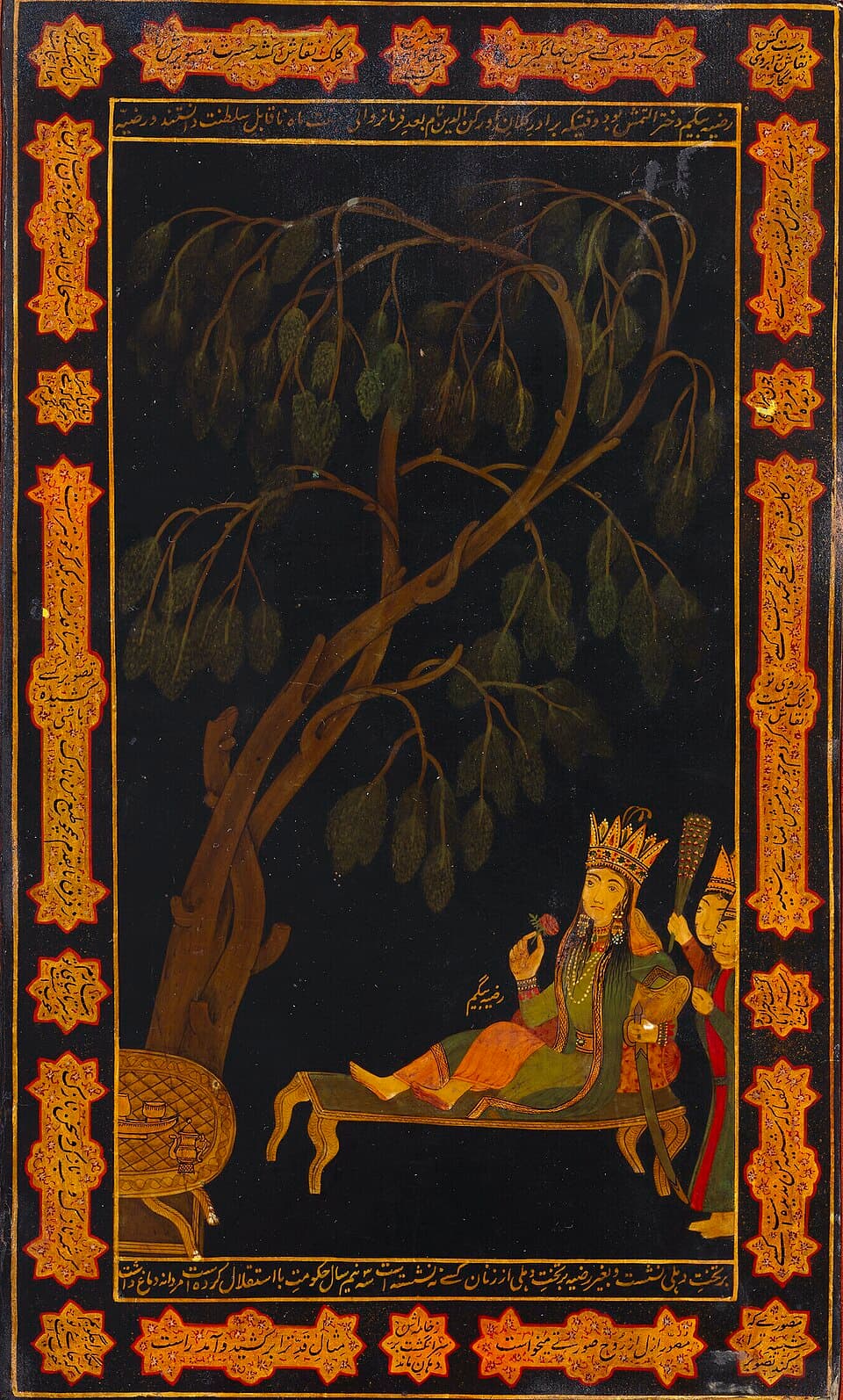
Indian · Politics
Razia Sultana
1205 – October 15, 1240
Early Life and Background
Razia Sultan, also known as Raziyyat‑ud‑Dunya wa‑ud‑Din, was born sometime between c.1205 and 1211, the daughter of Sultan Iltutmish of Delhi and a mother often described as of Turkic or Kipchak slave origin.[1][11][13] Exact birth records do not survive, but most modern scholars and reference works place her birth in the first decade of the thirteenth century, during the consolidation of the Mamluk (Slave) dynasty in North India.[1][3][13]
Iltutmish himself had been a slave purchased by the earlier ruler Qutb al‑Din Aibak, rising through military ranks to become Sultan. This background meant that Razia grew up in a court shaped by the ethos of military merit, servile origins, and Turkic cultural norms.[3][9] She was likely raised within the royal household in Delhi, exposed from an early age to administrative practices, court ceremonial, and the multi‑ethnic elites—Turkic, Afghan, Indian Muslim—who served the sultanate.
Unlike most girls of her era, Razia is described in later chronicles and modern scholarship as receiving training similar to that of a male heir: she learned statecraft, religious law, and cavalry skills, and was educated to lead armies and administer provinces.[3][9] The Shahjahanabad Redevelopment Corporation, drawing on historical records, notes that Razia, "like some other Muslim princesses of the time, was trained to lead armies and administer kingdoms if necessary."[9] This preparation—unusual for a woman—laid the foundation for her eventual claim to the throne.
Heir Apparent and Political Formation
During the 1220s and early 1230s, Razia’s father increasingly involved her in governance.[3][4][9] Sources suggest that she accompanied him in public audiences and may have overseen certain administrative tasks, positioning her as a visible figure in the machinery of rule. In a key political move, Iltutmish publicly designated Razia as his heir apparent, reportedly after observing the inadequacy of his other sons.[2][3][13]
This designation made Razia the first woman formally named successor to a Sultan of Delhi, challenging both patriarchal norms and the vested interests of the powerful Turkic nobility known as the Chihalgani (“the Forty”).[3][9] Many nobles resented the idea of a female ruler and feared the loss of their influence under a monarch who might favor merit over aristocratic birth.
When Iltutmish died in 1236, these nobles acted swiftly. Instead of honoring Razia’s nomination, they installed her half‑brother Rukn ud‑Din Firuz as Sultan.[1][3][9] His reign was short and marked by misrule; contemporaries and later historians report that he neglected state affairs, leaving governance largely to his mother, Shah Turkan, whose harsh actions alienated many factions.[1][3] The ensuing instability created the opening through which Razia would eventually ascend the throne.
Accession and Consolidation of Rule
After only a few months, opposition to Rukn ud‑Din and Shah Turkan culminated in their downfall. On 9 November 1236, Razia was elevated to the throne and formally became Sultan of the Delhi Sultanate.[11] With this accession, she became the first female Muslim ruler of the Indian subcontinent and the only woman ever to rule the Delhi Sultanate.[1][2][3][17]
Her accession was not a simple dynastic succession; it was a contested, negotiated process in which different court factions weighed the risks of supporting a woman against the dangers of continued chaos. Nonetheless, the nobles and military elite ultimately accepted her, persuaded by her reputation for ability and the need for a competent ruler.[1][3]
From the outset, Razia took steps to assert her authority. She insisted on the title "Sultan" rather than "Sultana," rejecting a feminized form that implied consort status.[1][15] Historians interpret this as a conscious strategy to claim full sovereign power in a male‑coded political language. She had the Friday sermon (khutba) read in her name and, during her reign, coins were struck bearing her name and image, reinforcing her legitimacy through key symbols of Islamic kingship.[1][5]
Government, Military Leadership, and Reforms
Razia’s reign (1236–1240) is widely remembered for its combination of military vigor, administrative competence, and meritocratic ambition.[1][3][10] Contemporary and later accounts praise her as a just and efficient ruler who sat personally in open court to hear petitions and administer justice.[3][13]
She led armies in person, riding at the head of troops in campaigns against rebellious governors and rival claimants. The World History Encyclopedia emphasizes that she "distinguished herself as an able and courageous leader," despite the "Herculean challenges" of ruling in a patriarchal society.[3] Her public presence was unusual: multiple sources note that she appeared unveiled in public and adopted attire similar to male rulers, defying prevailing expectations that elite Muslim women remain secluded and veiled.[3][5][17]
Administratively, Razia pursued policies that prioritized merit over ethnicity. She appointed officials from diverse backgrounds, including non‑Turkic Muslims, to key posts.[3][4][6][10] Most famously, she promoted Jamal‑ud‑Din Yaqut, an Abyssinian (Habshi) former slave, to the high office of Amir‑i‑Akhor (master of the stables).[4][8][9] In an environment dominated by Turkic nobles, this appointment was radical and provoked intense resentment, as it challenged both racial and class hierarchies.
Razia also worked to strengthen law and order, improve infrastructure, and encourage trade, according to later summaries of her reign.[14] Although detailed records of specific edicts are sparse, the general picture from encyclopedias and modern analyses is of a ruler who took seriously the task of consolidating the sultanate’s institutions after a period of instability.[1][3][13]
Relations with the Nobility and Opposition
Despite her competence, Razia’s position was always precarious. The Chihalgani nobles, whose power had grown under Iltutmish, were reluctant to submit to a Sultan who was both a woman and determined to curtail their influence.[3][9] Her promotion of Yaqut and other non‑Turkic officials intensified their hostility, as did her habit of ruling directly rather than through noble intermediaries.
Rumors circulated about Razia’s relationship with Yaqut, with some chroniclers suggesting that nobles exploited allegations of impropriety to undermine her standing.[3][10] Modern historians note that such stories may reflect gendered anxiety rather than verifiable fact, but they reveal how a woman ruler could be attacked through moralized narratives that would not have been applied in the same way to male kings.[3][13]
By 1240, the accumulated grievances of the nobility erupted into rebellion. A faction of Turkish amirs rose against Razia, deposed her, and placed her brother Bahram Shah on the throne.[1][3][9] This coup ended her formal rule after roughly four years, but Razia did not immediately fade from the political scene.
Deposition, Alliance with Altunia, and Attempted Restoration
Following her deposition in 1240, Razia was imprisoned. During this period, she forged an alliance with Malik Altunia, governor of Bhatinda and a former subordinate who had once rebelled against her authority.[1][3] Accounts differ on the sequence of events and the nature of their relationship, but many sources state that Razia and Altunia married, forming both a political and personal partnership.[1][3][13]
With Altunia’s support, Razia attempted to march on Delhi to reclaim her throne.[1][3] She raised forces and moved across the region, but her army was relatively small and faced opposition from nobles loyal to Bahram Shah. In ensuing clashes, her supporters were scattered, and she and Altunia were isolated near Kaithal in present‑day Haryana.[1][3]
Local groups—possibly hostile Jats or other regional actors—captured the couple. On 15 October 1240, Razia was killed, and Altunia was also slain.[1][3] Her burial near Kaithal marked the end of the only female sultanic reign in Delhi’s history.
Personal Life
Detailed information about Razia’s personal life outside of politics is sparse. Medieval chronicles focus overwhelmingly on her role as ruler, her conflict with the nobility, and her military campaigns, rather than domestic or intimate matters.[1][3] She is not recorded as having children, and any prior betrothals or marriages before her alliance with Altunia are uncertain in the surviving sources.
Her most documented personal relationship is with Malik Altunia. While some narratives romanticize their bond, modern scholarship approaches their marriage as a strategic alliance forged in a crisis: a deposed queen and a disaffected governor joining forces to attempt a political restoration.[3][13] Stories of alleged intimacy with Jamal‑ud‑Din Yaqut are debated and often seen as products of hostile court gossip used to discredit a woman in power.[3][10]
Awards, Honors, and Recognition
Pre‑modern Islamic sultanates did not commonly confer "awards" in the modern sense; instead, honor was expressed through titles, ceremonial recognition, and mention in religious rites. Razia’s principal "honor" during her lifetime was her status as Sultan, having the khutba proclaimed in her name and coins minted to signify her legitimacy.[1][5]
In subsequent centuries, chroniclers and historians have paid tribute to her exceptional position. Encyclopedic entries and scholarly works describe her as the first queen of India who defied norms to reign as sovereign, highlighting her "courage, intelligence and pragmatism".[13] Modern commemorations—from educational programs to museum exhibitions—celebrate Razia as a pioneering female leader.
Although she did not receive formal decorations comparable to modern medals, her memory has been honored through inclusion in academic curricula, public history initiatives, and media portrayals that recognize her as a trailblazer for women’s political leadership in South Asia.[2][3][5][10]
Legacy and Historical Impact
Razia’s legacy is both regional and global. Multiple independent sources—academic websites, government heritage pages, and encyclopedias—concur that she was the first female Muslim ruler of the Indian subcontinent, the only female Sultan of Delhi, and, in the words of the Delhi government’s heritage program, "the very first woman ruler in the Muslim and Turkish history" of the region.[1][2][3][9][17]
Her reign challenged deeply entrenched assumptions about gender and authority. By ruling unveiled, leading armies, and appointing officials based on merit rather than ethnicity, she demonstrated that women could exercise supreme political and military power effectively.[3][5][10] Modern interpretations emphasize her commitment to justice, meritocracy, and administrative innovation, portraying her as a model of inclusive leadership.[3][8][16]
Later historians and commentators have invoked Razia in debates about women’s rights and leadership in Muslim societies. The World History Encyclopedia describes her as a "symbol of resilience and leadership" in a male‑dominated era.[3] Contemporary educational and activist platforms cite her story to illustrate that patriarchal restrictions are historical constructs, not religious inevitabilities.[8][10]
In Indian national and regional memory, Razia is frequently presented as a precursor to later women rulers, such as Nur Jahan or the Rani of Jhansi, even though their contexts were different.[3][10] Her story serves as an early example of a woman who not only claimed power but exercised it in ways that reshaped political structures.
Cultural Representations
Razia’s life has inspired numerous cultural works. She is the subject of historical novels, television series, and films that dramatize her rise, reign, and tragic fall. For instance, the Indian film "Razia Sultan" and later television adaptations have brought her story to popular audiences, albeit with artistic embellishments.[1]
Digital platforms and museum projects also highlight her significance. A Google Arts & Culture story produced with the feminist publisher Zubaan, for example, emphasizes her defiance of gender and class barriers, noting her men’s attire and coins in her name as subversive acts.[5] Social media posts by history organizations and women’s history initiatives frequently commemorate her as India’s first Muslim female ruler and a symbol of women’s leadership.[14][17][18]
These representations have helped embed Razia in wider public consciousness beyond academic circles, though they sometimes blur the line between documented history and legend. Scholars continue to sift between embellishment and evidence, but the very abundance of portrayals reflects the enduring fascination with her life.
Later Life and Death
Razia’s later life was brief, bounded by her deposition and death in 1240. After the nobles replaced her with Bahram Shah, she was held captive but managed to negotiate or engineer her release in alliance with Malik Altunia.[1][3] Their joint attempt to seize Delhi ultimately failed under the pressure of superior forces and aristocratic opposition.
On 15 October 1240, near Kaithal, Razia and Altunia were killed; sources suggest that local hostile groups carried out the attack.[1][3] She was buried in or near Kaithal, and a tomb associated with her remains a point of local historical interest, though its precise authenticity has been debated.[3]
Her death ended the only experiment with female sovereignty in the Delhi Sultanate. Subsequent rulers did not repeat Iltutmish’s bold act of naming a woman heir, and no woman again ruled Delhi as Sultan. Yet Razia’s memory persisted in chronicles, poetry, and oral traditions, and in modern times she has been reclaimed as a central figure in women’s and Islamic history.
Assessment
Modern historians generally agree that Razia was an able, courageous, and intelligent ruler whose reign was cut short not by incompetence but by entrenched patriarchal and aristocratic resistance.[1][3][13] Her policies of merit‑based appointment and inclusivity could have strengthened the sultanate had she enjoyed longer tenure, but they also threatened established elites, contributing to her downfall.
Her story illuminates the structural constraints facing women in pre‑modern polities: even a highly capable, legitimately designated heir could be thwarted by gendered prejudice and elite self‑interest. At the same time, she stands as evidence that those constraints were not absolute; for several years, a woman did rule one of the largest and most powerful Muslim states in the world, issuing commands, leading armies, and leaving a mark on institutions and memory.
In the context of women’s history, Razia Sultan occupies a crucial position as a pioneer of female sovereignty in South Asia. Her reign bridges debates in Islamic law, gender studies, and political history, showing how a woman navigated—and briefly overcame—the barriers to ruling in a male‑dominated age.
Dated achievements
4 indexed.
- Nov091236Politics
Accession as Sultan of Delhi
Razia became the first woman to rule the Delhi Sultanate.
View details Razia, Daughter of a Kipchak Woman Sultan - Nov091236Politics
Uses the title 'Sultan' instead of 'Sultana'
Razia asserted her position as a sovereign by choosing the title 'Sultan.'