← All women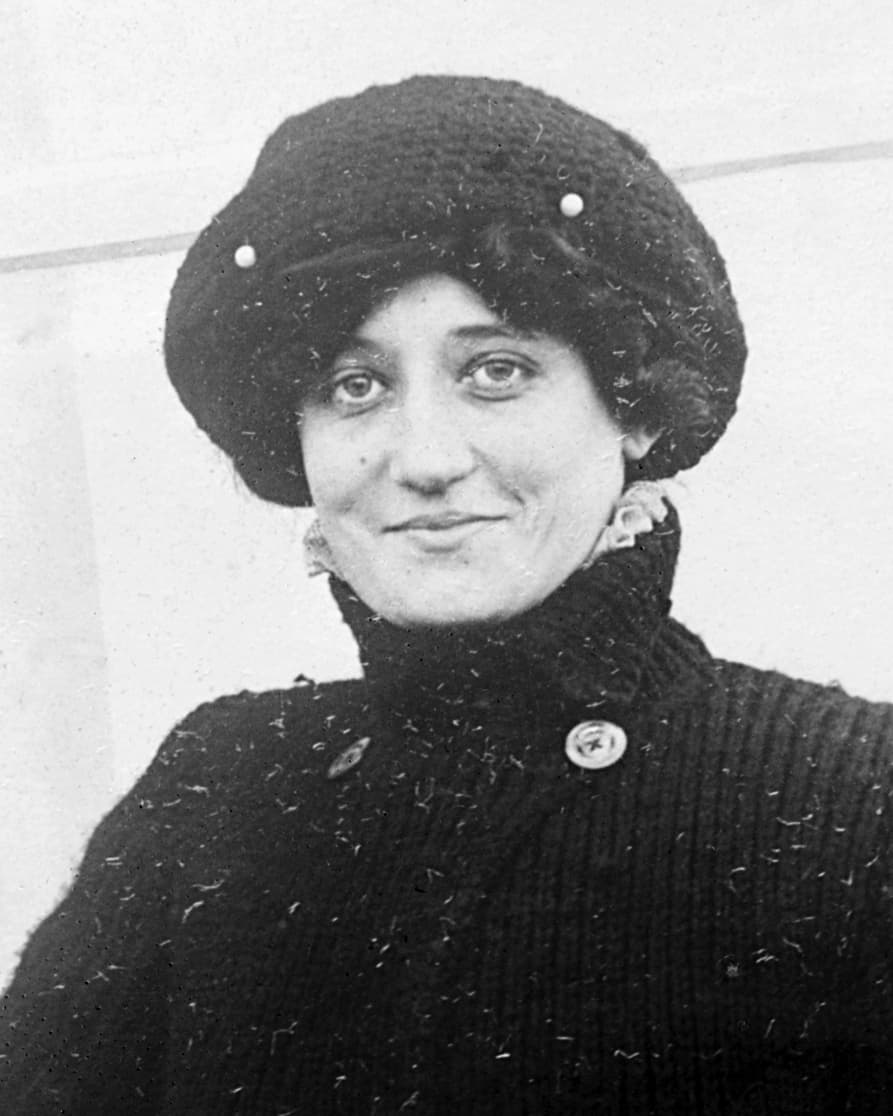
French · Aviation · Exploration
Raymonde de Laroche
August 22, 1882 – July 18, 1919
Early Life and Background
Raymonde de Laroche was born Élise Léontine Deroche on 22 August 1882 in Paris, France, a city that was rapidly becoming a center of technological and artistic innovation.[2][3][16] Very little is documented about her parents or family background, but she grew up in an urban environment where theater, mechanical spectacle, and new inventions were part of everyday life. This atmosphere of modernity and performance would strongly shape her later persona as an aviator.
As a young woman, Deroche pursued a career on the stage, working as an actress and adopting the professional name Raymonde de Laroche, sometimes styled as the "baroness" or "Baronne de Laroche".[2][3][10][16] The aristocratic flavor of this name added to her public image, though there is no reliable evidence that she held a noble title by birth. The theatrical training she received—voice, presence, and a cultivated air of daring—later proved useful when aviation shows became a form of public entertainment and when newspapers sought glamorous figures to personify the new age of flight.
Her life unfolded during the Belle Époque, a period in France characterized by optimism, industrial progress, and fascination with speed and mechanical power. Yet it was also an era in which women’s roles were restricted by law and custom: women lacked full political rights and were generally excluded from scientific and technical careers. In this context, Deroche’s eventual turn to aviation marked a dramatic departure from typical expectations for women.
Entry into Aviation and Training
De Laroche’s path into flight began with the world of lighter‑than‑air travel. Some early accounts describe her as previously having experience as a balloonist, participating in the fashionable sport of balloon ascents that captivated European audiences.[6][10] This exposure to aerial views and the culture of aeronautical display likely prepared her psychologically and socially for the radical step into powered, heavier‑than‑air flight.
By 1909, France was at the forefront of airplane development. The brothers Charles and Gabriel Voisin were among the leading designers and builders of early biplanes. According to a widely cited narrative, while dining with Charles Voisin, de Laroche expressed her desire to learn to fly, and Voisin agreed to teach her.[1][10] She began flight training at the Chalons military airfield, learning on a Voisin biplane. Training at that time involved ground instruction, taxiing practice, and short "hops" that progressively built a pilot’s confidence and skill.
Becoming a student pilot was itself a challenge. Early aviation was overwhelmingly male; pilots were often wealthy sportsmen, engineers, or military officers. A female trainee demanded a rethinking of assumptions about who could participate in this dangerous and technically demanding arena. De Laroche’s combination of determination, public poise, and already established reputation helped her secure training opportunities that were not easily available to most women.
First Solo Flight and Early Publicity
On 22 October 1909, at Chalons, de Laroche made her first solo airplane flight in a Voisin biplane.[1][2][17] The flight covered just over 300 meters at a height of about 10–15 feet. Though brief, it represented a major technical accomplishment. With no instructor in the aircraft, she had to manage take‑off, maintain control, and land safely in a machine that was inherently unstable and lacked modern instruments.
This flight is widely cited as making her the first French woman to pilot an airplane solo, and she is often regarded as the first woman to pilot a powered, heavier‑than‑air airplane.[2][8][16] In the context of 1909, only a handful of individuals worldwide had flown airplanes at all. That a woman could do so contradicted prevailing medical and social theories that claimed women were too physically frail or emotionally unstable for such work.
Press reports and later aviation histories emphasized both her skill and her daring. The image of the "Baroness" at the controls of a fragile biplane captured the public imagination, marrying the spectacle of modern technology with the novelty of a woman in command of it. This early publicity laid the foundation for her subsequent fame and positioned her as an emblem of female capability in technological fields.
World’s First Licensed Female Pilot
Following her training and initial flights, de Laroche sought formal certification. At the time, the Aéro‑Club de France and the Fédération Aéronautique Internationale (FAI) were pioneering systems of pilot licensing. Candidates had to demonstrate practical flying skill before club officials to receive a numbered licence.
On 8 March 1910, after performing the required manoeuvres, de Laroche was issued licence no. 36 by the Aéro‑Club de France under FAI authority.[2][3][12] This made her the world’s first licensed female pilot, a milestone later celebrated by the FAI and women’s aviation organizations.[2][12][14][15] The Aero‑Club’s licence system was the earliest of its kind, and de Laroche’s certification placed her at the heart of an international movement to standardize pilot qualifications.
On the same date, she became the first French woman to receive a pilot’s certificate from the Aero‑Club.[2][11] This national recognition enabled her to participate officially in air meets and exhibitions, no longer merely as a passenger or novelty but as a credentialed aviator. The timing—now associated with International Women’s Day—has given the event enduring symbolic resonance.
Her licence was not simply an individual honor. It publicly demonstrated that a woman could meet the exacting technical standards set by leading aviation authorities, challenging institutional barriers that had excluded women from pilot training and professional flying. This achievement influenced subsequent pioneers such as Harriet Quimby, who became the first licensed female pilot in the United States, and other early women aviators worldwide.
Air Meets, Accidents, and Recovery
Armed with her licence, de Laroche soon entered competitive and exhibition flying. In 1910only female participant, highlighting both her uniqueness and the continuing male dominance of the field.
During one of these events in 1910, she suffered a serious crash. Contemporary accounts and later summaries agree that she was badly injured, with fractures and other trauma that required a lengthy recovery.[1][2][10] The accident underscored the hazards of pioneer aviation. Aircraft were structurally fragile, engines unreliable, and airfields rough; crashes were common, and many early pilots died in training or competition.
De Laroche’s willingness to return to flying after the crash is frequently emphasized in historical narratives. After recuperating, she resumed training and public flying. Her persistence reinforced her reputation for courage and resilience, and it offered a powerful counter‑image to stereotypes that women would retreat from risk or technical challenges.
Femina Cup and Endurance Flying
Later in 1910, after returning to the air, de Laroche won the Coupe Femina (Femina Cup), a prestigious French endurance prize created specifically for women pilots.[1][2][10][13] The award honored the longest nonstop flight achieved by a woman within a designated period. De Laroche’s winning flight lasted about four hours, a remarkable achievement given the reliability issues of early engines and the physical demands of prolonged exposure to wind, noise, and vibration.
Although sources differ on the exact date of this flight, the accomplishment itself is well‑documented.[1][13] The Femina Cup was sponsored by the magazine Femina and was intended to encourage women’s participation in aviation. By capturing the prize, de Laroche not only demonstrated technical skill and endurance but also cemented her status as the leading French aviatrix of her time.
Endurance flying had particular symbolic significance. It was widely believed that women lacked the stamina for sustained physical exertion. De Laroche’s four‑hour flight contradicted such claims, showing that women could manage the physical and psychological demands of lengthy flights in harsh conditions. The Femina Cup thus functioned both as a sporting trophy and as a political statement about women’s capacities.
International Exhibitions and Public Recognition
In the years following her licensing, de Laroche flew at exhibitions across Europe and beyond. Sources attest to her participation in displays at Tours, Saint Petersburg, Budapest, Rouen, and Cairo, among other locations.[5][16] These events drew large crowds and extensive press coverage, and de Laroche was often highlighted as a central attraction because of her status as a female pilot.
Her international appearances contributed to the global visibility of women in aviation. In Saint Petersburg, she reportedly received personal congratulations from Tsar Nicholas II for her flying.[15] In other venues, she impressed observers with her professionalism and calm demeanor in the cockpit, countering the tendency to treat women aviators as mere curiosities.
These exhibitions also had a technical dimension: pilots used them to test aircraft, build experience, and sometimes compete in minor contests. De Laroche’s repeated invitations testify to the respect she commanded among organizers and fellow pilots. Her ability to navigate different cultural contexts while maintaining her professional role helped standardize the idea that women could be serious aviators, not just national exceptions.
World War I and Attempts at Military Service
With the outbreak of World War I in 1914, aviation’s importance shifted from sport and spectacle to military operations. De Laroche, by then an experienced pilot, reportedly volunteered to fly for the French military.[1][2] Her offer was refused, not because of her lack of skill, but because of her gender. Women were excluded from combat and most official military aviation roles.
This rejection illustrates the institutional barriers that persisted even after individual women had proved their capabilities. Despite possessing a licence and a record of endurance and exhibition flying, de Laroche was barred from serving as a military pilot. Her experience parallels that of other early women pilots who sought wartime roles but were confined to support functions or ground positions.
During the war years, de Laroche’s public flying activities appear to have been limited, in part because civilian aviation in France was heavily curtailed. Nonetheless, she remained associated with aviation circles and continued to be recognized as a pioneer. The wartime context, with its intensified emphasis on national defense and masculine heroism, made her earlier achievements all the more striking.
Records and Later Career
After the war, civil aviation revived, and de Laroche resumed active flying. In 1919, she set a women’s altitude record of around 4,785–4,800 meters (approximately 15,700 feet) and a women’s distance record of about 201 miles (323 kilometers).[1][2][7][13][16] These records demonstrated that, even a decade into her career, she remained at the cutting edge of performance.
Some sources specify that she broke women’s altitude marks on 7 June and 12 June 1919, with flights reaching 3,900 and 4,800 meters respectively, and that her distance record occurred in the same period.[9][16] Others describe the achievements more generally as having taken place in June 1919.[2][7] The exact dates vary among accounts, but all agree that she reached unprecedented heights for a woman pilot and flew an exceptional distance.
These records had practical implications. They required precise management of aircraft performance, weather, and navigation, especially at high altitude where engines struggled and temperatures dropped. By achieving them, de Laroche proved that women could excel in the most demanding aspects of aviation. Her flights contributed to the broader process of testing and improving aircraft, as record attempts often drove incremental refinements in design and operation.
Awards, Honors, and Cultural Status
Throughout her career, de Laroche accumulated a range of honors and informal titles. The Coupe Femina was one formally documented award, given for her four‑hour nonstop flight.[1][2][13] Beyond official trophies, she was frequently celebrated in the press as the "Baroness" or "Baronne de Laroche," a title that, whether or not rooted in actual nobility, signaled both social distinction and public fascination.
Her image appeared in photographs and postcards, such as the portrait preserved by the National Air and Space Museum, showing her in flying attire that emphasized both professionalism and gendered elegance.[1] She became a figure in popular culture, representing modern womanhood engaged with technology and risk.
Later institutions have continued to honor her. The Fédération Aéronautique Internationale and various aviation‑history organizations highlight her licence date as a key milestone in their timelines of women in aviation.[2][11][12] She is regularly referenced in articles, museum exhibits, and commemorative posts that celebrate International Women’s Day, women’s contributions to flight, and the centennial of women pilots.
Personal Life
Detailed information on de Laroche’s private life is scarce. The surviving sources focus overwhelmingly on her public role as an aviator and do not provide reliable documentation of marriage, children, or intimate relationships.[2][3][16] The theatrical persona of "Raymonde de Laroche" and the nickname "Baroness" sometimes blend with speculation, but there is no securely sourced biography that clarifies her domestic circumstances.
This lack of detail is typical for many women in early technical fields whose lives were recorded primarily through the lens of their public achievements. What is clear is that she fashioned a distinctive identity that combined elements of performance, aristocratic style, and technical competence. Her self‑presentation and choices suggest a strong commitment to independence and to a career defined by aviation rather than by traditional domestic roles.
Death in Test-Flight Crash
On 18 July 1919, while at the Le Crotoy airfield in northern France, de Laroche died in an experimental aircraft crash during its landing approach.[2][3][16] Reports indicate that she was in the aircraft with another pilot when it crashed, killing both. The flight appears to have been a test or demonstration rather than a scheduled commercial or military operation.
Her death came only weeks after her record‑setting flights, cutting short a career that had spanned a decade of aviation’s formative years. The accident highlights the continuing hazards of flight in the immediate postwar era. Even experienced pilots faced significant risk when operating new designs, and safety measures and investigative procedures were far less developed than today.
Within the aviation community, her death was widely mourned. She had become a symbol of female achievement and courage, and her loss was felt as both a personal tragedy and a historical turning point. Le Crotoy, already known as an aviation site, gained an added layer of significance as the place where the first licensed female pilot’s life ended.
Legacy and Historical Impact
Raymonde de Laroche’s legacy rests on a series of intertwined achievements: being the world’s first licensed female pilot, one of the earliest women to fly a powered airplane, a winner of endurance contests such as the Femina Cup, and a setter of altitude and distance records.[2][5][11][12][16] Together, these accomplishments substantially altered perceptions of women’s capabilities in aviation.
Her licence on 8 March 1910 is frequently highlighted in timelines of women in aviation and in commemorative pieces marking International Women’s Day.[2][11] She is cited as a foundational figure whose example encouraged other women to pursue pilot training in Europe, the Americas, and beyond. By demonstrating competence in an activity that was both technically demanding and socially prestigious, she helped make it harder for institutions to justify excluding women from flight.
De Laroche also contributed to the culture of aviation. Her theatrical background and cultivated persona as the "Baroness of Flight" made her a compelling public figure, helping to attract attention and support for the new technology. At the same time, her record‑setting flights and resilience after accidents showed that she was more than a symbol; she was a serious technician and professional.
In later decades, as women gained greater access to pilot training and military roles, her story has been repeatedly revisited by historians, museums, and advocacy groups. Organizations such as the Centennial of Women Pilots project and various educational outlets present her biography as part of a broader narrative of women breaking barriers in aviation.[12][18] Her name appears in multiple language editions of encyclopedias, ensuring international recognition.
While she did not live to see the full flowering of women’s participation in aviation—including female airline captains, test pilots, and astronauts—her pioneering work created a precedent that others could claim. In the editorial almanac of women’s history, Raymonde de Laroche stands as an early, decisive figure who took the sky at a time when women were expected to remain firmly on the ground.
Assessment
Raymonde de Laroche’s life illustrates the complex interplay between individual agency, technological change, and gender norms. She leveraged her theatrical skills and public persona to gain access to flight training, but her subsequent achievements depended on technical mastery and courage under risk. Her experiences—training with leading designers, competing at major air meets, recovering from serious injury, setting records, and being denied military service—reveal both the possibilities and limits faced by women in early twentieth‑century aviation.
Historically, she is significant not only for being "first" in various categories, but for demonstrating a sustained, professional commitment to aviation over many years. Her career bridged the transition from sports flying to wartime and postwar aviation, and her records in 1919 show that she remained engaged with the most advanced aspects of the field until her death.
For women’s history, de Laroche’s story underscores the importance of recognizing technical pioneers alongside activists and political leaders. By flying, obtaining licences, and winning competitions, she opened doors that would later allow women to serve as military pilots, commercial captains, and aerospace engineers. Her name continues to serve as a symbol and touchstone for efforts to document and celebrate women’s contributions to the conquest of the air.
Dated achievements
5 indexed.
- Aug221882Aviation
Birth in Paris
Élise Léontine Deroche, later known as Raymonde de Laroche, was born in Paris, France.
View details Raymonde de Laroche - Wikipedia - Oct221909Aviation
First solo airplane flight by a French woman
Raymonde de Laroche became the first French woman to pilot a solo flight in an airplane on 22 October 1909.