← All women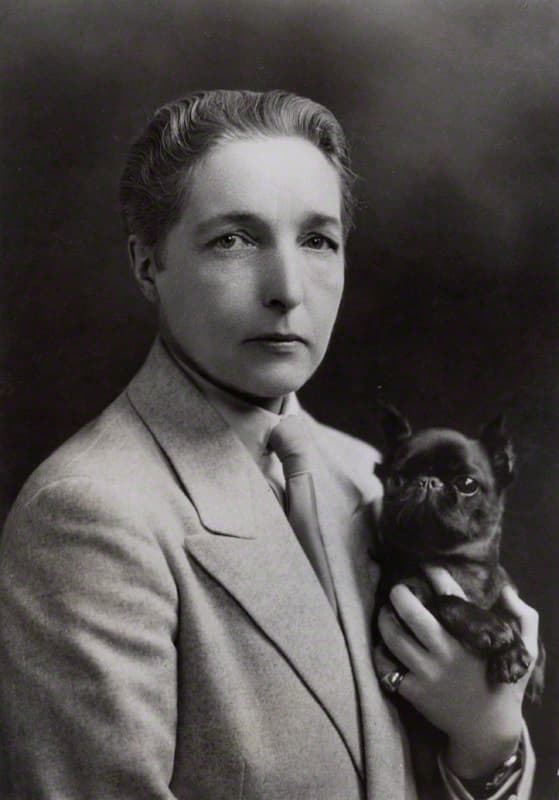
British · Literature
Radclyffe Hall
August 12, 1880 – October 7, 1943
Early Life and Background
Marguerite Antonia Radclyffe Hall was born on 12 August 1880 in Bournemouth, England, into a family marked by wealth but deep emotional dysfunction. Her father, Radclyffe Radclyffe-Hall, was a wealthy but largely absent figure who abandoned the family when Marguerite was young. Her mother, Mary Jane Sager, an American, later remarried Alberto Visetti, an Italian singing teacher at the Royal College of Music, whose household proved emotionally abusive and unstable for the young Marguerite.
Hall's childhood was characterized by parental neglect and hostility, particularly from her mother, with whom she had a fraught and painful relationship throughout her life. She received a sporadic education, briefly attending King's College London, but much of her intellectual and cultural development came through independent reading, travel, and exposure to the musical and artistic circles of her stepfather's household.
Upon reaching adulthood, Hall inherited substantial wealth from her father and later from her grandfather, providing her with financial independence rare for women of her time. This financial freedom allowed her to live outside the constraints of conventional marriage and to pursue a literary career and same-sex relationships relatively openly within her social circles, even as broader society remained hostile to homosexuality.
Adoption of Identity and Early Relationships
From an early age, Hall rejected conventional femininity, preferring to be called "John" by intimates and adopting a masculine style of dress and self-presentation that was unusual and often shocking for the era. This gender expression has led later scholars to view her as an important, if complicated, figure in the history of both lesbian and transgender identity.
Hall's first significant same-sex relationship was with Mabel Batten ("Ladye"), a older, sophisticated woman who introduced her to London's cultured lesbian social circles and encouraged her literary ambitions. Following Batten's death in 1916, Hall began a decades-long relationship with sculptor Una Troubridge, who had been married to Admiral Ernest Troubridge. Una left her husband for Hall, and the two women remained partners for the rest of Hall's life, presenting themselves publicly as a couple despite the social risks involved.
Literary Career Beginnings
Hall began her literary career as a poet, publishing several volumes of verse in the early 1900s and 1910s, including 'Twixt Earth and Stars (1906), A Sheaf of Verses (1908), and Poems of the Past and Present (1910). Some of her poems were set to music and gained modest popularity, but it was in prose fiction that she would find lasting fame.
Her early novels, including The Forge (1924) and The Unlit Lamp (1924), explored themes of female independence, thwarted ambition, and social constraint, establishing her as a serious literary voice within English fiction. The Unlit Lamp in particular examined a daughter's struggle to escape her mother's controlling influence to build an independent life—an evidently autobiographical theme given Hall's own childhood.
In 1926, Hall achieved mainstream literary recognition and commercial success with Adam's Breed, a novel about a lonely Italian waiter's spiritual crisis, which won both the James Tait Black Memorial Prize and the Prix Femina Vie Heureuse Anglais, cementing her reputation as a novelist of considerable skill and sensitivity, well before the controversy of her most famous work.
The Well of Loneliness and Its Trial
Hall's most significant and enduring work, The Well of Loneliness, was published on 27 July 1928 by Jonathan Cape. The novel follows Stephen Gordon, a woman raised as if she were a son by her father, who grows up to identify as an "invert"—the contemporary sexological term for what would now be understood as a lesbian or gender-nonconforming individual. The narrative traces Stephen's painful search for love, acceptance, and belonging in a society that pathologizes and rejects her identity.
Hall wrote the novel with explicit advocacy intent, aiming to generate public sympathy and understanding for "inverts" through a serious, literary treatment of the subject, drawing heavily on the sexological theories of Havelock Ellis, who contributed a commendatory preface to the book, lending it scientific and intellectual legitimacy.
Despite containing no explicit sexual content, the novel ignited a firestorm of controversy. The tabloid Sunday Express, under editor James Douglas, launched a campaign against the book, infamously declaring he would "rather give a healthy boy or a healthy girl a phial of prussic acid than this novel." This public pressure led to a prosecution under the Obscene Publications Act 1857.
The resulting trial, which culminated in a guilty verdict delivered by Chief Magistrate Sir Charles Biron on 9 November 1928, became one of the most famous obscenity trials in British literary history. Prominent writers including Virginia Woolf, E. M. Forster, and others rallied in support of the book and organized a petition defending its literary merit, though the court refused to admit most literary testimony, ruling that the question of obscenity was one of fact, not literary judgment. The novel was banned in the United Kingdom, with all copies ordered destroyed, though the ban did not extend to the United States, where a separate obscenity case in New York ultimately resulted in the book being cleared for publication in 1929.
Aftermath and Later Career
The controversy transformed Hall into an internationally recognized, if polarizing, figure. Paradoxically, the trial and subsequent ban dramatically increased the novel's fame and readership abroad, and the book continued to be smuggled into Britain and read widely underground. It became—and remains—one of the most significant and widely read works of lesbian literature in the English language, despite its melancholic tone and Hall's own conflicted, quasi-medicalized framing of homosexuality as an inborn "affliction" rather than a a celebrated identity, a framing that later feminist and queer scholars have both critiqued and contextualized within its era's sexological discourse.
Following the trial, Hall continued to write, publishing novels including The Master of the House (1932) and The Sixth Beatitude (1936), though none achieved the cultural impact or notoriety of The Well of Loneliness. She also continued to write poetry and remained active in London's literary and social circles, though the trial's stigma affected her standing with some publishers and segments of the public.
Personal Life
Hall's relationship with Una Troubridge remained central to her personal life for over two decades, though the relationship was complicated in its later years by Hall's romantic involvement with a younger Russian émigré, Evguenia Souline, beginning in the early 1930s. Despite this, Una remained Hall's primary companion and caretaker, particularly as Hall's health declined in her final years.
Hall's wealth, inherited independently of any husband, was unusual for women of her era and afforded her considerable social and personal freedom, enabling her to live openly with female partners despite the social and legal risks of doing so in early twentieth-century Britain, where lesbianism, though not explicitly criminalized as male homosexuality was, remained heavily stigmatized and socially dangerous.
Death and Legacy
Radclyffe Hall died of colorectal cancer on 7 October 1943 in London, with Una Troubridge at her side. She was buried in Highgate Cemetery, where her grave later became a site of pilgrimage and remembrance for LGBTQ+ readers, activists, and scholars.
Hall's legacy is complex and has been continually reassessed by literary scholars and LGBTQ+ historians. While The Well of Loneliness has been critiqued for its melancholic, sexologically-inflected portrayal of lesbian identity as a tragic "affliction," it remains a landmark text for its unprecedented sympathetic treatment of same-sex love in mainstream literature, and its trial remains a pivotal case study in the history of censorship, literary freedom, and LGBTQ+ visibility.
Hall's own gender presentation and identity as "John" have also prompted retrospective scholarly interest in her as a figure who might, in contemporary terms, be understood through a transgender or nonbinary lens, adding further layers to her historical significance as a queer icon whose life and work continue to resonate powerfully within LGBTQ+ history and literary studies.
Dated achievements
2 indexed.
- Aug121880Literature
Birth of Radclyffe Hall
Radclyffe Hall was born on August 12, 1880, in Bournemouth, England.
View details Wikipedia: Radclyffe Hall - Oct071943Literature
Death of Radclyffe Hall
Radclyffe Hall died on October 7, 1943, in London due to bowel cancer.
View details