← All women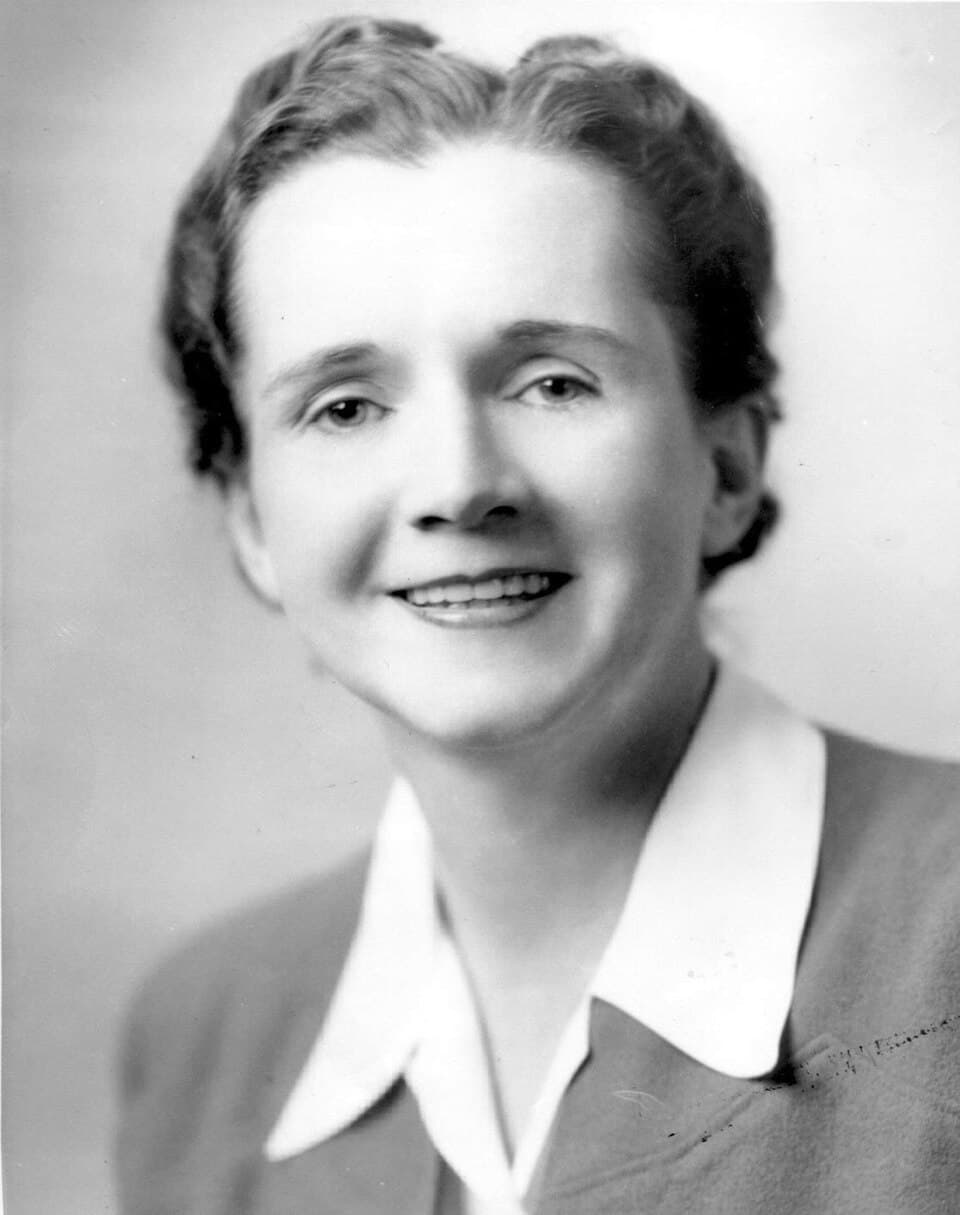
American · Science · Activism · Literature
Rachel Louise Carson
May 27, 1907 – April 14, 1964
Early Life and Background
Rachel Louise Carson was born on May 27, 1907, in Springdale, Pennsylvania, a small rural community near Pittsburgh. She was the youngest of three children of Robert Warden Carson and Maria McLean Carson. The family lived on a modest farm where Rachel spent much of her childhood exploring fields, woods, and the nearby river, experiences that nurtured a profound fascination with nature and wildlife.[1][2][5]
Carson’s mother, Maria, played a central role in shaping her intellectual and emotional life. Maria loved literature and the outdoors and encouraged Rachel to develop both her writing talent and her curiosity about the natural world. From an early age, Rachel read widely and wrote stories, combining keen observation with a lyrical sensibility that would later characterize her published work.[1][5]
In 1925, Carson graduated from high school and enrolled at Pennsylvania College for Women in Pittsburgh (later Chatham College).[1][2][5] She initially planned to major in English and become a writer, reflecting her early literary ambitions. However, in 1928 she changed her major to biology after taking an inspiring zoology course. This decision, made despite poor job prospects for women in science at the time, marked a crucial turning point in her life.[1][9]
Carson completed her B.A. degree magna cum laude in 1929, demonstrating strong aptitude both in science and in writing.[1][9] She then pursued graduate study at Johns Hopkins University in Baltimore, one of the few institutions that admitted women to advanced scientific training. Supporting herself with laboratory work and teaching, she earned an M.A. in zoology in 1932.[1][5][9]
Although she began work toward a Ph.D., financial constraints during the Great Depression and limited academic opportunities for women forced her to abandon doctoral study.[1][2] This setback pushed her toward government service and science writing—fields in which she would ultimately leave an indelible mark.
Career Beginnings and Development
Carson’s professional career took shape during the 1930s in the context of the U.S. federal government’s expanding role in natural resource management and public information. In the mid‑1930s she joined the U.S. Bureau of Fisheries, initially as a part‑time writer producing radio scripts and educational materials.[1][2]
Her responsibilities soon grew to encompass writing and editing brochures, articles, and reports intended to explain fishery science and conservation to the public. Carson combined technical accuracy with clear, engaging prose, earning a reputation within the Bureau as a gifted communicator of scientific ideas.[2]
During this period she wrote an essay titled “Undersea” for the Bureau, which described the underwater world in vivid detail and reflected her fascination with marine life.[2][5] This text was later reworked and expanded for publication in The Atlantic Monthly, appearing as “Undersea” in the September 1937 issue—Carson’s first major national magazine publication.[2][5]
According to biographical accounts, Carson eventually became one of the few women employed as a full‑time professional biologist at the Bureau of Fisheries, which later evolved into the U.S. Fish and Wildlife Service.[2][10] There she advanced to positions including aquatic biologist and chief editor of publications. Her government work immersed her in research on fish populations, coastal ecology, and conservation issues, while providing extensive experience in translating scientific findings for non‑specialist audiences.[2]
Alongside her duties at the Bureau, Carson increasingly devoted time outside of work to book projects. She sought to create narratives that would allow readers to experience nature—particularly the sea—as a living, interconnected system, rather than as a collection of isolated facts or resources.[1][2]
In 1949, after more than a decade in federal service, Carson left the U.S. Fish and Wildlife Service to focus fully on writing.[2][5] This transition from government biologist to independent author and science communicator was unusual for a woman in mid‑20th‑century America, and it reflected both her growing literary success and her commitment to reaching broad public audiences.
Major Works and Accomplishments
Under the Sea Wind (1941)
Carson’s first book, Under the Sea Wind, was published in 1941 by Simon & Schuster.[2][6] Structured as three interrelated narratives, the book follows the lives of a shore bird, a fish, and an eel through seasonal cycles. Drawing on her scientific training, Carson depicts the daily struggle for survival and the intricate relationships among species in coastal and marine ecosystems.
Although Under the Sea Wind received positive critical reviews, its sales were modest, in part because its publication coincided with the entry of the United States into World War II.[2][6] Nevertheless, the book established Carson’s distinctive approach: combining meticulous scientific observation with poetic language to foster empathy for nonhuman life.
The Sea Around Us (1951)
Carson’s second major work, The Sea Around Us, was first published in 1951.[2][7] It offers a sweeping exploration of the oceans, from their origins and geological evolution to contemporary currents, climates, and marine communities. Carson drew on a wide range of oceanographic and geological research, synthesizing complex findings into accessible chapters.
The book became an unexpected bestseller, remaining on lists for months and being translated into multiple languages.[2][7] It won the National Book Award for Nonfiction and the John Burroughs Medal, among other honors, and brought Carson international recognition as a leading science writer.[2][7]
The success of The Sea Around Us allowed Carson to resign from government work and pursue writing full time.[2][6] The book also helped popularize ecological thinking by portraying the oceans as dynamic systems that shape climate, landforms, and life itself, anticipating later public debates on marine pollution and resource exploitation.
The Edge of the Sea (1955)
In 1955, Carson completed her informal "sea trilogy" with The Edge of the Sea, a book focused on coastal habitats such as rocky shores, sandy beaches, and tidal pools.[2][6] Here she examines the adaptations of plants and animals to the shifting boundary between land and water, emphasizing the complexity and resilience of intertidal ecosystems.
The Edge of the Sea further cemented Carson’s reputation as a master interpreter of marine natural history. It encouraged readers to look more closely at common seaside environments, deepening public appreciation for ecological relationships and the vulnerability of coastal zones to human disturbance.[2][6]
Silent Spring (1962)
Silent Spring, published in 1962, marked a dramatic shift in Carson’s writing from celebratory natural history to environmental critique.[2][6][11] The book grew out of reports she began receiving in the late 1950s about bird mortalities and other ecological damage linked to widespread use of synthetic pesticides, especially DDT.
Carson undertook extensive research, reviewing scientific studies, government reports, and field observations, and consulting with toxicologists and ecologists. Portions of the work were serialized in The New Yorker before the full book appeared, ensuring a large initial readership.[2]
In Silent Spring, Carson documented how chemicals applied to crops, forests, and lawns entered soil and water, accumulated in food chains, and caused illness and death in wildlife and humans. She criticized the chemical industry for aggressive promotion of pesticides and for downplaying risks, and she faulted regulatory agencies for insufficient oversight.[2][6]
Carson argued that the prevailing "control of nature" mindset was dangerously simplistic, ignoring the complexity of ecosystems and the possibility of unintended consequences. She called for alternative approaches to pest management and for a broader ethical perspective respecting the integrity of natural systems.[2][11]
The book sparked intense controversy. Chemical companies and some allied scientists attacked Carson’s credibility and accused her of alarmism, while many independent researchers and environmental advocates supported her conclusions. Congressional hearings and government studies followed, and public concern about pesticide use expanded rapidly.[2][6][11]
Over time, Silent Spring came to be regarded as one of the most influential books of the 20th century. It helped catalyze the modern environmental movement, contributed to the eventual 1972 U.S. ban on DDT for agricultural purposes, and influenced the development of new regulatory frameworks for toxic substances.[2][6][7]
Awards, Honors, and Recognition
Carson received numerous honors during her lifetime and posthumously, reflecting both literary excellence and environmental impact. The Sea Around Us earned the National Book Award for Nonfiction and the John Burroughs Medal, as well as other prizes, attesting to its dual status as a scientific and literary achievement.[2][7]
Her works brought her honorary degrees and invitations to speak and write for prominent publications. Despite being a woman in a male‑dominated scientific and literary world, Carson’s books achieved significant commercial success and critical acclaim, making her an influential public intellectual.[2][5]
In 1980, President Jimmy Carter posthumously awarded Carson the Presidential Medal of Freedom, the highest civilian honor in the United States.[2][11] The award recognized her role in "awakening the world to the dangers of environmental pollution" and acknowledged the lasting importance of Silent Spring in shaping policy and public attitudes.
Carson has also been commemorated through institutions and memorials bearing her name, including the Rachel Carson Homestead in Pennsylvania, the Rachel Carson Council, and the Rachel Carson Center for Environment and Society in Munich, which highlight her contributions to environmental thought and activism.[1][11][12]
Personal Life
Rachel Carson never married, a choice shaped partly by her devotion to work and partly by family responsibilities.[5] She maintained close relationships with her mother and siblings and often shouldered caregiving duties alongside her professional commitments.
Carson’s personal life included significant responsibilities for children within her extended family. She helped raise two nieces, and later adopted Roger Christie, the son of one of these nieces, after his mother’s death.[5] This adoption made Carson a single mother while she was at the height of her literary and environmental work, adding a private dimension to her public career.
Carson was known among friends and colleagues for her quiet demeanor, intellectual rigor, and deep empathy for both people and the natural world. She valued close friendships, including with fellow writers and scientists, and maintained extensive correspondence that discussed scientific topics, ethical questions, and personal matters.[2][5]
Her letters and biographical studies suggest that Carson’s sensitivity to suffering—whether of humans or other species—underpinned her insistence that environmental decisions carry moral weight. This perspective helped shape the tone of Silent Spring, which addressed readers not only as citizens and consumers but also as moral agents responsible for the Earth’s future.[2][11]
Legacy and Historical Impact
Rachel Carson’s legacy is multifaceted, encompassing literature, science, environmental policy, and public ethics. She is widely regarded as one of the founders of the modern environmental movement.[2][6][11] By integrating ecological science with accessible narrative, she transformed how many people understand the relationship between humans and the natural world.
Her early sea books charged readers to see the oceans and coastal zones as intricate, interdependent systems rather than mere backdrops or exploitable resources. These works promoted ecological thinking before the term was broadly popularized, fostering awareness of interconnectedness across species and environments.[2][7]
Silent Spring had particularly profound influence. It helped stimulate public demands for stronger regulation of pesticides and other pollutants, contributed to the creation of new federal environmental agencies and laws, and encouraged scientists to investigate long‑term ecological and health effects of chemical exposure.[2][6][7]
Carson’s work also significantly advanced the role of science communication. She demonstrated that non‑specialists could engage deeply with complex scientific issues when those issues were presented clearly, accurately, and in human terms. Her success encouraged subsequent generations of science writers and environmental journalists.[2][7]
As a woman scientist and author who achieved wide recognition in mid‑20th‑century America, Carson helped challenge gender stereotypes in both fields. Her achievements showed that women could excel in research, public communication, and high‑impact policy debates, even when institutional support and representation remained limited.[2][5]
Carson’s ideas continue to influence contemporary discussions on climate change, biodiversity loss, and environmental justice. Her insistence on precaution, long‑term thinking, and ethical responsibility resonates with current debates over emerging technologies and global environmental risks.[7][11]
Later Life and Death
Following the publication of Silent Spring in 1962, Carson’s life was marked by both public prominence and personal strain. She faced vigorous attacks from chemical industry representatives, some government officials, and a subset of scientists who questioned her findings or feared restrictions on pesticides.[2][6]
At the same time, she received substantial support from many researchers, conservationists, and members of the public, who saw their own observations of wildlife decline and pollution reflected in her work. Carson responded to criticism through carefully documented statements, interviews, and testimony, defending the scientific foundation of Silent Spring.[2][11]
During this period, Carson’s health deteriorated. She had been diagnosed with breast cancer and underwent treatment while continuing to write and speak.[5] Despite illness, she agreed to testify before a U.S. Senate committee on pesticide hazards, illustrating her commitment to bringing scientific evidence into policymaking.[2]
Rachel Carson died on April 14, 1964, at her home in Silver Spring, Maryland, after a prolonged battle with cancer.[2][3][6] She was 56 years old. Her death came just as environmental activism and policy initiatives influenced by Silent Spring were gaining momentum.
In the decades since her death, Carson has been commemorated through biographies, documentaries, educational programs, and institutions dedicated to environmental scholarship and advocacy. Her writings remain widely read and studied, and she is frequently cited as a moral and intellectual exemplar in discussions about science, responsibility, and the environment.[2][6][11]
Today, Rachel Carson is remembered not only as a marine biologist and writer but also as a visionary who helped society recognize the far‑reaching consequences of technological interventions in nature. Her life and work continue to serve as a touchstone for those seeking to align scientific knowledge with care for the Earth and for future generations.[7][11]
Dated achievements
11 indexed.
- May271907Science
Birth in Springdale, Pennsylvania
Rachel Louise Carson was born in Springdale, Pennsylvania, United States.
View details Rachel Carson Biography - Sep011937Literature
Publication of "Undersea" in The Atlantic Monthly
Carson's essay "Undersea" was published in The Atlantic Monthly, marking her first national publication.