← All women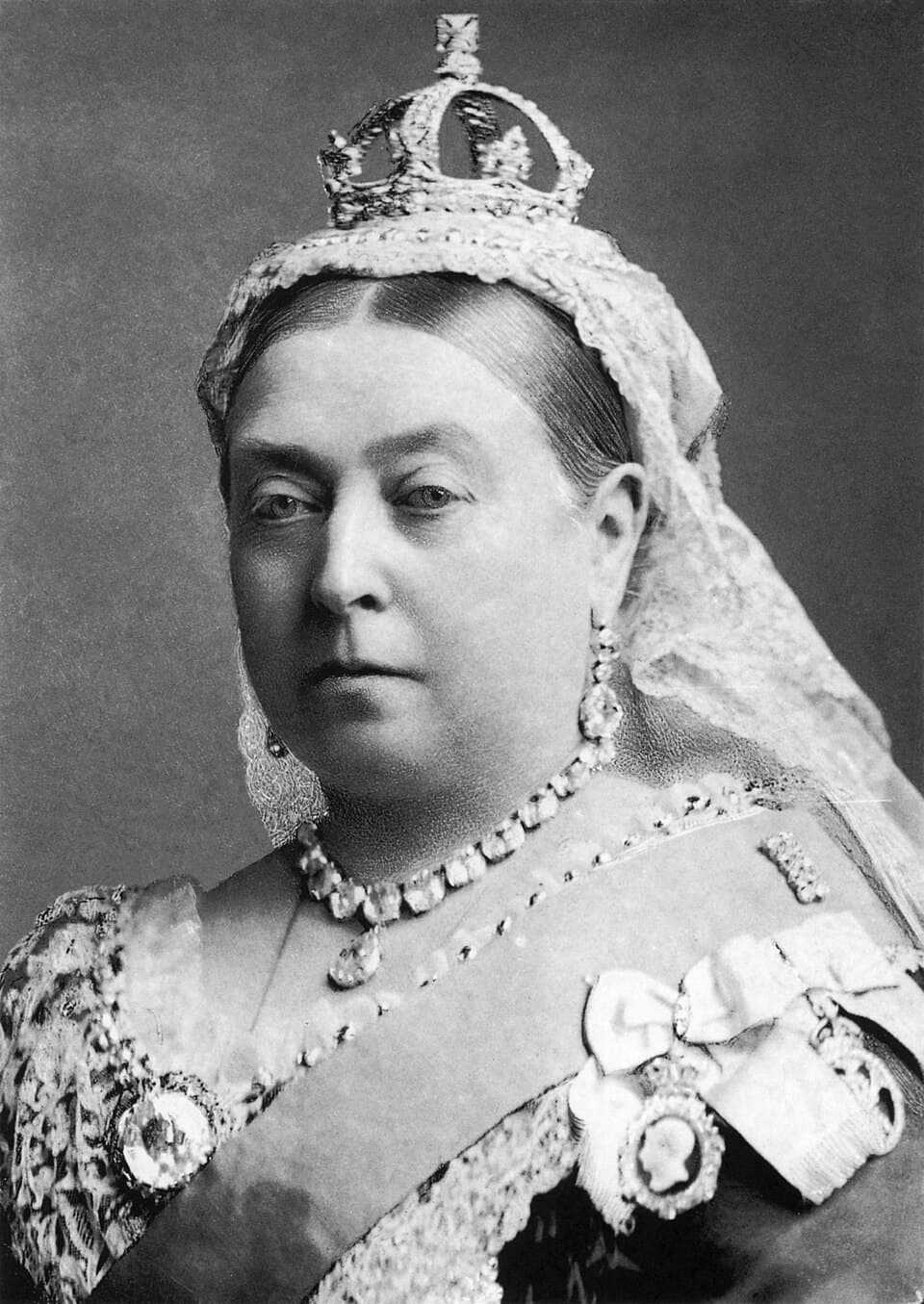
British · Politics
Queen Victoria UK
May 24, 1819 – January 22, 1901
Early Life and Background
Queen Victoria, born Alexandrina Victoria on 24 May 1819 at Kensington Palace in London, was the only child of Prince Edward, Duke of Kent and Strathearn (the fourth son of King George III) and Princess Victoria of Saxe‑Coburg‑Saalfeld.[1][10] Her father died when she was less than a year old, leaving her to be raised by her widowed mother in relatively confined financial and social circumstances compared with other branches of the royal family.[1]
Victoria’s childhood was shaped by the so‑called Kensington System, a strict regimen devised by her mother and her comptroller, Sir John Conroy.[1][13] Intended to keep the princess dependent and to strengthen her mother’s political position, it limited Victoria’s contact with other children, controlled her movements, and closely monitored her education. She was taught languages, history, and religion, but had little freedom or privacy.[1] This upbringing left her with a lasting distrust of Conroy and a strong sense of personal independence once she came of age.
As a descendant of George III in a generation where many of his sons had no legitimate surviving children, Victoria emerged gradually as a likely heir to the throne.[10] Upon the death of her uncle, King George IV, in 1830 and then of her father’s elder brother, William IV, she became, by virtue of the succession laws, the next in line.[10] The knowledge that she would probably become queen influenced her education and the expectations surrounding her, though she later recalled being told of her destiny only when she was 11.[1]
Accession and Early Reign
Victoria turned 18 on 24 May 1837. Less than a month later, on 20 June 1837, her uncle King William IV died, and she acceded to the throne as Queen of the United Kingdom of Great Britain and Ireland.[1][10] She was informed of her accession at Kensington Palace by the Archbishop of Canterbury and the Lord Chamberlain, an event she later described in her journals as solemn and humbling.[1]
Her accession occurred during a period of significant political change. The Reform Act of 1832 and subsequent reforms had altered parliamentary representation and expanded the electorate, reshaping the relationship between the crown, Parliament, and the public.[10] Victoria’s first prime minister, Lord Melbourne, became a mentor and close confidant, guiding her through constitutional practice and helping stabilize the monarchy’s image after the perceived extravagances and scandals of her uncles.[10][13]
On 28 June 1838, Victoria was crowned in a grand ceremony at Westminster Abbey.[1] The coronation, though criticized in some quarters for logistical shortcomings, was a major public spectacle that signaled a generational shift and helped rehabilitate the prestige of the monarchy.[10][13] Her youth and gender created both fascination and anxiety; she was one of the few women to rule a major European power as a sovereign in her own right, not merely as a consort.[10]
Shortly after her accession, Victoria moved her principal residence to Buckingham Palace, becoming the first reigning British monarch to make it her official home, even though her predecessor William IV had used it without fully occupying it.[1][4] The palace became both the domestic center of her large family and the stage for the evolving public rituals of the constitutional monarchy.
Marriage, Family, and Personal Life
On 10 February 1840, Queen Victoria married her first cousin, Prince Albert of Saxe‑Coburg and Gotha, in the Chapel Royal at St James’s Palace.[1][5] Victoria had first met Albert in 1836 and developed deep affection for him; as queen, she was the one who formally proposed after he returned to England in 1839.[1][13] Their marriage was widely presented as a love match, and Victoria’s letters and diaries attest to her intense emotional attachment to Albert.[1]
Victoria and Albert had nine children: Victoria, Edward (later Edward VII), Alice, Alfred, Helena, Louise, Arthur, Leopold, and Beatrice.[10][13] Through strategic marriages, these children and their descendants married into numerous European royal houses—including those of Germany, Russia, Spain, and the smaller principalities—earning Victoria the later epithet "grandmother of Europe."[13] These dynastic links created a dense web of political and familial connections that both fostered cooperation and, paradoxically, did not prevent the outbreak of war among related monarchs in the 20th century.
Prince Albert played a central role in Victoria’s reign. Though never officially given the title "king," he became her chief adviser on domestic policy, foreign affairs, education, and the arts.[1] Albert encouraged Victoria to take an interest in social issues, science, and technological innovation, and he was instrumental in projects such as the Great Exhibition of 1851, held in the Crystal Palace in Hyde Park as a showcase of industrial and artistic achievement.[1][10] Victoria’s writings reveal that she relied heavily on Albert’s judgment and struggled emotionally after his premature death in 1861.[1]
Victoria’s personal life was marked by periods of intense happiness and profound grief. She experienced multiple pregnancies and childbirths under the scrutiny of a rapidly expanding press. In 1853, she notably used chloroform in childbirth, contributing to wider acceptance of obstetric anaesthesia among respectable women.[6] After Albert’s death from typhoid fever in December 1861, Victoria entered a prolonged period of mourning, wearing black for the rest of her life and withdrawing for long stretches from public ceremonial duties.[1][13] This seclusion drew criticism but did not ultimately diminish her symbolic importance.
Major Works, Initiatives, and Political Role
As a constitutional monarch, Victoria did not personally legislate or govern in the manner of earlier absolute rulers; instead, she worked through a succession of prime ministers and the institutions of parliamentary government.[10][12] Her reign nonetheless influenced policy debates and institutional evolution through her choice of advisors, her correspondence, and her assent to key measures.
Victoria’s early reign was marked by political tensions, including the Bedchamber Crisis of 1839, when her refusal to dismiss certain ladies of the bedchamber, who were allied with the Whigs, complicated the formation of a Conservative government under Sir Robert Peel.[1][10] Although the crisis was resolved, it highlighted the difficulties of reconciling royal preferences with emerging norms of responsible government.
Over the decades, Victoria worked with major political figures including Peel, Lord John Russell, Benjamin Disraeli, and William Ewart Gladstone.[10][13] She was personally closer to Disraeli, whose flattery and imperial vision appealed to her, and often at odds with Gladstone, whose style she found exhausting despite his commitment to constitutional principle.[10] Through these relationships, she exerted influence on matters such as foreign alliances, military campaigns, and the symbolic representation of empire.
Victoria is closely associated with the Crimean War (1853–1856), the Indian uprising of 1857–58, and subsequent imperial consolidation.[10][12] Her letters and public statements during the Crimean conflict show concern for soldiers’ welfare and reputation. In 1856, she sanctioned the creation of the Victoria Cross, a new medal for valour in the face of the enemy, awarded regardless of rank.[3][1] This decoration embodied a more egalitarian concept of martial honour and remains the highest award for gallantry in the British and Commonwealth armed forces.
Victoria’s role in Indian affairs evolved after the British government assumed direct control following the 1857–58 uprising. The Government of India Act 1858 transferred power from the East India Company to the Crown, making Victoria the formal sovereign of India.[10] In 1858, she issued a proclamation to the people of India promising religious tolerance, equal treatment under the law, and respect for local traditions, although the realities of colonial rule often fell short of these ideals.[10]
Technological and Cultural Firsts
Victoria’s long reign coincided with rapid technological change—railways, steamships, photography, telegraphs, and later telephones and electric lighting.[9][17] The queen’s engagement with these innovations helped shape public perceptions of modernity and monarchy.
On 13 June 1842 she became the first reigning monarch to travel by train, journeying from Slough to Paddington on the Great Western Railway.[4] This journey, widely publicized, signaled royal approval of the railway revolution and helped normalize train travel for all classes.[2][4]
Victoria was also among the earliest monarchs to be extensively photographed, making her image widely available through new media technologies.[16][17] Historians have described her as one of the first "media monarchs," whose portraits, engravings, and later photographs circulated throughout Britain and the empire.[17] Her adoption of a white wedding dress in 1840 popularized that color choice in Western weddings, and her embrace of decorated Christmas trees helped entrench that tradition in British culture.[17]
Although frequently credited with being the first monarch to use the telephone or to switch on electric lights, the precise dates of these alleged firsts are not consistently documented in accessible sources.[9] They nonetheless reflect her willingness, especially under Albert’s influence, to engage with contemporary scientific and technological developments.
Awards, Honours, and Formal Titles
Victoria’s honours were primarily those inherent in her position as sovereign. She held the titles Queen of the United Kingdom of Great Britain and Ireland from 1837 to 1901 and, after 1876, Empress of India.[10] The latter title was established by the Royal Titles Act 1876 and formally proclaimed on 1 May 1876.[1][10] It reflected both Britain’s direct rule over India and Disraeli’s desire to elevate the monarchy’s global status.
Victoria’s image and name were attached to numerous institutions, monuments, and honours. The Victoria Cross, instituted in 1856, became one of the most respected military decorations in the world.[3][1] Public buildings, statues, and parks across the empire commemorated her. Many cities and provinces—such as the Australian state of Victoria—were named in her honour.[12][15]
By the end of her life, Victoria was widely recognized as a symbol of continuity. She was the grandmother of several reigning monarchs and consorts across Europe and was frequently depicted as a matriarchal figure whose personal virtues underpinned the monarchy’s moral authority.[13]
Views on Gender, Social Issues, and Religion
Victoria’s position as a female sovereign has made her an important figure in women’s history, though her personal views were often conservative regarding gender roles. She strongly opposed proposals for women’s suffrage, describing them in private correspondence as "mad and wicked folly".[13] She believed that a woman’s primary vocation was domestic, centered on marriage and motherhood, despite her own exceptional role as a reigning queen.
Nevertheless, her very presence on the throne challenged assumptions about women’s capacities in public life. She regularly consulted ministers, read government papers, and maintained an extensive correspondence on political and diplomatic matters.[10] Her reign demonstrated that a woman could exercise constitutional authority over a major industrial and imperial power for decades.
Religiously, Victoria was a committed Anglican with a personal, often emotionally expressed Christian faith.[10] She saw her responsibilities in providential terms and often framed major events, such as wars or family tragedies, within a religious narrative. Her morality and public emphasis on respectability contributed to the "Victorian" cultural association with strict sexual codes and a strong, if sometimes hypocritical, concern with propriety.[6][13]
Later Life and Empress of India
After Prince Albert’s death in 1861, Victoria’s withdrawal from public life caused concern about the monarchy’s visibility and popularity. She spent extended periods at Osborne House on the Isle of Wight and at Balmoral Castle in Scotland, relying on trusted servants and attendants, including John Brown and later Abdul Karim (the "Munshi"), whose relationships with her became the subject of court gossip and later historical debate.[1][3]
Despite her seclusion, Victoria continued to perform essential constitutional duties: reading dispatches, consulting ministers, and giving royal assent to legislation. She resumed more frequent public appearances in the 1870s and 1880s, particularly at jubilees and imperial celebrations.[1][12] Her Golden Jubilee in 1887 and Diamond Jubilee in 1897 were major events that highlighted the global reach of the British Empire and the loyalty of colonial subjects and dominions.[6][12]
On 1 May 1876 she was proclaimed Empress of India, a title that became fully integrated into her official style the following year.[1][10][13] This proclamation symbolized the centrality of India to the empire and reinforced Victoria’s role as the personal embodiment of imperial sovereignty. She took a keen interest in Indian affairs, studied aspects of Indian culture, and maintained relationships with Indian staff and visitors at court, though her understanding of colonial realities remained limited.
In her later years, Victoria witnessed mounting social and political challenges: the Irish Home Rule movement, trade unionism, the rise of the Labour movement, and debates over poverty and urban conditions. While personally conservative, she accepted many reforms, including modest expansions of the franchise and changes to local government, recognizing the need to adapt institutions to preserve stability.[10][15]
Death and Succession
Queen Victoria died on 22 January 1901 at Osborne House on the Isle of Wight, aged 81.[1][10] She had been in declining health for some time, suffering from rheumatism and other ailments common in old age. Her family gathered at her bedside, and she passed away surrounded by children and grandchildren, including the future King Edward VII and Kaiser Wilhelm II of Germany.[1][3]
Her death was widely mourned throughout Britain and the empire. Newspapers and public figures emphasized her role as a symbol of continuity across a period of unprecedented change. Memorial services were held in churches and civic spaces across the world, and her funeral combined military and religious elements, reflecting her dual status as head of state and matriarch.[5][10]
Victoria was succeeded by her eldest son, Edward VII, whose reign marked the beginning of the Edwardian era
Queen Victoria’s reign, lasting from 1837 to 1901, defined the Victorian era, a period of profound industrial, political, scientific, and imperial change.[1][10] Under her, the British Empire expanded to become one of the largest in history, with an estimated one in four people on Earth living under British rule by the end of the 19th century.[9] Her name became synonymous with the empire on which "the sun never set".[4] Victoria’s influence on the monarchy was transformative. She and Albert helped restore its dignity after earlier decades of scandal, presenting the royal family as a model of domestic respectability and moral seriousness.[2][13] Over time, the crown’s role shifted from direct political leadership to a more symbolic, constitutional function, a change that helped secure its survival in a democratic age.[5][12] Ceremonial events, public rituals, and the strategic use of media created a new template for monarchy as a national and imperial symbol rather than an active governing authority. Her legacy is complex. On one hand, she is remembered as a devoted wife and mother, a hardworking sovereign, and a figure who provided continuity amid the disruptions of industrialization and urbanization.[5][6] On the other, she stands as a personification of British imperialism, associated with policies that subjected colonized peoples to exploitation, racial hierarchies, and political domination.[7][9] Contemporary historians emphasize both her contributions to institutional stability and the profound moral contradictions of the empire she embodied.[7][15] In women’s history, Victoria is a paradoxical figure. As a woman who ruled a major world power for more than six decades, she broke gender precedents and demonstrated female capacity for high office. Yet she personally opposed many feminist goals, including women’s suffrage, and articulated traditional views of gender roles.[13] Her life thus illustrates the tension between individual female empowerment at elite levels and broader social constraints on women’s rights in the 19th century. Victoria’s cultural imprint remains visible today. Statues, place names, and institutions across the former empire commemorate her. The adjective "Victorian" continues to evoke a distinct set of values, aesthetics, and social norms. Her descendants populated European thrones, shaping diplomacy and dynastic politics well into the 20th century.[13] The constitutional monarchy she helped fashion endures in the United Kingdom and other Commonwealth realms, still drawing heavily on ceremonial forms established or popularized during her reign.[12] Overall, Queen Victoria’s life and reign created an enduring template for modern monarchy and left a global legacy that spans political institutions, cultural traditions, and contested memories of empire.Legacy and Historical Impact
Dated achievements
9 indexed.
- May241819Politics
Birth of Queen Victoria
Birth of Alexandrina Victoria at Kensington Palace, London.
View details Queen Victoria - Wikipedia - Jun201837Politics
Accession to the throne
Victoria acceded to the throne, becoming Queen of the UK.
View details