← All women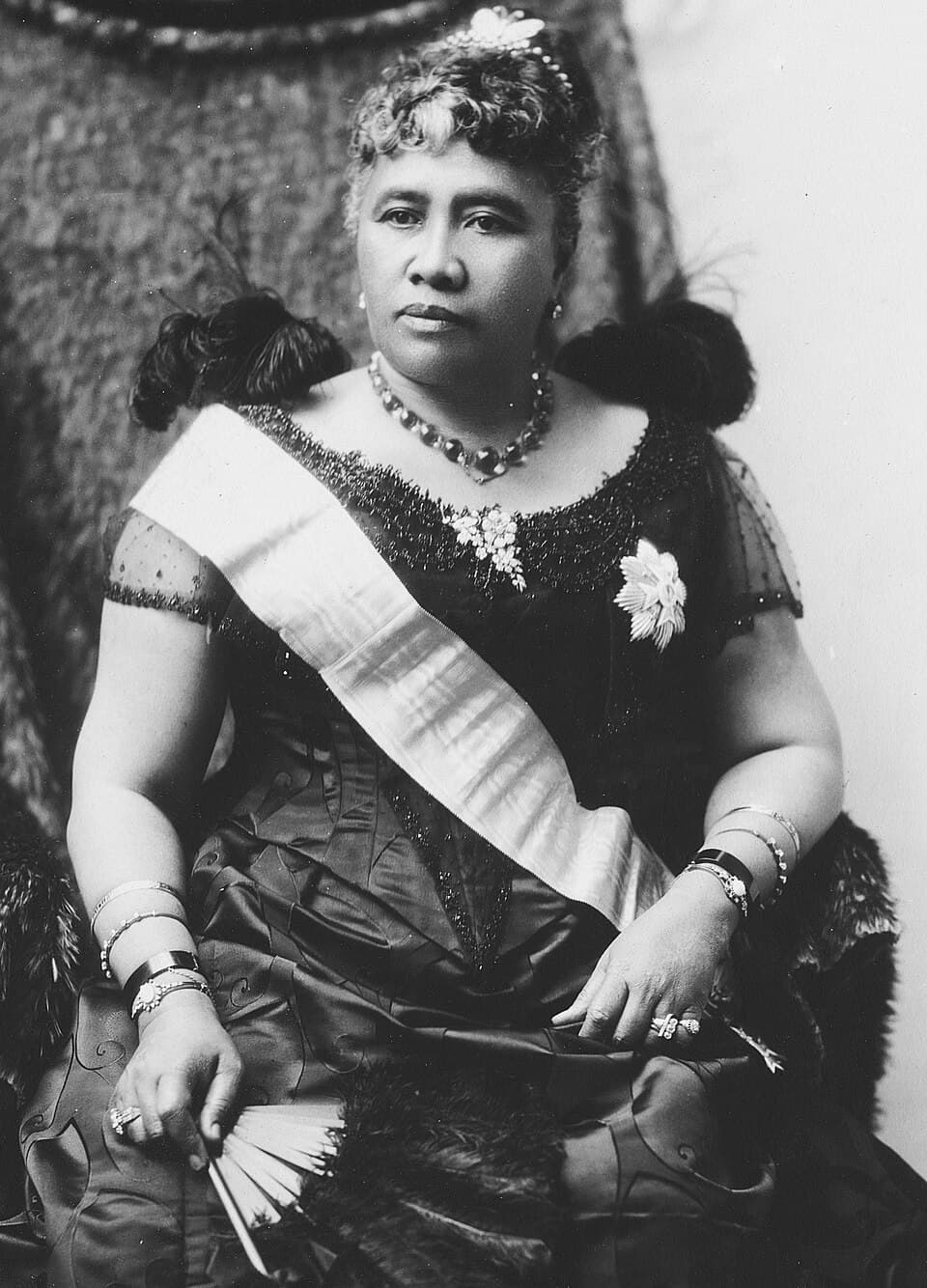
Hawaiian · Politics · Activism
Queen Lili’uokalani
September 2, 1838 – November 11, 1917
Early Life and Background
Queen Liliʻuokalani, born Lydia Liliʻu Loloku Walania Wewehi Kamakaʻeha on September 2, 1838, in Honolulu on the island of Oʻahu, came into the world as a high-ranking member of the Hawaiian aliʻi (nobility).[1][2][3][5][6][7][12] Her parents, Analea Keohokālole and Caesar Kapaʻakea, were influential chiefs and close political allies of the Kamehameha dynasty, which had unified the Hawaiian Islands in the early nineteenth century.[2][5][8][13] Soon after her birth, in keeping with the Hawaiian tradition of hānai—a customary form of adoption intended to solidify alliances and distribute responsibility for child-rearing among chiefly families—Lydia was raised in the household of Abner and Laura Konia Pākī, alongside their daughter, Bernice Pauahi (later Bernice Pauahi Bishop).[1][3][13]
Lydia grew up at a time when the Hawaiian Kingdom was undergoing rapid political, social, and religious transformation. Missionaries from New England had arrived in the 1820s, spreading Christianity and new models of education, while foreign merchants and whaling fleets drew the islands into global trade networks. As part of a generation of aliʻi children groomed for leadership, Lydia attended the Royal School in Honolulu, a boarding school run by American Protestant missionaries specifically for the children of the highest-ranking chiefs.[1][3][8][13] There she received instruction in English language, Christian theology, Western music, literature, and etiquette, while also maintaining her fluency in the Hawaiian language and knowledge of traditional protocols.
Her early education helped her become bicultural in outlook. She played the piano, organ, and guitar, and she composed songs in both Hawaiian and English, foreshadowing her later achievements as a prolific songwriter.[1][3][4][10][13] At the same time, she remained deeply connected to Hawaiian customs and aliʻi responsibilities, learning from elders about genealogy, land stewardship, and the obligations of chiefly rule. These dual influences—missionary schooling and Hawaiian tradition—would shape her political thought, her Christian-inflected sense of justice, and her insistence on the dignity and rights of Native Hawaiians.
Family Connections and Position in the Royal Line
Lydia belonged to a network of aliʻi families intertwined through marriage and political alliance. Her siblings included David Kalākaua, who would later reign as King Kalākaua, and Miriam Likelike, who became a noted patron of the arts and mother of future Princess Kaʻiulani.[2][3][5] The Kapaʻakea–Keohokālole line ranked among the highest chiefly lines, making Lydia a plausible candidate for royal succession even before formal titles were bestowed.
In 1874, after years of shifting dynastic fortunes and the deaths of earlier Kamehameha rulers, her brother David Kalākaua was elected king by the legislature following a contested royal election.[1][2][3] Upon his accession, Lydia was given the title Princess Liliʻuokalani, formalizing her position in the royal family and public life. In 1877, Kalākaua named her heir apparent to the throne, solidifying the expectation that she would one day rule the kingdom.[1][2][3] These appointments positioned her at the center of court politics and national affairs, and they would prove crucial when the monarchy was threatened by foreign interests.
Marriage and Personal Life
As a young woman, Lydia married John Owen Dominis, the American-born son of a sea captain who had settled in Honolulu and became a government official in the Hawaiian Kingdom.[3][8][10][13] Dominis, who eventually served as governor of Oʻahu and Maui and held other important offices, embodied the intertwined nature of Hawaiian and foreign influences in the kingdom’s governance. Their marriage, which lasted until his death in 1891, did not produce biological children. However, Liliʻuokalani participated in the Hawaiian practice of hānai by adopting and fostering several children within her extended family, including her nieces and nephews.[1][3]
The couple lived at Washington Place, a residence in Honolulu that became an important social and political center. The home hosted gatherings of aliʻi, foreign diplomats, and missionaries, giving Liliʻuokalani insight into the priorities and worldviews of the kingdom’s powerful foreign residents. While their marriage has often been described as emotionally distant, it placed her at a crossroads between Native Hawaiian interests and the growing influence of American and European elites.
Regency, Travel, and Public Service
Even before she became queen, Liliʻuokalani played a significant role in public life. In 1881, when King Kalākaua embarked on a landmark world tour to secure labor and maintain diplomatic ties, he appointed Liliʻuokalani as regent to act in his place.[1][2][3][10][13] During his absence she managed state affairs and responded to domestic crises, including a smallpox epidemic in Honolulu. Her firm handling of public health measures and social order earned her respect and demonstrated her administrative ability.
Liliʻuokalani also traveled abroad, gaining first-hand exposure to European courts and political culture. In 1887 she visited Britain and attended Queen Victoria’s Golden Jubilee, observing imperial ceremony and meeting with leaders in London and later in the United States.[3][10] Such experiences deepened her understanding of constitutional monarchy and international diplomacy, reinforcing her belief that Hawaiʻi should be treated as a sovereign equal among nations, not as a subordinate territory.
At home, she showed a consistent interest in education and welfare. In the mid-1880s she was involved in efforts to support schooling for Hawaiian girls, including founding the Liliʻuokalani Educational Society to assist the education of young women of aliʻi background.[1][3] She also supported charitable institutions such as Queen’s Hospital, founded earlier by King Kamehameha IV and Queen Emma, and took an active role in church and community life.[1][4][10]
Political Context: The Bayonet Constitution and Rising Tensions
The political environment in which Liliʻuokalani rose to prominence was shaped by intense conflicts over power and sovereignty. In 1887, a group of predominantly white, pro-business elites—many of them American and European residents with strong economic interests in sugar—forced King Kalākaua at gunpoint to sign what became known as the Bayonet Constitution.[2][3][8][10][14] This constitution drastically limited royal authority, transferred power to a cabinet and legislature dominated by foreign and native-born elites aligned with business interests, and imposed property and citizenship requirements that disenfranchised many Native Hawaiians and Asian residents.
Liliʻuokalani strongly opposed these changes. She saw the constitution as an illegitimate imposition that undermined both the authority of the monarchy and the political rights of her people. The Bayonet Constitution, however, remained in force when she became queen, setting the stage for her later attempt to restore a more equitable and sovereign government.
Accession to the Throne and Early Reign
On January 29, 1891, following King Kalākaua’s death in San Francisco, Liliʻuokalani ascended the throne and became the first and only reigning queen of the Hawaiian Kingdom.[2][3][4][10] She chose the regal name Liliʻuokalani, meaning roughly “the smarting of the royal ones,” a reference that acknowledged both her family’s status and the hardships they had endured.
Her reign began amid political turbulence. The kingdom’s economy faced downturns linked to changes in sugar tariffs and growing dependence on export agriculture controlled by foreign planters. At the same time, Native Hawaiians and many long-term residents objected to the oligarchic structure created by the Bayonet Constitution. Liliʻuokalani quickly signaled her intention to address these grievances. She appointed new cabinet members whom she believed would be more responsive to Hawaiian interests, and she began drafting a new constitution that would restore royal prerogatives and expand suffrage for Native Hawaiians and other disenfranchised subjects.[2][3][8][10][15]
The queen’s efforts alarmed the powerful planter and merchant class, many of whom were American or of American descent and supported eventual annexation to the United States. They interpreted her proposed constitution as a threat to their economic and political dominance and as a challenge to the Bayonet Constitution, which had secured their control.
The Overthrow of the Hawaiian Kingdom
In January 1893, a group of about thirteen men—often referred to as the Committee of Safety and composed largely of American and European businessmen and lawyers, along with a few Hawaiian subjects of American ancestry—organized a coup against the queen.[3][8][10][14] They received crucial backing from the United States minister to Hawaiʻi, John L. Stevens, who ordered U.S. Marines from the cruiser Boston ashore in Honolulu under the pretext of protecting American lives and property.[2][3][8][14]
Although the exact day of the coup is documented as mid-January 1893, the available sources for this project emphasize the year rather than specific day-level detail. What is clear is that Liliʻuokalani, facing the possibility of bloodshed and aware of the limited military support at her disposal, chose not to order armed resistance. Instead, she yielded her authority under protest, explicitly stating that she expected the United States government to investigate the circumstances and restore her to power once it recognized the illegality of the overthrow.[1][2][3][8][10]
The provisional government that replaced her quickly sought annexation to the United States, while the queen appealed to international law and moral authority. The overthrow became a pivotal moment in U.S. imperial history, forming part of a broader pattern of expansion into the Pacific and Caribbean in the late nineteenth century.
Imprisonment and Forced Abdication
In 1895, after supporters of the monarchy launched an unsuccessful armed uprising aiming to restore her to the throne, Liliʻuokalani was arrested by the Republic of Hawaiʻi and charged with misprision of treason.[1][2][3][4][8][10] Held under house arrest in an upstairs room of ʻIolani Palace, she was confined for roughly eight months. During this time she was closely guarded, restricted in her contacts, and subjected to intense political pressure.
Under these circumstances, she ultimately signed a formal abdication in favor of clemency for those who had participated in the rebellion.[1][3] Contemporary accounts and later historians emphasize that her abdication was coerced and that she signed not because she accepted the legitimacy of the Republic, but because she hoped to spare her followers severe punishment, including possible execution. Her imprisonment profoundly affected her health and outlook, yet she continued to assert that the overthrow and the subsequent republic lacked lawful basis.
Resistance to Annexation and Legal Struggles
Although Liliʻuokalani was never restored to the throne, she did not withdraw from public life. When the Republic of Hawaiʻi pursued annexation to the United States, she mounted vigorous opposition. In the mid-1890s, she traveled to Washington, D.C., and met with U.S. officials and sympathetic leaders, arguing that the Hawaiian monarchy had been overthrown illegally and that the majority of Hawaiians opposed annexation.[1][2][3][8][10][14]
In 1897, she participated in an organized campaign that produced the Kūʻē Petitions, in which tens of thousands of Native Hawaiians signed documents opposing annexation.[1][3][14] These petitions were presented to the U.S. Senate as evidence of local resistance. Despite this, the United States annexed Hawaiʻi in 1898 via a joint resolution of Congress (the Newlands Resolution) rather than by treaty, after the outbreak of the Spanish–American War heightened U.S. interest in Hawaiʻi as a strategic naval base.[2][3][8][10]
Liliʻuokalani also pursued legal redress. In 1909 she filed suit against the U.S. government for compensation for the crown lands and assets that had been seized after the overthrow, arguing that they were personal or dynastic property rather than state lands.[2][3][8][10][13] Although U.S. courts ultimately rejected her claim, the case helped articulate legal arguments about the status of Hawaiian sovereignty and property that would reverberate in later discussions about Native Hawaiian rights and federal trust obligations.
Writing, Music, and Cultural Contributions
Beyond her political efforts, Liliʻuokalani left a rich cultural legacy as a writer and composer. She is credited with composing more than 150 songs and chants, many in the Hawaiian language, which combine poetic imagery, personal emotion, and subtle political commentary.[1][3][4][10] Her most famous composition is “Aloha ʻOe”, which has become one of Hawaiʻi’s best-known songs worldwide and is often interpreted as both a love song and a farewell to an independent kingdom.
In 1898, while still contesting the loss of her throne, she published her English-language memoir, Hawaii’s Story by Hawaii’s Queen.[3][10][18] The book provided a detailed narrative of her life, her reign, the overthrow, and her perspective on the political and cultural transformations in Hawaiʻi. It was aimed in part at American and European audiences, seeking to correct what she saw as misrepresentations in the press and to appeal to readers’ sense of justice. The memoir remains a key primary source for historians of the Hawaiian Kingdom, U.S. imperialism, and Indigenous resistance.
Her cultural work extended to support for education, charity, and civic organizations. She backed efforts to promote literacy and formal schooling for Native Hawaiian children and helped raise funds for medical institutions and churches. Through these activities, she modeled a form of aliʻi leadership that emphasized service, cultural preservation, and moral responsibility.
Philanthropy and the Liliʻuokalani Trust
In the early twentieth century, Liliʻuokalani turned increasing attention to philanthropy, particularly for vulnerable children. She established what would later be known as the Queen Liliʻuokalani Trust, an institution dedicated to the welfare of orphaned and destitute Native Hawaiian children.[1][2][3][4][6] Although the founding is generally dated to around 1900 in secondary sources rather than tied to a specific day for the purposes of this profile, the trust represented a strategic use of her remaining personal resources to sustain her people into the future.
She also made significant land gifts for public purposes. On one of her later birthdays, she donated property near Waikahalulu Stream in Honolulu that became the Liliʻuokalani Botanical Garden, preserving green space for the community and honoring her long-standing commitment to the land.[1][3] These philanthropic actions reflected a broader aliʻi tradition of endowing schools, hospitals, and trusts (such as the Bernice Pauahi Bishop Estate) to secure Native Hawaiian welfare amid sweeping political change.
Later Life in Territorial Hawaiʻi
After annexation, Liliʻuokalani lived in a Hawaiʻi that had been transformed into a U.S. territory. Although she held no official political power, she remained a figure of considerable public interest and affection among many Hawaiians and others. She continued to receive visitors at her residence and occasionally appeared at public events, where she was often greeted as “our queen” by Native Hawaiians who considered her their rightful sovereign.[1][3][4][7]
Her relationship with U.S. authorities was complex. On the one hand, she sought to safeguard what remained of her personal assets and to secure recognition of her rights and dignity. On the other, she consistently refused to acquiesce to the narrative that the overthrow or annexation had been just. Yet she adopted a strategy of peaceful advocacy, combining legal petitions, published writings, and symbolic gestures—such as declining to attend the annexation ceremony in 1898 because she could not bear to witness the lowering of the Hawaiian flag.[1][3][4][14]
In her later years, Liliʻuokalani’s health declined following a stroke, but she remained mentally engaged and spiritually active. She was a devoted member of her church and a respected elder stateswoman whose memory and counsel were sought by younger activists and cultural leaders.
Death
Queen Liliʻuokalani died on November 11, 1917, in Honolulu, at the age of seventy-nine, reportedly from complications related to a stroke.[1][2][3][7][9][13] Her death marked the passing of the last reigning monarch of Hawaiʻi. Funeral ceremonies incorporated both Christian and Hawaiian royal traditions, and her body lay in state at ʻIolani Palace, where mourners from across the islands came to pay their respects. The procession and burial underscored her enduring status as a beloved aliʻi and symbol of the Hawaiian nation.
Although she left no biological heirs, the institutions she founded, particularly the Queen Liliʻuokalani Trust, carried forward her legacy of care for Native Hawaiian children and families. Her writings and musical compositions also lived on, reinforcing her multifaceted role as political leader, cultural figure, and chronicler of her people’s struggles.
Legacy and Historical Impact
Liliʻuokalani occupies a central place in the history of Hawaiʻi and in broader discussions of imperialism, Indigenous sovereignty, and women’s leadership. As the first and only queen regnant of the Hawaiian Kingdom, she broke gender barriers within her own society while navigating patriarchal power structures at home and abroad.[2][3][4][10][15] Her insistence on drafting a new constitution, expanding Native Hawaiian political rights, and resisting annexation made her a key figure in the global history of anticolonial resistance.
Her life also illuminates the complexities of cross-cultural encounters in the nineteenth century. Educated in a missionary-run school and fluent in English, she engaged deeply with Western literature, Christianity, and constitutionalism. Yet she remained firmly anchored in Hawaiian values, language, and aliʻi traditions. This dual identity enabled her to advocate for her people in international forums, but it also placed her at the mercy of foreign powers that did not always honor their stated principles of law and self-determination.
Historians and activists today often highlight her nonviolent resistance and moral authority. By choosing not to shed blood during the overthrow, Liliʻuokalani preserved lives, even as she sacrificed her throne. Her written protest at the time of her overthrow and her later autobiography laid a documentary foundation for subsequent critiques of U.S. actions in Hawaiʻi. In 1993, on the centennial of the overthrow, the United States formally acknowledged that the overthrow had been illegal and apologized for its role, a development that many connect back to the queen’s careful documentation and principled stance.
In Hawaiian cultural revival movements of the twentieth and twenty-first centuries, Liliʻuokalani’s music, writings, and image serve as powerful symbols of ʻonipaʻa—steadfastness. Schools, scholarships, parks, and cultural programs bear her name, while the Queen Liliʻuokalani Trust and other aliʻi-founded institutions continue to support Native Hawaiian communities. Her story is taught in classrooms and commemorated in public art, theatre, and film, including documentaries that emphasize her as both a political leader and a gifted artist.[1][3][4][11][14]
As a historical figure, Liliʻuokalani stands at the intersection of multiple themes of women’s history: she was a female sovereign in a male-dominated world; a political actor whose authority was undermined by foreign imperial designs; a writer who used the printed word to contest dominant narratives; and a philanthropist who invested her diminished resources in the welfare of vulnerable children. For scholars, activists, and community members alike, she remains a touchstone for thinking about justice, sovereignty, and the responsibilities of leadership.
Dated achievements
3 indexed.
- Sep021838Politics
Birth of Liliʻuokalani
Born at her family home in Honolulu, Hawaii, Liliʻuokalani was a future monarch.
View details Lili'uokalani - Britannica - Jan291891Politics
Becomes Queen of Hawaiʻi
Liliʻuokalani takes the oath of office to become the first and only reigning queen of Hawaii.