← All women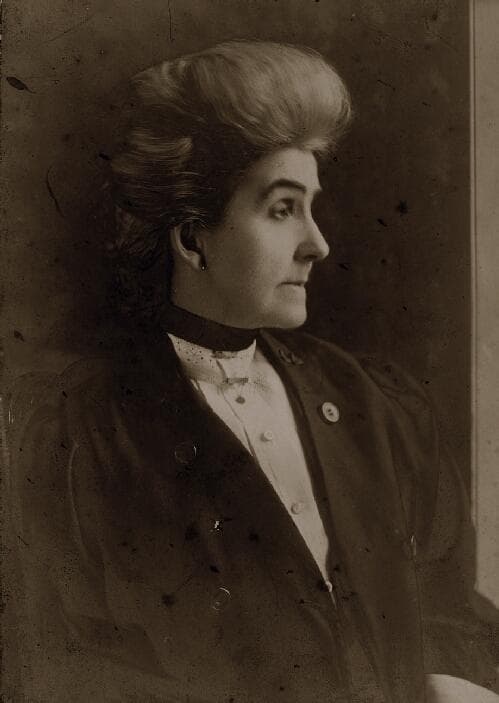
American · Law · Activism
Phoebe Couzins
September 8, 1842 – December 6, 1913
Early Life and Background
Phoebe Wilson Couzins (also spelled Phœbe) was born on 8 September 1842 in St. Louis, Missouri, the daughter of John Edward Decker Couzins and Adaline Weston Couzins.[1][3] Her father, of French Huguenot descent, became a prominent civic figure in St. Louis, eventually serving as city marshal and later as a U.S. marshal for the Eastern District of Missouri.[1][3] Her mother, of English ancestry, was a notable reformer who helped organize the Western Sanitary Commission, an agency that provided care and supplies for wounded soldiers during the American Civil War.[3][7]
Raised in a household deeply engaged in public service, Phoebe absorbed examples of women’s active participation in civic life that were unusual for her era. During the Civil War she, like her mother, was involved with the Ladies’ Union Aid Society and relief activities, tending to soldiers and refugees and assisting with humanitarian work in and around St. Louis.[7][6] These experiences exposed her to the suffering and dislocation of war and to the emerging idea that women’s moral authority could extend into public and political spheres.
Little is known in detail about her early formal education, but sources indicate that she received enough schooling to qualify for advanced study and that she developed strong oratorical skills at a young age.[2][9] St. Louis in the mid‑nineteenth century was a bustling river city, marked by commercial growth, immigration, and intense political conflict over slavery and union. Growing up amid these tensions, Phoebe encountered debates over citizenship and rights that would later shape her interest in law and suffrage.
Path to Law and Early Activism
After the Civil War, Couzins became involved in organized women’s rights activism in St. Louis. She joined the St. Louis Woman Suffrage Association, where she quickly became known as a capable public speaker.[3][7] Her speeches addressed women’s political rights, the need for legal reform, and broader questions of social justice.
Her emerging activism coincided with national debates over the Fourteenth and Fifteenth Amendments and the status of women as citizens. By 1869 she had attended the American Equal Rights Association convention as a delegate, aligning herself with leaders such as Susan B. Anthony and Elizabeth Cady Stanton who sought universal suffrage regardless of race or sex.[3][14] She later participated in the formation of the National Woman Suffrage Association (NWSA), helping to promote the cause through lectures and organizational work.[14]
At the same time, Couzins began to see law as a crucial tool for advancing women’s rights. In 1868 she petitioned Washington University in St. Louis to open its law school to women, pressing the case for coeducation at a time when almost all U.S. law schools excluded women.[9][10] Her petition argued that women, as citizens and wage earners, needed access to legal training to protect their interests and to participate fully in public life. The university accepted her plea.
Legal Education and Admission to the Bar
On 11 May 1869, Couzins was formally admitted to the Washington University School of Law, becoming, along with Lemma Barkeloo, one of the nation’s first women law students.[9][10] Their enrollment made Washington University the first law school in the United States to open its doors to women, a milestone in the history of legal education.
As a student, Couzins studied the standard nineteenth‑century curriculum, including common law, equity, constitutional law, and practice. She did so in classrooms dominated by male students and professors who were initially skeptical about women’s presence in the profession.[9][10] Her persistence and strong academic performance helped undermine assumptions about women’s incapacity for rigorous legal study.
On 31 May 1871, Phoebe Couzins graduated from Washington University School of Law, becoming the first woman graduate of the law school and the first woman graduate of Washington University.[9][15] This achievement placed her among the earliest women in the United States to hold a formal law degree, at a time when figures such as Arabella Mansfield and Myra Bradwell were challenging legal barriers through examination or litigation rather than traditional law‑school pathways.
Soon after graduation, on 14 June 1871, Couzins was admitted to the Missouri bar.[9][1] Later scholarship identifies her as the second woman lawyer in Missouri and the third or fourth licensed woman attorney in the United States.[1][9] Contemporary sources, including her New York Times obituary, sometimes credited her as the "first woman lawyer in the United States," a reflection of both admiration and limited awareness of other pioneers.[1] In any case, her admission required passing examinations and facing an all‑male bar and judiciary at a time when women’s professional competence was widely questioned.
During the early 1870s, Couzins extended her legal credentials beyond Missouri. Sources indicate that she was admitted to the bar in Arkansas, Kansas, and Dakota Territory, and that she became the first woman admitted to the Arkansas bar.[3][9] These additional admissions, though not precisely dated in surviving records, demonstrated her determination to build a multi‑jurisdictional practice and to prove that women could be licensed in diverse legal settings.
First Woman Admitted to the Utah Bar
In 1872, Couzins traveled west, combining suffrage lecturing with efforts to expand her legal practice. On 1 September 1872, in Salt Lake City, she was formally admitted to the Utah Territory bar.[6][9] At the ceremony, Governor George Lemuel Woods introduced her to the assembled lawyers with the phrase, "Gentlemen, I present to you our sister at the bar," a declaration that underscored both the novelty and the official endorsement of her admission.[6]
This made Couzins the first woman admitted to the Utah bar.[6][9] Her presence in Utah was closely linked to the territory’s pioneering grant of suffrage to women in 1870, and she became a vocal supporter of maintaining women’s voting rights in the face of later federal attempts to restrict them. As a lawyer and activist, she linked local struggles in Utah to national debates about constitutional rights and the role of women in public life.
Suffrage Leadership and Public Speaking
Throughout the 1870s and early 1880s, Phoebe Couzins balanced her emergent legal career with extensive public lecturing. She joined the National Woman Suffrage Association in 1871 and remained a prominent figure in suffrage circles.[3] She spoke across the country on topics such as women’s right to vote, legal reforms affecting married women and property, and the broader justice of gender equality.
One important episode in her suffrage career occurred on 23 January 1882, when she addressed the NWSA convention in Washington, D.C.[3][6] There she spoke about Utah women’s voting rights and was nominated to petition the Utah territorial commissioner to preserve women’s suffrage.[3] This role recognized her as an expert on western suffrage and as someone who could deploy both legal and political argument in defense of women’s rights.
Couzins’s activism extended beyond suffrage into temperance and broader reform. She often aligned with contemporaries such as Susan B. Anthony and Elizabeth Cady Stanton, and she appeared in the biographical collection "Woman of the Century" (1893), which highlighted notable American women in diverse fields.[2] Her profile in that volume emphasized her legal achievements and her service as a United States marshal, noting that she was the first woman appointed to a federal executive office.[2]
Federal Marshal Service and Barrier-Breaking "Firsts"
Phoebe Couzins’s most widely recognized "firsts" came through her service in the U.S. marshal system. In 1884, President Chester A. Arthur appointed her father, John E. D. Couzins, as U.S. marshal for the Eastern District of Missouri.[4][12] He in turn named Phoebe as a deputy U.S. marshal, and on 17 March 1884 she took up the role.[4][12]
This appointment made Couzins the first woman deputy U.S. marshal and one of the earliest women in any federal law‑enforcement office.[4][12] As deputy marshal, she assisted in serving writs, overseeing courtroom security, and performing duties that required both legal knowledge and administrative competence. Her presence in the marshal’s office generated public interest and some controversy, illustrating anxieties about women exercising coercive authority.
Upon her father’s death in 1887, the question of succession to the marshal’s office became politically charged. On 9 February 1887, President Grover Cleveland appointed Phoebe Couzins as interim United States marshal for the Eastern District of Missouri.[5][9] This made her the first woman U.S. marshal and, as "Woman of the Century" and later accounts emphasize, the first woman appointed to a federal executive office.[2][9]
Couzins’s tenure as marshal lasted approximately two months, after which she was replaced by a male appointee.[4][12] Her appointment sparked criticism from some quarters, who questioned the propriety of a woman heading a federal law‑enforcement agency, but it also inspired admiration among reformers who saw it as evidence that women could lead in governmental roles.[5][11] Although brief, her service stands as a significant milestone in women’s political and administrative history and foreshadowed later appointments of women to prominent federal positions.
Political Ambitions and Public Roles
Couzins continued to seek and occupy public roles in the late 1880s and early 1890s. In 1887 she made an unusual bid for elective office by running for governor of Missouri, highlighting her belief that women should participate directly in partisan politics and not merely lobby from the sidelines.[3] Although her campaign did not succeed and details are sparse, the effort itself was remarkable for the period.
In 1890, she was appointed as a delegate to the Board of Lady Managers of the World’s Columbian Exposition in Chicago and briefly served as the board’s secretary.[3] This board, created by Congress, was an unprecedented official body of women charged with overseeing women’s exhibits and participation in the 1893 world’s fair. Couzins’s appointment recognized her national stature and extended her influence into cultural and administrative realms.
Around 1891, she relocated to Chicago, continuing her work as a lecturer and political figure.[3] In 1894, she met fellow suffrage leader Emmeline B. Wells in Chicago, further cementing her ties to western and Mormon suffrage networks.[3] She also delivered a series of lectures in Utah in 1895, drawing on her earlier status as the territory’s first woman lawyer and reinforcing the connection between professional achievements and suffrage advocacy.[3][6]
Renunciation of Suffrage and Work for the Brewers
Despite her earlier prominence as a suffrage advocate, Couzins’s career took a controversial turn in the late 1890s. By this time she faced financial difficulties and health problems that made steady employment challenging.[7] In a shifting political landscape, she reassessed her alliances and sources of income.
On 12 February 1897, she publicly renounced woman suffrage and began working as a lobbyist and lecturer for the United Brewers’ Association.[3] The brewing industry, alarmed by the growing strength of the temperance and prohibition movements, recruited speakers who could argue that restrictions on alcohol would harm economic interests and personal liberties. Couzins, with her reputation as a former suffrage leader and her formidable speaking skills, became a conspicuous voice in this campaign.
Her reversal stunned former allies in the suffrage movement, who had long counted on her as a supporter of women’s political rights and temperance. Now she appeared on platforms opposing suffrage and criticizing prohibition advocates, including some of her old colleagues.[3][7] Historians have suggested that economic necessity and personal disillusionment played major roles in this shift, though the precise mix of motives remains uncertain.
Couzins’s anti‑suffrage stance illustrates the complexity of reform careers in the nineteenth century. It shows that women activists were not monolithic and that changing political and economic circumstances could lead even pioneering figures to adopt positions at odds with their earlier commitments. Her case has become a subject of scholarly interest as an example of internal dissent within the women’s movement.
Later Life and Decline
In the years after her work for the United Brewers’ Association began, Phoebe Couzins’s fortunes continued to decline. She lost her position with the brewers when she was around 68 years old, and her deteriorating health further hindered her ability to work.[7] Without stable income or institutional support, she slipped into poverty.
Accounts from St. Louis historical sources describe her later life as marked by isolation and financial hardship, despite the fame she had enjoyed in earlier decades.[7][8] The disconnect between her earlier barrier‑breaking achievements and her impoverished old age reflects a broader pattern in women’s history: many pioneering women lacked pensions, family wealth, or institutional recognition sufficient to sustain them in old age.
Death
Phoebe Wilson Couzins died on 6 December 1913 in St. Louis.[1][3][8] She was about seventy‑one years old. She had lived her final years in poverty, a stark contrast to the prominent public roles she had occupied as a lawyer, marshal, and suffrage leader.
Her death drew renewed attention to her career through obituaries and memorial notices. A New York Times obituary referred to her as the "first woman lawyer in the United States" and the "first woman U.S. marshal," echoing the popular perception of her as a singular pioneer.[1] While later scholarship has clarified that she was one among several early women attorneys and that others, such as Arabella Mansfield, were licensed earlier, the obituary testifies to the impact her life had made on public memory.
Legacy and Historical Impact
Phoebe Couzins’s legacy spans several domains: law, federal administration, and women’s rights activism.
- She was among the first women law students in the United States and the first woman law graduate at Washington University, helping to establish coeducation in legal education.[9][10]
- She became one of the earliest licensed women attorneys in the country, admitted to the bars of Missouri, Arkansas, Utah, Kansas, and Dakota Territory, including serving as the first woman admitted in Arkansas and Utah.[3][9]
- She broke new ground in federal law‑enforcement as the first woman deputy U.S. marshal and later as the first woman United States marshal, widely recognized as the first woman appointed to a federal executive office.[2][4][5][9][13]
- She played an important role in the National Woman Suffrage Association, speaking at major conventions and advocating for women’s voting rights in Utah and across the nation.[3][6][14]
- Her appointment to the Board of Lady Managers of the World’s Columbian Exposition integrated women’s leadership into a major national cultural event.[3]
At the same time, her later renunciation of suffrage and alignment with the United Brewers’ Association complicate her legacy. Historians have noted that her career illustrates both the possibilities and the vulnerabilities of pioneering women’s lives: she achieved remarkable "firsts," but faced economic precarity and political isolation later on.[3][7][9]
Modern scholarship, including articles in the Washington University Law Review and law and policy journals, has sought to re‑situate Couzins within a broader network of early women lawyers, examining her life alongside that of Lemma Barkeloo and others.[9][10] Archival collections, such as those of the Missouri Historical Society, preserve materials related to her lectures and activities, enabling ongoing research into her impact.[8]
In contemporary cultural memory, she appears in museum exhibits, local histories, and even commercial products named in her honor, testifying to her enduring symbolic status as a St. Louis pioneer in law and women’s rights.[11][16] For women’s‑history scholarship, Phoebe Couzins remains a key figure for understanding the intersection of gender, law, and federal power in the late nineteenth century.
Dated achievements
11 indexed.
- Sep081842Law
Birth of Phoebe Wilson Couzins
Phoebe Wilson Couzins was born in St. Louis, Missouri, on September 8, 1842.
View details Phoebe Wilson Couzins Biography - May111869Law
Among the first women law students at Washington University
Couzins was admitted to law school in St. Louis, a pioneering moment for women in U.S. legal education.