← All women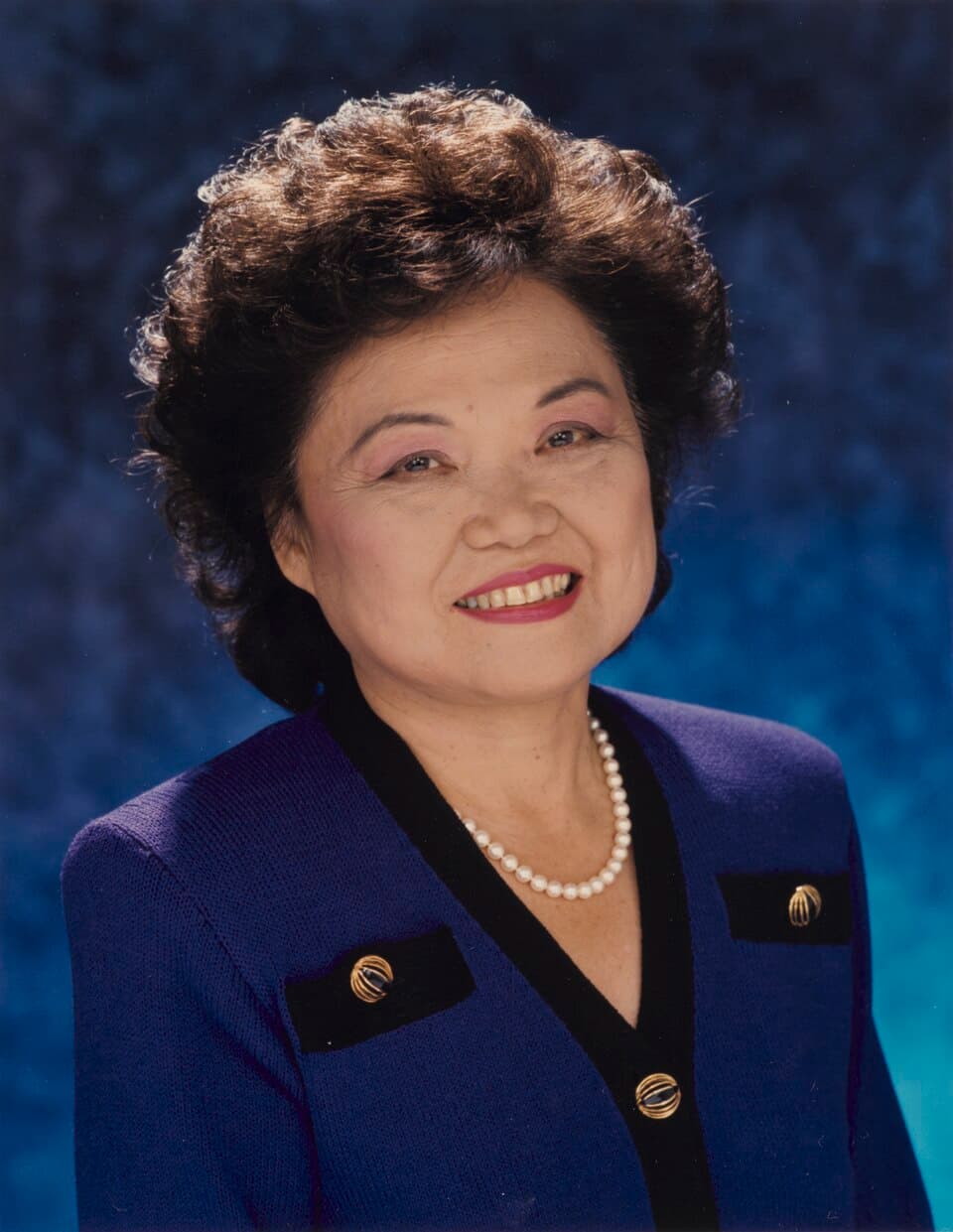
American · Politics · Activism
Patsy Mink
December 6, 1927 – September 8, 2002
Early Life and Background
Patsy Matsu Takemoto Mink was born on December 6, 1927, in Paia, a plantation town on the island of Maui in the Territory of Hawaii.[1][4][10] Her parents, Suematsu and Mitama Takemoto, were Nisei (second‑generation Japanese Americans), themselves children of migrant laborers brought from Japan to work in Hawaii’s sugarcane fields.[1][10] Growing up in this multiethnic, working‑class environment exposed Mink to the racial and economic hierarchies that structured territorial society.
Her father worked his way from plantation labor to a position as a land surveyor and eventually an administrator for the plantation company, while her mother contributed to the household economy and community life.[1][10] Despite their upward mobility, the family continued to encounter racially segregated institutions and social clubs. Mink later recalled that she first became aware of discrimination when her family was barred from certain facilities because they were not white.[1][9]
Mink attended Maui High School, where she excelled academically and became a student leader. During the mid‑1940s she was elected president of the student body, often cited as the first girl to hold that position at the school, an early indication of her willingness to cross gender barriers.[9] The experience of being a young woman in leadership in a conservative environment helped shape her confidence and political skills.
After graduating from high school, she enrolled at the University of Hawaii, where she initially studied chemistry and zoology.[3][4] World War II and its aftermath deeply affected her formative years. Although mass incarceration policies on the mainland did not apply in the same way to Japanese Americans in Hawaii, wartime suspicion and surveillance still marked everyday life. Mink’s awareness of the vulnerability of minority rights during crises later informed her civil‑liberties stance in Congress.
Education and Early Career
Mink earned her bachelor’s degree from the University of Hawaii in 1948, majoring in zoology and chemistry.[3] Aspiring to become a doctor, she applied to numerous medical schools on the mainland. All rejected her, citing a lack of seats for women or simply refusing to consider female applicants.[3][4][12] This systematic exclusion, based purely on gender, became a defining experience.
Denied a medical career, Mink turned to law, reasoning that legal training would enable her to challenge the discrimination she had encountered.[3][10] She was accepted to the University of Chicago Law School, one of the few elite programs willing to admit women and minorities at that time. She moved to Chicago and completed her Juris Doctor degree in 1951.[3][4] In law school she encountered a broader national context for civil rights and became increasingly committed to using legal tools to advance equality.
In 1951 she married John Francis Mink, a graduate student in engineering.[2][3] The couple’s partnership would prove enduring; John Mink supported her political ambitions and later managed aspects of her campaigns. Their daughter, Gwendolyn (Gwen) Mink, born in 1952, grew up to become a feminist scholar and policy advocate, reflecting the family’s deep engagement with issues of gender and justice.[2][12]
After law school, the Minks returned to Hawaii. Patsy soon learned that major Honolulu law firms were unwilling to hire her because she was a woman, and in some cases because of her race.[3][4] Rather than accept defeat, she opened her own law office, making her the first woman of Japanese‑American ancestry to practice law in Hawaii, following her admission to the territorial bar in 1953.[3][14] Her practice served ordinary residents and gave her firsthand insight into how law and bureaucracy affected everyday lives.
Entry into Politics in Hawaii
Mink’s frustration with structural inequality pushed her toward organized politics. In the early 1950s she became active in Democratic Party circles and helped to found the Oahu Young Democrats in 1954, a group that mobilized younger voters and future leaders in support of reform‑oriented policies.[14] Through this work she honed her skills as an organizer and public speaker.
In 1956, Mink ran for and won a seat in the Hawaii Territorial House of Representatives, becoming the first Japanese American woman in that body.[3][14] Two years later, in 1958, she won election to the Hawaii Territorial Senate, further elevating her profile.[3][13] As a legislator, she focused on issues such as housing, labor rights, and education, reflecting her plantation upbringing and legal experience.
Hawaii’s transition to statehood in 1959 reshaped the political landscape. Mink continued to serve, winning election in the newly formed state legislature—sources note her service in both the state House and state Senate during this period.[3][4] The state’s emerging Democratic coalition, powered by labor unions and ethnic minorities, aligned with her commitments to social and economic justice. Her legislative work in Honolulu allowed her to build coalitions and master parliamentary procedure, skills that would prove essential on the national stage.
Path to Congress
By the early 1960s, Mink had established herself as one of Hawaii’s most capable and outspoken legislators. In 1964 she sought national office, running for the U.S. House of Representatives from Hawaii’s 2nd District. Her campaign emphasized civil rights, education funding, and programs for low‑income families, as well as a pragmatic approach to economic development in the new state.[1][3]
On November 3, 1964, Mink was elected to the House, becoming the first woman of color and the first Asian American woman elected to the U.S. Congress.[3][4] She took office on January 4, 1965, when she was sworn in as a member of the 89th Congress.[3][15] Her victory marked a turning point in the representation of women and minorities in federal government. For the first time, a Japanese American woman from a distant Pacific state had a vote in the national legislature.
Mink’s initial congressional service lasted from 1965 to 1977, representing first an at‑large district and later the 2nd District after reapportionment.[3][4][12] During this period she became known for her detailed command of policy and her readiness to challenge both Republican and Democratic administrations when she believed civil rights or social welfare were at stake.
Legislative Achievements and Major Works
Mink’s most celebrated legislative achievement is her central role in Title IX of the Education Amendments of 1972. Working with Representative Edith Green and others on the House Education and Labor Committee, she helped draft and push forward a provision prohibiting sex discrimination in any education program receiving federal funding.[4][8][9] President Richard Nixon signed Title IX into law on June 23, 1972.[4][9]
Title IX had far‑reaching consequences. It required schools and universities to provide equal opportunities to women in admissions, academics, and athletics. Over time, it dramatically increased the number of women attending professional schools and participating in organized sports. Mink consistently defended the law against attempts to narrow its scope, arguing that equal access to education was fundamental to democracy.[4][8]
In addition to Title IX, Mink sponsored or co‑sponsored other landmark education and equity measures. She was instrumental in the Early Childhood Education Act, which sought to expand educational opportunities for young children, particularly from disadvantaged backgrounds.[1] She also played a major role in the Women’s Educational Equity Act (WEEA) of 1974, designed to provide grants and support for programs addressing bias and discrimination in educational materials and practices.[1][10][12] WEEA complemented Title IX by targeting the cultural and curricular dimensions of gender inequality.
Mink’s legislative interests extended beyond education. She was an outspoken critic of the Vietnam War, challenging the Johnson and Nixon administrations on issues of military escalation and civil liberties.[3][10] Later, she opposed the Gulf War, maintaining a consistent anti‑war stance rooted in concerns about civilian casualties and constitutional checks on executive power.[11]
She championed environmental protection, working on energy policy and conservation issues with both regional and national implications.[3] Mink also advocated for immigrant rights, including more humane policies for undocumented families and fair treatment for non‑citizens, and she pushed for programs supporting welfare recipients, childcare, and health services for low‑income communities.[3][11]
On judicial issues, Mink played a notable role in opposing the Supreme Court nomination of G. Harrold Carswell in 1970, criticizing his record on civil rights and competence.[11] The Senate ultimately rejected Carswell, clearing the way for the nomination of Harry Blackmun, who would author the Roe v. Wade decision. Mink’s stance contributed to a broader coalition insisting that lifetime judicial appointments reflect commitments to equality and constitutional rights.
Presidential Campaign and National Profile
In the early 1970s, Mink took the unusual step of seeking the presidency. Running as an anti‑war candidate, she entered several Democratic presidential primaries, including the Oregon primary on May 23, 1974, where she appeared on the ballot.[1] This campaign made her the first Asian American to run for U.S. president and the first Asian American woman presidential candidate.[1]
Her platform emphasized ending the Vietnam War, protecting civil liberties, and advancing women’s rights. While her candidacy was widely viewed as symbolic, it expanded the national conversation about who was qualified to seek the presidency. Mink herself framed the run as an effort to ensure that anti‑war and feminist perspectives were represented within the Democratic Party.
The campaign strengthened her visibility beyond Hawaii and underscored her willingness to challenge established political structures. Although she did not secure delegates or the nomination, her status as a pioneering woman of color presidential candidate anticipated later campaigns by Shirley Chisholm, Carol Moseley Braun, and other women of color who sought executive office.
Later Congressional Service
After losing a 1976 Senate race, Mink left Congress in 1977 and engaged in other forms of public service. She served on the Honolulu city council and held appointments in the Carter administration, including positions related to education and civil rights.[3][12] These roles allowed her to continue shaping policy outside the national legislature.
In 1990, Mink returned to the U.S. House of Representatives, winning election again from Hawaii’s 2nd District.[3][4][13] Her second congressional tenure lasted until her death in 2002. During these years she continued to advocate for education, civil rights, and social welfare, and she became a senior figure within the Democratic caucus.
She remained a vocal critic of punitive welfare reforms and immigration restrictions, arguing that policies should be evaluated by their impact on vulnerable communities.[3][11] She also opposed U.S. military interventions that she believed lacked clear objectives or adequate consideration of long‑term consequences. While some positions put her at odds with party leadership, they reinforced her reputation as a principled, independent legislator.
Awards, Honors, and Institutional Recognition
Mink received numerous honors reflecting her impact on women’s rights and public policy. Following her death, Congress passed legislation renaming Title IX the Patsy T. Mink Equal Opportunity in Education Act through Public Law 107‑255, enacted on October 29, 2002.[4][1] This placed her name directly in the federal statute governing sex equality in education.
In 2014, she was posthumously inducted into the National Women’s Hall of Fame in Seneca Falls, New York, recognizing her as a legislative trailblazer whose work changed the lives of millions of women and girls.[3] That same year, on November 24, she was awarded the Presidential Medal of Freedom, the United States’ highest civilian honor, by President Barack Obama, acknowledging her contributions to civil rights and education.[5][11]
Her name appears on schools, athletic events, and scholarship programs. The Patsy Takemoto Mink Education Foundation for Low‑Income Women and Children, established in 2003, provides grants to support education for women who face economic barriers, directly extending her legislative priorities into philanthropic work.[10][11]
Personal Life
Mink’s marriage to John Francis Mink remained a central source of support throughout her political career.[2][3] John, trained as an engineer, often assisted behind the scenes with campaign logistics and financial management, allowing Patsy to concentrate on policy and public communication. Their daughter, Gwen Mink, pursued an academic career in political science and women’s studies, writing extensively about welfare reform and feminist politics.[2][12] The family’s trajectory illustrates how personal and professional commitments to justice can reinforce one another across generations.
Mink balanced her demanding political life with family responsibilities, often bringing her daughter to campaign events and maintaining close ties to relatives in Hawaii. She drew strength from community networks formed in the islands’ multiethnic society. Observers frequently remarked on her ability to merge warmth and empathy with rigorous policy analysis, a combination rooted in her dual roles as mother and public servant.[3][10]
Legacy and Historical Impact
Patsy Mink’s legacy centers on her role as a pioneer for women of color and Asian Americans in U.S. politics and as a principal architect of modern education and gender‑equity law. As the first woman of color and first Asian American woman elected to Congress, she expanded the boundaries of political representation and demonstrated that women of color could successfully navigate and shape national institutions.[3][4][13]
Her authorship and defense of Title IX permanently transformed American education. Generations of women have benefited from increased access to collegiate sports, professional schools, and academic programs that were previously closed or hostile to them. Scholars and activists widely credit Title IX with reshaping cultural expectations about women’s capabilities and opportunities.[4][8][9]
Mink’s broader legislative record—covering early childhood education, women’s educational equity, environmental protection, immigrant rights, welfare policy, and judicial nominations—illustrates a comprehensive approach to social justice. She consistently framed her work in terms of ensuring that the benefits of democracy extend to those historically excluded: women, minorities, children, and low‑income families.[3][11]
Her anti‑war positions, though sometimes controversial, underscore the importance of dissent within democratic institutions. By challenging administrations of both parties on military intervention and civil liberties, she modeled a form of legislative leadership grounded in principle rather than partisan expediency.[10][11]
In historical memory, Mink is increasingly recognized not only as the "mother" or "major mover" of Title IX but also as a central figure in the broader feminist and civil‑rights movements of the late 20th century.[3][8][9] Educational institutions, museums, and digital archives now highlight her story to illustrate how policy work inside government is essential to achieving lasting equality.
Later Life and Death
In her final years, Mink continued to serve in Congress and remained active in legislative debates. She won renomination for another term in 2002, but her health declined due to viral pneumonia. On September 8, 2002, she died in Honolulu at age 74.[4][10][12] Despite her death, she posthumously won the general election for her House seat, underscoring the depth of support she enjoyed among constituents.[13]
In the months that followed, Congress honored her by renaming Title IX, and organizations and family members moved to institutionalize her legacy through foundations and educational programs.[4][10][11] Her death marked the end of an extraordinary career but also catalyzed renewed attention to the importance of protecting and expanding the equal‑opportunity laws she had helped create.
Today, Patsy Takemoto Mink is widely regarded as one of the most influential public servants of her generation. Her life demonstrates how personal experiences of discrimination can be transformed into powerful legislative tools for social change, and her work continues to shape the opportunities available to women and girls throughout the United States.[3][4][8]
Dated achievements
11 indexed.
- Dec061927Politics
Birth of Patsy Mink
Patsy Matsu Takemoto Mink was born in Paia, Maui, Territory of Hawaii.
View details Britannica: Patsy Takemoto Mink Biography - Jun271953Law
First Japanese American woman admitted to the Hawaii bar
Patsy Mink became the first Japanese American woman admitted to the Hawaii territorial bar.