← All women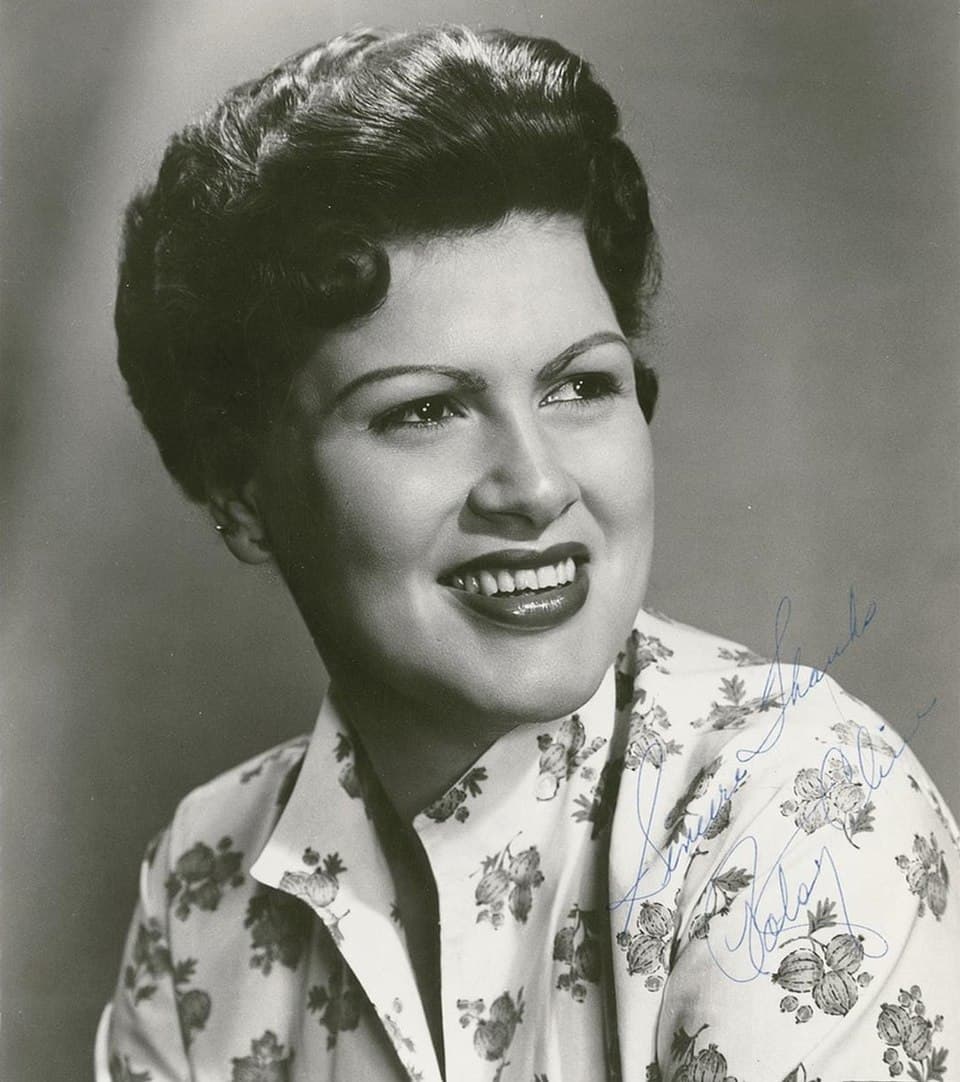
American · Arts
Patsy Cline
September 8, 1932 – March 5, 1963
Early Life and Background
Patsy Cline, born Virginia Patterson Hensley on September 8, 1932, in Winchester, Virginia, grew up in a working-class family during the Great Depression.[1][2][5] Her father, Hensley, was a blacksmith and sometimes factory worker, and her mother, Hilda (often called "Ginny"), worked various jobs to keep the household afloat.[1][5] Cline’s childhood was marked by financial hardship and frequent moves around the Shenandoah Valley, experiences that forged her resilience and deeply informed the emotional intensity of her later singing.[5][6]
From an early age, Cline showed a strong interest in music. She reportedly began singing in her local Baptist church and listening obsessively to radio broadcasts that featured country, pop, and big-band music.[1][5] Influenced by stars such as Hank Williams, Kitty Wells, and pop vocalists of the era, she developed a powerful voice with a distinctive throaty timbre. As a child and teenager she also learned to tap dance and perform on local stages, signaling an early aptitude for show business.[1][9]
Cline’s formal education ended early. Around sixteen, she left high school to help support her family, taking jobs in a poultry plant and as a soda fountain clerk while continuing to seek singing opportunities.[5][6] This decision reflected both economic necessity and her determination to build a career in music, despite the limited pathways available to young women in the 1940s and early 1950s entertainment industry.
Career Beginnings and Development
Cline’s local career began in earnest when she started winning amateur contests and appearing on Winchester radio station WINC, singing on the program of country disc jockey Joltin’ Jim McCoy.[1][5] Her compelling performances on this and other local shows attracted the attention of regional bandleaders.
A key early step occurred when she joined a band led by performer Bill Peer, who gave her the stage name “Patsy”, derived from her middle name, Patterson.[1][5] She combined this with the surname of her first husband to become "Patsy Cline." With Peer’s band, she toured in Virginia and neighboring states, honing her skills in honky-tonks, dance halls, and small clubs—venues that were often rowdy and male-dominated, presenting both opportunity and challenges for a young woman performer.[1][5]
In 1953, Cline married Gerald E. (Bill) Cline, a construction industry worker, and began to use his surname professionally.[1][5] The same year and shortly thereafter, she continued touring and, in 1954, signed a recording contract with Four Star Records, which leased her releases to Decca Records.[1][5] Her early singles, blending honky‑tonk, rockabilly, and traditional country, did not initially achieve major commercial success, in part because Four Star often steered her toward material she found uninspiring and controlled which songs she could record.[1][17]
Despite these constraints, Cline persisted. She appeared on Grand Ole Opry-related radio shows and toured on package bills, building a reputation as a dynamic live performer with an unusually rich voice. Yet by the mid‑1950s she remained better known regionally than nationally.[1][17]
Breakthrough and Major Works
Patsy Cline’s national breakthrough came with the song “Walkin’ After Midnight”. On January 21, 1957, she performed the song on the CBS television show Arthur Godfrey’s Talent Scouts, winning the contest and earning overwhelming viewer response.[1][4] The performance prompted her label to release “Walkin’ After Midnight” as a single later that year. The song became a major hit, reaching high positions on both the country and pop charts and establishing Cline as one of the first female country artists to achieve substantial crossover success.[1][2][9]
Following this success, Cline intensified her Grand Ole Opry appearances and touring, although conflicts with Four Star over material limited some of her recording momentum. In 1960, after her divorce from Gerald Cline and remarriage to Charlie Dick, she signed directly with Decca Records under the guidance of producer Owen Bradley.[1][17] Bradley’s sophisticated arrangements—featuring lush strings and smooth backing—paired with Cline’s emotive vocals helped define the emerging Nashville Sound, a style designed to appeal to both country fans and mainstream pop listeners.[1][2]
One of her first major hits in this new phase was “I Fall to Pieces”, released in 1960 and written by Hank Cochran and Harlan Howard.[1][2] The single gradually climbed the charts and eventually became a number-one country hit while performing strongly on the pop charts, confirming Cline’s status as a dominant force in early 1960s Nashville and as a leading female crossover artist.[1][12]
In 1961, Cline suffered a severe car accident in June near Nashville, which left her with significant injuries and a prolonged recovery.[1][2] Despite this, she returned to the studio to record key tracks, including “Crazy”, written by Willie Nelson. On August 21, 1961, she entered Owen Bradley’s studio on crutches and, after some difficulty, laid down the vocal that would become one of her signature performances.[1][4] "Crazy" became a major hit, reinforcing her role as a cross‑genre star and later being cited as one of the most-played jukebox songs in history.[1][3]
Cline’s subsequent singles maintained this momentum. In 1962, she released “She’s Got You”, a melancholic ballad that again charted strongly in both country and pop markets.[1][2] She also recorded “Sweet Dreams (of You)” and other tracks that would continue to resonate long after her death. Her studio albums, including "Patsy Cline" (1957), "Showcase" (1961), and "Sentimentally Yours" (1962), showcased her versatility—moving from honky‑tonk to torch ballads and sophisticated Nashville Sound arrangements.[1][17]
Touring Milestones and Firsts
Beyond chart success, Cline’s live performances broke important barriers for women in country music. She became one of the earliest female headliners to receive prominent billing over male artists on tours, challenging the industry’s assumption that women could only be supporting acts.[9][15] In 1962, she appeared on a prestigious bill at Carnegie Hall in New York City, performing alongside Grand Ole Opry colleagues such as Minnie Pearl, Jim Reeves, Faron Young, Bill Monroe, and Grandpa Jones—an occasion often cited as a first for a woman country star at that venue.[1][17]
That same year, Cline’s status as a top attraction was further confirmed when she undertook tour dates where she received top billing over male country stars, marking a shift in how promoters marketed female performers.[9][15] Although specific day-level dates for these barrier‑breaking events are not consistently documented, sources agree that 1962 was a pivotal year in which Cline became the first woman in country music to perform at Carnegie Hall and to headline and receive top billing over male stars on tour.[9][15]
In December 1962, she became the first woman in country music to headline her own Las Vegas show, at the Mint Casino.[7][14] This engagement illustrated both her mainstream appeal and the new avenues opening to country performers in urban entertainment centers. While the exact day is not clearly recorded in available sources, the month‑level documentation underscores the significance of her presence in Las Vegas as a leading female act.
Awards, Honors, and Recognition
During her lifetime, Cline won several industry honors, including recognition from trade publications and popularity polls, reflecting her growing status among both fans and professionals.[1][17] She became one of the first female country singers to enjoy sustained chart success in the pop market, often described as the first female country and western singer to earn major success on the pop charts.[9]
Her most notable institutional recognition came posthumously. In 1973, Cline was inducted into the Country Music Hall of Fame, becoming the first female solo artist to receive this honor.[3][13] The induction, generally associated with the Hall’s 1973 ceremony held on October 14, 1973, validated her enduring influence and established her as a foundational figure in the genre.[3] Numerous later sources, including educational and museum profiles, emphasize that she was the first woman so honored.[3][13][15]
Since her death, Cline has been the subject of biographies, stage plays, and films, notably the 1985 movie "Sweet Dreams", which dramatized her life and further cemented her iconic status.[1][18] Her recordings frequently appear on "greatest songs" and "greatest vocalists" lists in both country and broader popular music polls.[2][3]
Personal Life
Cline’s personal life intertwined closely with her professional trajectory. She married Gerald E. (Bill) Cline in 1953, but the marriage ended in divorce as her touring schedule and career aspirations diverged from their life together.[1][5] In 1957, she met Charlie Dick, a linotype operator, and the two married in 1957 (sources generally give the year rather than a specific day).[1][17]
Cline and Dick had two children—a daughter, Julie, born in 1958, and a son, Allen ("Randy"), born in 1961.[1][17] Balancing motherhood with an intensive touring and recording schedule posed significant challenges, particularly in an era that placed strong social expectations on women’s domestic roles. Accounts from contemporaries and later biographers describe Cline as fiercely devoted to her children, often returning home between shows whenever possible.[17][18]
She was also known for her close friendships with other women in country music, including Loretta Lynn, whom she mentored and supported.[1][2] Stories of Cline’s generosity—helping other women navigate contracts, giving wardrobe advice, and encouraging them to demand fair treatment—have contributed to her legacy as not only a star but also a backstage advocate for her peers.
Later Life, Final Performances, and Death
In the early 1960s, Cline’s career was ascending rapidly. She appeared regularly on the Grand Ole Opry and on national television programs, and she toured widely across the United States.[1][2] Her repertoire increasingly emphasized polished ballads and sophisticated arrangements, pairing her rich, controlled voice with the Nashville Sound’s orchestral backing.
Despite the lingering effects of her 1961 car accident, Cline continued to perform demanding schedules. In early 1963, she participated in a benefit concert in Kansas City, Kansas, organized to help the family of DJ "Cactus" Jack Call, who had died in a car crash.[1][2] After the show, she boarded a small Piper Comanche aircraft with fellow performers Hawkshaw Hawkins, Cowboy Copas, and pilot Randy Hughes to return to Nashville.[1][2]
On March 5, 1963, the plane encountered adverse weather and crashed in a wooded area near Camden, Tennessee, killing all aboard.[1][2][9] Cline was only thirty years old. Her body was later returned to Winchester, where she was buried at Shenandoah Memorial Park under a well‑visited gravesite that has become a pilgrimage destination for admirers.[13]
Legacy and Historical Impact
Patsy Cline’s legacy rests on her extraordinary vocal achievements and her role in reshaping gender and genre boundaries in American music. She is widely regarded as one of the most influential country and country‑pop vocalists of the 20th century.[1][2][3] Her recordings exemplify the Nashville Sound—melding country songwriting with pop‑oriented arrangements—and demonstrate her ability to convey complex emotion with precision and restraint.
Cline’s success on the pop charts as a country artist—especially with “Walkin’ After Midnight,” “I Fall to Pieces,” “Crazy,” and “She’s Got You”—helped establish that country music could appeal to mainstream audiences without sacrificing its storytelling core.[1][2][12] She showed that a female singer could be marketed as a primary star rather than a supporting act, influencing industry attitudes and opening paths for artists such as Loretta Lynn, Tammy Wynette, Dolly Parton, Linda Ronstadt, k.d. lang, Trisha Yearwood, and Wynonna Judd, all of whom have cited her as an inspiration.[3][15]
Institutionally, her 1973 Country Music Hall of Fame induction as the first female solo artist marked a watershed in recognizing women’s central contributions to country music history.[3][13] Educational and museum programs, including the Virginia Museum of History & Culture and the Library of Virginia’s "Virginia Changemakers" project, feature Cline as a key figure in the state’s cultural heritage.[5][21] The Patsy Cline Historic House in Winchester and local tourism initiatives preserve the physical spaces of her life and invite visitors to engage with her story.[15]
Cline’s recordings remain in circulation through reissues, box sets, and digital platforms, and her songs continue to be covered across genres—from traditional country to jazz and pop—demonstrating the adaptability and enduring appeal of her interpretive style.[2][3] Biographical works and tribute performances keep her narrative alive, often emphasizing her perseverance through economic hardship, industry constraints, and physical injury.
From a women’s history perspective, Patsy Cline stands as a representative of mid‑century female performers who navigated male-dominated institutions and societal expectations to build careers on their own terms. Her life illustrates the intersecting pressures of gender, class, and regional identity, and her achievements show how a woman from a modest background could help redefine what country music sounded like—and who it was for—on a national and international scale.
Historical Assessment
In the decades since her death, scholarly and popular assessments have consistently elevated Cline’s importance. Encyclopedic entries and biographies describe her as the first female country and western singer to earn major success on the pop charts and emphasize her role in the development of the Nashville Sound.[9][1][2] Critics highlight her technical command—especially her pitch accuracy, phrasing, and dynamic control—and her ability to convey vulnerability without sentimentality.
Her relatively small recorded output, constrained by a brief career, has nonetheless proved remarkably influential, serving as a touchstone for discussions of vocal expression, crossover marketing, and women’s presence in country music. For historians of women’s cultural contributions, Patsy Cline’s story offers a vivid case of how talent, persistence, and strategic alliances—combined with changing mid‑century media landscapes—enabled a woman to reshape an entire genre, even as structural inequalities continued to limit her choices.
Today, Patsy Cline remains a central figure in country music historiography and in public memory, her name synonymous with vocal excellence and with the possibilities and costs of stardom for women in the American entertainment industry.
Dated achievements
6 indexed.
- Sep081932Arts
Birth of Patsy Cline
Virginia Patterson Hensley (later known as Patsy Cline) was born in Winchester, Virginia.
View details Patsy Cline - Wikipedia - Jan211957Arts
Television breakthrough on Arthur Godfrey’s Talent Scouts
Patsy Cline performed “Walkin’ After Midnight” on Arthur Godfrey’s Talent Scouts, bringing national attention.