← All women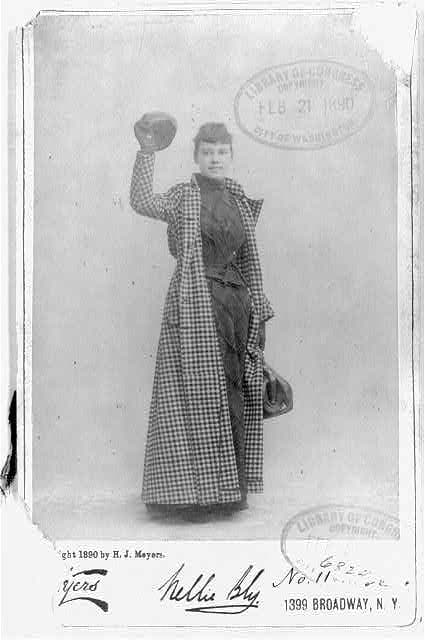
American · Literature · Exploration · Activism
Nellie Bly
May 5, 1864 – January 27, 1922
Early Life and Background
Nellie Bly, born Elizabeth Jane Cochran (often spelled Cochrane), entered the world on May 5, 1864, in Cochran’s Mills, a part of Burrell Township in Armstrong County, Pennsylvania.[1][2][3][5][8] The town had been founded by her father, Michael Cochran, a mill owner and landholder, whose position afforded the family a measure of prosperity and local influence.[1][3] Elizabeth grew up in the broader region around Pittsburgh, including time spent in Apollo, Pennsylvania, as western Pennsylvania industrialized around steel, coal, and railroads.[2]
Elizabeth’s childhood was marked by both opportunity and loss. Her father died when she was still young, leaving her mother, Mary Jane, with limited financial means.[1][3] The death fractured the security that had come from property and business ownership, forcing the family to confront the economic vulnerability common to widows and children in the nineteenth century. According to later accounts, Elizabeth attended local schools and, for a time, a boarding or "normal" school to prepare for teaching, but her formal education was cut short when funds ran low.[1][3][9]
These experiences shaped her worldview. The sudden drop in social and economic status heightened her awareness of class inequality and the precariousness of women’s lives under the legal and financial structures of the era. Her mother’s remarriage to a man who proved abusive—details mentioned in some biographical treatments—underscored for Elizabeth how few options women had to protect themselves and their children.[1][3][9] This background helps explain her later interest in women’s rights, labor conditions, and the lives of the poor, all recurring themes in her journalism.
Path into Journalism
Bly’s entry into journalism grew from a personal act of protest. In the mid‑1880s, the Pittsburgh Dispatch published a column titled “What Girls Are Good For,” arguing that women belonged exclusively in the home.[1][3][16] Outraged, Elizabeth wrote a spirited anonymous letter to the editor, signed “Lonely Orphan Girl,” challenging the article’s assumptions and defending women’s right to work and self‑determination.[1][3]
The editor, George Madden, was impressed and placed an advertisement seeking the letter’s author. When Elizabeth came forward, he offered her a job at the Dispatch, marking the start of her professional reporting career.[3][16] She adopted the pen name Nellie Bly—spelled "Nelly" in the original Stephen Foster song—from a suggestion by the editor, who believed a distinctive byline would stand out in print.[3]
At the Dispatch, Bly wrote about working women, poor families, and social issues, an unusual focus for a young female reporter at a time when women were typically confined to the "women’s pages" covering fashion and domestic life.[1][3] Her articles challenged conventional views about women’s roles and highlighted the hardships faced by factory workers and other laboring women. When the paper reassigned her to more traditional features, she grew frustrated and briefly traveled to Mexico, where she reported on the lives of ordinary Mexicans and criticized the dictatorship of Porfirio Díaz, an experience that honed her interest in international affairs and political repression.[1][3][9]
After returning to the United States, Bly moved to New York City in 1887, determined to make a name for herself in the nation’s leading newspapers. She struggled for months to secure a position, repeatedly visiting offices and pitching stories. Eventually she impressed editors at Joseph Pulitzer’s New York World, who recognized her tenacity and willingness to undertake risky assignments.[1][3][13]
Undercover Asylum Investigation
Bly’s breakthrough came in the fall of 1887, when the World assigned her to investigate conditions at the Women’s Lunatic Asylum on Blackwell’s Island in New York.[1][3][8][13] On September 24, 1887, she began the daring undercover operation: feigning mental illness under the alias "Nellie Brown," she checked into a boardinghouse, behaved erratically, and was soon examined by physicians and a judge who ordered her committed to the asylum.[8][18]
For ten days, Bly lived among women labeled insane, enduring freezing baths, spoiled food, physical roughness, and neglect. She observed that many inmates seemed more poor, foreign, or simply unwanted than truly mentally ill.[8][18] Nurses shouted at and beat patients; doctors were indifferent or dismissive; translation and diagnosis were haphazard. Bly carefully noted these abuses, all while facing the personal risk that she might not be released on schedule.
Once the World arranged her discharge, Bly published her findings in a multi‑part series that exposed systemic cruelty and failure in New York’s treatment of the mentally ill.[1][3][8] The articles were later collected in the book Ten Days in a Mad-House, which drew wide public attention.[1][3] Her work prompted a grand jury investigation, and city officials increased funding for the care of the mentally ill by approximately one million dollars, adding staff and improving conditions at the asylum and related institutions.[1][3][8]
This investigation is widely regarded as a landmark in investigative and undercover journalism. Bly’s immersive method—entering an institution as a participant rather than an observer—helped usher in the era of "stunt" or "muckraking" reporting, in which journalists took on physical and social risks to uncover hidden abuses.[3][8][13] It also demonstrated the power of the press to effect policy change and highlighted the vulnerability of women, immigrants, and the poor within medical and legal systems.
Stunt Reporting and Social Exposés
Following the asylum exposé, Bly became one of the World’s most prominent reporters. She undertook a series of dramatic assignments designed to reveal social and economic injustices: she investigated sweatshop conditions, examined the experiences of female factory workers, and explored the lives of working‑class families struggling under industrial capitalism.[1][3][9]
Her pieces often focused on women and children, bringing to light issues such as domestic abuse, inadequate wages, and the challenges of single motherhood. Bly’s reporting style combined vivid storytelling with moral urgency, presenting her subjects as individuals rather than abstract statistics. This personalized approach helped readers connect emotionally with social problems and reinforced the idea that journalism could serve as a tool for reform.
In addition to these social investigations, Bly experimented with more sensational forms of stunt reporting—such as testing employment agencies or posing as different types of workers—to demonstrate how quickly women could be exploited in urban economies.[3][9] Critics sometimes questioned the theatricality of such work, but it undeniably expanded the boundaries of what newspaper reporting could encompass and showcased the courage and ingenuity of one of the era’s few nationally known women journalists.
Record‑Breaking Trip Around the World
Bly’s most famous stunt began in late 1889. Inspired by Jules Verne’s novel Around the World in Eighty Days, she proposed to the World that she attempt to beat the fictional record by traveling around the globe in less than eighty days.[2][3][13] Editors initially doubted that a woman could travel alone with sufficient speed, suggesting a man might be better suited, but Bly insisted on her capability and threatened to undertake the journey for a rival paper if refused.[3]
On November 14, 1889, she departed from Jersey City by steamship, beginning a journey of roughly 25,000 miles that would take her through England, France, Italy, Egypt, Ceylon (Sri Lanka), Singapore, Hong Kong, Japan, and across the United States.[2][3][13] Along the way she met Jules Verne in France, visited cultural sites, and filed dispatches describing her experiences, the people she encountered, and the logistics of global travel.[2][3]
The World turned her trip into a promotional phenomenon. Readers followed her progress on a map printed in the paper, entered contests to guess her return date, and marveled at the idea of a lone woman navigating steamships and trains across multiple continents.[2][3][16] On January 25, 1890, Bly returned to Jersey City, having completed her circumnavigation in 72 days, 6 hours, and 11 minutes, a widely celebrated speed record.[2][3][13]
This feat solidified her international reputation. Bly’s journey demonstrated both the capabilities of modern transportation and the determination of a woman who refused to be constrained by gender norms.[2][3][11] It boosted the circulation of the World, cemented her status as a household name, and remains one of the iconic episodes in the history of travel and journalism.
Marriage and Transition to Industry
On April 5, 1895, Bly surprised the public by secretly marrying Robert Livingston Seaman, an older and wealthy industrialist who owned the Iron Clad Manufacturing Company and the American Steel Barrel Company.[3][13] The marriage shifted her social position from wage‑earning reporter to the spouse of a prominent businessman, though she did not immediately abandon writing.
Seaman’s companies produced steel barrels, enameled goods, and other industrial containers that were integral to a rapidly expanding manufacturing and transportation network.[3][13] Bly became increasingly involved in business matters, observing operations and developing ideas for improving products and processes. Her interest in efficiency and design foreshadowed her later role as an inventor and industrial manager.
When Seaman died, Bly assumed principal ownership of Iron Clad, formally taking control on March 11, 1904.[3][13] She stepped into a rare role for a woman of her time: executive leader of a major manufacturing firm. Drawing on her investigative instincts, she scrutinized the company’s finances and production systems and sought to introduce innovations that would keep Iron Clad competitive in a crowded market.[3][9]
Inventor and Industrialist
As the owner of Iron Clad Manufacturing, Bly applied her creativity to product design. She secured patents for steel barrels and related technologies, aiming to improve durability, safety, and efficiency in the transport of oil and other industrial materials.[3][7][9] These innovations reflected her understanding of the logistical demands of a rapidly industrializing economy and her willingness to engage with technical details typically reserved for male engineers and executives.
Under her leadership, Iron Clad became known for enameled kitchenware and specialized containers used in rail and maritime shipping.[3][9] Bly promoted the company through advertising and public relations, leveraging her fame as a journalist to highlight the quality and reliability of its products.
Despite these efforts, the firm eventually encountered financial difficulties, in part due to mismanagement by subordinates and broader market pressures. Iron Clad went into receivership, and Bly lost much of her fortune.[3][9] Nonetheless, her tenure as an industrialist remains historically significant: she was one of the early twentieth century’s most visible women business leaders, demonstrating that women could run complex manufacturing operations and participate in technological innovation.
Return to Journalism and World War I Reporting
After Iron Clad’s collapse, Bly returned to journalism. During the 1910s, she wrote columns that combined news, opinion, and advice, often featuring her charitable activities and efforts to assist individuals in need.[9][13] She continued to champion causes involving women, children, and the poor, using her public platform to connect readers with opportunities for philanthropy and volunteerism.
With the outbreak of World War I, Bly again pushed the boundaries of female reporting. In August 1914, she traveled to Europe and became the first woman journalist to report from the Eastern Front, according to several accounts.[9][11] She covered troop movements, military conditions, and the impact of war on civilians, navigating censorship and physical danger in areas generally off‑limits to women.
Bly’s war dispatches drew on her longstanding concern for ordinary people affected by powerful institutions, now shaped by the vast destructive capabilities of modern weaponry and state mobilization. Her presence near the front lines challenged assumptions about appropriate roles for women in journalism and contributed to a gradual expansion of female participation in political and international reporting.
Later Work and Public Service
In the late 1910s and early 1920s, Bly’s writing increasingly emphasized charitable efforts and individual cases of hardship. She wrote an advice and help column in which readers brought their problems to her attention, and she used her influence to secure assistance from institutions, benefactors, and public agencies.[9][13]
One notable example of this work occurred on December 19, 1919, when she played a significant role in resolving the "Love of Mike" baby case, a widely discussed custody and welfare matter involving a young child.[13] Bly investigated the situation and advocated for decisions centered on the child’s welfare, demonstrating her commitment to practical intervention rather than mere publicity.
These efforts reflected the Progressive Era ethos of social reform and public service, as well as Bly’s personal evolution. Having begun her career with undercover exposés, she now used her fame and journalistic tools to function as a mediator between vulnerable individuals and the institutions that could help them.
Awards, Honors, and Recognition
During her lifetime, Bly’s most visible "honors" took the form of massive public attention and professional respect rather than formal awards. Her asylum exposé and world trip were widely praised in newspapers, and she became a celebrated figure of the late nineteenth‑century press.[1][2][3][8][9]
Editors at the World gave her some of their highest‑profile assignments, and her name became synonymous with fearless reporting. In the decades following her death, historians of journalism and women’s history have consistently highlighted her contributions, and her story has been retold in biographies, children’s books, museum exhibits, and television programs.[1][2][5][8][13]
Institutions such as the Library of Congress, the National Women’s History Museum, and the National Park Service now present Bly as a key figure in the development of investigative journalism and women’s public activism.[1][5][8][13] These recognitions underscore her enduring influence even without a long list of formal prizes.
Personal Life
Beyond her public persona, Bly’s personal life was shaped by family responsibilities and complex relationships. Her early experiences in a household disrupted by her father’s death and a troubled second marriage for her mother gave her firsthand insight into the dangers of economic dependence and domestic instability.[1][3][9]
Her marriage to Robert Seaman offered financial security and social status, but it also required her to balance professional ambitions with expectations placed on a wealthy businessman’s wife in New York society.[3][13] There is no strong evidence that the couple had children, and much of Bly’s emotional energy appears to have been directed toward her work and her advocacy for others.
Accounts of her later years describe her as energetic, outspoken, and deeply engaged with charitable causes. She cultivated friendships in journalistic and reform circles and remained committed to suffrage and women’s rights, both explicitly and through the example of her career.[1][5][8]
Later Life and Death
In her final years, Bly continued writing and maintaining public involvement despite financial setbacks from the failure of Iron Clad Manufacturing. She remained based in New York City, where she had long been part of the media and reform community.
On January 27, 1922, Bly died of pneumonia (bronchopneumonia) at St. Mark’s Hospital in New York City at the age of 57.[2][3][5] Obituaries recalled her asylum investigation, world trip, and war reporting as defining episodes in a remarkable career. She was buried at Woodlawn Cemetery in the Bronx, further anchoring her story in the city whose institutions she had so often scrutinized.[5]
Legacy and Historical Impact
Nellie Bly’s legacy rests on several intertwined contributions. She is widely regarded as a pioneer of investigative journalism, particularly undercover reporting that exposes hidden abuses.[1][3][5][8][13] Her 1887 asylum exposé demonstrated the power of immersive journalism to reveal systemic cruelty and effect policy change, setting a model for later muckrakers and investigative reporters.
Her record‑breaking 72‑day trip around the world in 1889–1890 reshaped public perceptions of both global travel and women’s capabilities.[2][3][11] Bly’s success showed that a woman could navigate complex and often hostile environments with skill and courage, challenging Victorian notions of female fragility and domestic confinement. The trip also illustrated how newspapers could harness spectacle and celebrity to expand their audience.
As an industrialist and inventor, Bly broke new ground by managing a major manufacturing company and securing patents in her own name, demonstrating that women could lead and innovate in heavy industry.[3][7][9][11] Her work in business, though ultimately not financially successful, expanded the imagined range of women’s professional roles.
Her reporting from the Eastern Front in World War I further extended the boundaries of female journalism, inserting a woman’s perspective into coverage of global conflict and helping to normalize women’s presence in political and international reporting.[9][11]
Beyond these specific achievements, Bly’s career helped transform public expectations about journalism itself. She embodied a more engaged, activist model of the reporter—someone who not only described events but sought to change unjust conditions. Her focus on women, the poor, and the marginalized prefigured later traditions of social justice journalism and feminist media criticism.
Today, Nellie Bly is commemorated in museum exhibits, scholarly works, and popular narratives about women’s history and the press. Institutions such as the Library of Congress and the National Women’s History Museum highlight her as a central figure in stories about the rise of investigative reporting and the broader movement for women’s equality.[1][5][8][13] Her life continues to inspire journalists and activists who see in her example a powerful reminder that tenacity, empathy, and courage can reshape both public policy and cultural norms.
Dated achievements
9 indexed.
- May051864Literature
Birth of Nellie Bly
Birth of Nellie Bly in Cochran's Mills, Pennsylvania.
View details Encyclopedia.com: Bly, Nellie (1864–1922) - Sep241887Activism
Undercover asylum investigation begins
Bly feigns insanity and enters Blackwell’s Island Asylum for an investigation.