← All women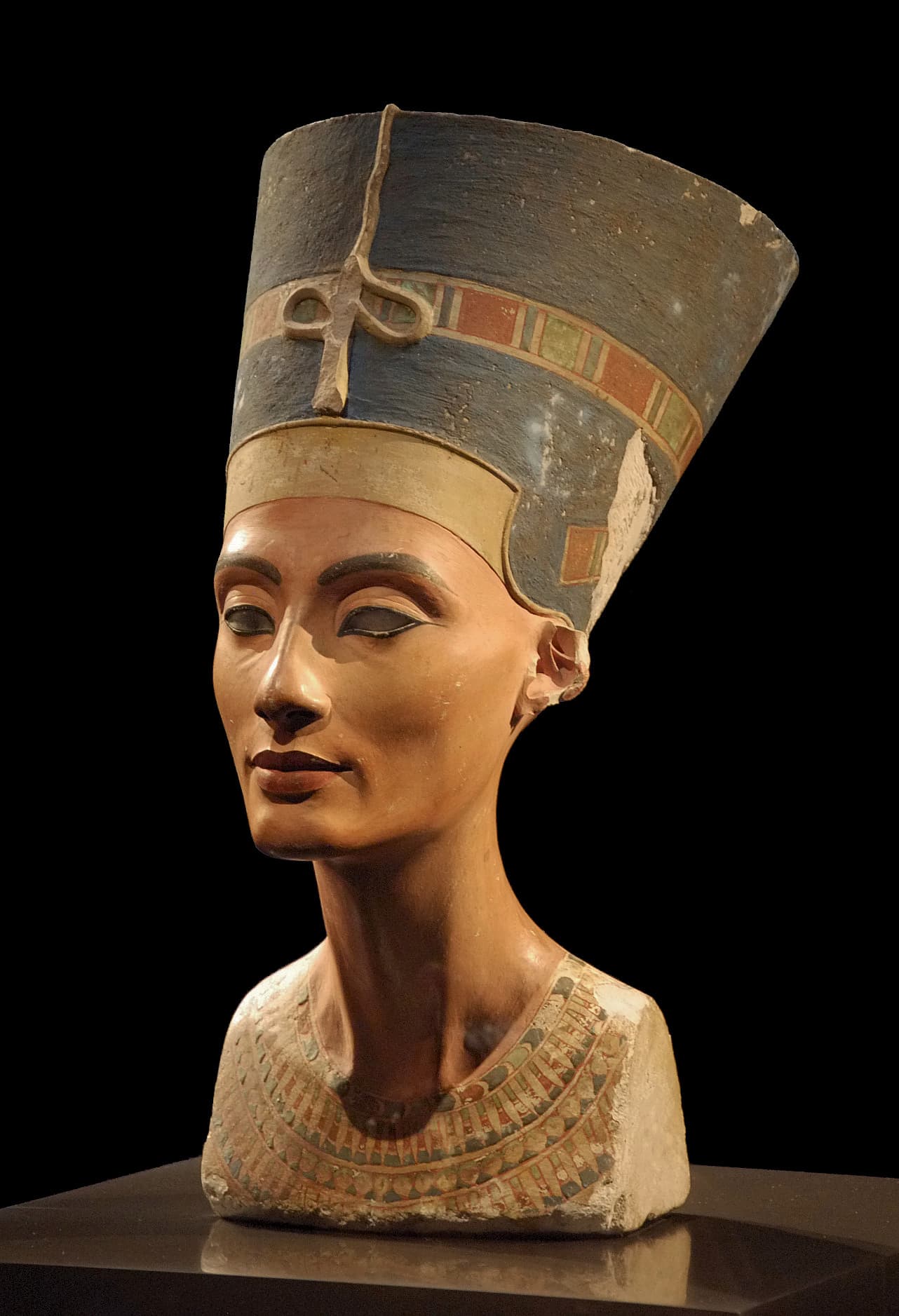
Ancient Egyptian · Politics
Nefertiti
-1370 – -1330
Introduction
Nefertiti (c.1370 – c.1330 BCE) was queen of Egypt during the 18th Dynasty and the Great Royal Wife of Pharaoh Akhenaten (Amenhotep IV). She is best known for her prominent role in the religious transformation often called Atenism, and for the celebrated painted limestone bust discovered at Amarna in 1912, now one of the most recognizable images from antiquity.[2][3][10][16] Her name, usually translated as “the beautiful one has come,” has become synonymous with ancient Egyptian ideals of beauty, yet evidence from inscriptions and reliefs shows that she also exercised significant religious and political authority, appearing in contexts normally reserved for pharaohs.
Early Life and Background
Very little is securely known about Nefertiti’s early life, and no ancient source records her precise birth date or parentage.[2][3][10] Modern Egyptologists generally place her birth around c.1370 BCE, probably in or near Thebes (modern Luxor), based on the chronology of Akhenaten’s reign and the age of her daughters depicted in reliefs.[2][4][10] Her name, attested in hieroglyphs as Neferneferuaten Nefertiti (“Beautiful are the beauties of Aten, the beautiful one has come”), suggests a later religious elaboration linking her to the Aten cult, but her original family connections remain debated.[2][10][16]
Several hypotheses about her origin have been proposed. One influential suggestion is that she was a daughter or close relative of Ay, a high-ranking courtier who later became pharaoh after Tutankhamun.[2][3] Another theory posits that she may have been a princess of a neighboring region such as Mitanni, though this is largely speculative and lacks firm textual support.[3][10] What is clear from early depictions is that she entered the royal household before or at the start of Akhenaten’s reign and quickly occupied a central position in court ceremonial life.
Like other elite Egyptian women of the New Kingdom, Nefertiti would have been educated in the complex etiquette, religious rituals, and political expectations of the royal household. Reliefs and inscriptions later show her participating in offerings to deities, interacting with foreign envoys, and appearing in formal processions, all of which suggest training appropriate to a woman who would become queen and, possibly, co-ruler.[2][10]
Marriage and Rise to Prominence
Nefertiti’s marriage to Amenhotep IV, later known as Akhenaten, almost certainly took place before or near the beginning of his reign, but the exact date is unknown.[2][3][10] When her husband succeeded his father, Amenhotep III, she assumed the title of Great Royal Wife, the highest status for a queen in the Egyptian court. Her elevated position is immediately apparent in early reliefs from Thebes and the newly built Aten temples, where she appears beside the king in scenes of worship and royal celebration.[2][3]
During the initial years of Akhenaten’s rule, still under the name Amenhotep IV, the couple began to emphasize the worship of the sun disc Aten over traditional gods, though the major shift to exclusive Atenism came later.[2][4] Nefertiti’s name begins to appear with elaborate titles such as “Great Royal Wife,” “Mistress of Upper and Lower Egypt,” and “Lady of the Two Lands,” underscoring her exceptional standing.[1][2][16] She is frequently depicted in the artistic record—more than any other Egyptian queen—suggesting her visibility was a deliberate element of royal ideology.[1]
Their marriage produced at least six daughters, who are named and shown with them in numerous reliefs: Meritaten, Meketaten, Ankhesenpaaten (later Ankhesenamun), Neferneferuaten Tasherit, Neferneferure, and Setepenre.[1][2][3] These princesses occupy a conspicuously prominent place in Amarna art, often shown accompanying their parents, which is unusual for female royal offspring and may reflect the heightened status of women in Akhenaten’s religious and political program.[1][2]
Akhenaten’s Reign and Nefertiti’s Political Role
Akhenaten’s reign is commonly dated to c.1353–1336 BCE (or c.1351–1334 BCE), and Nefertiti was his chief queen throughout most of this period.[2][3][5][10][16] Historically, the reign is notable for the radical transformation of religion and artistic style, often called the Amarna period. Nefertiti’s visibility in these changes is unusually high; she appears in temple reliefs making offerings to Aten, driving chariots, and even smiting Egypt’s enemies—roles traditionally reserved for the pharaoh.[2][10][18]
In the mid-14th century BCE, Akhenaten and Nefertiti oversaw the shift from Egypt’s longstanding polytheistic system toward the exclusive state worship of Aten. Aten was represented as a sun disc with rays ending in hands that bestow life on the royal couple.[2][3][5][10] The king and queen were portrayed as intermediaries between Aten and humanity, effectively centralizing religious power in the royal household. Nefertiti’s participation as the female counterpart of Aten is emphasized in art: she is shown with Akhenaten beneath the rays of Aten, receiving life and authority directly.[5][10]
Egyptologists debate the extent of Nefertiti’s political authority, but several lines of evidence point to a role beyond that of a conventional queen. She appears wearing royal crowns and the uraeus (rearing cobra), symbols of kingship, and is depicted in scenes of ritual smiting, which visually associate her with pharaonic power.[2][10][18] Some inscriptions grant her titles that approach those of a co-ruler, and later theories suggest she may have held independent authority as a ruler under the name Neferneferuaten, though this remains contested.[2][3][10]
The Founding of Akhetaten (Amarna)
During the early to mid years of Akhenaten’s reign (often placed in years 4–6), the king ordered the establishment of a new capital city, Akhetaten (“Horizon of Aten”), at modern Tell el-Amarna.[2][3][5][10][16] The move from Thebes to this purpose-built city represented a dramatic break with tradition, aligning the political center directly with the Aten cult. Nefertiti plays a prominent role in the art and inscriptions from Akhetaten: she appears in temple scenes, palace reliefs, boundary stelae, and private tombs, often in equal scale with Akhenaten.[2][3][10][18]
Amarna art reflects a new aesthetic, characterized by elongated limbs, pronounced facial features, and intimate domestic scenes. Nefertiti is frequently shown in affectionate poses with Akhenaten and their daughters, which contrasts with the more formal iconography of earlier dynasties.[2][10] At the same time, she appears in official ceremonies, including offerings to Aten and reception of foreign tribute, illustrating her integration into core state functions.[2][3] These depictions have led scholars to regard her as a co-participant in the religious revolution, not merely a symbolic consort.
Within Akhetaten’s temples, Nefertiti’s image is used as a focal point of worship alongside the king. Some scenes show her making offerings independently, suggesting that she may have had her own cultic status as a living fertility goddess associated with motherhood and the life-giving power of the sun.[3] This is reinforced by representations of her with the six royal daughters, emphasizing a divine family model at the heart of Atenism.
Major Works, Religious Policy, and Possible Co-Rule
Nefertiti’s “works” are best understood as her participation in, and shaping of, Akhenaten’s religious and political program. Together, they promoted the exclusive worship of Aten, closing or downgrading temples of other gods and reallocating resources to Aten sanctuaries.[2][3][5][10] Reliefs show Nefertiti conducting offerings, burning incense, and presenting food and floral tributes to Aten, activities that formed the core of public ritual life at Akhetaten.[2][4][10]
Her distinctive blue crown, familiar from the famous bust, appears in numerous reliefs and may have served as a visual symbol of her special status in the Aten cult.[2][16] Some scholars interpret the combination of royal regalia and religious iconography as evidence that Nefertiti functioned as a priestess-queen, bridging the traditionally separate spheres of kingship and temple ritual.[2][10]
Debate continues over whether Nefertiti became a co-ruler and later a sole ruler under the throne name Neferneferuaten. Certain inscriptions and objects from the late Amarna period reference a ruler with that name, distinct from Akhenaten and from his successor, the short-lived king Smenkhkare.[2][3] Stylistic and titular analysis has led some Egyptologists to argue that this ruler was Nefertiti, functioning as either coregent or independent monarch in the final years of Akhenaten’s reign and beyond.[2][10] However, definitive proof is lacking, and alternative theories propose other identities for Neferneferuaten, including one of the royal daughters.
Despite these uncertainties, it is clear that Nefertiti’s influence extended deeply into the religious, artistic, and diplomatic life of the Amarna court. She appears in scenes of foreign tribute and may have had a role in managing Egypt’s relationships with Levantine and Near Eastern powers, though the surviving textual corpus focuses more on ideology than on day‑to‑day governance.[2][10]
Awards, Honors, and Cultic Recognition
The modern concept of “awards” does not apply to ancient Egyptian royalty, but Nefertiti was honored through titles, cultic depictions, and the monumental scale of her representations. Her principal titles included Great Royal Wife, Lady of Grace, Sweet of Love, and Lady of the Two Lands, all of which emphasized her legitimacy, charisma, and role as embodiment of royal and divine favor.[1][2][3]
In religious contexts, Nefertiti was sometimes treated as a manifestation of divine femininity linked to fertility and nurturance. Representations of her with her daughters, under the life-giving rays of Aten, suggest that she functioned symbolically as a living fertility goddess, a status noted by modern scholars based on the iconography of the period.[3] Her exceptional visibility on monuments—she is the Egyptian queen with the largest number of surviving artistic appearances—can itself be seen as a form of honor, reflecting deliberate choices by court artists and patrons.[1]
Later, in modern times, the bust of Nefertiti has been exhibited as a masterpiece of ancient art, prominently displayed in Berlin’s museums and featured in countless publications, documentaries, and exhibitions. These curatorial decisions have effectively granted Nefertiti a posthumous status as one of the most celebrated women in ancient history.[2][3][16]
Personal Life: Marriage and Children
Nefertiti’s personal life is partially visible through Amarna art and inscriptions, which depict her as a wife and mother. Her marriage to Akhenaten appears to have been central to both political and religious symbolism, emphasizing a harmonious royal couple acting together as intermediaries of Aten.[2][5][10] Scenes show the pair sharing intimate moments, such as holding hands or embracing their children, unusual in Egyptian royal art and suggestive of a deliberate ideological emphasis on familial unity.[2][10]
The couple’s six daughters are repeatedly shown with them, often in lively, informal poses—playing, sitting on their parents’ laps, or gesturing toward offerings.[1][2][3] This emphasis on daughters rather than sons may reflect both the particular family situation of Akhenaten and Nefertiti and the theological importance of the royal family as the focal point of Aten’s blessing. One daughter, Ankhesenpaaten, later became Ankhesenamun and married Tutankhamun, connecting Nefertiti’s lineage to the subsequent restoration of the traditional gods.[2][3][17]
Beyond these family scenes, little is known of Nefertiti’s private life. The texts of the Amarna period are formal and ideological, concerned with praising Aten and the royal family rather than recording personal experiences. There is no surviving record of her daily routine, personal opinions, or inner life, and all reconstructions must be inferred from official art and a limited number of inscriptions.
Later Years, Disappearance, and Debated Death
Nefertiti’s last securely dated appearance in contemporary inscriptions occurs in Year 12 of Akhenaten’s reign, during a large-scale royal celebration that included foreign tribute and ceremonial processions.[2][3][10][16] After this point, the historical record becomes fragmentary. She disappears from many inscriptions, leading early scholars to speculate that she died around this time. Later research has challenged that view, suggesting alternative scenarios including a change of name, elevation to coregent, or continued life under a royal throne name.[2][3][10]
The approximate traditional date often given for Nefertiti’s death is c.1330 BCE, but this is not securely attested in primary sources and remains an estimate based on the chronology of Akhenaten, Smenkhkare, and Tutankhamun.[2][10][12][15] Some Egyptologists argue that she may have lived longer, possibly ruling as Neferneferuaten or even overlapping with the early years of Tutankhamun’s reign. Others suggest she died in the late Amarna period, contributing to the succession crisis that followed Akhenaten’s death.[2][3][10]
Nefertiti’s tomb has not yet been definitively identified. Various hypotheses have been advanced regarding possible burial sites within the Amarna royal necropolis or in the Valley of the Kings, but none has been conclusively proven.[2][3] This absence of a confirmed burial contributes to the aura of mystery surrounding her end: unlike several other New Kingdom royals, Nefertiti has no securely identified mummy or tomb inscriptions documenting her death and funerary rites.
Modern Rediscovery: The Bust of Nefertiti
Nefertiti’s modern fame rests heavily on the bust of Nefertiti, created c.1340 BCE in the workshop of the royal sculptor Thutmose at Amarna.[2][12][16] Crafted from limestone with stucco and polychrome paint, the bust portrays Nefertiti with her distinctive blue crown, graceful neck, and finely modeled facial features. It is considered a masterpiece of ancient Egyptian art and a key exemplar of Amarna-period style.[2][3][12]
On 6 December 1912, the bust was discovered by a German archaeological team led by Ludwig Borchardt in Thutmose’s workshop at Amarna.[2][3][7][16] The excavations, conducted under a system that divided finds between Egypt and the foreign mission, allowed the bust to be transported to Germany in 1913, where it eventually entered museum collections.[2][4][18]
The bust’s public unveiling in Berlin on 21 March 1923 caused an immediate sensation. Art critics and the public hailed it as an icon of beauty and as one of the finest surviving works from ancient Egypt.[2][7][18] On 7 September 1924, it was installed in the Neues Museum in Berlin, becoming a central piece of the Egyptian collection and a major draw for international visitors.[2][16] Its display history, including movements during and after the Second World War and eventual reinstallation in the refurbished Neues Museum in 2009, has been closely tied to debates over the stewardship and repatriation of cultural heritage.[2][16][18]
The bust has profoundly shaped global perceptions of Nefertiti. Its refined features and vivid colors have provided a visual template for countless reproductions in film, fashion, advertising, and popular culture. For scholars, it offers invaluable evidence of royal portraiture and artistic technique at Amarna, from pigment composition to stylistic conventions of representation.[2][3][12]
Legacy and Historical Impact
Nefertiti’s legacy can be assessed in two broad dimensions: her role in the Amarna religious revolution and her enduring presence as a modern cultural icon. In the ancient context, she was central to the attempt to reorient Egyptian religion around Aten, narrowing the pantheon and elevating the royal family as unique intermediaries.[2][3][5][10] Though Atenism was short-lived—largely dismantled after Akhenaten’s death and the accession of Tutankhamun—its experimentation with more exclusive worship has often been compared to later monotheistic traditions, even if the analogy is imperfect.[2][4][10]
Artistically, the Amarna period introduced a more naturalistic, emotionally expressive style, visible in Nefertiti’s depictions. The bust and reliefs of her family helped reshape modern understandings of ancient Egyptian art as not purely formal and static but capable of tenderness and individualized portraiture.[2][10][12] Her frequent appearance in official scenes, sometimes in roles usually reserved for the king, has influenced scholarly debates on gender, power, and the possibility of female co-rule in ancient Egypt.[2][10][18]
In the modern era, Nefertiti has become one of the most famous women of antiquity. The bust’s impact on fashion and aesthetics is well documented: its sharp jawline, high cheekbones, and elongated neck have been cited as inspirations for mid‑20th‑century and contemporary beauty standards.[14][17] She is regularly featured in exhibitions, documentaries, children’s educational materials, and scholarly discussions, reinforcing her status as a symbol of both beauty and political power.[6][11][18]
Her story also plays a role in discussions of cultural identity and restitution. Egypt has repeatedly requested the return of the bust, arguing that it is a key part of national heritage and was removed under conditions that no longer reflect modern norms of archaeological ethics.[2][16] German authorities have maintained that the artifact was legally exported under the rules of the time. The ongoing controversy illustrates how Nefertiti’s legacy intersects with colonial history, museum practice, and international cultural law.
Debates and Misconceptions
Several common claims about Nefertiti are either debated or anachronistic. Popular accounts sometimes describe her as the “first woman pharaoh,” but secure evidence shows that Hatshepsut ruled earlier in the same dynasty with full pharaonic titulary, and other queens through Egyptian history held notable power.[2][6][10] While Nefertiti may have exercised quasi-pharaonic authority and possibly ruled as Neferneferuaten, this remains a matter of scholarly interpretation rather than settled fact.[2][3][10]
Another misconception involves precise dates for her birth, death, or key political acts. Modern literature often supplies specific years or even day-and-month dates, but these are rarely grounded in primary Egyptian sources. Current Egyptological consensus is that only approximate years or reign-year references can be responsibly used for her life events, and that no exact calendar dates survive for her birth, marriage, or death.[2][10][15][17]
These gaps in the record have contributed to Nefertiti’s aura as a mysterious figure. Scholars continue to examine new evidence, including ongoing excavations and reanalysis of Amarna texts, but it is unlikely that a fully detailed biography will ever be reconstructed. Instead, Nefertiti’s historical significance is best understood through the convergence of surviving art, inscriptions, and their modern reception.
Conclusion
Nefertiti stands at the crossroads of ancient religious innovation, royal politics, and modern cultural imagination. As Great Royal Wife to Akhenaten, she helped shape a controversial religious program centered on Aten and a new capital at Akhetaten, leaving an indelible mark on Egypt’s 18th Dynasty.[2][3][5][10][16] As the subject of one of antiquity’s most celebrated sculptures, she has become an enduring symbol of beauty, femininity, and power, inspiring generations of artists, scholars, and the public.[2][3][12][16][18] Even with major uncertainties surrounding her origins, possible co-rule, and death, Nefertiti remains one of the most studied and discussed women in history—an ancient queen whose image and legacy continue to resonate more than three millennia after her time.
Dated achievements
3 indexed.
- Dec061912Arts
Discovery of the Nefertiti Bust at Amarna
Borchardt's team discovered Nefertiti's bust in 1912, bringing her prominence.
View details The Queen: Bust of Nefertiti - SMB Museum - Mar211923Arts
Public Unveiling of the Nefertiti Bust in Berlin
The bust was unveiled in Berlin on March 21, 1923, causing a sensation.