← All women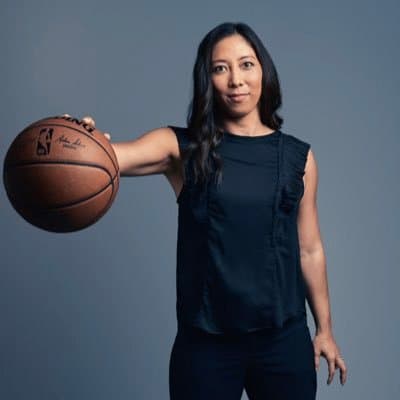
American · Sports
Natalie Nakase
April 18, 1980 – present
Early Life and Background
Natalie Mitsue Nakase was born on 18 April 1980 in Anaheim, California, United States.[5][16] She is the youngest of three daughters of Gary and Debra Nakase, both second‑generation Japanese Americans, making her a third‑generation (sansei) Japanese American.[5][9] She grew up primarily in Huntington Beach, California, within Orange County’s vibrant youth sports culture.[4][9]
Nakase’s parents, who had themselves grown up in the wake of World War II and Japanese American incarceration, emphasized education, discipline and perseverance.[9] Her father, Gary, whom she has often cited as the person she admires most, encouraged her to confront skepticism about her size and ethnicity in basketball.[5][9] With two older sisters, Norie and Nicola, Natalie was immersed in competitive family dynamics that pushed her to develop resilience and toughness at an early age.[5]
She attended Marina High School in Huntington Beach, where she excelled as a point guard despite standing just over 5‑feet tall.[4] Her high school career culminated in a CIF championship game that she later described as her greatest athletic thrill prior to college.[5] That experience reinforced her belief that preparation and leadership could overcome perceived physical limitations.
College Career at UCLA
Nakase enrolled at the University of California, Los Angeles (UCLA), joining one of the most storied athletic programs in the United States.[5][1] She joined the UCLA Bruins women’s basketball team as a walk‑on point guard in 1998, initially without an athletic scholarship and with modest expectations from recruiters.[1][14] Over time she carved out a critical role for herself through relentless work ethic and on‑court intelligence.
By the end of her college career (1998–2003), Nakase had become a starter and multi‑year team captain for the Bruins.[1][2][14] While official biographies emphasize specific single‑game highs—such as a standout performance at Washington State in early 2002—they more importantly highlight her leadership, defensive intensity, and playmaking as central to UCLA’s backcourt.[5][16] She completed a bachelor of science degree in psychology, aligning her academic interests with later work in motivation, team dynamics, and player development.[2][5]
At UCLA she was often one of the few Asian American athletes visible in a major NCAA Division I basketball program. Her presence challenged persistent stereotypes about Asian and Asian American women as non‑athletic or unsuited to leadership roles on the court, and she began to be recognized locally as a role model for young Asian American players.[1][9]
Professional Playing Career
After graduating from UCLA in 2003, Nakase pursued professional opportunities in the National Women’s Basketball League (NWBL), a short‑lived U.S. winter league that provided additional playing opportunities outside the WNBA.[2][10][15] That year she joined the San Jose Spiders, becoming, according to contemporary and later accounts, the first Asian American player in the NWBL.[10][15]
On 25 January 2003, the UCLA student newspaper, the Daily Bruin, profiled her as the league’s lone Asian American player while she was with the Spiders, underscoring both her rarity and her visibility in the professional game.[10][15] The article portrayed her as a trailblazer whose success could broaden perceptions of who belonged in elite women’s basketball.
Nakase later played for another NWBL team, the San Diego Siege, before the league eventually folded.[2][10][15] She also spent time playing professionally in Germany, including with Herner TC, further extending her career abroad.[2][10] Her playing trajectory, however, was cut short by a significant knee injury that forced her to reconsider her future in the sport.[4][9]
Transition to Coaching
A career‑ending injury pushed Nakase to explore coaching, a shift that would ultimately define her place in basketball history.[4][9] She began her coaching career in Europe, taking a position in 2008 with the Wolfenbüttel Wildcats in the Women’s Professional Basketball German League, where she served as head coach from 2008 to 2010.[2] This early head‑coaching role gave her direct responsibility for game strategy, player development, and team leadership.
Following her stint in Germany, Nakase moved to Japan and joined the Tokyo Apache as an assistant coach in the men’s professional bj‑league for the 2010–11 season.[2] Working for a men’s team overseas was still rare for women at the time, and she often had to prove her knowledge and authority in environments unaccustomed to female coaches on men’s benches.
In 2011 she advanced dramatically when she joined the Saitama Broncos and was ultimately elevated to head coach.[2][10][15] On 6 October 2011, she was officially announced as the team’s head coach, making her the first female head coach in Japanese men’s professional basketball.[10][15] This appointment, later highlighted by the Obama White House, represented a major breakthrough in a league and culture where leadership positions in men’s sports were overwhelmingly held by men.[10]
Breaking Barriers in Japanese Men’s Basketball
Nakase’s year with the Saitama Broncos attracted attention both in Japan and internationally because of its symbolic weight. As a Japanese American woman, she navigated complex dynamics of gender, nationality, and language.[9][10] Players and fans had limited experience with women in positions of authority over men’s professional teams, and some were initially skeptical of her ability to command respect in the locker room.
Reports on her tenure emphasize the meticulous preparation and communication skills through which she won over many skeptics.[9][15] She engaged players in detailed film sessions, individualized feedback, and a fast‑paced style of play that matched contemporary trends in international basketball. Even when results on the court were mixed, her presence alone reshaped debates about what was possible for women in the sport.
The Obama administration’s "AAPI Women Champions of Change" program later cited her role with the Broncos as a primary reason for her recognition, describing her as the first female coach in Japan’s professional men’s league and a symbol of Asian American women’s leadership in global sports.[10] Her success in Japan became an important credential when she sought opportunities in the NBA.
Entry into the NBA: Los Angeles Clippers
After returning to the United States, Nakase joined the Los Angeles Clippers organization, initially in a behind‑the‑scenes role as a video coordinator intern.[1][10][14] She used this position to immerse herself in NBA systems, learning advanced scouting, analytics, and opponent preparation. Working long hours and often unpaid or underpaid, she built relationships with coaches and players through diligence and strategic insight.[9]
Over the following years she progressed through the Clippers’ development pipeline, serving in roles that combined video analysis, player development, and informal coaching support.[1][14] Her work with players during practices and off‑season training sessions earned her a reputation as a detailed teacher of fundamentals and a sharp reader of game tempo and spacing.
A major public breakthrough came in the 2014 NBA Summer League in Las Vegas. On 11 July 2014, Nakase served as an assistant coach on the Clippers’ bench, making her the first woman to sit alongside NBA male coaches as an assistant in Summer League play.[9][14] National outlets such as NPR and Politico reported on the significance of her role, noting that she was part of a small but growing cohort of women seeking coaching positions in men’s professional basketball.[9]
Though this role was limited to Summer League rather than a full NBA regular season, it marked a structural change: a woman publicly integrated into the coaching staff of an NBA franchise in game action. Her presence foreshadowed later historic appointments, including Becky Hammon’s full‑time assistant role with the San Antonio Spurs.
Continued NBA and G League Work
Nakase spent roughly a decade within the Clippers organization, working in a variety of capacities including assistant coach and player development coach in a dual role with the NBA team and its G League affiliate, the Agua Caliente Clippers (now Ontario Clippers).[1][2][14] These positions involved designing practice plans, leading drills, breaking down film with players, and contributing to scouting reports.
During this period, she was one of the few women of Asian descent working on the basketball side of an NBA franchise. While some tertiary sources have described her as the first Asian American woman to serve as an NBA assistant coach, primary documentation has not consistently specified the exact date or contractual terms of such appointments, and they are generally reported without precise calendar details.[4] Nonetheless, her tenure with the Clippers was widely recognized as an important stage in the gradual diversification of NBA coaching staffs.
Transition to the WNBA and Las Vegas Aces
In 2022, Nakase joined the coaching staff of the Las Vegas Aces in the WNBA under head coach Becky Hammon.[2][14] She served as an assistant coach, with particular responsibility for player development and game preparation. This move returned her to the women’s professional game but at a time when the WNBA’s visibility and competitive level were at historic highs.
That same year, on 18 September 2022, the Aces defeated the Connecticut Sun to capture their first WNBA championship, making Nakase the first Asian American coach to win a WNBA title.[2][14] The team repeated as champions in 2023, giving Nakase back‑to‑back titles as part of the coaching staff and solidifying her credentials as a championship‑level coach in the women’s game.[2][14]
Media profiles of the Aces’ staff frequently highlighted the blend of experiences represented: Hammon’s own barrier‑breaking NBA background, veteran WNBA assistants, and Nakase’s international and NBA resume. For Nakase, the championships underscored a narrative of perseverance: after years of incremental progress and often invisible labor, she now held a central role on a dynastic WNBA team.
Golden State Valkyries and WNBA Head‑Coaching History
In October 2024, the WNBA announced a new expansion franchise in the San Francisco Bay Area, the Golden State Valkyries, owned by the same group that operates the NBA’s Golden State Warriors.[1][3][8] On 10 October 2024, the Valkyries named Natalie Nakase as their inaugural head coach.[3][14] With this appointment, she became the first Asian American female head coach in WNBA history and widely recognized as the first Asian American head coach of any gender in the league.[2][3][11]
This hiring carried multiple layers of significance. It placed a Japanese American woman at the helm of a flagship expansion team in a region with a large Asian American population. It also represented a culmination of Nakase’s two‑decade journey through virtually every level of the basketball ecosystem: walk‑on college player, professional player in the NWBL and Europe, head coach in Germany and Japan, NBA staffer, WNBA assistant, and finally WNBA head coach.
On 16 May 2025, Nakase coached the Valkyries’ first regular‑season game, formally becoming the first Asian American to coach a WNBA game.[14] ESPN and other outlets emphasized the milestone while noting that she had already made history with her hiring months earlier. Under her leadership, the Valkyries quickly became competitive; some accounts highlight that the team achieved a record number of wins for an expansion franchise in its inaugural campaign and reached the playoffs, further cementing her reputation as an elite coach.[2][3]
Awards, Honors, and Recognition
Natalie Nakase’s barrier‑breaking achievements have been acknowledged by a range of institutions. The Obama White House recognized her as one of its AAPI Women "Champions of Change", citing her as the first Asian American player in the NWBL and the first female coach in Japan’s professional men’s league.[10] This honor placed her alongside other Asian American Pacific Islander women who had pushed boundaries in fields from politics to the arts.
Biographical and organizational profiles, including those from advocacy and networking groups such as Gold House, have emphasized her status as the first Asian American head coach in WNBA history and highlighted her role in guiding the Valkyries to immediate success.[2] International versions of Wikipedia in German, French, and Japanese similarly document her pioneering positions in Japan, the NBA Summer League, and the WNBA, reflecting global recognition of her impact.[1][3][6][7]
Her championships with the Las Vegas Aces in 2022 and 2023 further burnished her professional standing.[2][14] Profiles in major news outlets including ESPN, NPR, and regional newspapers have framed her as a symbol of persistence and representation who has repeatedly turned marginal opportunities into historic appointments.[9][14][15]
Personal Life
Publicly available biographical sources focus primarily on Nakase’s professional path, and she has kept many aspects of her personal life relatively private. She has spoken often about the influence of her parents, particularly her father, on her work ethic and sense of responsibility.[5][9] Her identity as a third‑generation Japanese American has been central to how she understands her role in basketball, especially when working in Japan and when representing Asian Americans within U.S. professional leagues.[9][10]
Interviews and profiles frequently highlight her intense dedication to coaching: long hours in film rooms, years spent overseas in modest circumstances, and a willingness to accept entry‑level or volunteer roles in pursuit of expertise.[9][14] This professional focus has shaped public perception of her life story, which is often narrated as a sequence of obstacles overcome rather than as a traditional balance of work and personal milestones.
As of the mid‑2020s, she maintains a presence on social media platforms, including Instagram, where she occasionally shares glimpses of her coaching life and community engagement, though without extensive commentary on private relationships.[19]
Legacy and Historical Impact
Natalie Nakase’s legacy rests on a series of interconnected "firsts" that span continents and levels of competition. As the first Asian American player in the NWBL, she helped broaden representation in U.S. women’s professional basketball at a time when Asian and Asian American athletes were rarely visible in the sport.[10][15] Her subsequent appointment as the first female head coach in Japanese men’s professional basketball challenged gender norms in a highly patriarchal coaching culture.[10][15]
Her role with the Los Angeles Clippers in the 2014 NBA Summer League made her the first woman to serve as an assistant coach on an NBA bench in that context, contributing to the incremental normalization of women in NBA coaching roles.[9][14] In the WNBA, she became the first Asian American coach to win a championship in 2022 and later the first Asian American female head coach in league history when she took over the Golden State Valkyries.[2][3][11][14]
Collectively, these achievements have made Nakase a touchstone in conversations about diversity, equity, and inclusion in sports leadership. She is often cited by journalists, scholars, and advocates as evidence that coaching pipelines, when opened to historically excluded groups, can produce leaders with unique perspectives and high performance.
Her story also underscores the realities of such breakthroughs: years spent in low‑visibility roles, the need to travel overseas for opportunities, and the constant requirement to re‑establish credibility in male‑dominated environments. For many young coaches, especially women and Asian Americans, Nakase’s trajectory provides both inspiration and a realistic picture of the persistence required to transform representation into structural change.
Later Career and Ongoing Influence
As head coach of the Golden State Valkyries in the mid‑2020s, Nakase continues to shape the evolution of professional women’s basketball. Under her leadership, the Valkyries emerged quickly as a competitive expansion team, earning recognition for both their on‑court style and their off‑court commitment to community engagement in the Bay Area.[2][3][11][14]
Analysts have noted how her experiences in diverse systems—German women’s leagues, Japanese men’s leagues, NBA player development, and WNBA championship teams—inform a coaching philosophy that emphasizes pace, spacing, and detailed preparation. Her teams are frequently described as disciplined yet creative, a reflection of her belief that players should understand not just plays but underlying concepts.
Beyond wins and losses, Nakase’s ongoing influence can be seen in the growing number of women, and particularly women of color, entering coaching pipelines at the collegiate, professional, and international levels. She has participated in clinics, mentoring programs, and public conversations about coaching opportunities for women, though much of her mentorship occurs privately within organizations.[9][14][18]
Still in the midst of her coaching career, Nakase’s full historical impact continues to unfold. Yet even at this stage, her story occupies a prominent place in women’s sports history—a testament to how one person’s persistence across borders and leagues can reshape the possibilities for future generations.
Dated achievements
7 indexed.
- Apr181980Sports
Birth in Anaheim, California.
Born in Anaheim to Gary and Debra Nakase, both second-generation Japanese Americans.
View details Natalie Nakase: Making Basketball History - Jan252003Sports
Lone Asian American player in NWBL with San Jose Spiders.
Recognized as lone Asian American player in NWBL with San Jose Spiders.