← All women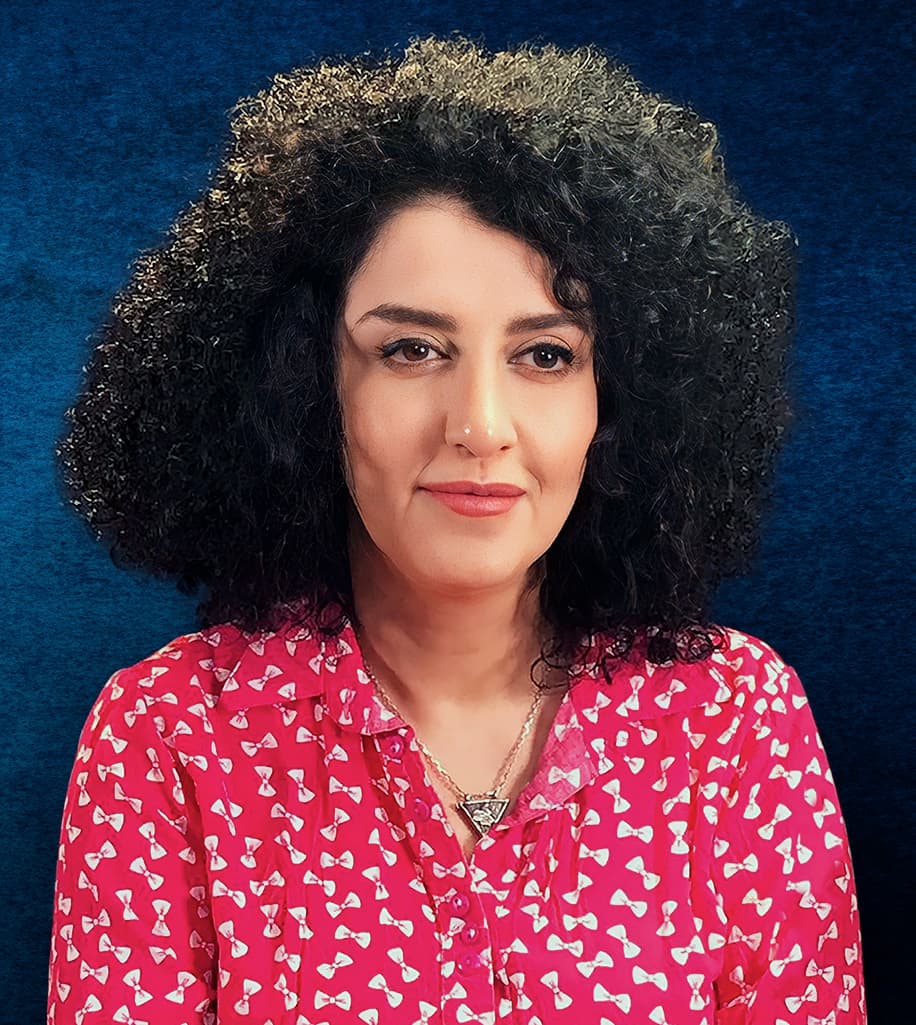
Iranian · Activism
Narges Mohammadi
April 21, 1972 – present
Early life and education
Narges Mohammadi was born on 21 April 1972 in Zanjan, Iran. She grew up in a country shaped by authoritarian politics, social conservatism, and later the tightening restrictions of the Islamic Republic, conditions that would profoundly influence her understanding of public life and justice. Sources identify her as Iranian and note that she later became known as a journalist, writer, and human rights activist.
Mohammadi studied physics at university, earning a bachelor’s degree from Imam Khomeini International University. Her scientific training is a notable part of her background because it shows that her path into activism was not through a traditional political career, but through a broader intellectual formation that included analytical discipline and public-minded inquiry. Over time, she moved into journalism and rights work, bringing her voice to issues affecting prisoners, women, and political dissidents.
Her early life unfolded in a national context in which women’s public participation was limited and independent civil society faced constant pressure. Those circumstances form an important backdrop to her later work: Mohammadi’s activism developed not from a position of safety, but from within a system that repeatedly punished dissent. That reality would remain central to her biography and public meaning.
Beginning of activism
Mohammadi first came to wider prominence in the late 1990s and early 2000s as she became involved in journalism and human rights advocacy. Available sources note that she was first arrested in 1998 for criticism of the Iranian government, marking the beginning of a long pattern of detention and prosecution. She later joined the Defenders of Human Rights Center in 2003, the organization co-founded by Nobel Peace Prize laureate Shirin Ebadi.
At the DHRC, Mohammadi became one of Iran’s best-known human rights defenders and eventually served in leadership roles, including deputy director and spokesperson. Her work focused on political prisoners, prisoners of conscience, women’s rights, and the abolition of the death penalty. These were especially sensitive causes in Iran, where legal reform and open criticism of the state could result in severe retaliation.
In 2009, she was summoned to the Revolutionary Court in connection with her membership in the DHRC, and in 2010 she was detained for about a month. By 2011, she had become a target of repeated legal and administrative punishment that set the pattern for the rest of her public life. Her activism, though peaceful, was treated by the state as a threat because it exposed abuses and demanded accountability.
Imprisonment and state pressure
Mohammadi’s biography is inseparable from her repeated arrests, prosecutions, and prison terms. Sources report that between 1998 and October 2023 she was arrested 13 times and received sentences totaling decades of imprisonment and dozens of lashes. Amnesty and other rights organizations documented the severity of the punishments imposed on her, including long prison terms and corporal punishment that reflected the harshness of the judicial response to dissent.
In 2011, she was sentenced to 11 years in prison on politically motivated charges related to her work. Later accounts indicate that this sentence was reduced, but it nevertheless contributed to her incarceration and to the broader campaign against her. In May 2016, she was again sentenced in Tehran, this time to 16 years’ imprisonment on charges including “establishing an illegal group” and “propaganda against the state.” Rights organizations described the case as politically motivated and emblematic of the repression facing civil society in Iran.
Reports also note that she spent long periods in solitary confinement and experienced repeated pressure on her family life and health. The pattern of detention was not only punitive but also strategic: it sought to isolate her from networks of support and to deter others from following her example. Nevertheless, Mohammadi continued to communicate with the outside world through writing, testimony, and international advocacy channels.
Writing, testimony, and public voice
Alongside activism, Mohammadi became known as a writer and public witness. Human rights groups and parliamentary documentation describe her as the author of White Torture, a multi-volume work investigating the inhumane treatment of prisoners in Iran. This body of work is important because it converts lived experience and testimony into public record, preserving evidence of confinement practices that authoritarian systems often try to obscure.
Her writing and interviews emphasized the realities of interrogation, solitary confinement, psychological pressure, and the treatment of women prisoners. In this respect, Mohammadi’s significance extends beyond one organization or one campaign. She helped articulate a language of resistance in which women’s rights, prisoners’ rights, and freedom of expression were treated as inseparable. That approach gave her work international resonance, especially among journalists, diplomats, and rights advocates seeking to document abuses in Iran.
International recognition
Mohammadi’s work gradually won major international recognition. On 21 October 2011, she received Sweden’s Per Anger Prize for human rights work. On 6 March 2018, the American Physical Society announced that she had been awarded the Andrei Sakharov Prize for her campaign against the death penalty in Iran. On 5 May 2020, PEN America announced that she would receive the PEN/Barbey Freedom to Write Award.
These honors were significant not only as personal achievements, but also as forms of protective visibility. Each award drew attention to the legal persecution she faced and helped keep her case in global circulation. For a prisoner of conscience, international recognition can function as both moral support and political pressure, making it harder for authorities to enforce silence without scrutiny.
The awards also reveal the breadth of the coalition that came to support her: governmental human rights programs, scientific institutions, literary advocates, and women’s rights organizations. That range illustrates how her activism crossed disciplinary and institutional boundaries, speaking to issues at the center of modern human rights practice.
Nobel Peace Prize and global significance
The defining international moment in Mohammadi’s public life came on 6 October 2023, when she was named the Nobel Peace Prize laureate “for her fight against the oppression of women in Iran and her fight to promote human rights and freedom for all.” The prize was announced while she was imprisoned in Evin Prison, making her one of the most visible political prisoners in the world and placing Iranian women’s resistance at the center of global attention.
Her Nobel recognition was followed by the formal ceremony in Oslo on 10 December 2023. Because she remained in prison, her family accepted the medal and diploma on her behalf. The symbolism of the ceremony was striking: a woman denied liberty by her government was being honored internationally for her refusal to renounce the struggle for freedom. In women’s history, the event underscored how female dissidents can reshape the meaning of peace, not as passive absence of conflict, but as active resistance to oppression.
The Nobel Committee’s decision also consolidated Mohammadi’s status as a defining figure in Iranian civil society. Her recognition linked her to a lineage of women who have challenged coercive state power through organizing, testimony, and moral courage. It also amplified the demands of Iranian women protesting compulsory social control and state violence.
Later developments and continuing imprisonment
Mohammadi remained a focal point of international concern after the Nobel Prize. In February 2025, reports documented that she began a hunger strike while detained, and later that month an Iranian court added a further seven and a half years to her sentence. These developments indicated that state pressure on her had not ended with her Nobel recognition; instead, it continued in the form of renewed legal punishment and restrictions on her health and liberty.
Even in confinement, Mohammadi remained a symbol of persistence. Her case demonstrates how authoritarian systems can simultaneously isolate and amplify dissidents: they seek to silence them through prison, but often end up enlarging their public significance. Her continued imprisonment also illustrates the risks borne by women who challenge gendered and political repression in Iran.
Personal life
Public sources identify Mohammadi as married to Taqi Rahmani, a fellow activist and writer. Their relationship is often discussed in the context of shared political commitment and the costs of dissent. The couple has children, and her imprisonment has had a lasting effect on family life, including prolonged separation and the burden of public advocacy carried by relatives.
Her personal life is historically relevant because it reflects the broader family consequences of political repression. In authoritarian settings, activism is rarely borne by one person alone; it reverberates through spouses, children, and extended support networks. Mohammadi’s life therefore has significance not only as an individual record of courage, but also as a family history shaped by the struggle for rights and freedom.
Legacy
Narges Mohammadi’s legacy rests on the combination of organized activism, prison testimony, and international recognition. She has become one of the most important contemporary Iranian voices for women’s rights, the abolition of the death penalty, and the defense of political prisoners. Her life has demonstrated how a single activist can become a global symbol when state repression attempts to erase her.
For women’s history, Mohammadi stands as an example of leadership formed under constraint. She has worked in a political environment that punished independent journalism, criminalized dissent, and sought to silence women who challenged compulsory social order. Yet her continued visibility shows how women can transform vulnerability into political authority through persistence, documentation, and solidarity.
Her significance will likely endure not only because of the Nobel Prize, but because her case captures a central truth of modern human rights history: the struggle for women’s freedom is inseparable from the struggle against political imprisonment, bodily coercion, and state violence. Mohammadi’s life remains an active part of that history.
Dated achievements
8 indexed.
- Apr211972Activism
Birth of Narges Mohammadi
Narges Mohammadi was born in Zanjan, Iran, on April 21, 1972.
View details Nobel Prize: Facts about Narges Mohammadi - Oct212011Activism
Per Anger Prize award ceremony
Narges Mohammadi received the Per Anger Prize in Sweden on October 21, 2011, for her human rights efforts.