← All women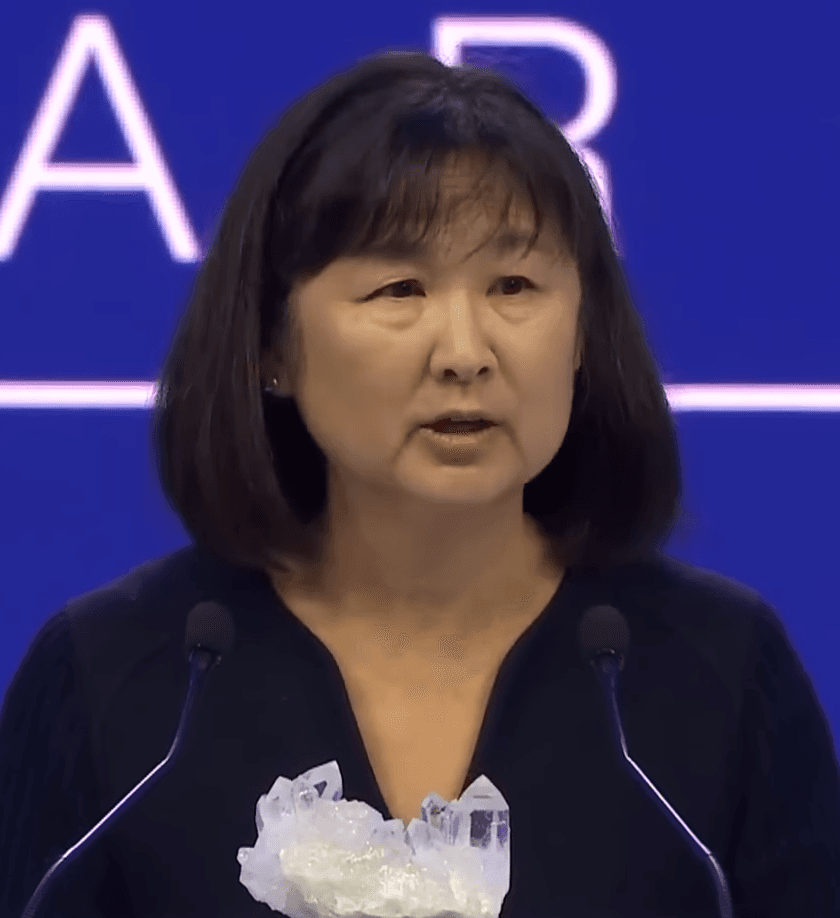
American · Arts
Myay Lin
October 5, 1959 – present
Early Life and Background
Maya Ying Lin (Chinese: 林瓔) was born on October 5, 1959, in Athens, Ohio, United States, to Chinese immigrant parents who had left China in the wake of the 1949 revolution.[4][11][17] Her parents, Henry Huan Lin (also cited simply as Henry Lin) and Julia Ming Hui Lin, were both academics and artists. Her father was a noted ceramicist and taught at Ohio University, eventually serving as dean of its art school, while her mother was a poet and professor of literature.[9][10] Growing up in a household that combined scholarship, craft, and a strong connection to Chinese culture, Lin was surrounded by influences that would later shape her approach to art and architecture.
As a child, Lin spent considerable time in her father’s ceramics studio, observing and experimenting with materials and form.[18] She also roamed the landscapes of southeastern Ohio, a region marked by rolling hills and ancient Indigenous earthworks such as the Serpent Mound. Biographical accounts note that these early experiences with both the tactile world of clay and the sculptural forms of the land seeded her interest in earthworks, topography, and minimal interventions in the environment.[2][12]
Lin attended local schools in Athens and displayed early aptitude in mathematics and science as well as art. She has described herself as introverted, drawn to reading and solitary making rather than to social life, an orientation that later informed the contemplative tone of her memorials.[5] As the daughter of Chinese immigrants in a predominantly white Midwestern college town, Lin grew up negotiating multiple cultural identities, an experience that contributed to her sensitivity to questions of belonging, memory, and representation.
Education and Formative Influences
After high school, Lin enrolled at Yale University, where she studied architecture and sculpture.[16][18] At Yale College she pursued a combined focus in art and architecture, earning her Bachelor of Arts in 1981
While still an undergraduate, Lin took a senior seminar in funerary architecture, where she explored how societies remember the dead through built forms.[17] This intellectual and design exploration would become directly relevant when, in 1980, a national competition was announced for a memorial to United States service members who died in the Vietnam War. Encouraged by a professor, she developed a submission that drew on her academic and personal reflections on grief and collective memory. Lin later returned to Yale for graduate study, earning her Master of Architecture (M.Arch.) in 1986 from the Yale School of Architecture.[16][18] Her formal training as both an architect and an artist laid the groundwork for a career that would move fluidly between building design, sculpture, installations, and environmental projects. Yale’s environment—rich in intellectual debate and critical theory—also sharpened her ability to articulate the conceptual underpinnings of her work, a skill she would need as her designs became the subject of public controversy. Lin’s career was dramatically launched when, as a 21-year-old undergraduate, she entered the open competition for the Vietnam Veterans Memorial in Washington, D.C. The competition, organized for a site on the National Mall, drew more than 1,400 entries from across the United States.[12][13][17] In 1981, the jury unanimously selected her design: two simple, wedge-shaped walls of polished black granite, set into the earth and meeting at an angle, with the names of over 58,000 U.S. service members killed or missing in Vietnam inscribed chronologically.[12][17] Lin’s concept was radically different from traditional heroic figurative monuments. She envisioned a "cut" in the earth, opening a wound in the landscape that could be touched and experienced, with the reflective surface allowing visitors to see themselves within the field of names.[17] Her minimal design emphasized personal encounter over didactic narrative. The chronological listing of names created a subtle timeline of loss, while the descent along the wall’s length offered a physical metaphor for immersion into memory and grief. The proposal, however, immediately became controversial. Critics attacked the memorial as too abstract and insufficiently patriotic, and some objected to the choice of a young Asian American woman as designer.[2][5][17] Others felt the dark granite and lack of heroic figures conveyed shame rather than honor. Political and veterans’ groups debated the design intensely, and compromises were negotiated, including the addition of a representational bronze statue "The Three Soldiers" and a flagpole near the site.[17] Despite the conflict, construction proceeded, and the memorial was completed and opened to the public in 1982.[17] On November 13, 1982, the Vietnam Veterans Memorial was formally dedicated on the National Mall, in ceremonies that coincided with Veterans Day.[2][17] Visitors quickly began leaving flowers, letters, photographs, and other mementos, transforming the site into a living archive of personal remembrance.[17] Over time, the initial controversy gave way to widespread admiration; many veterans reported powerful emotional experiences when encountering the wall. The Vietnam Veterans Memorial became one of the most visited sites in Washington, D.C., and is widely regarded as a turning point in the history of memorial design. Art historians and critics credit Lin with demonstrating that minimal, landscape-integrated forms can carry deep emotional resonance, and with reconceiving memorials as participatory spaces rather than distant monuments.[4][12][17] Following the success and debates surrounding the Vietnam Veterans Memorial, Lin continued to develop her practice, taking on projects that bridged architecture, sculpture, and public memory. In the late 1980s, she was commissioned by the Southern Poverty Law Center (SPLC) in Montgomery, Alabama, to design a memorial to individuals killed during the U.S. civil rights movement.[4][6] Completed in 1989, the Civil Rights Memorial consists of a circular black granite table, set at a slight angle and inscribed with the names and key dates of 40 martyrs of the movement, along with significant legal milestones. Water flows continuously over its surface, inviting visitors to touch and trace the names.[6] A curved wall behind the table bears a quotation from Martin Luther King Jr.: "Until justice rolls down like waters and righteousness like a mighty stream."[6] On November 13, 1989, the Civil Rights Memorial was dedicated in Montgomery, a city central to the history of civil rights struggles.[6] The memorial’s integration of text, water, and stone created a meditative environment that connects the sacrifices of activists to ongoing efforts for justice. Its placement at SPLC headquarters underscores the organization’s commitment to documenting hate crimes and defending civil rights.[6] With this project, Lin expanded her role from interpreter of war memory to chronicler of domestic social transformation. The Civil Rights Memorial demonstrated her capacity to distill complex narratives of racism, courage, and legal change into a simple yet potent experiential form. It also reinforced her interest in using water and landscape as active elements of remembrance. Alongside her memorials, Lin has designed architectural projects, interior spaces, and numerous sculptures and installations. After earning her M.Arch. in 1986, she established a studio practice that allowed her to work across disciplines.[16][18] Her architecture includes private residences and institutional buildings characterized by clean lines, attention to natural light, and sensitive siting in the landscape. As an artist, Lin has created series such as "Disappearing Bodies of Water", which maps threatened lakes and seas through sculptural forms.[8] She often employs materials like wood, stone, and recycled media, and uses topographic data to create works that visualize environmental change. Many installations are large-scale earthworks or room-filling pieces that encourage viewers to consider the fragility of ecosystems.[12][16] In 2009, Lin launched "What Is Missing?", a multi-sited, multimedia project that serves as a memorial to extinct and endangered species and habitats.[12] The work exists as physical installations, videos, and an online platform, highlighting the ongoing disappearance of biodiversity and inviting public participation in envisioning conservation solutions. Although specific launch dates are documented by year rather than day, the project has become a central focus of her later career. Lin’s practice consistently addresses themes of landscape, time, and loss. Whether mapping river systems, creating wave-like forms from wood or glass, or cutting into the earth to reveal underlying structures, she seeks to make visible the processes—geological, historical, and ecological—that shape human experience. Her dual training allows her to integrate architectural precision with sculptural expressiveness, blurring boundaries between disciplines.[12][16] Lin’s work and the controversies surrounding it have been the subject of extensive documentation. In 1994, the documentary film "Maya Lin: A Strong Clear Vision", directed by Freida Lee Mock, premiered.[8] The film examines her upbringing, her time at Yale, the design and construction of the Vietnam Veterans Memorial, and the intense public debates that accompanied it, as well as her subsequent projects. On March 27, 1995, the documentary received the Academy Award for Best Documentary Feature at the 67th Academy Awards, substantially increasing public awareness of Lin’s story and the broader issues of race, gender, and authority in public art.[8] The film has since served as a key resource for students and scholars studying the intersection of design, politics, and collective memory. In 2000, Lin published "Boundaries", a book that reflects on her art, architecture, and design philosophy.[4] The text explores the conceptual frameworks underpinning her projects and discusses her experiences navigating institutional structures and public opinion. "Boundaries" offers insights into her commitment to minimal form, environmental awareness, and the emotional dimensions of space. Lin has frequently participated in public lectures, interviews, and exhibitions, articulating her views on memorialization, environmental crisis, and the responsibilities of artists and architects. She has appeared in programs such as PBS’s "Becoming American: The Chinese Experience", where her life is presented as part of the broader narrative of Chinese American history.[5] Through these platforms, she has become an influential voice in debates about how societies remember and how design can catalyze reflection and change. Over the course of her career, Maya Lin has received numerous awards and honors acknowledging her artistic and civic contributions. She has been awarded grants from the National Endowment for the Arts (NEA) and has received honorary doctorates from multiple institutions.[12][18] She was inducted into the National Women’s Hall of Fame, which praised her for reshaping public consciousness through the Vietnam Veterans Memorial and her subsequent work.[13] On February 25, 2009, Lin was awarded the National Medal of Arts by President Barack Obama, recognizing her as an architect and artist whose work has deeply influenced how Americans remember and engage with their history.[4][12] This is the highest official U.S. honor for artistic achievement, underscoring the national significance of her practice. On November 22, 2016, President Obama further honored Lin with the Presidential Medal of Freedom, the United States’ highest civilian award.[4][15] The White House citation noted that her "profoundly moving" memorials and environmental projects had changed how the nation thinks about monuments and memory, and highlighted her efforts to draw attention to climate change and species extinction.[4] In 2022, TIME magazine named Lin to its TIME100 list of the world’s most influential people, reaffirming her global impact on art, architecture, and environmental activism.[4] The accompanying profile emphasized the enduring power of the Vietnam Veterans Memorial and the importance of "What Is Missing?" in raising awareness of ecological loss. Lin’s works have been exhibited and commissioned internationally, and she is represented by major galleries such as Pace Gallery.[18] Her career has been recognized across multiple domains—fine art, architecture, public history, and environmental advocacy—reflecting the breadth of her influence. Maya Lin has largely maintained a private personal life, but available biographical sources note that she married Daniel Wolf, an art and photography dealer and collector.[8] The couple have at least one daughter.[8] Lin has often balanced family life with an intensive studio practice and travel for projects and installations. She has been based primarily in New York City, with later ties to Colorado as well, living and working in environments that support engagement with both urban culture and expansive landscapes.[6][18] Her personal commitment to environmental causes, including climate and conservation issues, is reflected not only in her work but also in her choice of living environments and collaborations with scientific and advocacy organizations. Lin’s identity as a Chinese American woman has been central to many interpretations of her life and work. She has spoken about both the challenges and strengths of occupying this positionality in fields historically dominated by white men, and her success has made her an important figure for Asian American and women’s representation in architecture and design.[2][5] Maya Lin is widely regarded as one of the most significant designers of memorials in the late 20th and early 21st centuries. Her Vietnam Veterans Memorial is frequently cited as a turning point in the evolution of public monuments, demonstrating that minimalist, landscape-integrated forms can carry profound emotional weight.[4][17] The memorial’s influence can be seen in later projects across the world that prioritize visitor experience, reflection, and integration with the environment. Her Civil Rights Memorial further expanded the possibilities for commemorating social movements and victims of racial violence, using water and touch to create an intimate connection between visitors and the names of the dead.[6] Together, these works redefined how national trauma—war abroad and civil rights struggles at home—could be remembered in public space. Beyond memorials, Lin’s environmental projects, particularly "What Is Missing?", have brought ecological concerns into the realm of public art and design. By framing species extinction and habitat loss as a form of collective memory that must be preserved and acted upon, she has linked environmental activism to the commemorative impulse that drove her earlier work.[12] From the perspective of women’s history, Lin’s prominence as a young woman of color designing a national monument on the U.S. Mall was highly significant. Her success challenged assumptions about who could legitimately shape national narratives through architecture and design. Although sources do not consistently document precise "firsts"—such as being the first Asian American woman to design a major national memorial—her impact on representation is widely acknowledged in discussions of Asian American and women’s achievements.[2][14] Her career has also influenced generations of architects, artists, and students, many of whom study her projects as exemplars of conceptually driven, socially engaged design. Institutions ranging from universities to museums have integrated her work into curricula and exhibitions, ensuring that her approaches to minimalism, landscape, and narrative remain central to contemporary discourse.[5][16][18] Maya Lin continues to live and work, maintaining active studios and engaging in new commissions and environmental initiatives.[6][16][18] She remains involved with "What Is Missing?" and other projects that address climate change, conservation, and the visualization of data related to ecological decline.[12] Her later works often involve sophisticated mapping and modelling techniques, integrating scientific information with aesthetic form. In 2022, the 40th anniversary of the Vietnam Veterans Memorial’s dedication prompted renewed attention to Lin’s contributions. Around November 13, 2022, Smithsonian-associated exhibitions and media coverage revisited her design and career, highlighting the memorial’s enduring resonance and the evolution of public attitudes toward it over four decades.[2] This anniversary situates her early achievement within a longer historical arc, demonstrating how a project forged amid political and cultural conflict has become an accepted, even beloved, part of national memory. As of the mid-2020s, Lin’s legacy encompasses not only iconic memorials but also a sustained effort to connect art and architecture with environmental science and activism. Her work continues to inspire discussion and research, and she remains a key figure in both the history of U.S. public monuments and the broader narrative of Asian American and women’s contributions to cultural life.Breakthrough: Vietnam Veterans Memorial
Civil Rights Memorial and Expansion of Practice
Architecture, Sculpture, and Environmental Works
Documentary, Writing, and Public Discourse
Awards, Honors, and Recognition
Personal Life
Legacy and Historical Impact
Later Life and Ongoing Work
Dated achievements
8 indexed.
- Oct051959Arts
Birth of Maya Lin
Maya Ying Lin was born in Athens, Ohio, to Chinese parents.
View details Biography of Maya Lin - Britannica - Nov131982Arts
Dedication of the Vietnam Veterans Memorial
The Vietnam Veterans Memorial, designed by Maya Lin, was dedicated in Washington, D.C.
View details