← All women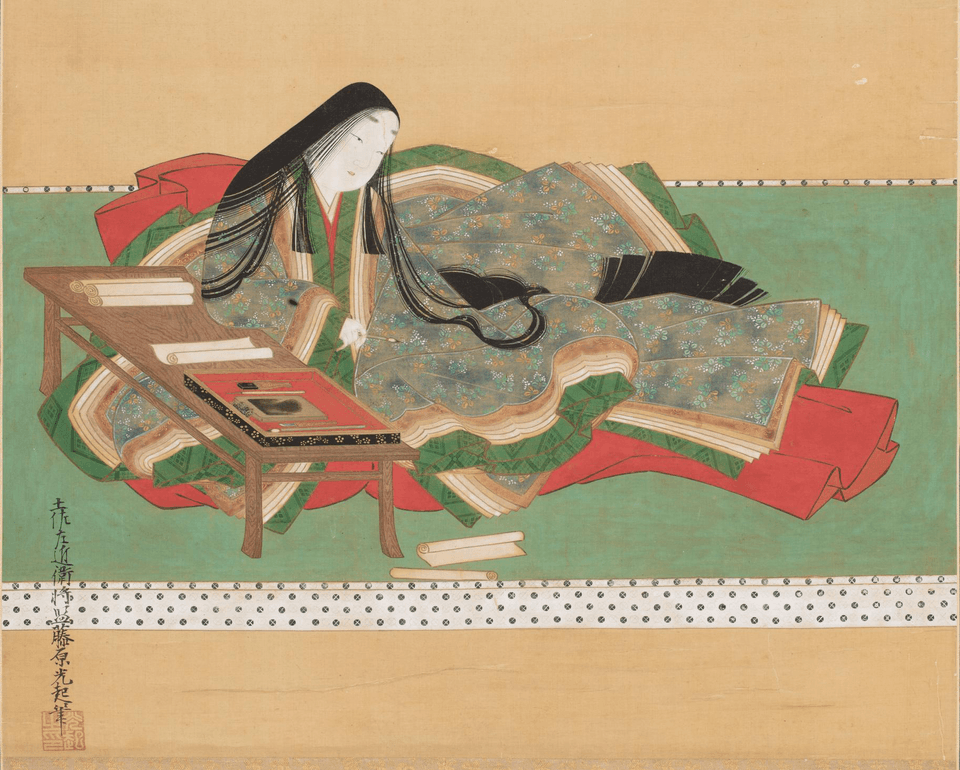
Japanese · Literature · Arts
Murasaki Shikibu
973 – 1015
Early Life and Background
Murasaki Shikibu (紫式部) is the descriptive name by which one of Japan’s most important writers of the Heian period is known. Her personal name is unknown; later sources and some modern scholars have suggested possibilities such as Fujiwara no Kaoriko, but no identification is securely documented and the appellation "Murasaki Shikibu" remains a courtly sobriquet rather than a birth name. She was born into a minor branch of the powerful Fujiwara clan, probably in Heian-kyō (present-day Kyoto), in the 970s—most modern reference works place her birth around 973–978. Her father was Fujiwara no Tametoki, a mid-ranking court official and scholar of Chinese literature, and her mother is unknown, though likely from another Fujiwara line.
Contemporary and later accounts portray Murasaki as intellectually precocious. Tametoki is said to have lamented that she was born a girl, believing she outshone her brother in classical learning, particularly in Chinese. In a court culture that largely reserved formal study of Chinese texts for men, her familiarity with Chinese poetry and prose was notable. These formative experiences—immersion in Chinese literature, exposure to court life through her father, and keen observation of aristocratic society—shaped the sensibility that would later inform her fiction and diary.
Heian Court Context
Murasaki’s life unfolded during the Heian period (794–1185), an era marked by refined court culture, elaborate rituals, and a flourishing of vernacular literature. Political power at the time lay substantially with the Fujiwara regents, who exercised control through strategic marriages of Fujiwara women to emperors. The court’s women—consorts, ladies-in-waiting, and attendants—were central figures in the creation and circulation of literature, especially in kana (the Japanese syllabary), as opposed to Chinese characters used for official documents.
Within this milieu, diaries and tales written by court women became an important literary tradition. Works such as Sei Shōnagon’s Pillow Book and other nikki (diaries) captured the texture of court life. Murasaki’s achievements must be understood against this background: she wrote not only within a thriving culture of women’s writing, but in ways that extended and transformed it, especially in the realm of long-form narrative fiction.
Marriage, Widowhood, and Turn to Writing
Around the late 990s, Murasaki married Fujiwara no Nobutaka, a court official substantially older than she was. Sources differ on the exact year, but a date around c. 998 is commonly cited. The marriage produced at least one child, a daughter later known as Daini no Sanmi, herself a distinguished poet who would contribute to the court anthology Shinkokinshū. Murasaki was widowed after only a few years of marriage; Nobutaka’s death left her with a young child and uncertain economic prospects.
Later biographical traditions suggest that Murasaki’s turn to writing was connected to her widowhood, both as a means of livelihood and as an outlet for reflection on the fragility of status and affection in courtly life. Whether or not writing directly supported her finances, it certainly became central to her identity. She began composing narratives and episodes that would eventually coalesce into her masterpiece, Genji monogatari (The Tale of Genji), drawing on her observations of aristocratic society, her reading, and her experiences as a woman navigating the constraints of the Heian elite.
Lady-in-Waiting at the Imperial Court
Murasaki’s literary talents brought her to the heart of political power. Around the year 1005, she was summoned to serve as a lady-in-waiting at the imperial court of Empress Shōshi (also known as Akiko), consort of Emperor Ichijō and daughter of the formidable statesman Fujiwara no Michinaga. Her appointment was part of Michinaga’s cultural and political project: surrounding his daughter with distinguished writers and artists who could enhance her prestige.
At court, Murasaki moved within a circle of highly educated women. Her diary and scattered references show that she participated in poetic gatherings, religious observances, and the daily routines of palace life. She observed fellow writers such as Sei Shōnagon with a critical eye, sometimes expressing disapproval of what she considered frivolity or ostentation. Serving Shōshi required balancing literary production, ceremonial duties, and careful navigation of court rivalries.
Her presence in Shōshi’s entourage linked her writing directly to the politics of the day. The Genji episodes likely circulated in manuscript form at court, being read aloud or shared among elite women. The courtly audience shaped both the content and reception of her work, which reflected the aspirations, anxieties, and intricate etiquette of the Heian aristocracy.
Major Works
Murasaki’s reputation rests primarily on three extant works attributed to her: Genji monogatari, the Murasaki Shikibu nikki (Diary of Murasaki Shikibu), and a small corpus of waka poetry. Together, they offer complementary views of Heian court culture and of her own literary practice.
The Tale of Genji
Genji monogatari (The Tale of Genji) is widely regarded as one of the world’s earliest full-length novels and a masterpiece of classical Japanese literature. Most scholars date its composition to the early 11th century, roughly between c. 1000 and 1012, with some refinement continuing into the 1010s. Though exact dates for individual chapters are uncertain, its temporal and thematic coherence suggests a sustained creative effort over many years.
The work consists of over fifty chapters (traditionally fifty-four), tracing the life and loves of Hikaru Genji, a fictional prince, and later the fortunes of his descendants and associates. Murasaki’s narrative explores themes of impermanence, desire, jealousy, familial obligation, and the subtle interplay between personal emotion and public duty. She deploys intricate characterization, psychological insight, and an elaborate sense of setting, moving through seasonal cycles, religious ceremonies, and private encounters.
Formally, Genji blends prose narration with interwoven waka poems, reflecting Heian court practice where poetry served as social communication and emotional expression. The work’s psychological depth, organic development of characters over decades, and attention to interiority have led many historians of literature to call it the world’s first psychological novel and, in a strong sense, one of the earliest "modern" novels.
Within Japan, Genji became foundational to subsequent literary and artistic traditions. It inspired picture scrolls (emaki), commentaries, and later adaptations, shaping aesthetic ideals such as mono no aware—a sensitivity to the transience of things. Internationally, modern translations introduced it to readers across Europe, the Americas, and Asia, prompting reassessments of the global history of the novel and foregrounding women’s contributions to early long-form fiction.
Murasaki Shikibu’s Diary
The Murasaki Shikibu nikki (Diary of Murasaki Shikibu) is an invaluable historical document, offering a more direct, personal window onto court life and Murasaki’s own perspectives. Written in Japanese, likely during her years at Shōshi’s court, the diary records events such as the birth and upbringing of the empress’s sons, displays of Michinaga’s wealth and influence, and the emotional dynamics among ladies of the court.
In the diary, Murasaki describes lavish ceremonies, visits to temples, and the intricate etiquette governing interactions among courtiers. She also reveals a reflective, sometimes critical mind, assessing the literary and moral qualities of those around her. Her observations of Sei Shōnagon, for example, show both admiration for her wit and reservations about her pride. Through these passages, modern scholars reconstruct aspects of Heian gender expectations, aesthetic values, and social tensions.
The diary’s mix of narrative, reflection, and detail complements Genji, grounding its fictional world in lived experience. Although the diary is more fragmentary and circumscribed than the novel, it reinforces Murasaki’s status as both keen observer and sophisticated participant in the courtly world she depicted in her fiction.
Poetry and Contributions to Waka Tradition
Murasaki’s waka poems appear in her diary, in Genji, and in later imperial anthologies, though the precise attribution of some poems can be complex. She composed within a highly codified poetic tradition, using the classical thirty-one syllable form to express emotional nuance, respond to other poets, and participate in courtly exchanges.
Her poems often engage themes of longing, separation, changing seasons, and religious reflection. The integration of poetry into Genji demonstrates how deeply the Heian elite embedded verse into daily life; characters communicate through poems, and the quality of a response could affect reputations and relationships. Murasaki’s own skill in crafting layered, allusive poetry supported her broader narrative artistry and contributed to her standing among contemporaries.
Personal Life and Relationships
Beyond her marriage to Nobutaka and her role as mother to Daini no Sanmi, details of Murasaki’s personal life are sparse and often colored by later legend. Her diary reveals bouts of melancholy, concern over status, and ambivalence about the court’s vanities. She appears as both insider and critic, benefiting from Fujiwara networks yet wary of their excesses.
Her relationship with Empress Shōshi and Fujiwara no Michinaga was pivotal to her career. Michinaga appreciated the prestige that a talented writer brought to his daughter’s salon, and Shōshi valued the companionship and cultural capital Murasaki supplied. These ties provided both security and pressure, as her literary output could be read as a reflection on the political order.
Later stories about Murasaki’s personality—depicting her as austere, jealous, or deeply romantic—often draw more on interpretations of Genji than on secure biographical evidence. Modern scholarship tends to separate the fictional persona of "Lady Murasaki" from the fragmentary historical record, emphasizing the limits of what can be known about her inner life.
Later Life and Death
The chronology of Murasaki’s later years is uncertain. Most traditional sources place her death in the early 11th century, with proposed dates ranging from around 1014–1015 to possibly as late as the 1020s or even c. 1030. The majority of modern reference works cluster around the mid-1010s, but no contemporary record gives a specific day or month.
She likely spent her final years either still attached to the court or in relative retirement, possibly continuing literary work, religious observance, and family duties. A site in northern Kyoto has been venerated as her grave, though its identification is not secure. The uncertainty surrounding her death mirrors the broader gaps in our knowledge of her life, reflecting the limitations of surviving Heian documentation and the focus of records on high-ranking male officials.
Reception, Honors, and Historical Recognition
During her lifetime, Murasaki’s Genji circulated among elite readers, gaining admiration within Shōshi’s circle and beyond. Over subsequent centuries, the work’s reputation grew. By the medieval period, it had inspired illustrated scrolls and commentaries, with scholars elaborating interpretations of its themes and constructing genealogies of its characters. While formal "awards" in the modern sense did not exist in Heian Japan, the sustained attention, copying, and study of Genji functioned as a powerful form of cultural recognition.
In early modern Japan, Genji remained a canonical text. Aristocrats, literati, and eventually a broader reading public encountered it through printed editions and adaptations. Its imagery permeated visual arts, theater, and fashion, reinforcing Murasaki’s posthumous stature. The work’s influence extended into Edo-period scholarship, where commentators debated its moral and aesthetic significance.
In the modern era, with the rise of academic literary history and comparative literature, Murasaki gained prominence as a global figure. Western translations—especially those in the 20th century—introduced Genji to international audiences. Scholars of the novel’s history began to re-evaluate Eurocentric narratives, recognizing Genji as predating major European novels by centuries and offering sophisticated psychological and structural complexity.
Legacy and Historical Impact
Murasaki Shikibu’s legacy is multifaceted. As the author of The Tale of Genji, she helped define the possibilities of long-form prose fiction, integrating character development, emotional introspection, and social observation in ways that resonate with later novelistic traditions. Her work demonstrates that a woman writer in 11th-century Japan could shape literary history on a global scale, challenging assumptions about where and when the novel "began."
Within Japanese culture, Murasaki is celebrated as a national literary icon. She appears in school curricula, cultural festivals, and artistic representations, and Genji continues to be translated, adapted, and studied. Her depiction of court life serves as a crucial historical source for the Heian period, informing research in literature, history, art history, and gender studies.
For women’s history, Murasaki’s significance lies not only in her achievements but in what her career reveals about women’s roles in premodern intellectual life. She operated within a patriarchal society that constrained women’s formal political authority yet allowed them considerable influence through cultural production. Her success illustrates how women at court used literary skill to shape taste, comment on power, and secure their own reputations.
In contemporary feminist and comparative literature scholarship, Murasaki is often invoked as an example of an early woman novelist whose work matches or surpasses later classics in sophistication. This recognition contributes to a broader effort to re-center women and non-Western authors in global narratives of literary innovation. More than a millennium after her probable death, Genji monogatari remains a living text, and Murasaki Shikibu endures as one of the most influential writers in world history.
Dated achievements
0 indexed.