← All women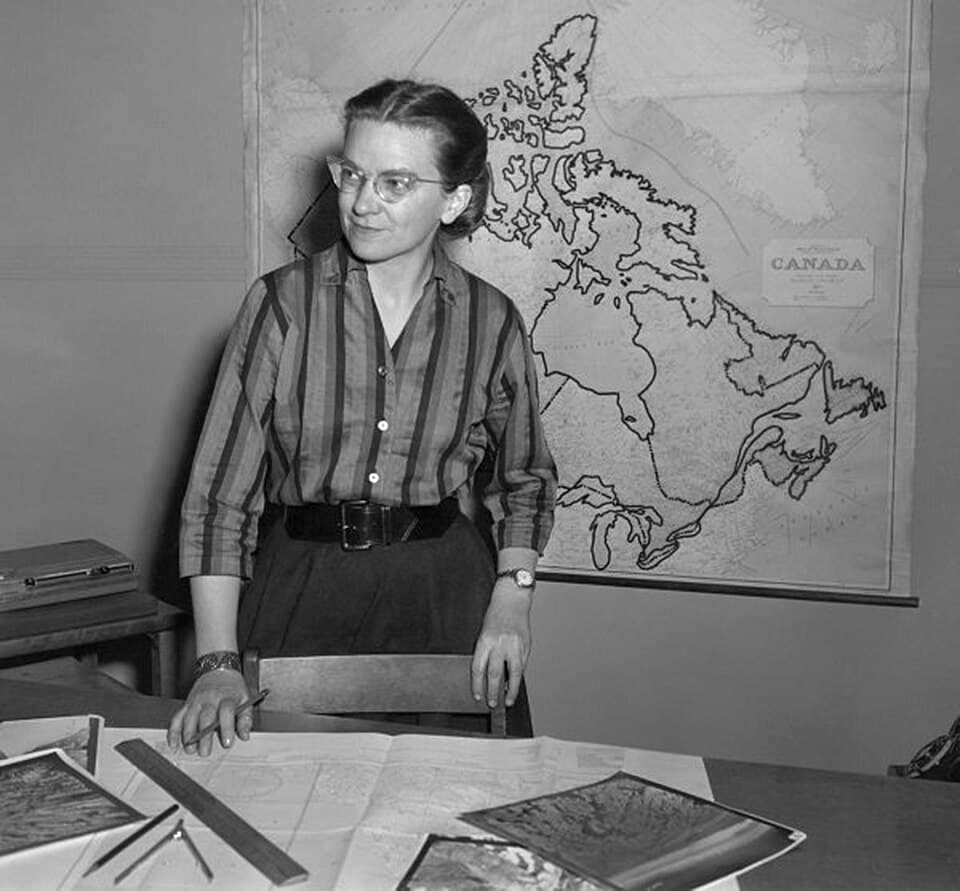
Scottish, Canadian · Science · Exploration
Moira Dunbar
February 3, 1918 – November 22, 1999
Early Life and Background
Isobel Moira Dunbar was born on 3 February 1918 in Edinburgh, Scotland.[1][4][8] She grew up in several Scottish communities, including Stornoway, Strathpeffer, and Kilmarnock, environments that combined maritime culture with rugged northern landscapes and likely helped cultivate her later interest in the Arctic.[2][4][8] Her family background is sparsely documented in public sources, but accounts agree that she was raised in Scotland and educated in girls’ schools that emphasized academic achievement.[2][5][8]
Dunbar attended Cranley School for GirlsSt Anne’s College, University of Oxford, where she studied geography and completed a Bachelor of Arts degree in 1939.[2][3][5][8] Earning an Oxford geography degree on the eve of World War II positioned her among a small cohort of women trained in the emerging discipline of modern geography.
Her formative years were marked by the social constraints placed on women’s careers and movement, particularly in technical fields. Nonetheless, Dunbar’s choice of geography and her later comfort with performance and travel during wartime show an early willingness to cross conventional boundaries between arts and science, a duality that would continue to shape her life.[2][3][5]
Wartime Theatre and Career Beginnings
After graduating from Oxford, Dunbar did not immediately enter scientific work. Instead, she spent about seven years on the professional stage in England, working as a stage actress and stage manager during World War II.[2][3][5][10] She performed with theatre troupes that traveled around the United Kingdom, providing entertainment for the armed forces and civilians in wartime conditions.[2][3][5] This first career in theatre reflected both the limited scientific employment available to women and her own versatility.
Her experience in theatre equipped her with practical skills that later proved useful in the field: confidence in male‑dominated environments, logistical organization, and the ability to work under pressure and in unfamiliar settings. Science.ca’s profile notes that her "first career was as a stage actress in London, where she performed for the armed forces during the Second World War."[3] The Globe and Mail obituary similarly describes her seven years on the professional stage before she left for Canada.[10]
By 1947, in the aftermath of World War II, Dunbar chose to shift from performance to science. She emigrated from Edinburgh to Canada carrying her geography degree and an emerging interest in polar regions.[3][6][9][10] This migration marked the beginning of her second major professional incarnation, as a researcher of Arctic sea ice.
Emigration to Canada and Early Arctic Work
In 1947 Dunbar emigrated to Canada, settling in Ottawa.[3][6][9][10] She was hired by the Joint Intelligence Bureau of Canada, where she began studying the movement of Arctic sea ice as part of Cold War strategic assessments.[3][6][9] Her work involved gathering information on ice conditions that could affect military and commercial navigation, submarine operations, and the broader geopolitics of access to the Arctic.
Sources describe this period as the start of her serious engagement with sea‑ice science. Mujeres con ciencia notes that "desde 1947 comenzó a estudiar el movimiento del hielo en el Ártico" (from 1947 she began to study the movement of Arctic ice).[6] Science.ca similarly records that she first worked for the Joint Intelligence Bureau, "gathering information on the movement of arctic ice at the time of the Cold War."[3] This early work was largely analytical, based on charts, reports, and limited field data, but it introduced Dunbar to the practical challenges of understanding ice in a strategic context.
Her presence in the Joint Intelligence Bureau also reflected a broader trend: the Cold War created new demand for technical expertise on remote environments, opening niches for some women to enter scientific intelligence and geosciences. Dunbar was among those who leveraged this opportunity, despite ongoing skepticism about women in technical and field roles.[3][6][9]
Defence Research Board and Development as a Sea‑Ice Researcher
In 1952, Dunbar moved from intelligence work into more explicitly scientific research, joining Canada’s Defence Research Board (DRB) in Ottawa.[2][3][6][9] She became a Scientific Staff Officer in the Arctic Research Section, specializing in sea ice and navigation through frozen Arctic waters.[2][3][6] Her role involved both desk‑based analysis and field reconnaissance from aircraft and, eventually, icebreakers.
At the time, "scientific work in the North was just starting," as Science.ca notes, and Dunbar helped shape the emerging field of operational sea‑ice research.[3] She studied patterns of ice formation, movement, and breakup, and she contributed to the development of standardized terminology for describing ice types and conditions.[3] Her analytical studies of ice conditions drew on data collected from summer cruises in Canadian government icebreakers and from reconnaissance flights over the Arctic islands.[3][9]
Dunbar’s work at DRB coincided with the broader expansion of Canadian Arctic science in the 1950s and 1960s, driven by military, commercial, and sovereignty concerns. Within this environment, she became recognized as an expert on sea ice whose advice informed navigation, ship design, and the planning of Arctic operations.[3][6][9]
Breaking Barriers: First Woman Ice Researcher in the High Arctic
From the beginning of her DRB career, Dunbar confronted institutional barriers to women’s participation in Arctic fieldwork. She repeatedly requested permission to travel north on military aircraft and icebreakers, facing refusals based on prevailing attitudes about the presence of women in such environments.[3][6][9] Mujeres con ciencia emphasizes that after numerous rejected requests, she persevered until she was finally allowed aboard icebreakers.[6]
In 1955 she became the first woman to conduct scientific research from Canadian icebreakers, sailing as part of the science crew on Royal Canadian Navy and other government icebreakers in the High Arctic.[1][2][3][6][9] This barrier‑breaking achievement is widely cited: the English and Spanish Wikipedia entries, the Canadian Department of National Defence profile, and educational biographies all describe her as the first woman to conduct scientific observations on Canadian icebreakers.[1][2][3][6][9]
Her fieldwork expanded dramatically once she secured this access. Dunbar logged over 600 flight hours on Royal Canadian Air Force (RCAF) aircraft conducting reconnaissance over Arctic sea‑ice and islands.[3][9] She became one of the first women to fly over the North Pole, using aerial photography and later radar imagery to map ice conditions.[2][3][9][10] Science.ca notes that "she was one of the first women to fly over the North Pole" and that she "pioneered sideways‑looking radar for airborne reconnaissance" of ice.[3]
During the 1950s she was recognized as the first woman ice researcher in Canada’s High Arctic, combining ship‑borne, airborne, and analytical methods to build a comprehensive picture of sea‑ice behavior.[2][3][6][9][10] Her ability to overcome institutional resistance to women on military platforms helped open pathways for later generations of women scientists in polar research.
Major Scientific Contributions
Dunbar’s scientific work centered on the dynamics and structure of Arctic sea ice and the development of tools to observe and classify it. One of her key contributions involved the study of polynyas, areas of open water or thin ice within otherwise continuous ice cover. Science.ca notes that she was "one of the first to observe a polynya," recognizing how strong winds and warm upwelling could create persistent openings in winter ice.[3] Understanding polynyas became important for navigation, marine ecology, and climate studies.
She also played a central role in the standardization of ice terminology, working on analytical studies and classifications that clarified how mariners and scientists should describe various ice types and conditions.[3] This terminological work helped reduce confusion in reporting and improved communication between research institutions, navies, and shipping companies.
Dunbar was an early adopter and evaluator of remote sensing technologies for ice observation. She tested and promoted the use of sideways‑looking airborne radar and other remote sensors, showing how radar images could reveal ice thickness, structure, and movement even in darkness or cloud cover.[3][6][9] This work anticipated later satellite remote sensing and contributed to making radar reconnaissance a standard tool in Arctic operations.
Her expertise extended beyond Canada. Dunbar traveled to Europe to observe icebreaking practices in other northern countries, learning from Scandinavian and other experiences and advising on ice trials for hovercraft and supertankers.[3] She contributed insights on how large vessels could safely operate in ice‑covered seas and how hovercraft might be used in polar regions, linking research to practical engineering and policy decisions.
"Arctic Canada from the Air" and Publications
A landmark achievement in Dunbar’s career was the co‑authorship of Arctic Canada from the Air with RCAF navigator Keith R. Greenaway in 1956.[2][3][6][9][10] This volume, based on extensive aerial surveys and photographic reconnaissance, provided one of the first comprehensive overviews of the geography and ice conditions of Arctic Canada from an airborne perspective.
The book combined descriptive text, maps, and aerial imagery to document coastlines, islands, ice formations, and navigational challenges. Educational biographies and IcySeas.org describe it as a pioneering effort that significantly advanced understanding of the region.[2][3][6][9] The Globe and Mail obituary notes that Dunbar "co‑authored 'Arctic Canada from the Air'," underscoring its importance in her body of work.[10]
Beyond this book, Dunbar wrote numerous scientific papers on Arctic sea ice throughout the 1950s, 1960s, and 1970s.[2][3][6][10] These publications addressed topics such as seasonal ice variability, the implications of ice conditions for navigation, and the interpretation of aerial and radar imagery. Her outputs contributed both to scientific literature and to practical manuals used by mariners and military planners.
Awards, Honors, and Recognition
Dunbar’s contributions received significant recognition in Canada. In 1971 she was awarded the Meteorological Service of Canada’s Centennial Award for her work in glaciology and sea‑ice research.[2][3] This award acknowledged her role in improving understanding of ice in relation to weather and climate.
In 1972 she received the Massey Medal from the Royal Canadian Geographical Society (RCGS) for "her excellent work in Arctic geography and sea ice".[2][3][7] She is widely noted as the first woman ever to receive this medal, highlighting her trail‑blazing role in Canadian geography and polar science.[2][3][6][7] The Canadian Department of National Defence and educational profiles both emphasize the uniqueness of this achievement.[2][3]
Dunbar’s standing in the wider Canadian scientific community was further recognized when she was elected a Fellow of the Royal Society of Canada (FRSC) in 1973.[1][2][4][8] Fellowship in the Royal Society of Canada is one of the country’s highest academic honors, awarded for exceptional scholarly, scientific, or artistic achievement.
In 1976 she was appointed an Officer of the Order of Canada (OC), one of the nation’s highest civilian honors, "for her pioneering Arctic research".[1][2][4][8] The Arabic and Danish Wikipedia entries list her as a fellow of the Royal Society of Canada and an officer of the Order of Canada, indicating international recognition of these honours.[4][8] Together, these awards place Dunbar among the most distinguished Canadian scientists of her generation.
Personal Life
Public sources on Dunbar focus primarily on her professional achievements, and relatively little is recorded about her private family life, including marriage or children. The Globe and Mail obituary describes elements of her later personal activities but does not mention spouses or descendants, suggesting either that she did not marry or that family details were not foregrounded in public remembrance.[10]
What is documented is her strong commitment to community and local history after retirement. She ran a hobby farm in Dunrobin, near Ottawa, and became an active volunteer with the March Historical Society and the Pinhey’s Point Foundation.[3][10] This third "incarnation" of her life—as the obituary calls it—shows a continuity between her interests in geography, place, and narrative: she moved from mapping Arctic landscapes to preserving and interpreting local rural and historical landscapes in Ontario.[10]
Later Life, Retirement, and Death
Dunbar retired from her formal research career in 1978, ending more than two decades of work with the Defence Research Board and related institutions.[2][3] Following retirement, she did not withdraw from active engagement with the world. Instead she operated her hobby farm and immersed herself in community historical work, contributing to exhibitions and educational materials through the March Historical Society and Pinhey’s Point Foundation.[3][10]
Her later years thus combined rural life with intellectual activity, reflecting the same blend of practicality and curiosity that had characterized her Arctic fieldwork. She continued to be recognized in scientific and historical circles for her pioneering role in sea‑ice research and as a symbol of women’s expanding participation in science.
On 22 November 1999, Dunbar died peacefully at Queensway‑Carleton Hospital in Nepean, Ontario, at the age of 81.[1][5][10] Her obituary in The Globe and Mail lists her honours (OC, FRSC), notes her major scientific achievements, and highlights her service as a local historian, encapsulating the three major phases of her life: theatre, Arctic science, and rural historical work.[10]
Legacy and Historical Impact
Isobel Moira Dunbar’s legacy spans scientific, institutional, and cultural domains. Scientifically, she is remembered as a pioneer of Arctic sea‑ice research, whose analytical studies, polynya observations, and work on standardized ice terminology laid foundations for modern operational ice services and contributed to broader understanding of polar processes.[3][6][9]
Her early adoption and testing of airborne and radar remote sensing for ice reconnaissance anticipated later satellite programs and demonstrated the value of synthetic imagery for navigation and climate research.[3][6][9] Her co‑authored book Arctic Canada from the Air remains an important milestone in the visual and cartographic documentation of Canada’s Arctic.[2][3][6][9][10]
Institutionally and culturally, Dunbar’s greatest impact lies in her role as a barrier‑breaking woman in polar science. She was the first woman to conduct scientific research from Canadian icebreakers, one of the first women to fly over the North Pole, and the first woman to receive the Massey Medal of the Royal Canadian Geographical Society.[1][2][3][6][7][9] These achievements challenged entrenched assumptions about women’s capabilities and appropriate roles in field science, especially in militarized and harsh environments.
Her story has been revisited in contemporary efforts to document women’s contributions to science. The Canadian Department of National Defence published a profile describing her as "the first woman ice researcher in Canada’s High Arctic" and emphasizing her use of sideways‑looking airborne radar.[2] Outreach articles such as "Moira Dunbar, Arctic Exploration, and Women in Science" on IcySeas.org and features on science education sites and women‑in‑science blogs continue to use her career as a case study of perseverance and excellence in the face of gendered barriers.[6][9]
In broader women’s history, Dunbar exemplifies the trajectory of 20th‑century women who moved from cultural fields (theatre) into scientific and technical roles, leveraging wartime and Cold War openings while also pushing back against institutional resistance. Her life offers insight into how individual determination, combined with changing geopolitical circumstances, enabled women to reshape scientific landscapes.
Assessment in Women’s and Polar History
Within the history of women in science, Dunbar occupies a significant though still under‑recognized place. Her achievements show that women were present and active in high‑stakes Cold War scientific intelligence and field research, even if their work was often framed in gender‑neutral terms that obscured their trail‑blazing status.
Her role in Canadian Arctic exploration is also notable. Although she was not an explorer in the romantic sense of leading large expeditions, her aerial and ship‑borne reconnaissance contributed directly to mapping and understanding vast, previously poorly documented regions of the Canadian Arctic. In this respect, she can be considered a key figure in the scientific phase of Arctic exploration, where detailed observation and analysis replaced heroic narratives with systematic knowledge.[3][6][9]
Modern depictions, including educational websites and artistic tributes created for Ada Lovelace Day, portray Dunbar as a symbol of women’s capacity to excel in physically demanding and technically complex fields. A 2025 Ada Lovelace Day illustration by Stewart Lamb Cromar highlights her as a "pioneering Scottish‑Canadian glaciologist and Arctic sea‑ice researcher," bringing her story to new audiences.[7]
Overall, Isobel Moira Dunbar’s life illustrates the intersections of gender, science, and geopolitics in the 20th century. From an Edinburgh childhood and Oxford education, through wartime theatre and Cold War ice intelligence, to recognized leadership in Canadian sea‑ice research and local historical work, she forged a multifaceted career that continues to inform both polar studies and the history of women in science.
Dated achievements
2 indexed.
- Feb031918Science
Birth of Moira Dunbar
Isobel Moira Dunbar was born in Edinburgh, Scotland, becoming a pioneering glaciologist.
View details Wikipedia - Moira Dunbar - Nov221999Science
Death of Moira Dunbar
Moira Dunbar died at Queensway-Carleton Hospital in Ottawa, Ontario, Canada.
View details