← All women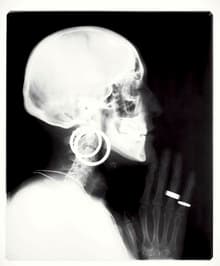
Swiss, German · Arts
Meret Oppenheim
October 6, 1913 – November 15, 1985
Early Life and Background
Meret Elisabeth Oppenheim was born on 6 October 1913 in Berlin‑Charlottenburg, then part of the German Empire.[1][3][4][5] She was the first daughter of a Swiss mother, Eva Aeschlimann, and a German father, Dr. Erich Oppenheim, a physician.[4][10] Her family was culturally engaged and unconventional; through her maternal grandmother, Lisa Wenger, a writer and painter who was a close friend of psychiatrist Carl Gustav Jung, Meret was exposed early to Jungian thought and ideas about dreams, symbolism and the unconscious.[10] These interests later aligned closely with Surrealist explorations of the psyche.
Although born in Berlin, Oppenheim spent significant parts of her childhood in Switzerland. Several sources describe her as being raised "near Basel" or in southern Germany and Switzerland, reflecting the family’s mobility during and after World War I.[1][3][14] The bilingual, bicultural environment in which she grew up nourished her sense of in‑betweeness and transformation, themes that would become central to her art.
From an early age, Oppenheim was fascinated by dreams, myths and mathematics. Encyclopedic accounts recount that at age 11 she conceived an equation "X = Rabbit," later incorporated by André Breton into Surrealist writings, indicating her precocious engagement with symbolic thinking.[13][14] The young Meret drew constantly and showed an independent, rebellious temperament, resisting traditional expectations for girls.
Education and Formative Influences
In her teens, Oppenheim increasingly committed herself to art. She admired the work of Paul Klee and other modernists, and she sketched prolifically. After secondary schooling, she moved more decisively toward an artistic career. Sources note that she briefly attended the Basel School of Arts and Crafts, gaining formal training in drawing and design before seeking broader horizons in Paris.[3][5]
At 18, in 1932, Oppenheim relocated to Paris, then the hub of the European avant‑garde, specifically to study at the Académie de la Grande Chaumière.[2][3][7][10] The academy was known for its relatively open, progressive atmosphere, and her time there offered life‑drawing practice and exposure to contemporary artistic debates. More importantly, the move immersed her in the circles of the Surrealists.
Through fellow student and friend Alberto Giacometti, Oppenheim quickly met leading Surrealist figures including André Breton, Man Ray, Marcel Duchamp and Max Ernst.[2][7][10][18] She began frequenting the Café de la Place Blanche and other gathering spots where artists exchanged ideas about automatism, chance, eroticism and the unconscious. The Surrealists were intrigued by her wit and originality; she modeled for Man Ray and developed close relationships within this predominantly male community.
Oppenheim’s early works already showed Surrealist tendencies. In 1933, while in Paris, she produced the sketch L’Oreille de Giacometti (Giacometti’s Ear), an image later cast in bronze in 1959.[4][13] The piece demonstrates her interest in bodily fragments and metamorphosis—the ear detached and transformed—motifs she would revisit throughout her career.
Career Beginnings and Development
Oppenheim’s first significant public recognition came rapidly. She participated in Surrealist exhibitions and collaborated with Man Ray on photographs that played with identity, disguise and the objectification of women.[2][3][17] Her jewelry designs and objects attracted attention among avant‑garde circles. She also contributed to Surrealist publications and conversations, though official manifestos remained largely dominated by male voices.
In 1936, at the age of 22–23, Oppenheim achieved sudden, international fame with the creation of her most famous work, Object (Le Déjeuner en fourrure) (Lunch in Fur). The work consists of a standard porcelain teacup, saucer and spoon covered in Chinese gazelle fur.[1][2][3][16][17] The idea reportedly emerged during a conversation with Pablo Picasso and Dora Maar about covering everyday objects in fur; Oppenheim then realized the concept with startling simplicity and precision.[3][19]
That same year, she had an early solo show in Basel and participated in the landmark Exposition surréaliste d’objets organized by Breton.[7][16] Her fur‑covered set was exhibited at the Surrealist Objects exhibition in Paris and attracted immediate attention for its unsettling juxtaposition of domestic familiarity and animalistic sensuality.
"Object (Le Déjeuner en fourrure)" and Surrealist Fame
The decisive institutional moment for Object came on 9 December 1936, when the Museum of Modern Art (MoMA) in New York acquired the work for its collection.[4][20] MoMA soon exhibited the piece in its influential show Fantastic Art, Dada, Surrealism, and it rapidly became emblematic of Surrealist object practice and, more broadly, of 20th‑century art.[1][3][16]
Critics and historians hailed the fur cup as a definitive Surrealist object, precisely because it transformed a banal object of everyday domestic ritual into a tactile, disquieting presence. The work invoked ideas of consumption, desire and disgust: the promise of warmth and comfort of tea is disturbed by the hairy surface, suggesting bodily intimacy and animality.[2][17] For many viewers, the piece alluded to the eroticization of women and the intersection of domestic labor and sexuality.
The enormous success of Object had complex consequences for Oppenheim. On one hand, it established her as a major Surrealist and secured her a place in the canon, particularly as one of the few women artists recognized at that level.[1][2] On the other hand, she felt overshadowed by the work’s fame, fearing that her identity would be reduced to "the artist of the fur cup." This tension contributed to a period of self‑doubt and partial withdrawal from the Parisian avant‑garde.
Return to Switzerland and Mid‑Career Work
As the political situation in Europe deteriorated toward World War II, Oppenheim left Paris and returned to Switzerland around 1937–1939.[3][5][14] She settled in Basel and later in Bern, where she engaged with local artistic communities and supported herself through various jobs, including design work and assisting in her father’s practice. During this time, she continued to produce art but felt the weight of critical expectations shaped by her earlier Surrealist fame.
In the 1940s and early 1950s, Oppenheim experimented across media—painting, drawing, prints, and small objects. Her work often incorporated mythological references, animal forms, and hybrid creatures, reflecting both Jungian symbolism and a personal mythology. She developed a distinctive visual language that resisted straightforward classification as either Surrealist or abstract.[3][18]
A significant step in her public re‑emergence occurred in 1954, when she participated in the exhibition Femmes Peintres Suisses (Women Painters of Switzerland) at the Kunsthalle Bern.[1][13] The show sought to increase visibility for women artists in Switzerland. Though Oppenheim later criticized the idea of segregating women’s art, her inclusion marked recognition of her importance within the national context.
In 1956, she held a major solo exhibition at Galerie Cordier in Paris.[1][13] This show is often considered her first major postwar solo presentation, reintroducing her to French audiences and confirming that her practice had evolved well beyond the fur cup. Works from this period explore landscapes, symbolic objects, dream imagery and metamorphosis, underlining her refusal to be fixed in a single style.
Major Works and Artistic Themes
Throughout her career, Oppenheim created a wide range of works across media:
- Surrealist objects, including Object (Le Déjeuner en fourrure) and later pieces that transformed everyday items into uncanny, poetic forms.[1][2][3]
- Jewelry and design, such as bracelets, rings and accessories that blurred boundaries between art and adornment, often incorporating animal motifs or unexpected materials.[2][10]
- Paintings and drawings that featured dreamlike landscapes, hybrid bodies, symbolic structures and playful abstractions, revealing her engagement with mythology and psychological archetypes.[3][18]
- Poetry and texts, in which she articulated her views on creativity, gender and artistic freedom, further demonstrating her intellectual rigor.[3][5]
Among her notable works are pieces like My Nurse, Spring Feast, and numerous objects and collages that reflect her interest in the transformation of materials and meanings.[1] She repeatedly emphasized that the artist’s imagination should not be constrained by gendered expectations or by strict adherence to any movement’s dogma. Her practice embraced contradiction—both sensual and austere, playful and rigorous.
Awards, Honors and Institutional Recognition
From the 1960s onward, Oppenheim received increasing official recognition. In 1967, her work appeared in important exhibitions in Switzerland, coinciding with rising scholarly interest in Surrealism.[1] On 8 November 1967, she was formally awarded the Art Prize of the City of Basel (Basler Kunstpreis), acknowledging her contributions to contemporary art and her role as a pioneer in object art and Surrealist practice.[4][5]
On 24 January 1975, the canton of Basel‑Stadt conferred on her the Culture Prize of Basel‑Stadt.[4][9] Around this period, she delivered speeches in which she forcefully argued that there is no "women’s art" separate from "men’s art" and that creativity is fundamentally human.[3][9] She criticized the art world’s tendency to marginalize women and insisted on the importance of equal recognition.
In the 1970s and early 1980s, Oppenheim’s reputation broadened further. She was invited to join the Academy of Arts in Berlin, and in 1982 she received the Grand Award of the City of Berlin, reflecting her cross‑border significance as a German‑born Swiss artist.[9] Museums in Switzerland and abroad increasingly collected and exhibited her work.
On 6 October 1983, her 70th birthday, the city of Bern inaugurated the Meret Oppenheim‑Weg, a public path named in her honor.[4] Municipal sources emphasize that this was one of the first urban spaces in Switzerland named after a contemporary woman artist during her lifetime, signaling both local pride and a broader shift in public commemoration practices.
In 1984, the Kunstmuseum Bern mounted a major retrospective titled simply Meret Oppenheim, presenting an overview of her life’s work.[1][18] The exhibition was a pivotal event, consolidating her status as a central figure in 20th‑century art and offering a more holistic view of her oeuvre beyond the fur cup.
Personal Life
Oppenheim’s personal relationships intersected with her artistic milieu. In Paris, she had close friendships and romantic entanglements with fellow artists, including Max Ernst.[3][5] She modeled for Man Ray and appeared in iconic photographs that both reflected and critiqued the Surrealists’ tendency to cast women as muses.
After returning to Switzerland, she sought greater independence. In 1949, she married Wolfgang La Roche, a businessman.[3][5] The marriage provided some financial stability but did not diminish her commitment to art; she continued to work and exhibit, increasingly on her own terms. Sources do not emphasize children, suggesting that her primary focus remained her artistic life.
Oppenheim lived for extended periods in Basel and Bern, maintaining a studio and engaging with local and international networks. She cultivated friendships with other artists and writers and remained intellectually engaged with debates about Surrealism, feminism and modernism. She resisted being reduced to the role of muse or "female Surrealist," insisting on the autonomy of her artistic vision.
Views on Gender and Creativity
Although often cited in feminist art histories as an important example of a woman navigating male‑dominated avant‑garde circles, Oppenheim herself was wary of being labeled as a "woman artist" in a restrictive way. She repeatedly argued that there is no inherent difference between the creative powers of men and women and that such distinctions were socially constructed.[3][5][9]
Nevertheless, her experiences of marginalization and objectification informed her work. Many of her objects, including Object, can be read as critiques of the ways women are associated with domesticity and sensual consumption. Later scholars, including institutions like the National Museum of Women in the Arts, have emphasized that her oeuvre embodies themes central to feminist inquiry—body, desire, domestic labor and the revaluation of craft—even if she did not adopt explicit feminist rhetoric.[2]
Legacy and Historical Impact
Meret Oppenheim is now widely recognized as one of the most significant women artists of the 20th century and a key figure in Surrealism and modern art.[1][2][3][18] Her work has been collected and exhibited by major institutions worldwide, including MoMA in New York, Kunstmuseum Bern, and other leading museums. Her fur‑covered tea set remains an enduring symbol of Surrealist innovation, frequently reproduced in textbooks and exhibitions.[1][20]
Beyond the single iconic object, Oppenheim’s legacy lies in her insistence on artistic freedom and her refusal to be constrained by gender, nationality or style. She bridged German and Swiss cultures, participated in Parisian avant‑garde circles, and later contributed to debates in postwar European art. Her multidisciplinary practice—encompassing sculpture, painting, jewelry, poetry and photography—anticipated later conceptions of the artist as a cross‑media experimenter.[2][17][18]
Her impact is especially notable in the history of women in art. She was one of the few women recognized within the core Surrealist group, and her success with Object demonstrated that a young woman could produce a work considered central to a major movement.[3][6] Later feminist scholars and institutions have highlighted her as a precursor to feminist art, someone who challenged the domestic sphere and the objectification of women through subtle yet powerful transformations of everyday objects.[2]
In addition, Oppenheim’s own writings and statements continue to resonate. Her assertion that creativity is not gendered but human, and her critique of the notion of "women’s art," complicate simple narratives while supporting efforts to recognize women artists on equal terms with men. Contemporary exhibitions, such as those organized by Hauser & Wirth and other galleries, have contributed to renewed interest in her work and thought.[18]
Later Life and Death
In her final decade, Oppenheim enjoyed increasing recognition and institutional support. The 1984 retrospective at Kunstmuseum Bern gave her the opportunity to shape public understanding of her oeuvre while she was still alive, showcasing the breadth of her practice and countering the tendency to focus solely on the fur cup.[1][18] She continued to produce new works and to participate in discussions about art and society.
On 15 November 1985, Meret Oppenheim died in Basel, Switzerland, aged 72.[1][3][5] Her death followed a long, intensely creative life that had begun with Surrealist experiments in Paris and evolved into a multifaceted practice recognized across Europe and beyond. Obituaries and subsequent scholarship emphasized both her role in Surrealism and her broader significance as a pioneer of object‑based and conceptual approaches to everyday materials.
Posthumously, her reputation has grown. Exhibitions, catalogues and scholarly studies have explored her contributions in greater depth, situating her alongside artists such as Man Ray, Max Ernst, and contemporaries like Dora Maar while also acknowledging her distinctiveness. Paths, prizes and institutional collections in Switzerland and abroad continue to honor her, and her work remains a touchstone in narratives about modernism, Surrealism and the history of women in art.[2][18][20]
Dated achievements
6 indexed.
- Oct061913Arts
Birth of Meret Oppenheim
Meret Oppenheim is born in Berlin-Charlottenburg, Germany.
View details Britannica: Meret Oppenheim Biography - Dec091936Arts
Object (Le Déjeuner en fourrure) acquired by MoMA
Her iconic fur-covered teacup, saucer, and spoon are acquired by MoMA.
View details