← All women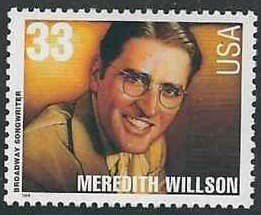
American · Arts
Meredith Willson
May 18, 1902 – June 15, 1984
Early life and education
Robert Reiniger Meredith Willson was born in Mason City, Iowa, on 18 May 1902, and he grew up in a family and community that fostered musical talent from an early age.[1][5][6] Biographical accounts describe him as musically gifted as a child and note that he later became closely identified with the city that shaped his imagination.[5][11][12] He was known to friends as “Mere,” and his hometown background would later become central to his best-known musical, The Music Man.[12]
Willson’s early development reflected both local opportunity and formal training. He performed in Mason City as a young musician and later enrolled in New York’s Damrosch Institute of Musical Art, the institution that became the Juilliard School, where he pursued advanced musical study beginning in 1920.[7][11] That move marked a decisive transition from a gifted Midwestern youth to a professional musician entering the national musical world.
His education gave him a foundation in flute performance, composition, and arranging, but his later career would show an unusual ability to move between elite concert settings and popular entertainment. That versatility became one of the defining features of his professional life.[1][4][7]
Career beginnings: band, orchestra, and early professional reputation
Willson’s first major professional breakthrough came in the 1920s. In 1923, he joined John Philip Sousa’s band as a flautist, gaining national touring experience and establishing himself as a performer of unusual skill.[1][4][7] The following year, he became a flautist with the New York Philharmonic Orchestra, where he worked with major conductors and deepened his classical credentials.[1][4][7]
Those years were important because they placed him at the intersection of symphonic prestige and popular touring culture. Few musicians could move so easily between the concert hall, the marching band, and the emerging commercial music industries. Willson’s technical fluency and adaptability allowed him to do precisely that, and these early appointments built the reputation that later carried him into radio and composition.[1][4][7]
After serving in the Army, he moved into a broader set of musical roles. By 1938, he had begun work in radio, eventually becoming a musical director and head of the NBC West Coast division.[1][4] Radio in this period was one of the most influential entertainment media in the United States, and Willson’s work in it expanded his reach far beyond the concert stage. He helped shape orchestral and popular programming for national audiences, proving that a classically trained flutist could become a major figure in broadcast entertainment.[1][4][7]
Film scoring and wartime-era popular music
In 1940, Willson composed the score for Charlie Chaplin’s first talking film, The Great Dictator.[3][4] The project connected him to one of the most famous film artists of the era and demonstrated that his arranging and compositional skills were suited not only to live performance and radio but also to cinema. He later received Academy Award recognition for this work, which placed him within the history of major Hollywood film scoring.[4][6]
His songwriting also broadened his reputation in the 1940s and early 1950s. Among his best-known standards is “It’s Beginning to Look a Lot Like Christmas,” written in 1951 and widely popularized through recordings by Bing Crosby and others.[1][6][11] The song became one of the most durable Christmas standards in American popular music, demonstrating Willson’s ability to write melodies that survived changing fashions and entered seasonal tradition.[1][6][11]
Willson’s other songs, including “May the Good Lord Bless and Keep You,” “You and I,” and “Till There Was You,” also circulated widely in the repertory of American popular music.[6][11] Together, they show a composer whose craft was not limited to one hit musical but extended into the everyday listening life of the country.
The Broadway breakthrough: The Music Man
Willson’s greatest artistic achievement was The Music Man, which opened on Broadway on 19 December 1957 at the Majestic Theatre.[1][4] He wrote the book, music, and lyrics, a rare full authorship that made the work uniquely his.[1][4][7] Drawing inspiration from his Iowa upbringing, the show transformed the setting of a small-town Midwestern community into a richly theatrical world of persuasion, civic life, and musical exuberance.[11][12]
The musical was an immediate success and became one of the most enduring works in the American stage repertory. Its score included songs that became standards, and the show’s balance of humor, sentiment, and rhythmic vitality helped secure its place in Broadway history.[1][4][7] It won the Tony Award for Best Musical in 1958, and the original cast album received a Grammy in 1959.[5][7] The show’s success also demonstrated that a musical rooted in regional memory could become a national favorite without losing its local flavor.[11][12]
The Music Man became the work for which Willson is most widely remembered, and it shaped public perceptions of Iowa, band culture, and small-town America for generations. The musical’s continued revival life has kept his name present long after the original production closed.[1][4][11][12]
Later Broadway work and continuing reputation
Willson did not stop with The Music Man. His second major Broadway musical, The Unsinkable Molly Brown, opened in 1960 and extended his reputation beyond a single triumph.[4][11] He later created Here’s Love in 1963, an adaptation of Miracle on 34th Street, for which he provided the book, music, and lyrics.[1][4] Although none of these later projects equaled the historic impact of The Music Man, they confirmed that he was a serious and prolific dramatist rather than a one-hit songwriter.[4][7]
Willson’s work continued to be recognized late in life. On 9 June 1982 he received a star on the Hollywood Walk of Fame for Radio, and on 24 June 1982 he was inducted into the Songwriters Hall of Fame.[6][14] These honors reflected the full breadth of his career: radio leadership, Broadway composition, and popular songwriting.[6][14]
Personal life
Biographical sources indicate that Willson was married more than once. The IMDb biography notes marriages to Rosemary Patricia Sullivan, Ralina Zarova, and Elizabeth “Peggy” Wilson.[8] He also appears in public memory as a figure whose career and personal life were intertwined with performance culture, travel, and collaboration.[8][11] Source material provided here does not reliably document all family details, so only the relationships specifically confirmed in available biographical references are included.[8]
Willson’s life also had a strong civic and philanthropic dimension. Accounts of his career emphasize not only his artistic achievements but also his role as a celebrated public figure connected to Iowa’s cultural identity.[12] His personal reputation in his home state remained closely tied to the pride Mason City took in being the inspiration for The Music Man.[11][12]
Legacy and historical impact
Meredith Willson’s legacy rests on his ability to unite several musical worlds that were often treated as separate: concert performance, radio direction, film composition, and Broadway songwriting.[1][4][7] He was a flautist with classical training, a band musician under Sousa, an orchestral performer, a radio executive, and a dramatist whose stage work became a national classic.[1][4][7] That range made him unusually representative of twentieth-century American musical life.
His best-known work, The Music Man, turned Iowa small-town memory into a durable national myth while also providing one of Broadway’s most beloved scores.[1][11][12] Songs such as “Seventy-Six Trombones” and “Till There Was You” remain familiar to audiences, and “It’s Beginning to Look a Lot Like Christmas” has become a seasonal staple.[1][6][11] His influence is still visible in stage revivals, recordings, institutional honors, tourism, and commemorative tributes such as the Iowa Award and the USPS stamp.[5][11]
Willson died on 15 June 1984 in Santa Monica, California.[1][4][6] Yet his name continues to stand for a distinctive kind of American musical craftsmanship: polished, melodic, theatrical, and deeply rooted in place. His career shows how a Midwestern musician could become a national cultural figure without abandoning the regional identity that made his work memorable.[1][11][12]
Dated achievements
8 indexed.
- May181902Arts
Birth of Meredith Willson in Mason City, Iowa
Birth of Robert Reiniger Meredith Willson in Mason City, Iowa, future composer of *The Music Man* and one of America’s best-known musical storytellers.
View details Meredith Willson - Wikipedia - Dec191957Arts
Broadway opening of The Music Man
Broadway opening of *The Music Man* at the Majestic Theatre, the musical that became Meredith Willson’s signature work and a lasting stage classic.