← All women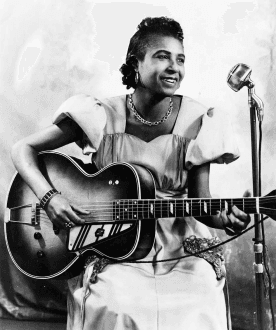
American · Arts
Memphis Minnie
June 3, 1897 – August 6, 1973
"
Early Life and Background
Memphis Minnie, born Lizzie Douglas on June 3, 1897, in Algiers, Louisiana, was the eldest of thirteen children born to Abe and Gertrude (Wells) Douglas. Nicknamed 'Kid' by her family, she grew up in a poor sharecropping household. When she was around seven years old, the family moved to Walls, Mississippi, a small town just south of Memphis, Tennessee, in the heart of the Mississippi Delta blues region.
At approximately age eight or ten, Lizzie received her first musical instrument, a banjo, followed soon after by a guitar. She proved to be a naturally gifted musician, and by her early teens she was slipping away from home to busk and perform in Memphis, particularly on the famous Beale Street, absorbing the sounds of medicine shows, jug bands, and itinerant blues musicians. She reportedly ran away from home as a teenager to join a traveling circus and performed with the Ringling Brothers Circus for a time, further honing her showmanship and stagecraft. Her formal education was minimal, as was typical for poor rural Black children in the Jim Crow South, but her musical education—self-taught and absorbed from the vibrant oral tradition of Delta and Memphis blues—was extraordinarily rich.
Career Beginnings
By the 1920s, Lizzie Douglas was working as a professional musician in Memphis, playing on street corners, in juke joints, and at house parties, often partnering with various guitarists and combining traditional country blues with the rowdier, more urban sounds of Beale Street. It was during this period she adopted the stage name Memphis Minnie. She partnered romantically and musically with several men over the years, and in the late 1920s she was working with guitarist Kansas Joe McCoy, whom she would marry.
In June 1929, the duo was discovered performing on Beale Street by a talent scout for Columbia Records, leading to their first recording session that same month in Memphis. Their debut single, featuring the song 'Bumble Bee,' was an immediate success, showcasing Minnie's virtuosic guitar work and expressive, assertive vocals. The success of these sides led Columbia (and subsequently other labels) to bring the duo to Chicago, which was rapidly becoming the epicenter of recorded blues music.
Rise to Fame in Chicago
Minnie and McCoy relocated to Chicago in the early 1930s, where Minnie quickly established herself as one of the most in-demand blues performers of the era. She recorded prolifically for labels including Vocalion, Decca, Bluebird, and Okeh throughout the 1930s and into the 1940s, ultimately amassing a recorded catalog of nearly 200 songs—an extraordinary output for any blues artist of her generation, let alone a woman.
Her songs ranged from double-entendre-laden party numbers to sharp, socially observant commentary on poverty, relationships, and daily life for Black Americans during the Great Depression and World War II eras. Notable recordings include 'Bumble Bee' (1929), 'I'm Talking About You', 'When the Levee Breaks' (1929, later famously reworked by Led Zeppelin as 'When the Levee Breaks'), 'Me and My Chauffeur Blues' (1941), and 'In My Girlish Days' (1941), among many others. She played both acoustic and, notably, was among the earlier blues artists to adopt the electric guitar in the late 1930s and 1940s, helping to pioneer its use in blues performance and recording.
Minnie was renowned for her technical guitar skill, and blues folklore holds that she won guitar 'cutting contests'—informal musical duels—against prominent male musicians including Big Bill Broonzy and Muddy Waters. She was reportedly awarded a bottle of gin and the title of victor in a famous contest against Broonzy at a Chicago blues club, a story that has become emblematic of her reputation as a fierce and formidable musician who refused to be diminished by the male-dominated blues scene.
Marriages and Musical Partnerships
Memphis Minnie was married multiple times, and her marriages were frequently also musical collaborations. Her first husband was reportedly a man named Casey Bill Weldon, though this is debated among biographers; she is more definitively documented as having been married to and recording with Kansas Joe McCoy from around 1929 until their split around 1934–35. Following her separation from McCoy, she partnered with and later married guitarist Ernest 'Little Son Joe' Lawlars (also known as Son Joe) in 1939. The couple recorded together extensively throughout the 1940s, with Lawlars providing rhythm guitar backing on many of Minnie's most celebrated recordings, including 'Me and My Chauffeur Blues.' Their musical and personal partnership lasted until Minnie's declining health in the late 1950s.
Later Career and Decline
Minnie continued performing and recording into the 1950s, adapting her sound to the emerging Chicago electric blues scene that she had helped pioneer, and which would soon give rise to figures like Muddy Waters and Howlin' Wolf who built directly upon the foundation she and her contemporaries established. However, as tastes shifted and her health began to decline, her career slowed considerably.
In 1957, Minnie and Lawlars returned to Memphis. She suffered a serious stroke in 1960, which left her partially paralyzed and largely unable to perform or play guitar thereafter. Lawlars died in 1961, and Minnie's health continued to deteriorate over the following decade. She spent her final years cared for by her sister, Daisy Douglas Johnson, in a Memphis nursing home, living in relative poverty and obscurity despite her earlier fame—a common fate for blues artists of her generation who saw little in the way of royalties or long-term financial security from their recorded work.
Death and Burial
Memphis Minnie died on August 6, 1973, in Memphis, Tennessee, at age 76. She was buried in New Hope Cemetery in Walls, Mississippi, in what was for decades an unmarked grave. In 1996, admirers of her music, including blues-rock musician Bonnie Raitt, funded a proper headstone for her grave through the Mount Zion Memorial Fund, a nonprofit dedicated to honoring forgotten blues musicians.
Legacy and Recognition
Memphis Minnie's influence on American music is difficult to overstate. She was one of the first and most successful female blues guitarists to achieve national recording success, defying the gender norms of the blues industry, which typically confined women to vocal-only roles (as with classic blues singers like Bessie Smith and Ma Rainey) while reserving instrumental prowess as a male domain. Her guitar technique—intricate fingerpicking, innovative use of the electric guitar, and rhythmic drive—directly influenced the sound of Chicago blues and, by extension, rock and roll.
Her songs have been covered and reinterpreted by a wide range of later artists. Led Zeppelin's famous 1971 track 'When the Levee Breaks' draws directly from her and Kansas Joe McCoy's 1929 original. Other artists who have covered or cited her influence include Jefferson Airplane, Bonnie Raitt, and numerous blues revivalists.
In recognition of her towering contribution, Memphis Minnie was inducted into the Blues Hall of Fame in 1980 and the Memphis Music Hall of Fame. She remains a celebrated figure in blues scholarship and Black history, cited as a pioneering figure who paved the way for future generations of women in blues, rock, and popular music. Her recorded catalog of nearly 200 songs continues to be studied, reissued, and celebrated as an essential part of the American musical canon, and she is widely regarded as one of the greatest blues guitarists—male or female—of the 20th century.
"Dated achievements
3 indexed.
- Jun031897Arts
Birth of Lizzie Douglas (Memphis Minnie)
Born Lizzie Douglas near Algiers, Louisiana, on June 3, 1897; she would become one of the most influential blues guitarists and singers of the 20th century.
View details Memphis Minnie - Wikipedia - Jun181929Arts
First Recording Session for Columbia Records in Memphis
Memphis Minnie and Kansas Joe McCoy were discovered by a Columbia Records talent scout and recorded their debut sides in Memphis in June 1929.