← All women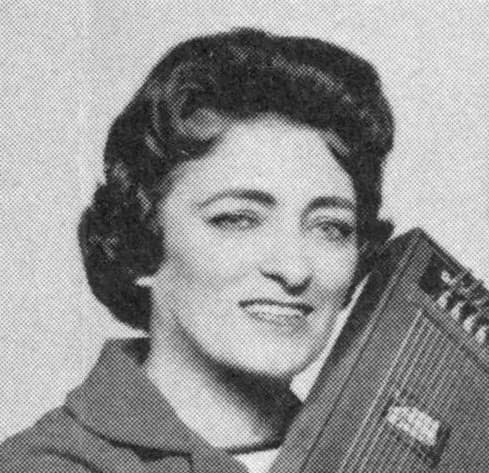
American · Arts
Maybelle Carter
May 10, 1909 – October 23, 1978
Early Life and Background
Maybelle Addington Carter was born on May 10, 1909, in the Copper Creek community near Nickelsville, Scott County, Virginia, in the Appalachian region of the state.[2][4][5] She was one of the ten children of Margaret Elizabeth (Kilgore) Addington and Hugh Jackson Addington, a farming family whose livelihood and culture were rooted in rural southwest Virginia.[1][2][8][11] The Addington household was steeped in music; family members sang hymns and ballads, and instruments such as the autoharp, banjo, and fiddle were common at home and in local gatherings.[5][14]
From an early age, Maybelle showed exceptional musical aptitude. Her mother taught her to play the banjo and autoharp, and she quickly became proficient, later gravitating toward the guitar, which would become her primary instrument.[5][8][11] By around age twelve she was reportedly winning regional picking contests, evidence of a prodigious talent emerging from a modest rural setting.[8] These experiences in Copper Creek and Nickelsville exposed her to a repertory of folk songs, religious hymns, and dance tunes that would later form the core of the Carter Family’s recorded catalog.
Appalachia in the early 20th century was economically isolated and largely agrarian, with limited opportunities for women beyond domestic and farm labor. Yet it was also a fertile ground for musical creativity, where oral traditions flourished. In this environment, Maybelle’s skill on stringed instruments and her intuitive approach to melody and rhythm began to set her apart. The informal, community-based performance contexts of churches, barn dances, and front porches provided the training ground for her future innovations in country guitar.[2][14][15]
Marriage and Family Foundations
On March 13, 1926, Maybelle married Ezra J. Carter, a member of a nearby family who was a cousin of Alvin Pleasant (A.P.) Carter
Maybelle and Ezra had three daughters: Helen Myrl (b. 1927), Valerie June (later known as June Carter, b. 1929), and Anita (b. 1933).[1][15] All three would become musicians in their own right, eventually performing with their mother as the Carter Sisters and Mother Maybelle. This multi-generational musical family stood out at a time when women were rarely recognized as instrumental leaders or band organizers. In 1927, A.P. Carter invited Maybelle to join a vocal trio with his wife and Maybelle’s first cousin, Sara Elizabeth Dougherty Carter.[2][5][16] The group became known as the Carter Family, combining A.P.’s talent for collecting and adapting songs, Sara’s powerful lead vocals, and Maybelle’s innovative guitar and autoharp playing.[1][16] That summer, the trio traveled from their Virginia home to Bristol, Tennessee, to audition for record producer Ralph Peer of the Victor Talking Machine Company.[2][5][16] On August 1–2, 1927, in a makeshift studio over the Taylor-Christian Hat Company, they cut six sides, including “Bury Me Under the Weeping Willow” and “Single Girl, Married Girl.”[2] These recordings became part of what are now known as the Bristol Sessions, often described as foundational in the birth of commercial country music.[2][3] Maybelle’s role in these sessions was crucial. She played guitar with a strong, driving style that provided both rhythmic support and melodic interest. Her thumb picked out the melody on the bass strings, while her fingers brushed the treble strings for chords—a technique that would later be codified as the "Carter scratch" or "Carter lick."[1][5] This approach was unusual within the 1920s country recording context, where guitars typically served a purely rhythm role behind fiddles or voices. Over the late 1920s and early 1930s, Maybelle refined her thumb–lead style into a distinctive technique that allowed the guitar to carry the melody line while simultaneously providing chordal accompaniment.[1][5][14] This style drew on elements of older banjo picking and autoharp playing, but its application to the steel-string acoustic guitar was strikingly new. Music historians frequently credit her with helping to establish the guitar as a lead instrument in country music.[1][4] On May 10, 1928, the Carter Family recorded “Wildwood Flower” in Camden, New Jersey, a performance that came to be recognized as one of the clearest expressions of Maybelle’s mature style.[4] Her flowing, vocal-like guitar lines on this track became iconic, and the recording is still used as a teaching model by guitarists studying early country and bluegrass techniques.[4] Throughout the 1930s, the Carter Family continued to record for Victor and later other labels, producing a substantial body of work that included songs such as “Keep on the Sunny Side,” “Can the Circle Be Unbroken,” and “I’m Thinking Tonight of My Blue Eyes.”[1][16] Maybelle’s guitar and autoharp accompaniments were central to the group’s sound, marrying rhythmic solidity with lyrical melodic phrasing. Their recordings were widely distributed across the United States, bringing Appalachian-derived song material and Maybelle’s instrumental style to a national audience.[2][4][15] In addition to studio work, the trio performed on radio, notably through broadcasts from border stations and regional outlets that increased their reach. By the late 1930s, the Carter Family was often described as one of the first "supergroups" of country music, with Maybelle recognized among peers as a leading guitarist.[2][15][16] The original Carter Family lineup with A.P., Sara, and Maybelle began to wind down its activities in the early 1940s, in part because of personal changes and the evolving music business.[1][2][16] Maybelle continued performing, however, forming a new group with her daughters Helen, June, and Anita. This act was billed as Mother Maybelle and the Carter Sisters.[1][2] Through the 1940s and 1950s, Mother Maybelle and the Carter Sisters appeared on radio programs and touring shows, including the influential Grand Ole Opry, further solidifying Maybelle’s status as a central figure in country music.[1][2][15] The group blended older Carter Family songs with newer material, featuring close vocal harmonies and Maybelle’s guitar and autoharp. June Carter’s comic monologues and later songwriting added another dimension to their performances. Maybelle’s presence in this period was significant not only musically but symbolically. She was now widely referred to as “Mother Maybelle”, a title that captured both her role as matriarch of a musical clan and her perceived status as a nurturing figure in the broader country music community.[3][5][15] Her continued leadership as an instrumentalist, even as her daughters took on more vocal spotlight, reinforced her reputation as one of the rare female guitar virtuosos in the genre. In the 1960s and 1970s, Maybelle’s musical life became closely interwoven with that of her son-in-law, Johnny Cash, who married her daughter June Carter in 1968.[1][13][15] Prior to and after their marriage, the Carter Sisters and Mother Maybelle frequently toured with Cash, and the Carter Family songs were integrated into his live shows and recordings. Maybelle appeared on Cash’s television programs and concert stages, often introduced respectfully by Cash as a foundational influence on his music and on country at large.[1][3][15] These appearances brought her work to new audiences, including younger listeners of the folk revival and mainstream country-pop, many of whom discovered the earlier Carter Family recordings through her performances with Cash. During this period, she also recorded solo and collaborative projects that highlighted her guitar and autoharp playing, and she participated in interviews and oral histories that documented the history of the Carter Family and her own career.[1][6][11] Even as she coped with health challenges later in life, she remained active enough to perform and to mentor younger musicians who sought her guidance on traditional repertoire and technique. Maybelle Carter’s most enduring accomplishment lies in her transformation of the guitar’s role in country and related styles. Her "Carter scratch"—melody on the bass strings with the thumb, chords brushed on the treble strings with the fingers—allowed one player to fulfill both lead and rhythm functions.[1][4][5] This approach influenced countless guitarists, among them Chet Atkins, Doc Watson, and generations of bluegrass pickers. Among the recordings that cemented her reputation, “Wildwood Flower”, “Keep on the Sunny Side”, “Can the Circle Be Unbroken”, and “I’m Thinking Tonight of My Blue Eyes” stand out as canonical country songs.[1][4][16] On these tracks and many others, her playing exhibits clarity, drive, and an expressive melodic sense that complements the voices rather than overshadowing them. In addition to guitar, Maybelle was a highly respected autoharp player. She helped elevate the instrument from a parlor novelty to a serious folk and country instrument, using it to provide rich, chordal accompaniments in both the original Carter Family and later ensembles.[1][4][15] Her facility on multiple instruments contributed to the group’s distinct sound and broadened the palette of American string-band music. During her lifetime, Maybelle Carter received increasing recognition from the country music industry and fans. She was honored as a member of the Country Music Hall of Fame through the induction of the Carter Family, reflecting their status as one of the "first families" of the genre.[6] She also became the subject of retrospective articles, radio features, and scholarly studies that highlighted her guitar innovations and her influence on American popular music.[3][4][11][15] Posthumously, her legacy has continued to be celebrated. In 2001, the Carter Family, including Maybelle, was inducted into the Bluegrass Music Hall of Fame (International Bluegrass Music Museum’s Hall of Fame), recognizing their foundational impact on the string-band traditions that fed into bluegrass.[12] Museums, archives, and educational programs—including the Country Music Hall of Fame and Museum and Virginia’s historical resources—feature exhibits and teaching materials on her life and work.[2][5][6] Contemporary media, such as NPR’s "Forebears" series and curated playlists, have introduced her to new generations, often referring to her as the "Mother of popular country music" or "Mother of Country Music."[3][14] These tributes underscore a broad consensus among historians and musicians that Maybelle Carter occupies a central place in the history of American roots music. Accounts from family members and contemporaries describe Maybelle Carter as a calm, steady presence, dedicated to both her family and her music. She balanced touring and recording with raising her three daughters, encouraging their musical development and eventually performing with them professionally.[1][2][15] Her marriage to Ezra Carter endured through the strains of the music business and the economic challenges faced by early country performers. Ezra played a supportive role in managing aspects of the Carter Family’s career, including travel and business arrangements. The extended Carter–Addington–Cash family formed a tight-knit network of musicians, spouses, and children who lived, traveled, and worked together for decades.[1][8][15] In interviews, Maybelle often emphasized the importance of the songs themselves and the communities from which they came. She saw herself as a keeper and interpreter of traditional material, even as her guitar style introduced a modern, technically sophisticated element to those songs.[3][6][11] Her modest demeanor and reluctance to seek the spotlight for herself contributed to a public image of quiet authority rather than overt showmanship. In her later years, Maybelle suffered from arthritis and Parkinson’s disease, conditions that increasingly limited her mobility and playing.[2] Nevertheless, she continued to appear on stage and in recordings when able, supported by her family and fellow musicians. Her later performances, often with Johnny Cash and the extended Carter–Cash clan, underscored her role as an elder stateswoman of country music.[1][2][6] On October 23, 1978, she died suddenly of a respiratory ailment in a Nashville hospital.[2][4][6] She was buried at Woodlawn Memorial Park East in Hendersonville, Tennessee, a cemetery later renamed Hendersonville Memory Gardens.[2] Her passing prompted extensive obituaries and tributes in the country music press and among fans, many of whom hailed her as a pioneer whose work had shaped the sound of the genre for half a century. Maybelle Carter’s legacy rests on several intertwined contributions. First, she was instrumental in transforming the guitar into a lead instrument within country music, using the Carter scratch to carry melody and rhythm simultaneously.[1][4][5] This technique influenced not only country guitarists but also musicians in bluegrass, folk, and early rock, helping to establish the guitar’s dominance in 20th-century popular music. Second, as a member of the original Carter Family, she helped popularize a vast body of Appalachian and southern folk songs, many of which entered the standard repertoire of country and American roots music.[1][2][16] Their recordings preserved and disseminated material that might otherwise have remained localized, and Maybelle’s accompaniments gave these songs a distinctive sonic identity. Third, Maybelle’s career stands as an important example of a woman instrumentalist and band leader achieving long-term prominence in a male-dominated industry. Her status as "Mother Maybelle" and the "Mother of Country Music" reflects not only familial associations but also a recognition that she nurtured and shaped the genre itself.[3][5][15] She opened pathways for later women guitarists and bandleaders by demonstrating that technical mastery and musical leadership were not confined to men. Finally, her influence continues through recordings, instructional materials, museum exhibits, and the ongoing performances of Carter Family songs by contemporary artists. Guitarists still learn her arrangements note for note, while scholars cite her as a key figure in the evolution of American vernacular music.[3][4][11][14] In the broader history of women in music, Maybelle Carter occupies a central place as a rural Appalachian woman whose artistry redefined an instrument, shaped a genre, and left an indelible mark on the soundscape of the 20th century.Formation of the Carter Family and Career Beginnings
Development of the "Carter Scratch" and Recording Career
The Carter Sisters and Mother Maybelle
Collaboration with Johnny Cash and Later Performances
Major Works, Style, and Accomplishments
Awards, Honors, and Recognition
Personal Life and Character
Later Life and Death
Legacy and Historical Impact
Dated achievements
6 indexed.
- May101909Arts
Birth of Maybelle Addington (Carter)
Maybelle Addington was born on May 10, 1909, near Nickelsville, Virginia.
View details Wikipedia - Maybelle Carter - Aug011927Arts
First Carter Family recording session at the Bristol Sessions
On August 1, 1927, the Carter Family recorded their first commercial tracks at the Bristol Sessions.