← All women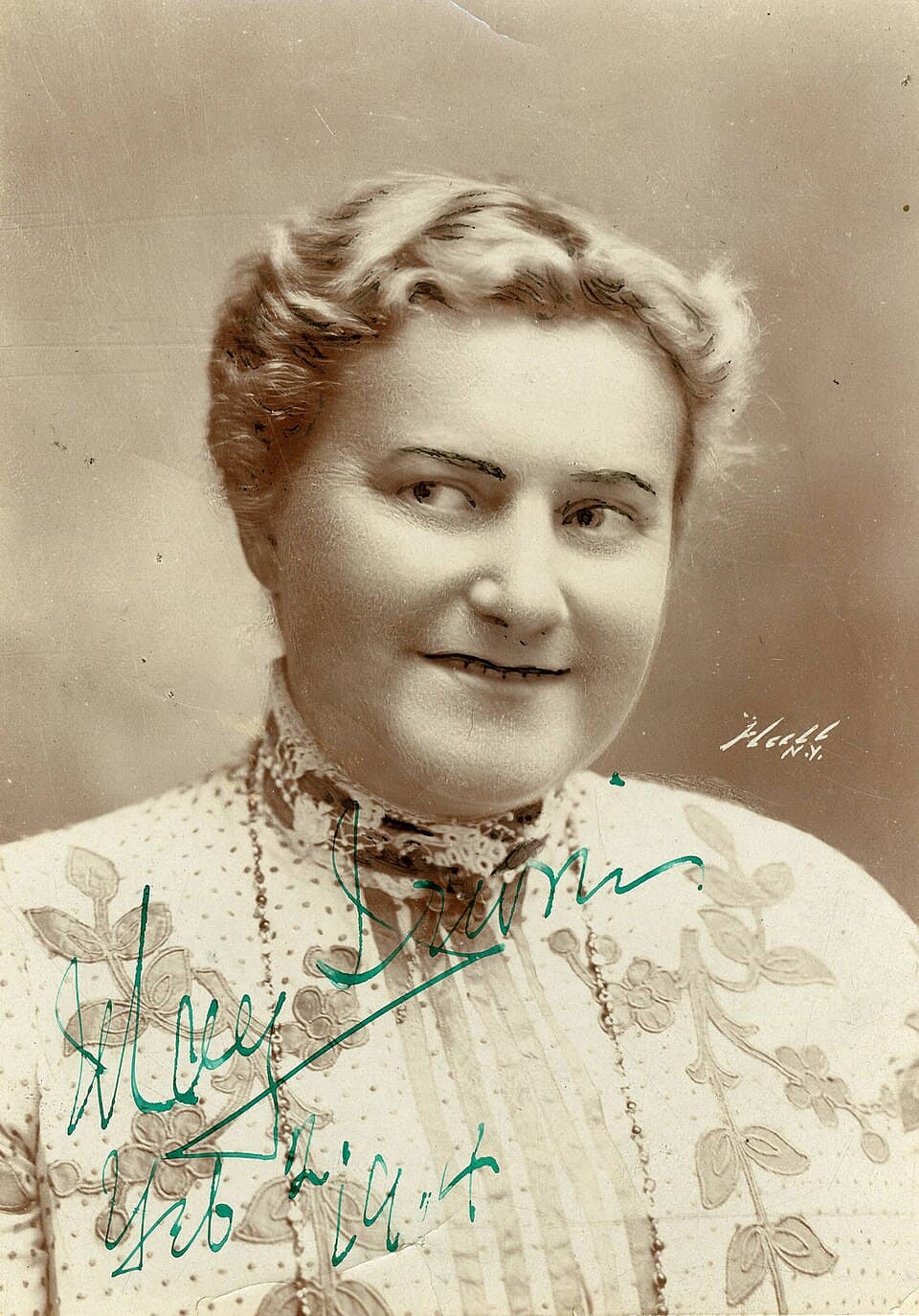
Canadian · Arts
May Irwin
June 27, 1862 – October 22, 1938
Early Life and Background
May Irwin, born Georgina May Campbell on 27 June 1862 in Whitby, Canada West (now Ontario), was the second of two daughters of Robert E. Campbell and Sophoria Jane Draper.[1][4][10] Her family background was solidly middle‑class, but not wealthy, and her father’s death when she was about thirteen dramatically altered their economic circumstances.[1][4] In need of income and aware of her daughters’ talent, Irwin’s "stage‑minded" mother encouraged May and her elder sister, Adeline Flora—known professionally as Flo Irwin—to perform.
Irwin received some formal education at St. Cecilia Convent, Mount Hope, Ontario, according to biographical reference works.[10] However, her schooling soon gave way to professional ambitions. The family relocated frequently in search of opportunity, and the girls’ performing talents quickly became their primary means of support. This early responsibility shaped Irwin’s later reputation as a practical, shrewd businesswoman, as well as a versatile entertainer.
Growing up in small‑town Ontario, Irwin was far removed from the major theatrical centres of New York and London. Yet the border between Canada and the United States was porous for performers, and cross‑border touring troupes provided a path to larger stages. Her Canadian origins remained a point of pride: contemporary accounts and later encyclopedias consistently describe her as a Canadian‑born American actress and singer, underscoring her hybrid cultural identity.[3][10]
Career Beginnings
Irwin’s professional career began very early. With her sister she developed a singing and comedy act, performing as the Irwin Sisters. Encyclopedia entries note their first professional appearance around the mid‑1870s, with a documented booking in Buffalo in 1875.[10] Soon they were appearing in New York, debuting at the London Theatre in 1877 and working in vaudeville and burlesque under impresario Tony Pastor, one of the architects of American variety theatre.[10]
These formative years in Pastor’s company were crucial. Vaudeville demanded versatility: singers needed to be comedians, and comedians often integrated popular songs into their routines. Irwin honed a robust, good‑humoured stage persona marked by a rich contralto voice, physical comedy, and an earthy style that contrasted with the more delicate femininity idealized in Victorian middle‑class culture. She and Flo became popular attractions, earning enough to stabilize their family finances.
Around age twenty‑one, Irwin launched a solo career, signaling both ambition and confidence in her own drawing power.[2][5][10] In 1883 she joined Augustin Daly’s stock company, one of the premier theatre ensembles in New York.[5][10] Working with Daly from roughly 1883 to 1887, she learned the discipline of repertory theatre and became known for her improvisational skills, often adding comic business or ad‑libbed lines that enlivened productions.[5] Daly’s troupe also toured to London, where Irwin appeared in Dollars and Sense in 1884, giving her an early international credit.[10]
Rise to Stardom in Vaudeville and Broadway
By the 1890s, Irwin was widely recognized as a major star of vaudeville and Broadway. Biographical summaries describe her as a star of vaudeville, a label reflecting both her popularity and her centrality to the evolving culture of mass entertainment.[1][3][4] She specialized in full‑length farces and musical comedies that showcased her comic timing, improvisation, and singing of topical and novelty songs.
Among her most successful stage vehicles were A Country Sport (1893) and The Widow Jones (premiering 28 December 1895).[10] In these plays, Irwin often portrayed bold, flirtatious, and independent women, using humour to invert conventional gender expectations. Contemporary accounts and later scholarship note that she popularized several hit songs through her performances, including "After the Ball", "I'm Looking for de Bully" (published as "May Irwin's Bully Song"), "A Hot Time in the Old Town", and "The Opera Rag".[1][10] Her interpretation of "Bully Song" in particular has been cited in discussions of early ragtime and coon songs, although the racialized nature of such material is now critically examined.
Irwin’s comic style was distinctive: she was often described as a "coon shouter," a term used at the time for performers who sang ragtime‑inflected songs with exaggerated dialect.[1][4] While these songs are now understood as participating in problematic racial stereotyping, they were central to the period’s popular music. Irwin’s renditions helped shape audience expectations for what ragtime and comic songs sounded like on stage, and her success reinforced the economic importance of female performers to both theatre and the emergent recording industry.
Her popularity translated into financial success. Period commentary and later retrospectives assert that Irwin was among the highest‑paid actresses and singers of the 1890s, earning sums that were remarkable for a woman entertainer of her time.[8][9] This financial independence allowed her to invest in property, including a substantial estate in the Thousand Islands region on the St. Lawrence River, which became central to her personal life.
Major Works and Cinematic Firsts
Irwin’s most enduring claim to historical fame arises from her participation in the earliest years of motion pictures. While still starring in The Widow Jones, she performed a playful onstage kiss with actor John C. Rice. According to biographical notes and film histories, inventor Thomas A. Edison saw this stage moment and invited the pair to recreate it for his camera.[2][5]
On 21 April 1896, Irwin and Rice filmed The Kiss at Edison’s studio. The short, often running under a minute, shows the two seated, leaning toward each other, exchanging a hearty kiss, and then sharing affectionate conversation.[2][6] This film is widely cited in reference works and encyclopedias as the first onscreen kiss in cinematic history.[1][3][6][10] Its release provoked moral anxiety among some viewers and commentators, who considered such intimacy daring or even indecent. Nonetheless, the film became a sensation, demonstrating the power of motion pictures to capture and disseminate intimate moments on a mass scale.
Irwin’s involvement in The Kiss positioned her at a crucial juncture in media history. She bridged live theatre and the new medium of film, bringing established stage business into the realm of recorded moving images. In doing so, she helped define how romance and humour could be visually represented, and her hearty, unapologetic performance challenged more delicate ideals of feminine modesty. For women’s history, this moment highlights a woman performer actively shaping one of cinema’s foundational tropes, rather than merely being its passive subject.
Irwin returned to film years later in the silent feature Mrs. Black Is Back, released on 26 January 1914.[1][2] This production, now largely lost except for still photographs, cast her in a comic role compatible with her stage persona. Biographical summaries note that Mrs. Black Is Back was her only feature‑length film, and that after its release she did not pursue an extensive screen career, preferring the stage and live performance.[2][5] Nonetheless, the film stands as evidence of her adaptability and of the early integration of established theatre stars into the developing film industry.
Beyond film, Irwin contributed to the popular song repertoire by performing and sometimes writing comic songs such as "Frog Song" and "Ragtime Dance", mentioned in modern blog‑style retrospectives.[5] These works complemented her farces, reinforcing her image as a multi‑talented entertainer who could carry a full evening’s bill with both spoken comedy and musical numbers.
Awards, Honors, and Professional Recognition
While formal awards for theatre and film were not yet institutionalized during Irwin’s prime, contemporary accounts emphasize the exceptional scale of her success. Retrospective pieces and social‑media‑style historical notes refer to her as one of the most well‑known and well‑loved comediennes of her era and identify her as the world’s highest‑paid actress and singer of the 1890s.[8][9] Although such superlatives are difficult to verify quantitatively, they align with the consistent portrayal of Irwin as a top‑tier star in both vaudeville and Broadway.
Her professional recognition is also evident in the range of venues and producers who employed her. She worked under Tony Pastor, one of the architects of vaudeville, and Augustin Daly, a leading figure in legitimate theatre.[10] She headlined multiple Broadway productions, with databases such as the Internet Broadway Database crediting her in numerous shows over several decades.[12] This pattern of sustained starring roles indicates that critics and audiences alike valued her work.
Irwin’s pioneering status in film has been memorialized in reference works, which routinely mention her as the woman who gave cinema its first famous screen kiss.[1][3][4][11] While not an award in the institutional sense, this enduring association functions as a symbolic honour in film history, ensuring that her name appears in discussions of the medium’s origins.
Personal Life
Irwin’s personal life reflected both conventional and unconventional elements for a woman of her time. Encyclopedia entries record that she married Frederick W. Keller, a businessman, in 1878, when she was still in the early phase of her performing career.[10] The couple had two sons, Walter and Harry. Keller died in 1886, leaving Irwin a widow with children at a relatively young age.[10] This loss likely intensified her need to sustain a high‑earning career in entertainment.
On 26 May 1907, Irwin married again, this time to Kurt Eisfeldt (often spelled Eisenfeldt), who had been her agent.[2][6][10] This partnership linked her professional and personal worlds; having an agent as a spouse may have further strengthened her negotiating position and business acumen in an industry that often exploited performers, particularly women.
Irwin’s affection for the Thousand Islands region on the St. Lawrence River became a defining feature of her private life. Articles in regional historical magazines describe her establishing a substantial residence there, where she spent long periods away from the city and entertained guests.[9] Anecdotal accounts, including a popular "today in history" note, credit her with naming "Thousand Island Salad Dressing" after the archipelago, though this story remains more folklore than fully documented fact.[8][9] Nonetheless, it underscores her social presence in the region and her engagement with leisure culture.
Descriptions of Irwin emphasize that she was not only beloved onstage but also a smart business woman, managing her own affairs and property.[5] In this respect, her personal life illustrates how a woman performer in the late 19th and early 20th centuries could leverage fame into enduring financial stability and social autonomy.
Legacy and Historical Impact
Irwin’s historical significance rests on several intertwined contributions: her role in popular theatre and vaudeville, her shaping of early popular music, and her participation in the formative years of cinema. As a star of vaudeville, she helped define the genre’s blend of comedy, song, and variety, setting expectations for the kind of robust, audience‑engaging performance associated with the form.[1][3][10] Her success demonstrated that women could be central, not peripheral, to mass‑market entertainment.
Musically, Irwin introduced and popularized songs that became staples of turn‑of‑the‑century popular culture, such as "After the Ball" and "A Hot Time in the Old Town".[1][10] Her performances of ragtime‑inflected and dialect pieces contributed to the spread of those styles, although modern perspectives critically assess the racial stereotypes embedded in some of the material. This dual legacy—commercial success and participation in problematic conventions—makes her an important figure for historians examining the intersection of gender, race, and entertainment.
In film history, her legacy is especially concentrated in The Kiss. The image of Irwin and John C. Rice sharing a hearty kiss has been repeatedly reproduced in textbooks, documentaries, and online archives as an emblem of the new medium’s capacity to capture intimate human behaviour.[1][2][7][11] That this pivotal image features a woman of strong build and middle age, rather than a delicate young ingénue, also challenges later stereotypes about how femininity appears on screen. Irwin’s unapologetic, jovial performance foregrounds humour and mutual enjoyment, rather than coyness or victimhood.
For women’s history, Irwin exemplifies the possibilities and limits faced by female entertainers in her era. She achieved remarkable earnings and creative control, yet much of her repertoire was constrained by the period’s expectations and prejudices. Her career invites nuanced assessment: she was both a trailblazer for women’s visibility and agency in entertainment and a participant in cultural forms that modern audiences view critically.
Later Life and Death
In her later years, Irwin gradually withdrew from continuous theatrical work, spending more time at her Thousand Islands home while maintaining a public presence through occasional performances and appearances.[9][10] Even as film and radio rose to dominance, she remained associated primarily with stage comedy and early film novelty, rather than with the new generation of talkies.
On 22 October 1938, Irwin died in New York City at the age of 76, with biographical sources citing bronchial pneumonia as the cause of death.[1][2][3] She was buried at Kensico Cemetery in Valhalla, New York, according to modern data collections.[14] Obituaries and later references remembered her as a beloved comedienne, a star of vaudeville, and the woman who gave the world its first widely publicized screen kiss.
After her death, Irwin’s name persisted in specialized histories of theatre, music, and film, as well as in regional histories of the Thousand Islands. Reference works in multiple languages—English, German, Spanish, French—continue to document her life, underscoring her transnational legacy.[1][3][4][11] Today she stands as a key figure for researchers examining women’s roles in the evolution of popular entertainment and the early formation of cinematic conventions.
Dated achievements
5 indexed.
- Jun271862Arts
Birth of May Irwin
May Irwin was born in Whitby, Ontario, Canada.
View details May Irwin - Wikipedia - Dec281895Arts
Broadway debut in The Widow Jones
May Irwin appeared in the Broadway production of The Widow Jones.
View details