← All women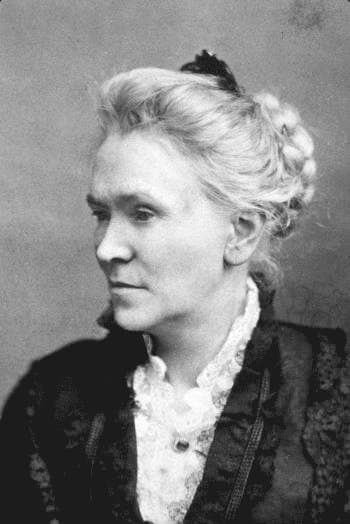
American · Activism · Politics
Matilda Joslyn Gage
March 24, 1826 – March 18, 1898
Early Life and Family Background
Matilda Electa Joslyn was born on March 24, 1826, in the small town of Cicero, New York, the only child of Dr. Hezekiah Joslyn and Helen Leslie Joslyn. Her father was a country physician with strong abolitionist convictions; the Joslyn household is believed to have served as a station on the Underground Railroad, exposing young Matilda from an early age to radical political action and the moral urgency of fighting injustice. Unusually for the time, Hezekiah Joslyn believed his daughter's education should not be limited by her sex. He tutored her personally and encouraged her to study mathematics, physiology, Greek, and other subjects normally reserved for boys, and he reportedly allowed her some exposure to medical knowledge and practice, a highly unconventional choice for a girl in early nineteenth-century rural New York.
Matilda grew up in the intellectually and religiously turbulent environment of upstate New York's "Burned-Over District," a region famous for revivalist fervor and the birthplace of numerous reform and utopian movements, including Spiritualism, Mormonism, and abolitionism. This environment, combined with her father's progressive parenting, gave her both the intellectual tools and moral conviction to eventually become one of the most searching and radical critics of American religious and political institutions in the nineteenth century.
Marriage and Personal Life
In January 1845, at the age of eighteen, Matilda married Henry H. Gage, a merchant from Fayetteville, New York. The couple settled in Fayetteville, where Matilda would live for much of her adult life, and they had five children together, four of whom survived to adulthood: Helen Leslie Gage, Thomas Clarkson Gage, Julia Louise Gage, and Maud Gage, who later married L. Frank Baum, the author of The Wonderful Wizard of Oz. The Gage home in Fayetteville is believed to have continued the family tradition of Underground Railroad activity, and Matilda later claimed to have sheltered fugitive slaves there, an act that was illegal under the Fugitive Slave Act of 1850. Henry Gage was largely supportive of his wife's public activism, a rarity among husbands of the period, which allowed Matilda the freedom to travel and engage extensively in reform work.
Entry into Activism
Matilda Joslyn Gage's formal entry into the organized women's rights movement came on October 1, 1852, when, at just 26 years old, she rose unplanned to address the National Women's Rights Convention held in Syracuse, New York. Despite having no prior public speaking experience, she delivered an impassioned and historically grounded speech on women's contributions throughout history and the injustice of their disenfranchisement. She was reportedly the youngest speaker at the convention, and her performance immediately drew the attention of movement leaders such as Susan B. Anthony and Elizabeth Cady Stanton.
From this point forward, Gage became deeply involved in the suffrage movement, participating in state and national conventions, writing extensively for newspapers and pamphlets, and gradually establishing herself as one of the movement's most rigorous intellectuals. Unlike many contemporaries who focused primarily on securing the vote, Gage brought a broader analytical framework to her activism, examining the historical, legal, and religious structures that perpetuated women's subordination.
The Anthony Trial and the "New Departure"
In the early 1870s, suffragists pursued a legal strategy known as the "New Departure," arguing that the Fourteenth Amendment's guarantee of citizenship rights already implicitly granted women suffrage. On November 5, 1872, Susan B. Anthony and a group of women, including Gage, attempted to vote in the presidential election in Rochester, New York. While Anthony was arrested and prosecuted in a widely publicized trial, Gage played an instrumental supporting role, campaigning to persuade registrars to allow women to register and assisting in Anthony's legal defense and public relations campaign. Though the "New Departure" strategy ultimately failed in the courts, the episode generated significant national attention for the suffrage cause and further established Gage's reputation as a sharp legal thinker.
The Centennial Protest of 1876
One of the most dramatic moments of Gage's activist career occurred on July 4, 1876, during the United States Centennial celebrations in Philadelphia. Gage was a principal author of the Declaration of Rights for Women, a document modeled on the original Declaration of Independence but cataloguing the ways in which women had been denied the rights promised to all citizens. During the official centennial ceremony at Independence Hall, Susan B. Anthony and four other suffragists, including Gage, staged a bold protest: Anthony presented the Declaration to the presiding officer before the assembled dignitaries, and the women then read the document aloud to a crowd outside. This act of political theater, occurring at the nation's foremost patriotic celebration, drew widespread press coverage and remains one of the most memorable acts of nineteenth-century suffragist civil disobedience.
Scholarly Contributions and "History of Woman Suffrage"
Beginning in the late 1870s, Gage collaborated with Elizabeth Cady Stanton and Susan B. Anthony on the monumental multi-volume History of Woman Suffrage, a project intended to document the movement's development and preserve its history for future generations. Gage contributed extensively to the first three volumes, published between 1881 and 1886, drawing on her deep historical knowledge and research skills. She also served as president of the National Woman Suffrage Association at various points and held leadership roles within the movement's organizational structure. Her scholarly bent distinguished her from other leaders, and she frequently published essays exploring the historical status of women across cultures and eras, including in ancient societies, indigenous American nations (particularly the Iroquois Confederacy, whose matrilineal structures she admired and cited as evidence that gender equality was historically achievable), and various religious traditions.
Woman, Church and State and Ideological Radicalism
Gage's most significant and controversial scholarly work was Woman, Church and State, published in 1893. In this ambitious and provocative volume, Gage argued that organized Christianity, and the Catholic Church in particular, had been a primary historical instrument for the subjugation of women, tracing patterns of witch persecution, restrictions on education and property rights, and doctrinal justifications for female subordination across centuries of Western history. The book was far more radical than most suffragist writing of the era, which frequently sought to reconcile feminism with Christian piety in order to appeal to a broader public. Gage's uncompromising anticlerical stance put her at odds with leaders such as Frances Willard of the Woman's Christian Temperance Union, who sought alliances between suffrage and religious temperance movements, and it created friction even with her longtime collaborator Susan B. Anthony, who increasingly sought broader coalition-building with religious women's organizations.
In 1890, dissatisfied with what she viewed as the increasingly conservative and religiously accommodating direction of the National Woman Suffrage Association (which merged that year with the more conservative American Woman Suffrage Association to form the National American Woman Suffrage Association), Gage broke away to found the Woman's National Liberal Union, an organization dedicated to a broader vision of freethought, secularism, and women's rights that went beyond suffrage alone. This split marked Gage's transition from mainstream movement leader to a more marginalized, though intellectually influential, radical voice.
Influence on L. Frank Baum and Legacy in Popular Culture
Gage's daughter Maud married L. Frank Baum in 1882, and Matilda Joslyn Gage lived with the Baum family for extended periods in her later years, particularly after her husband Henry's death in 1884. Historians and biographers have long noted the significant influence Gage exerted on her son-in-law's writing, particularly his creation of The Wonderful Wizard of Oz (1900). The independent, capable female characters of Oz, including Dorothy, and the story's imaginative critique of authority (embodied in the Wizard, revealed to be a fraud manipulating power through deception) are frequently interpreted by scholars as reflecting Gage's feminist and anti-authoritarian ideas, transmitted to Baum through years of close family association and intellectual exchange.
Later Life and Death
In her final years, Gage continued to write and advocate for her expansive vision of freethought and women's rights, even as she found herself increasingly sidelined by the mainstream suffrage establishment. She died on March 18, 1898, at the age of 71, at the Chicago home of her daughter Maud Gage Baum. She was buried in Fayetteville Cemetery in Fayetteville, New York. Her chosen epitaph, inscribed on her gravestone, reads: "There is a word sweeter than Mother, Home, or Heaven. That word is Liberty."
Historical Legacy
For much of the twentieth century, Matilda Joslyn Gage was largely overshadowed in popular memory by her contemporaries Elizabeth Cady Stanton and Susan B. Anthony, partly due to her marginalization within the movement during her later years and partly due to the discomfort many later suffrage historians felt with her uncompromising anti-religious views. However, beginning in the late twentieth century, feminist historians began to reassess her contributions, recognizing her as one of the most intellectually original and radical thinkers of first-wave feminism. Modern scholarship, supported by organizations such as the Matilda Joslyn Gage Foundation (which preserves her historic home in Fayetteville, New York, as a museum and educational center), has worked to restore her reputation as a pioneering feminist theorist whose critiques of the intersecting oppressions of patriarchy, organized religion, and state power anticipated many themes of later feminist thought. She is inducted into the National Women's Hall of Fame, and her home is designated a National Historic Landmark, cementing her place as an essential, if long underappreciated, figure in the history of American women's rights.
Dated achievements
1 indexed.
- Mar241826Activism
Birth of Matilda Joslyn Gage
Matilda Joslyn Gage was born in Cicero, New York.
View details Wikipedia