← All women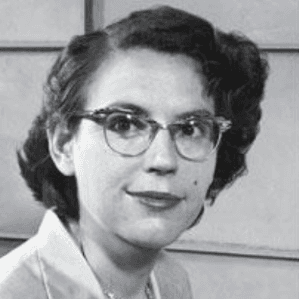
American · Science
Mary Sherman Morgan
November 4, 1921 – August 4, 2004
Introduction
Mary Sherman Morgan (4 November 1921 – 4 August 2004) was an American rocket-fuel scientist whose work played a decisive but long-unrecognized role in the early U.S. space program. She is widely credited with inventing Hydyne, a high-energy liquid propellant developed in 1957 that powered the Jupiter-C/Juno I rocket used to launch Explorer 1, the first successful American satellite, on 31 January 1958.[1][3][4][2] Retrospective accounts describe her as "America’s first female rocket scientist" or the world’s first woman rocket fuel specialist, highlighting both her technical achievements and the obscurity into which they fell during her lifetime.[1][6][9]
Early Life and Background
Mary Sherman was born on 4 November 1921 in Ray, North Dakota, a small agricultural community with fewer than a thousand residents.[1][2][3][4] She grew up on a remote farm in a strict German Catholic household, in conditions of rural poverty typical of the northern Great Plains in the interwar years.[2][9][10] Family and later biographical accounts note that her parents kept her out of school through much of her childhood so she could work on the farm, and that she did not begin formal education until around age eight or nine, after a sheriff and social worker insisted she be sent to school.[9][10]
Despite starting school several years behind her peers, Morgan advanced rapidly. She showed an early aptitude for mathematics and an intense curiosity about chemistry, reportedly sparked by fascination with the coal and fuels used to heat the family home.[9][6] She ultimately graduated from Ray High School as valedictorian, an achievement that required overcoming both educational delay and limited local resources for science teaching.[2][10] Graduating at the top of her class in a rural town at that time was particularly significant for a young woman, given contemporary expectations that girls would focus on domestic roles rather than academic or technical careers.
Education and Wartime Training
Ambitious to pursue science, Morgan "ran away" from home against her family’s wishes to attend Minot State University, a teachers’ college in North Dakota where she studied chemistry in the late 1930s.[2][3][9] Sources indicate that she was one of relatively few women in her cohort studying a physical science, and that her intention was to become a professional chemist rather than a teacher, at a time when such aspirations for women were uncommon.[6][9]
Economic and wartime pressures soon reshaped her path. Around the early 1940s, as the United States mobilized for World War II, Morgan was recruited from college for a position as a chemist at the Plum Brook Ordnance Works, a defense plant associated with the U.S. Army that manufactured explosives and related ordnance.[2][5][11] She left Minot State without completing a degree, a decision reflecting both the immediate availability of industrial work and the broader wartime trend in which technical skill was prioritized over formal credentials.
At Plum Brook, Morgan worked as a chemical analyst, testing the purity of nitric acid and other components used in explosives.[2][11] This role provided intensive practical training in analytical chemistry, safety protocols, and the behavior of energetic materials—experience that would later be crucial to her work in rocket propellants. Wartime plants often employed women as laboratory chemists and production workers due to labor shortages, but they rarely offered them long-term career pathways or formal recognition. Morgan’s work at Plum Brook fits this pattern: highly specialized, critical to the war effort, yet largely invisible in public accounts.
Transition to North American Aviation
With the end of World War II and the decline in ordnance demand, Morgan, like many wartime workers, faced the need to find new employment. She relocated to California and applied for a position at North American Aviation (NAA), an aerospace company heavily engaged in missile and rocket development during the early Cold War.[2][5] Despite lacking a completed college degree, she was hired into the engineering department as an analyst, focusing on calculations related to propellant performance.[2][9]
At NAA, Morgan entered a workplace overwhelmingly dominated by men. Accounts from later sources state that she worked among roughly 900 engineers, most of whom were male and formally credentialed, while she held a lower-ranking job title and was paid less, despite comparable or superior technical responsibilities.[2][9] Her official classification as an "analyst" rather than engineer reflected institutional barriers that restricted women’s advancement and recognized degrees over demonstrated expertise.
Nonetheless, Morgan’s role quickly became central within the company’s rocket propulsion activities. She specialized in theoretical performance calculations for liquid rocket fuels, evaluating mixtures, combustion characteristics, and thrust outputs for various oxidizer–fuel combinations used in missile and research programs.[9][11] This analytical work placed her at the intersection of chemistry and aerospace engineering, requiring both deep chemical knowledge and an understanding of rocket hardware constraints.
Major Work: Development of Hydyne
Morgan’s most significant technical achievement emerged in the context of the space race between the United States and the Soviet Union. On 4 October 1957, the Soviet launch of Sputnik 1 and later Sputnik 2 dramatically demonstrated Soviet capabilities in rocketry and satellite technology.[1][16] In contrast, the United States suffered a widely publicized setback with the failure of the Vanguard TV‑3 launch in December 1957, when the rocket collapsed shortly after liftoff.
In response, U.S. authorities turned to Wernher von Braun and his team, who had been developing the Jupiter‑C and Redstone rockets. To achieve orbital capability quickly, they needed more performance from the existing Redstone first stage without extensive hardware redesign.[2][9] The U.S. government outsourced the search for a higher-energy propellant to North American Aviation, where Morgan was by then recognized internally as the leading propellant analyst.[2]
In 1957, Morgan was assigned primary responsibility for creating a new fuel formulation.[2][9] Working largely on her own and under classified conditions, she designed a liquid propellant based on unsymmetrical dimethylhydrazine (UDMH) combined with diethylenetriamine and other components.[1][2][8] This mixture, later named Hydyne, offered higher specific impulse and better performance than the standard fuels then used with Redstone engines.
Hydyne was adopted as the first-stage fuel for modified Jupiter‑C/Juno I vehicles. On 31 January 1958, a Juno I rocket using Hydyne successfully launched Explorer 1 into orbit, marking the first successful American satellite mission and a turning point in the early space race.[1][2][3][11] Explorer 1 carried instruments that detected what became known as the Van Allen radiation belts, providing major scientific insight into Earth’s magnetosphere.
While von Braun and other male engineers were prominently celebrated for the mission’s success, Morgan’s contribution remained hidden. Hydyne’s development and the performance calculations that justified its use were classified, and her role did not appear in contemporary press coverage or official award lists.[12][10] Only later, as documents were declassified and oral histories collected, did sources identify her as the inventor of Hydyne and emphasize that without her fuel formulation, the United States might have remained behind the Soviet Union for much longer in orbital launches.[1][8][9]
Career Status and Gender Barriers
Retrospective narratives often describe Mary Sherman Morgan as "America’s first female rocket scientist" or the world’s first woman rocket fuel specialist.[1][6][9][12] These designations derive from later research and promotional framing, particularly by her son and by authors writing about overlooked women in STEM, rather than from a contemporaneous official title. Nonetheless, they underscore the extreme rarity of women working in rocket propulsion and propellant chemistry during the 1950s.
Within North American Aviation, Morgan’s status as a woman without a formal engineering degree contributed to structural limitations on her career. She remained classified as an analyst rather than engineer, which affected her pay and promotion opportunities, even as she handled problems of equivalent or greater complexity.[2][9] The culture of aerospace engineering at the time tended to attribute key advances to high-profile male figures, while supporting scientists—especially women—were seldom named in project histories.
Morgan’s experience reflects broader patterns of gender discrimination in mid‑20th‑century science and engineering: women were recruited to wartime laboratories and industrial research roles yet often lacked pathways to long-term recognition or senior positions. Her case is particularly stark because her most consequential work occurred in a classified program, further reducing the visibility of her contributions.
Retirement and Later Life
After the hydyne-fueled success of Explorer 1 and subsequent work on rocket propulsion, Morgan eventually left North American Aviation. Sources describe her retiring from formal scientific work relatively soon after her major contributions in order to focus on raising her children and managing family responsibilities in California.[2][11] This transition was consistent with the expectations placed on women of her generation, who were often encouraged—or required—to "step back" from professional careers once they married or had children.
In later life, Morgan rarely spoke in detail about her classified work, even to her family. Her son George has said that while they knew she had "worked on rockets," the specifics of her role, the technical complexity of Hydyne, and the importance of Explorer 1 were not clear to them while she was alive.[12][10] As a result, her children grew up with only a partial understanding of their mother’s contribution to the space program.
Morgan lived out her retirement quietly, away from public scientific recognition. She died on 4 August 2004, at the age of 82.[1][3][4] At the time of her death, major historical narratives of the U.S. space race still largely omitted her name.
Posthumous Recognition and "Rocket Girl"
Only after Morgan’s death did significant efforts begin to document and publicize her work. Her son, George D. Morgan, a playwright, embarked on extensive research into her career, seeking out former colleagues, declassified documents, and technical records to reconstruct her story.[5][6][12][16] This process revealed the central role she had played in devising Hydyne and solving the performance problem that threatened America’s early satellite launches.
George Morgan’s biography, Rocket Girl: The Story of Mary Sherman Morgan, America’s First Female Rocket Scientist, was published in 2013.[5][6][11] The book, along with related talks and media coverage, framed her as a pioneering yet forgotten figure whose work "saved America’s space programme" by enabling the Explorer 1 launch. The Smithsonian Libraries catalog describes the book as recounting how, in an age when girls "rarely dreamed of a career in science," Mary wanted to be a chemist and ultimately solved a rocket-fuel problem that had stymied more famous engineers.[6]
Articles in outlets such as Chemistry World, educational resources from institutions like the IPO Education Foundation, and profiles in women-in-STEM compilations further amplified her story.[8][9][7] These sources highlighted her rural origins, delayed schooling, valedictorian status, non-degree pathway into industrial chemistry, and analytic brilliance at NAA. They also emphasized the gendered erasure of her contributions: while von Braun and others became household names, Morgan remained virtually unknown outside specialist circles.
Media pieces, including C‑SPAN classroom materials and video features, present her as a case study in how Cold War secrecy and gender bias combined to obscure women’s scientific work.[12][13] Educational PDFs and online biographies encourage students to consider the structural factors that led to her invisibility and to recognize the importance of archival research in restoring women’s contributions to the historical record.[7][9]
Awards, Honors, and Institutional Recognition
There is no evidence that Morgan received major public awards or honors for her rocket-fuel work during her lifetime. The classified nature of the Explorer 1 propulsion program and the male-dominated culture of aerospace engineering meant that recognition was typically directed toward higher-profile figures and institutional teams rather than individual analysts, especially women.[12][8]
Posthumously, however, she has been honored in a variety of ways. The Royal Society, in a social media feature marking her birthday, highlighted her invention of Hydyne and described her as a chemist and rocket-fuel scientist whose work powered the United States’ first satellite.[15] Educational organizations have produced profiles and classroom materials about her, and she is now frequently included in lists of "magnificent women" or pioneering women in science and engineering.[7][9]
Although these forms of recognition do not equate to official medals or institutional awards, they contribute to a reframing of the historical narrative, positioning Morgan among the key figures of early space-age propulsion.
Personal Life
Source material focused on Morgan’s technical career offers limited detail on her personal life, but it is clear that she married and had at least two children, including her son George.[2][5][11] Her decision to retire from North American Aviation and "proceed with a full-time job mothering her two children" reflects both personal choices and societal pressures on mid‑century women to prioritize domestic responsibilities once they had families.[2]
Family accounts emphasize that she was private about her work and modest about her achievements. To her children, she appeared primarily as a devoted mother who had once held a "mysterious" job involving rockets and chemistry, but who did not present herself as a trailblazing scientist.[10][12] This disconnect between her public self-image and historical significance is a recurring theme in later narratives, underscoring the ways in which structural forces can shape how women perceive—and narrate—their own careers.
Legacy and Historical Impact
Mary Sherman Morgan’s legacy lies both in the technical impact of Hydyne and in what her life story reveals about the history of women in science. Technically, Hydyne provided a crucial performance boost to the Redstone/Jupiter‑C architecture, enabling the Explorer 1 mission and contributing to subsequent developments in liquid rocket propellants.[1][2][8] While Hydyne itself was eventually superseded, its success demonstrated the feasibility of highly energetic amine-based fuels and validated analytical approaches to propellant design.
Historically, Morgan embodies the figure of the "hidden" or "airbrushed" woman scientist. She operated in a field dominated by men, under conditions of national security secrecy, with limited formal credentials yet substantial responsibility.[6][8][14] Her near-total absence from early space-race narratives illustrates how credit for scientific and engineering achievements has often been unevenly distributed along gender lines.
The recovery of her story through Rocket Girl, educational initiatives, and popular science writing has made her a symbol of the broader effort to recognize women’s contributions to STEM. She is now cited in discussions of how many women, particularly in mid‑20th‑century industrial and defense research, played key roles that went unacknowledged in public histories.[8][9][12]
In women’s history and the history of science, Morgan’s biography encourages several critical reflections:
- The importance of access to education—even when delayed—and how talent can flourish despite structural barriers.
- The role of wartime and Cold War laboratories in providing women with technical opportunities, while often denying them long-term recognition.
- The need for archival and oral-history work to uncover contributions that were classified, anonymized, or overshadowed.
By tracing Morgan’s path from a North Dakota farm to the analytical heart of the U.S. rocket program, historians and educators highlight both the contingency of scientific careers and the systemic biases that shape who is remembered.
Later Life, Death, and Continuing Reassessment
Mary Sherman Morgan’s death on 4 August 2004 closed a life that had intersected with some of the most dramatic technological developments of the 20th century.[1][3][4] Yet it was only in the years following her death that her role in those developments became widely discussed. As George Morgan and others brought her story to light, institutions, educators, and writers began to integrate her into accounts of the space race and women in STEM.
Today, profiles of Mary Sherman Morgan appear in online encyclopedias, educational guides, and popular science media in multiple languages, including English, Portuguese, Catalan, and Galician.[1][3][4][2] These texts consistently emphasize her invention of Hydyne and its centrality to the Explorer 1 launch, frequently repeating the phrase "America’s first female rocket scientist" while acknowledging that the title is retrospective rather than official.
As part of a broader movement to diversify historical narratives, Morgan’s story serves as a reminder that major technological milestones often rest on the work of individuals whose names do not initially appear in headlines or official histories. The continuing reassessment of her contributions contributes to a more inclusive understanding of the early space age and underscores the necessity of examining the roles of women and other underrepresented groups in science and engineering.
Dated achievements
3 indexed.
- Nov041921Science
Birth of Mary Sherman Morgan
Mary Sherman Morgan was born in Ray, North Dakota, USA.
View details Wikipedia - Jan311958Science
Explorer 1 Launches with Hydyne
Juno I rocket using Hydyne, developed by Mary Sherman Morgan, launched Explorer 1.
View details