← All women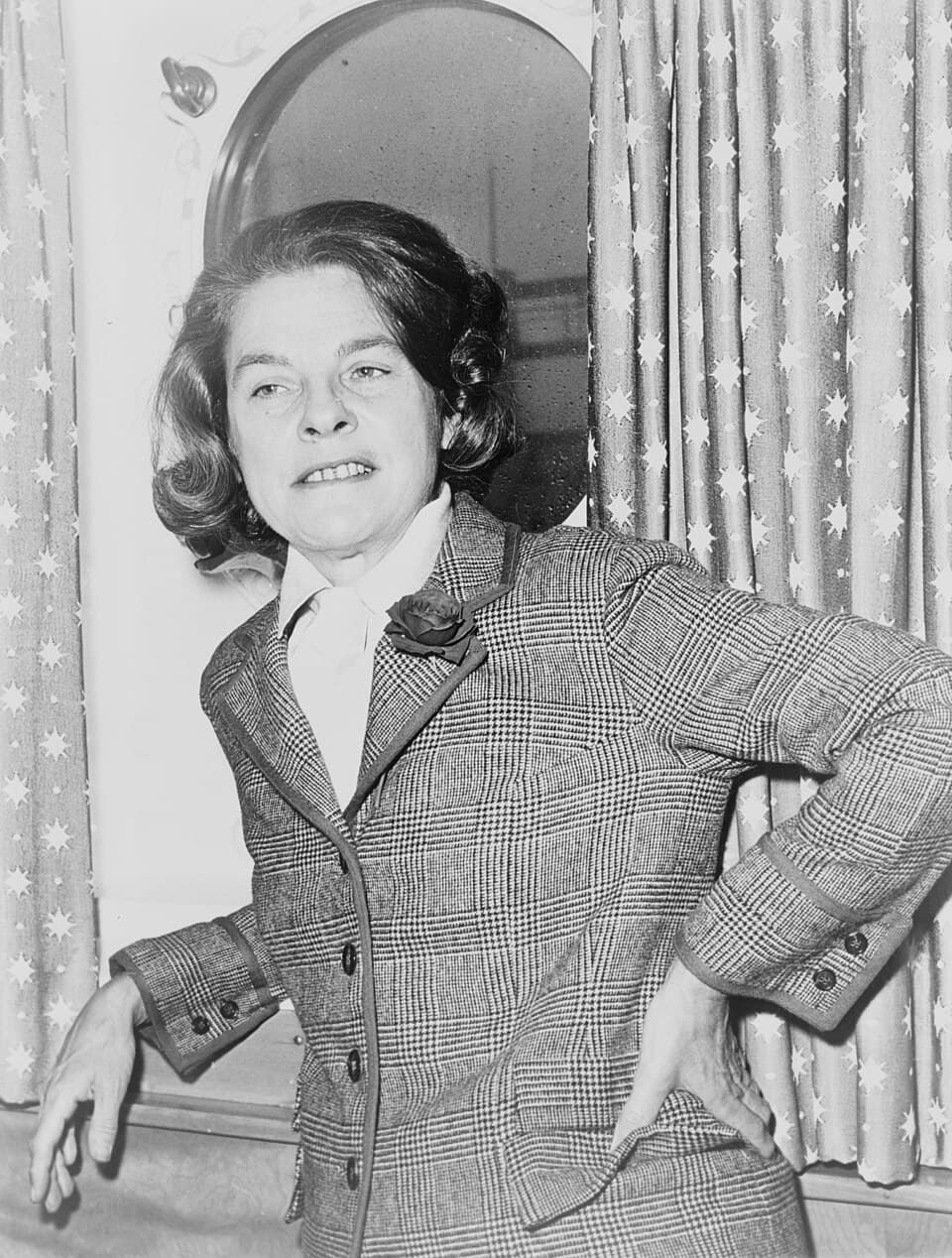
American · Literature · Activism
Mary McCarthy
June 21, 1912 – October 25, 1989
Early Life and Family Tragedy
Mary Therese McCarthy was born on June 21, 1912, in Seattle, Washington, the eldest of four children of Roy Winfield McCarthy and Therese Preston McCarthy. Her father, a charming but financially unstable man of Irish Catholic ancestry, had married into the affluent Preston family of Seattle. Mary's mother was of mixed Protestant and Jewish descent, a heritage McCarthy would later explore with characteristic candor in her writing.
In 1918, when Mary was six years old, both of her parents died within a day of each other during the catastrophic influenza pandemic while the family was traveling by train from Seattle to Minneapolis. Mary and her three younger brothers—including Kevin McCarthy, who would later become a well-known film and stage actor—were left orphans. They were taken in by a great-aunt and her husband in Minneapolis, whose household McCarthy later described as one of poverty, neglect, and casual cruelty. This harrowing period of her childhood became the subject of her celebrated memoir Memories of a Catholic Girlhood (1957), which remains one of the most searing and clear-eyed accounts of childhood trauma in American letters.
Eventually, Mary's maternal grandparents, Harold and Augusta Preston of Seattle, intervened and took her into their comfortable, cultured household, while her brothers remained in Minneapolis. This rescue gave McCarthy access to a superior education and exposed her early to literature and ideas. She attended the Annie Wright Seminary, an Episcopalian boarding school in Tacoma, Washington, before enrolling at Vassar College in Poughkeepsie, New York, in 1929.
Education and Vassar Years
At Vassar, McCarthy studied English and immersed herself in the vibrant intellectual culture of the all-women's college, which would later serve as the setting and inspiration for her most famous novel, The Group. She graduated in 1933, part of a generation of educated women grappling with how to forge professional and intellectual lives in a society that offered them limited institutional support. Vassar shaped her permanently: many of her lifelong friendships, rivalries, and literary preoccupations trace back to this formative period.
Early Career and the Partisan Review Circle
After graduating, McCarthy moved to New York City and quickly became involved with the city's left-leaning literary and political intelligentsia. She began writing book reviews for The Nation and The New Republic, and by the mid-1930s had become a theater critic for the influential magazine Partisan Review, then closely associated with anti-Stalinist leftist intellectuals. Her criticism was immediately distinguished by its precision, wit, and willingness to attack sacred cows—qualities that would define her entire career.
McCarthy's first marriage, to actor and literary manager Harold Johnsrud in 1933, ended in divorce in 1936. In 1938, she married the eminent literary critic Edmund Wilson, a union that proved artistically transformative if personally difficult. Wilson, recognizing McCarthy's storytelling gifts, reportedly pressed her—by some accounts locking her in a room—to write fiction rather than only criticism. The result was a series of satirical short stories that were later collected as her first book, The Company She Keeps (1942), a thinly-veiled roman à clef about New York intellectual and bohemian life that established her reputation as a sharp-eyed chronicler of her milieu.
Literary Career and Major Works
Throughout the 1940s and 1950s, McCarthy produced a steady stream of novels, stories, and essays that combined satirical social observation with rigorous intellectual engagement. Her novels from this period include The Oasis (1949), a satire of utopian intellectual communities that won the Horizon Prize, and The Groves of Academe (1952), a witty send-up of academic politics inspired by her own brief teaching stint at Bard College.
Her 1957 memoir, Memories of a Catholic Girlhood, was a critical sensation, praised for its unsentimental, almost forensic examination of her traumatic childhood and Catholic upbringing. The book combined personal narrative with McCarthy's characteristic skepticism, interrogating the reliability of memory itself in ways that were innovative for the genre.
McCarthy's most commercially successful and controversial work was The Group (1963), a novel following the lives of eight Vassar graduates from the class of 1933 as they navigate careers, marriage, sex, and disillusionment in the years following their graduation. The novel's frank treatment of sexuality, contraception, and women's disappointments with the promises of feminism and modern life made it both a bestseller and a scandal. It spent nearly two years on the New York Times bestseller list and was adapted into a 1966 film directed by Sidney Lumet. Though some critics dismissed it as gossipy, others recognized it as a groundbreaking exploration of educated women's lives in mid-century America, prefiguring second-wave feminist literature.
McCarthy was also a formidable travel writer and essayist, producing acclaimed books on Renaissance art and history, including Venice Observed (1956) and The Stones of Florence (1959), which showcased her erudition and elegant prose style outside the realm of fiction and social satire.
Political Engagement and Vietnam
McCarthy was also deeply engaged with political affairs. A committed anti-Stalinist leftist in her youth, she later became an outspoken critic of American involvement in the Vietnam War. She traveled to both South and North Vietnam in the late 1960s and wrote a series of reports—published as Vietnam (1967) and Hanoi (1968)—that were among the most prominent literary interventions against the war by an American writer of her stature.
Personal Life and Relationships
McCarthy married four times. Her first marriage to Harold Johnsrud ended in 1936. Her second, to Edmund Wilson (1938–1946), produced her only child, Reuel Wilson, born in 1938, and was marked by significant personal turbulence, including incidents of conflict that McCarthy discussed in later interviews. Her third marriage, to Bowden Broadwater, lasted from 1946 to 1961. In 1961, she married her fourth husband, James Raymond West, a former U.S. State Department diplomat, with whom she remained until her death, dividing her time between Paris and Maine.
McCarthy was renowned—and sometimes feared—for her sharp tongue and combative relationships with fellow writers. Her most famous feud was with playwright Lillian Hellman: in a 1979 television interview with Dick Cavett, McCarthy said of Hellman that she was "a bad writer, overrated" and that every word she wrote was "a lie, including 'and' and 'the.'" Hellman sued for defamation; the lawsuit remained unresolved when Hellman died in 1984.
Awards, Honors, and Recognition
Over her career McCarthy received numerous honors, including a Guggenheim Fellowship, the Horizon Prize for The Oasis, and election to the American Academy of Arts and Letters. She received the National Medal for Literature in 1984 and the MacDowell Medal in 1984 as well, recognitions of her lifetime contribution to American letters. She also received honorary degrees from several universities and was widely regarded, alongside contemporaries like Susan Sontag, as one of the preeminent American woman public intellectuals of her generation.
Later Life, Death, and Legacy
In her later years, McCarthy continued writing criticism, memoir, and fiction, and remained an active, often combative presence in American letters. She was working on a multi-volume memoir project, Intellectual Memoirs, at the time of her death; the completed portion, covering 1936–1938, was published posthumously in 1992.
Mary McCarthy died of lung cancer on October 25, 1989, in New York City at age 77. She was buried in Maine, near the home she shared with her final husband. Her death was widely mourned in literary circles as the passing of one of the last great figures of the mid-century New York Intellectuals, a group that included Lionel Trilling, Dwight Macdonald, Philip Rahv, and her onetime husband Edmund Wilson.
McCarthy's legacy rests on her fearless, often unforgiving intelligence; her mastery of satire; and her insistence on subjecting even her own memories and motives to unsparing analysis. The Group remains a touchstone for understanding the constraints faced by educated American women before the feminist movements of the 1960s and 1970s, while Memories of a Catholic Girlhood continues to be read as a masterwork of American memoir. Vassar College, her alma mater, maintains an extensive archive of her papers and continues to celebrate her as one of its most distinguished alumnae. McCarthy is remembered not only for her literary output but as a model of the woman intellectual unafraid to challenge orthodoxy—whether political, literary, or personal—in an era when few women were afforded such license.
Dated achievements
2 indexed.
- Jun211912Literature
Birth of Mary McCarthy
Mary McCarthy was born on June 21, 1912, in Seattle, Washington.
View details Mary McCarthy - Encyclopedia.com - Oct251989Literature
Death of Mary McCarthy
Mary McCarthy passed away on October 25, 1989, in New York City.
View details