← All women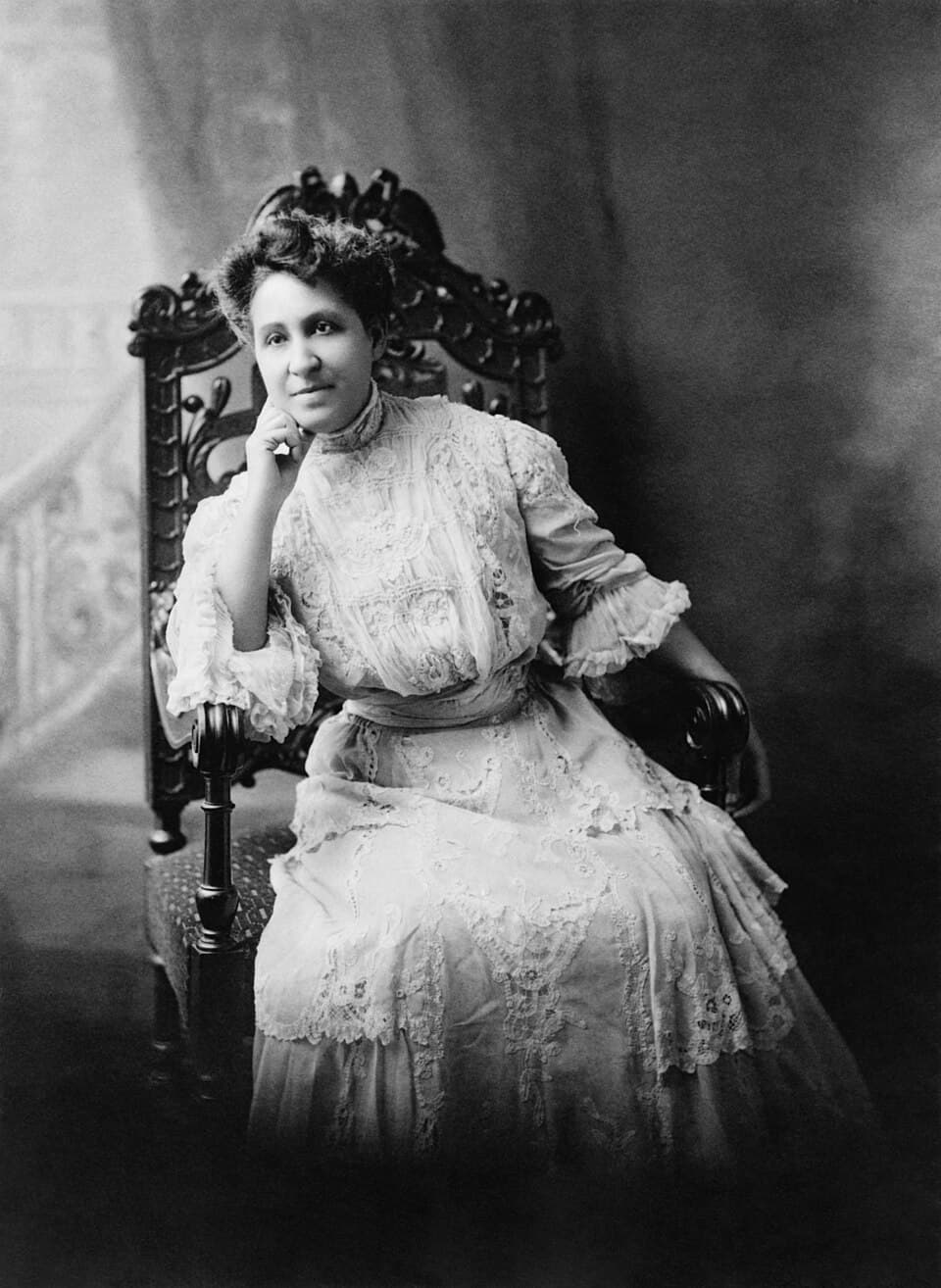
American · Activism · Politics
Mary Church Terrell
September 23, 1863 – July 24, 1954
Early Life and Background
Mary "Mollie" Eliza Church Terrell (born Mary Church) was born on September 23, 1863, in Memphis, Tennessee, during the American Civil War.[1][5][7][10] She was the daughter of Louisa Ayers and Robert Reed Church, both formerly enslaved. Her father rose to prominence as a successful businessman and is often described as one of the first African-American millionaires in the South, while her mother operated a successful hairdressing and beauty business catering to Black women.[2][6][9][10] Their relative prosperity placed Mary in the emerging Black middle and upper class of the Reconstruction era.
Terrell’s childhood was shaped by the contradictions of postwar Memphis: the promise of emancipation coexisted with racial violence and economic instability. Her parents’ marriage ended in divorce, and she spent time in both Memphis and other cities as her father’s investments and her schooling required.[10] Despite these upheavals, Robert Church prioritized his daughter’s education, sending her to prestigious institutions where she had access to rigorous academic training.
Mary attended Antioch College’s preparatory school in Yellow Springs, Ohio, and later enrolled at Oberlin College, one of the few American colleges that admitted both women and African Americans.[1][3][5][7] At Oberlin, she chose the "gentleman’s course" in classical studies—Latin, Greek, and advanced literature—rather than the less demanding "ladies’ course," signaling early her refusal to accept gendered limitations on her education.[1][3][5]
Education and Career Beginnings
On June 19, 1884, Terrell graduated from Oberlin College with a Bachelor of Arts degree in classics, becoming one of the first African-American women in the United States to earn a college degree.[1][3][5][6][7] Four years later, on August 22, 1888, she completed a Master of Arts at Oberlin, further distinguishing herself in an era when very few women of any race held graduate degrees.[1][3][5][7] Her Oberlin education profoundly shaped her later activism, providing both intellectual tools and social networks.
After graduation, Terrell began her professional career in education. Around 1884, she accepted a position at Wilberforce University in Xenia, Ohio, a historically Black institution supported by the African Methodist Episcopal Church.[3] There she served not only as a teacher of Latin but also as a professor and principal, gaining administrative experience and insight into the challenges facing Black higher education.[3][5] In 1887 she moved to Washington, D.C., to teach at the prestigious M Street High School (later Dunbar High School), one of the nation’s leading public schools for African-American students.[2][3] Her work at M Street connected her to Washington’s Black professional community and introduced her to the city that would anchor much of her later activism.
During these years, a personal tragedy deepened her commitment to racial justice. An Oberlin classmate and friend, Thomas Moss, was lynched in Memphis in 1892 for defending his successful grocery business against white competition.[1][3][10] Terrell later recalled this event as a turning point that convinced her she must devote her life to combating racial violence and injustice, rather than limiting herself to classroom teaching.[1][10]
Marriage, Family, and Personal Life
In 1891, Mary Church married Robert Heberton Terrell, a Harvard-educated lawyer who would later become the first Black municipal court judge in Washington, D.C.[1][2][7][10] Their marriage joined two prominent Black professional families and provided a stable base for her activism in the capital. The couple had one daughter, Phyllis, and also adopted Mary’s young niece, later known as Mary Church Terrell, Jr.[1][10] Balancing motherhood with public leadership, Terrell often wrote and spoke about the responsibilities of Black mothers to educate and uplift their children in a hostile society.
The Terrell household became a hub for intellectual and political discussion, hosting Black leaders, reformers, and visiting dignitaries. Mary and Robert shared commitments to education and legal reform, although Mary’s activism frequently took her into public controversies that extended beyond her husband’s judicial role. Their partnership symbolized the emergence of a Black professional class determined to contest Jim Crow through both legal argument and community organizing.[1][2][10]
Club Movement and Early Activism
By the early 1890s, Terrell had become deeply involved in the Black women’s club movement, a nationwide network of organizations devoted to "racial uplift" through education, social services, and public advocacy.[1][2][3][10] In 1892 she helped co-found the Colored Women’s League in Washington, D.C., which organized kindergartens, industrial classes, and other programs for poor Black children and families.[1][3][11] The League exemplified her belief that educated Black women had a duty to work collectively to improve conditions for those most marginalized by race and gender.
On January 11, 1892, Terrell broke a local barrier when she was elected president of the Bethel Literary and Historical Society, a leading Black debate and cultural organization in Washington, becoming its first woman president.[3][7] The Society’s lectures and discussions influenced Black public opinion in the capital; her election signaled recognition of women’s intellectual and leadership capacities in a space previously dominated by men.
Terrell’s prominence grew further in 1895, when she was appointed to the District of Columbia Board of Education, becoming the first African-American woman in the United States to serve on the school board of a major city.[2][3][7] In this role she advocated for improved conditions in segregated Black schools and insisted on professional respect for Black educators. Her appointment symbolized an important breach in the racial and gender barriers surrounding public educational governance.
National Association of Colored Women and Organizational Leadership
In 1896, a controversy involving a racist attack on the character of Black women helped spur the consolidation of Black women’s clubs into a national federation. That year, Terrell became the first president of the National Association of Colored Women (NACW), formed by the merger of the Colored Women’s League of Washington and the National Federation of Afro-American Women.[1][2][3][11] The NACW adopted the motto "Lifting as we climb," capturing Terrell’s philosophy that educated and prosperous Black women bore special responsibility to aid others.
As NACW president, Terrell traveled widely, giving speeches on education, lynching, temperance, and women’s rights. She helped establish kindergartens, day nurseries, and vocational programs, while also advocating for political rights and anti-lynching legislation.[1][3][10][11] Under her leadership, the NACW became a key institution in the struggle against Jim Crow, offering a collective voice for Black women in national debates.
Terrell also helped to broaden interracial alliances. She worked with white suffragists such as Susan B. Anthony and Lucy Stone, while insisting that mainstream women’s movements address racial discrimination.[1][4][10] Her insistence on linking race and gender issues sometimes created tensions, but it also helped shift national feminist discourse toward greater inclusivity.
Suffrage, Civil Rights, and International Advocacy
Terrell was an early and persistent advocate of women’s suffrage, arguing that Black women needed the vote both as a protection against racial injustice and as a means to influence public policy. She spoke at national suffrage gatherings and wrote for suffrage periodicals, often highlighting the double discrimination Black women faced.[1][2][8][10]
Her activism extended beyond the United States. In 1904, Terrell traveled to Berlin to address the International Congress of Women, delivering her speech "The Progress of Colored Women" on September 5.[3][7] Speaking in German, she presented the achievements of African-American women in education and professional life and drew attention to lynching and segregation. The speech is widely seen as an early example of Black feminist internationalism, connecting struggles against racism and sexism across national boundaries.[3][7][10]
Domestically, Terrell was increasingly involved in civil-rights organizing. In 1909 she participated as a founding member in the organization that became the National Association for the Advancement of Colored People (NAACP).[1][2][3][11] As a charter member, she contributed to the NAACP’s early strategies for challenging segregation and disfranchisement through legal action and public campaigns.
Throughout the early 20th century, she wrote and spoke extensively, publishing articles in both Black and mainstream periodicals. Her essays addressed race relations, women’s rights, education, and social reform, making her one of the most prominent Black women public intellectuals of her time.[2][3][10] She often wrote under the pen name Euphemia Kirk, especially in pieces that critiqued racial prejudice and sexism.
Literary Work and Intellectual Contributions
Terrell’s most substantial published work is her autobiography, A Colored Woman in a White World, released in 1940.[2][3][10] In it, she narrates her experiences as a Black woman navigating predominantly white institutions and hostile racial environments from Reconstruction through the 1930s. The book offers vivid accounts of her encounters with discrimination, her work in the club movement, and her education at Oberlin.
Beyond the autobiography, Terrell produced a large body of essays, speeches, and pamphlets. Notable among these is "What It Means to Be Colored in the Capital of the United States," a powerful address that exposes the hypocrisy of racial discrimination in Washington, D.C., the nation’s capital.[2] She also wrote on topics such as kindergarten education, Black women’s moral leadership, and the responsibilities of the Black middle class.
Her writing combined classical rhetorical training with incisive social analysis. She frequently employed historical examples, legal reasoning, and appeals to Christian ethics and democratic ideals, arguing that racism and sexism violated both national principles and religious morality. Scholars later recognized her as a key figure in the intellectual history of African-American feminism and civil-rights thought.[2][3][10]
Later Activism: Desegregation and Legal Challenges
Far from retiring in later life, Terrell remained active through the 1940s and early 1950s. She joined and sometimes led pickets and sit-ins at segregated restaurants in Washington, D.C., targeting discriminatory policies that excluded Black patrons or forced them into separate sections.[2][3][9] She worked closely with younger activists and legal strategists to craft an innovative approach to desegregating public accommodations.
The breakthrough came with the case District of Columbia v. John R. Thompson Co. Beginning around 1950, Terrell and others argued that Reconstruction-era laws passed by the D.C. legislative assembly already prohibited racial discrimination in restaurants.[2][9] When local authorities failed to enforce these laws, they initiated litigation to compel compliance. On June 8, 1954, the U.S. Supreme Court agreed, ruling that the earlier statutes were valid and required the desegregation of restaurants in the District.[2][7][9]
This decision was a major civil-rights victory and the first successful Supreme Court challenge that directly ended segregation in Washington’s restaurants. Terrell’s role as a named plaintiff and organizer underscored her lifelong commitment to confronting racial injustice through both grassroots protest and legal action.[2][9] The Thompson case helped set precedents for later campaigns to desegregate public accommodations across the country.
During this same period, Terrell also fought segregation within organizations ostensibly dedicated to education and professional advancement. She successfully pressured her local chapter of the American Association of University Women (AAUW) to admit African-American members, challenging racially exclusionary practices in a national women’s organization.[2] These campaigns demonstrated that, even in her nineties, she continued to confront racism wherever she found it.
Awards, Honors, and Public Recognition
Over the course of her long career, Terrell received numerous honors and forms of recognition, although these were often less documented than her activism itself. She was widely celebrated in the Black press as a "race woman"—a term signifying unwavering loyalty to the African-American community.[10] She was invited to speak at major national and international conferences, including events organized by the National American Woman Suffrage Association and international women’s groups, a recognition of her stature as a leading Black feminist and civil-rights advocate.[1][3]
Her service on the D.C. Board of Education was itself a form of honor, indicating trust in her judgment and expertise. Likewise, her selection as founding president of the NACW and her inclusion as a charter member of the NAACP reflected broad confidence in her leadership among Black organizations.[1][2][3][11] In later years, tributes in newspapers and commemorative essays highlighted her role as an elder stateswoman of the civil-rights and women’s-rights movements.
Posthumously, institutions such as the Library of Congress have honored her memory by preserving and showcasing her papers, and historical organizations have featured her in exhibitions on Black suffrage, women’s activism, and civil-rights history.[2][4][7] Contemporary historians and public history projects—such as the National Women’s History Museum and the National Park Service—continue to recognize her as a central figure in U.S. women’s and civil-rights history.[1][8]
Legacy and Historical Impact
Mary Church Terrell’s legacy rests on the breadth and longevity of her activism. For roughly seventy years, she worked to expand educational opportunities, secure women’s suffrage, combat lynching and segregation, and articulate a vision of racial uplift grounded in collective responsibility.[1][3][10] She helped institutionalize Black women’s leadership through the NACW and other organizations, ensuring that future generations would have organizational platforms from which to fight injustice.
Terrell was one of the first African-American women to demonstrate how higher education could be used as a weapon against racism and sexism. Her Oberlin degrees lent authority to her interventions in public debates and inspired many younger Black women to pursue college and graduate study.[1][3][5] Her example contributed to the emergence of a Black women’s intelligentsia whose writings and activism reshaped U.S. public life.
Through her speeches and writings, Terrell helped to formulate arguments that would become central to later civil-rights campaigns. She emphasized that segregation violated both American democratic ideals and Christian ethics, and she insisted that true progress required addressing racism and sexism together. Her autobiography and essays remain key sources for understanding Black women’s experiences in the late 19th and early 20th centuries.[2][3][10]
Her work in the Thompson case and earlier campaigns against segregation in Washington foreshadowed the broader use of litigation and direct action that characterized the mid-20th-century civil-rights movement. By reviving old statutes and combining them with modern protest tactics, she illustrated a creative legal strategy that influenced later activists.[2][9]
Terrell’s long life also symbolizes continuity in Black freedom struggles. She personally knew and collaborated with figures ranging from Frederick Douglass and Ida B. Wells to founders of the NAACP and younger civil-rights activists of the 1940s and 1950s.[3][4][10] As such, she served as a living bridge connecting successive waves of activism, demonstrating that progress was cumulative and often required persistent effort across generations.
Later Life and Death
In her later years, Terrell continued to write, lecture, and participate in activism despite declining health. She remained in Washington, D.C., closely following national developments in race relations and women’s rights.[2][3] The publication of A Colored Woman in a White World in 1940 allowed her to reflect publicly on the trajectory of her life and the condition of Black Americans, and it introduced her story to a wider readership.[2][3][10]
Through the 1940s and early 1950s, she engaged in campaigns to desegregate Washington’s public accommodations, culminating in the Supreme Court’s Thompson decision on June 8, 1954.[2][9] Just weeks later, on July 24, 1954, she died in Annapolis, Maryland, at the age of 90.[2][5][7][11] Her death followed closely the Supreme Court’s Brown v. Board of Education ruling, meaning she lived long enough to witness major legal strides toward dismantling segregation in schools and public spaces.
After her death, Terrell’s papers were deposited at the Library of Congress, where they comprise one of the most important archival collections documenting Black women’s activism in the United States.[2][7] Historians, students, and the general public continue to draw on these materials to understand her life and the broader movements she helped shape.
Today, Mary Church Terrell is remembered as a pioneering educator, suffragist, civil-rights activist, and public intellectual. Her insistence that those who "climbed" must lift others, her integration of race and gender analysis, and her strategic use of education, organization, and law have secured her place in the canon of American women’s history and civil-rights history.[1][2][3][10]
Dated achievements
8 indexed.
- Sep231863Activism
Birth of Mary Church Terrell
Mary Church was born in Memphis, Tennessee, during the Civil War.
View details Mary Church Terrell - Wikipedia - Jun191884Activism
Graduation from Oberlin College with Bachelor’s degree
Graduated from Oberlin College, making her one of the first African-American women to earn a college degree.