← All women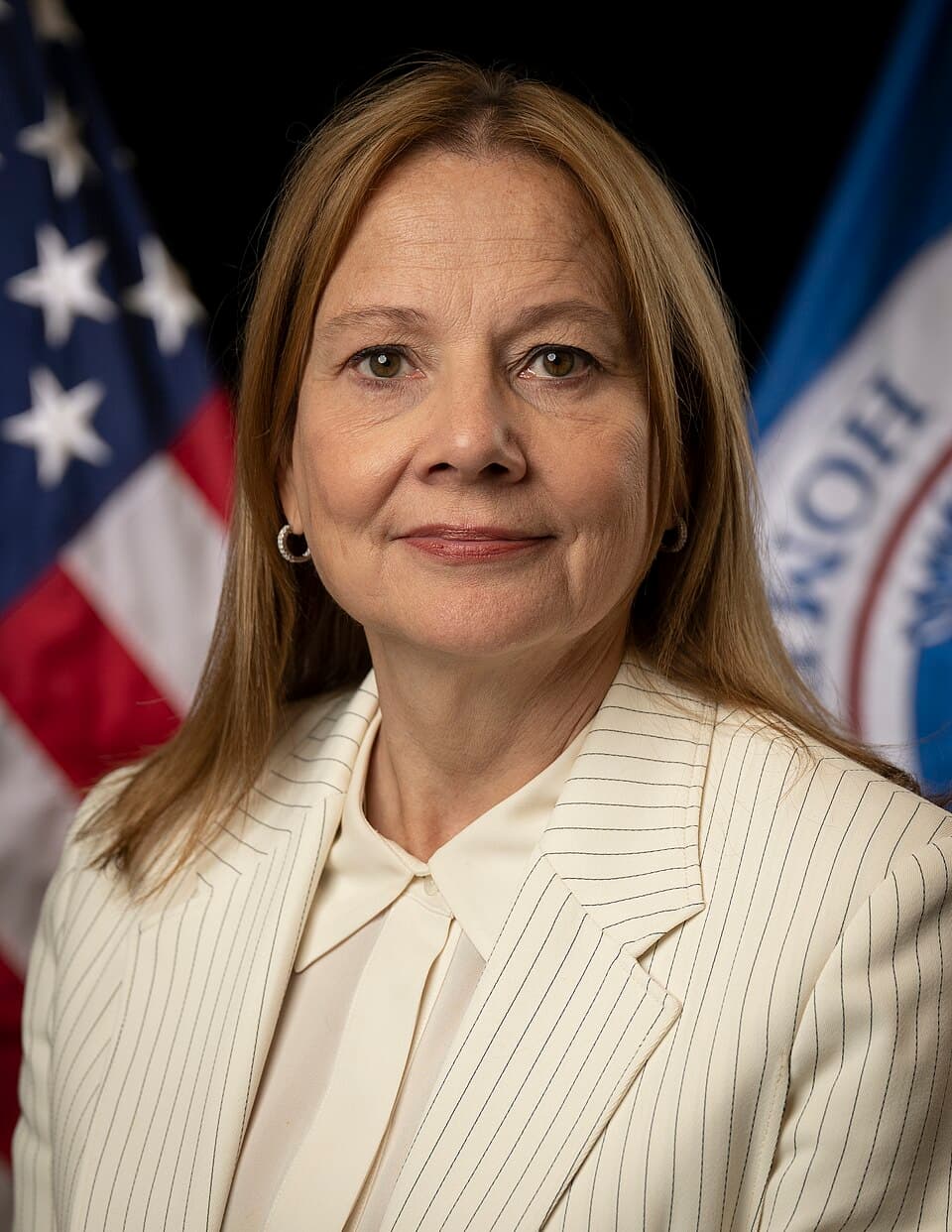
American · Politics
Mary Barra
December 24, 1961 – present
Early Life and Background
Mary Teresa Barra (née Makela) was born on December 24, 1961, in Waterford, Michigan, part of the metropolitan Detroit area that has long been the center of the United States automotive industry.[3][7][9] Her parents, Ray Makela, a factory worker at General Motors, and Eva Makela, raised their family in a working‑class environment shaped by the rhythms of auto production.[7][9] Barra is of Finnish descent, and her family’s immigrant background and industrial livelihood exposed her early to the opportunities and vulnerabilities of manufacturing communities.[3][12]
Growing up near Detroit, Barra developed a fascination with cars and engineering, nurtured by visits to GM facilities and her father’s experiences on the shop floor.[7] She attended Waterford Mott High School, where she showed aptitude in mathematics and science and began to consider technical study and an automotive career, an uncommon ambition for girls in the 1970s.[7][15] Those formative years coincided with debates over women’s access to engineering and corporate leadership roles, giving her early exposure to the cultural barriers she would later confront.
Education and Early Technical Formation
In 1980, at age 18, Barra joined General Motors as a co‑op student at the Pontiac Motor Division.[2][9][10] She enrolled at the General Motors Institute in Flint, Michigan—later renamed Kettering University—in a program that combined classroom study with paid industrial work.[2][7] Her early duties included inspecting fenders and hoods, giving her frontline experience with manufacturing quality and plant operations.[2][10]
Barra earned a Bachelor of Science in electrical engineering from what is now Kettering University in 1985.[2][7][9] The combination of rigorous engineering coursework and hands‑on experience on the factory floor provided the technical foundation for her later roles in manufacturing, product development, and corporate leadership. Her performance attracted the attention of GM, which saw her as a high‑potential engineer and manager.
In 1988, GM awarded Barra a coveted fellowship to attend the Stanford Graduate School of Business, a rare opportunity for a young engineer from the shop floor.[9][11] She completed her Master of Business Administration (MBA) at Stanford in 1990.[2][7][17] The MBA program exposed her to strategy, finance, organizational behavior, and global business perspectives, complementing her technical background and preparing her for executive responsibilities in a complex multinational corporation.
Career Beginnings and Development at General Motors
Barra’s entire professional career has been at General Motors, making her rise to CEO emblematic of long‑term internal development in a legacy industrial firm.[2][10] After completing her engineering degree, she worked as a senior engineer at Pontiac, gaining deeper experience in product and manufacturing engineering.[10]
During the 1990s, Barra moved through a series of engineering and managerial assignments within GM. From 1999 to 2001, she served as general director of internal communications for GM North America, an unusual role for an engineer that broadened her understanding of corporate culture and employee engagement.[9] This appointment indicated GM’s recognition that she could bridge technical expertise with organizational leadership.
Her responsibilities expanded in the 2000s. In 2003, Barra became plant manager of the Detroit–Hamtramck Assembly Plant, a key facility responsible for producing various GM models.[9] This role placed her in direct control of manufacturing operations, workforce management, and production efficiency, reinforcing her reputation as a leader capable of delivering results in demanding environments.
From 2004 to 2008, she was executive director of vehicle manufacturing engineering, overseeing engineering processes that support GM’s global manufacturing network.[9] She then served as vice president of global manufacturing engineering from 2008 to 2009, followed by a term as vice president of global human resources from 2009 to 2011.[9] The human resources role substantially widened her exposure to corporate governance, talent management, and compensation structures, and it allowed her to influence GM’s culture during a period of restructuring following the company’s 2009 bankruptcy.
In 2011, Barra was appointed senior vice president of global product development, and later she became executive vice president for global product development, purchasing, and supply chain.[1][2][9] In these positions she oversaw the design, engineering, and launch of GM vehicles worldwide, as well as procurement and logistics. Her leadership focused on reducing complexity in GM’s product portfolio, improving quality, and aligning engineering decisions with customer needs, reinforcing her image as a technically grounded, results‑oriented executive.[2][7]
Appointment as CEO and Barrier‑Breaking Firsts
On December 10, 2013, GM announced that Mary Barra would succeed Daniel Akerson as chief executive officer, effective January 2014.[1][3][5][9] This appointment made her the first woman to be named CEO of a major or global automaker, including the U.S. "Big Three" (General Motors, Ford, and Chrysler).[1][3][7] The announcement received extensive coverage and was widely interpreted as a milestone for gender diversity in heavy industry, where leadership had historically been male dominated.
Barra officially assumed the role of CEO of General Motors on January 15, 2014.[1][3][4][6][9] Her appointment placed an engineer with deep manufacturing and product‑development experience at the top of one of the world’s largest automakers. According to Encyclopaedia Britannica and numerous business analyses, her promotion marked the first time a woman had headed a global automaker, a distinction that has become central to her historical significance in women’s and business history.[3][7]
In 2016, Barra was elected chair of the GM board of directors, consolidating her position as the company’s top leader and giving her greater influence over strategic direction and governance.[2][3][14] She thus became both chair and CEO, a dual role still relatively rare for women in major corporations.
Leadership Challenges: Ignition‑Switch Crisis and Post‑Bankruptcy Transformation
Barra’s early tenure as CEO was marked by the ignition‑switch defect crisis. Shortly after she took office, GM faced revelations that faulty ignition switches in several models could inadvertently shut off engines and disable airbags, a defect linked to numerous fatalities and injuries.[3][5][7] She testified before the U.S. Congress, apologized to victims’ families, and initiated internal investigations and a compensation program.
Her handling of the crisis has been cited as an example of a new approach to accountability in industrial firms. Instead of minimizing the issue, Barra acknowledged systemic failures and emphasized the need for cultural change, especially around safety and transparency.[3][5][7] The episode reinforced her reputation as a leader willing to confront difficult realities and reorient a company’s values, and it shaped subsequent discussions about women’s leadership styles and crisis management.
Beyond the recall, Barra guided GM through continued restructuring after its 2009 bankruptcy, focusing on product quality, brand clarity, and financial discipline. Under her leadership, GM exited some markets, streamlined its operations, and invested heavily in future technologies to remain competitive in a rapidly changing automotive landscape.[2][7]
Strategic Vision: Electrification, Autonomy, and "Zero" Goals
A central feature of Barra’s leadership has been GM’s shift toward electric and autonomous vehicles. She has articulated a long‑term vision described internally as a world with "zero crashes, zero emissions, and zero congestion", framing GM’s strategy around safety, environmental sustainability, and mobility efficiency.[2][7]
Under her guidance, GM announced ambitious plans to expand its portfolio of battery‑electric vehicles and committed to a goal of producing solely electric vehicles by 2035, positioning the company as a major player in the global transition away from internal‑combustion engines.[7] GM has also invested in autonomous‑vehicle technology through initiatives such as Cruise, reflecting Barra’s belief that software, data, and connectivity are core to the future of transportation.[2][7]
Barra’s strategic choices have drawn attention from environmental analysts, business scholars, and policymakers. Her focus on electrification and autonomy demonstrates how a leader rooted in traditional manufacturing can reposition an incumbent firm toward innovation and sustainability, and it underscores her influence on the broader trajectory of the automotive sector.[2][7][11]
Awards, Honors, and Recognition
Mary Barra has received extensive recognition for her leadership and barrier‑breaking role in the automotive industry. In 2014, Time magazine named her one of the 100 most influential people in the world, reflecting global acknowledgment of her impact as GM’s new CEO during a period of crisis and transformation.[8][12] In 2015, Fortune ranked her first on its list of the Most Powerful Women, highlighting her influence over one of the world’s largest manufacturing companies.[12]
Barra has frequently appeared on lists compiled by Fortune, Forbes, and other outlets that track the world’s most powerful and influential business leaders, particularly women executives.[3][7][8] These rankings, though sometimes varying in date and position, consistently underscore her significance in global business.
In 2023, she was inducted into the Automotive Hall of Fame, which honors individuals who have made significant contributions to the automotive industry worldwide.[10][7] This recognition placed her in a lineage of pioneering industrialists, engineers, and executives and signaled that her legacy is already considered historically important within the sector.
Barra has also been profiled in in‑depth features and interviews, such as a Stanford Magazine article titled "What Drives Mary Barra" and alumni voices pieces from the Stanford Graduate School of Business, which explore her leadership philosophy, commitment to inclusion, and strategic thinking.[11][17]
On September 7, 2017, TIME released its project "Firsts: Women Who Are Changing the World", in which Barra was profiled as the first woman CEO of a major global automaker, reinforcing her place in a broader narrative of women’s "firsts" across multiple fields.[11][7]
Board Service and Broader Influence
Beyond GM, Barra has played roles in corporate and civic governance. She serves on the board of directors of The Walt Disney Company, bringing industrial and technological experience to a major entertainment and media conglomerate.[2][7] She has also been a member of the Business Roundtable, an association of CEOs of leading U.S. companies that engages in public policy discussions, and the Duke University Board of Trustees and the Detroit Economic Club.[2]
Previously, she served on the boards of General Dynamics and the Barbara Ann Karmanos Cancer Institute, reflecting her engagement in defense‑industry governance and healthcare philanthropy.[9] Through these roles, Barra has influenced policy and organizational decisions beyond the automotive sector, contributing to broader debates about corporate responsibility, innovation, and economic development.
Personal Life
Mary Barra is married to Anthony (Tony) Barra, an engineering consultant.[9][12] The couple has two children, Nicholas and Rachel Barra.[9][12] While she maintains a relatively private personal life, she has spoken about the importance of balancing family responsibilities with executive leadership and has been cited as an example of a woman managing both a demanding corporate role and family commitments.
Her personal story—daughter of a GM line worker, engineer, Stanford MBA graduate, and mother of two—has often been highlighted in profiles that emphasize her relatability and the grounded nature of her leadership. Barra’s trajectory illustrates pathways through which women from working‑class backgrounds can rise to the highest levels of corporate leadership when educational and institutional opportunities are accessible.
Legacy and Historical Impact
Mary Barra’s legacy is anchored in her status as the first woman to lead a major/global automaker and as the first female CEO of General Motors.[1][3][7] In the context of women’s history, her appointment is frequently referenced as a landmark event demonstrating that women can command complex, capital‑intensive industries traditionally led by men.
Her leadership has also changed narratives around engineering and manufacturing careers for women. Unlike many female CEOs who come from finance, law, or marketing backgrounds, Barra’s path originated in electrical engineering and plant operations. This technical foundation challenges stereotypes about women’s capabilities in STEM and heavy industry and provides a powerful role model for young women considering engineering degrees.[2][7]
Barra’s strategic push toward electrification and autonomous vehicles reinforces her historical significance beyond gender representation. By aligning GM with global efforts to reduce emissions and improve road safety, she has contributed to shaping the automotive industry’s response to climate change and technological disruption.[2][7] Her articulation of "zero crashes, zero emissions, zero congestion" encapsulates a vision in which corporate leadership is evaluated not only on profit but on social and environmental impact.
Her handling of the ignition‑switch crisis has been studied in business schools and leadership literature as an example of crisis management that blends accountability with culture change. Scholars and commentators have examined how her approach reflects broader shifts toward transparency and ethical responsibility in corporate governance.[3][7][11]
Within women’s‑studies and business scholarship, Barra is often discussed alongside other prominent female CEOs as part of analyses of glass‑ceiling breakthroughs, gendered leadership expectations, and the slow evolution of boardroom diversity. Her story complicates simplified narratives by demonstrating how a woman can rise through technical ranks in a single corporation rather than entering leadership from outside or through non‑technical functions.[7][11]
Later Career and Continuing Influence
As of the mid‑2020s, Mary Barra continues to serve as chair and CEO of General Motors.[2][14] She remains a central figure in debates over the future of mobility, the role of incumbent automakers in the transition to electric vehicles, and the integration of software and data into automotive products. GM’s ongoing investments in battery technology, autonomous driving, and connected‑vehicle platforms reflect strategic directions shaped under her leadership.[2][7]
Barra’s continuing presence on lists of influential business leaders and her induction into the Automotive Hall of Fame underscore that her contributions are seen as historically significant even while her career is still unfolding.[7][8][10] Her biography is now regularly included in research on women’s leadership, corporate governance, and industrial transformation, and her story is used pedagogically in MBA programs, including Stanford’s, where she is celebrated as a notable alumna.[11][17]
In women’s‑history and business‑history almanacs, Mary Barra stands as a key figure who links the mid‑20th‑century manufacturing world of her parents to the 21st‑century landscape of electrified, software‑defined mobility. Her life and work illustrate how gender barriers can be challenged from within legacy institutions and how technical and ethical leadership can reshape an industry’s trajectory.
Dated achievements
4 indexed.
- Dec241961Politics
Birth of Mary Teresa Makela (Mary Barra)
Born in Waterford, Michigan, United States.
View details Mary Barra - Britannica - Dec102013Politics
Announced as first female CEO of a major automaker
First woman to lead a major automaker, General Motors.
View details