← All women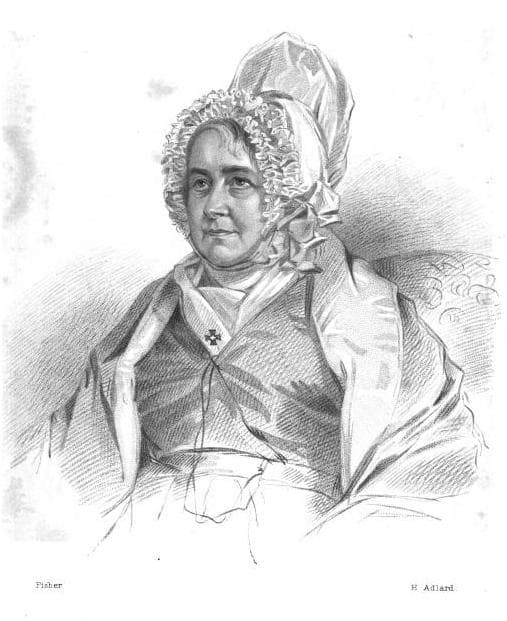
British, English · Literature · Activism
Mary Anne Schimmelpenninck
February 24, 1778 – August 8, 1856
"
Early Life and Family Background
Mary Anne Galton was born on 24 February 1778 in Barr, near Birmingham, England, into a prosperous and intellectually distinguished Quaker family. Her father, Samuel Galton Jr., was a wealthy gun manufacturer and banker who was also a prominent member of the Lunar Society of Birmingham, an informal but highly influential dining club and learned society that brought together some of the greatest scientific and industrial minds of the late eighteenth century, including Erasmus Darwin, James Watt, Josiah Wedgwood, and Joseph Priestley. Her mother, Lucy Barclay, came from another well-established Quaker banking family.
Growing up in this milieu, Mary Anne was exposed from childhood to conversations about natural philosophy, chemistry, theology, and the social and political questions of the Enlightenment. This upbringing was unusual for a girl of her era, and it nurtured in her an intense intellectual curiosity that would characterize her entire life. She was educated largely at home, receiving a broad education in languages, literature, and religious studies that was far more extensive than typically afforded to women of her class and period. She would later become the aunt of the polymath scientist Francis Galton, reflecting the family's continuing tradition of intellectual distinction.
Religious Journey and Intellectual Formation
Although raised within the Society of Friends (Quakers), Mary Anne's religious convictions did not remain static. As a young woman she underwent a series of profound spiritual crises and transformations, moving through Quietist, Moravian, and evangelical Anglican influences before developing a deep and lasting fascination with the French Jansenist tradition, particularly the history and spirituality associated with the convent of Port-Royal in France. This was an extraordinary intellectual trajectory for an Englishwoman of her time, as Jansenism was a controversial and largely marginalized strand of French Catholic theology, viewed with suspicion by both mainstream Catholics and Protestants.
Her engagement with Jansenism was not merely devotional but genuinely scholarly. She read extensively in French religious history and theology, and her intellectual seriousness allowed her to produce works that were respected even by those who did not share her theological sympathies. Her personal religious life remained something of a puzzle to contemporaries: she never formally converted to Roman Catholicism, yet she wrote with deep sympathy and admiration about Catholic mystics and reformers, blending this with a continuing Protestant evangelical sensibility.
Marriage and Personal Life
In 1806, Mary Anne Galton married Lambert Schimmelpenninck, a member of a Dutch merchant family connected to the prominent Schimmelpenninck lineage that included the Dutch statesman Rutger Jan Schimmelpenninck. The marriage brought her into a network of continental European connections that further enriched her intellectual and religious engagement with French and Dutch thought. The couple settled in Bristol, where Mary Anne would spend much of the remainder of her life. The marriage appears to have been supportive of her literary and scholarly pursuits, though it did not produce children who survived to prominence in the historical record, and her household increasingly became a center for her theological writing and correspondence.
Her cousin, Christiana C. Hankin, became her close companion and literary executor, eventually compiling and publishing the primary biographical source for Mary Anne's life after her death.
Literary Career and Major Works
Mary Anne Schimmelpenninck's literary output was substantial and varied, spanning theology, history, and personal memoir. Her most celebrated and historically significant work was her Narrative of the Demolition of the Monastery of Port Royal des Champs (1816), a sympathetic historical account of the suppression of the famous Jansenist convent of Port-Royal in France, which had been a center of rigorous spiritual reform and intellectual life until its violent dissolution by royal and papal authority in the early eighteenth century. This work introduced English readers to the drama and spiritual seriousness of the Port-Royal community, including figures such as Blaise Pascal's sister Jacqueline, and contributed to a broader nineteenth-century revival of interest in Jansenist history and spirituality among English-speaking readers.
She also produced numerous religious and devotional writings that engaged with themes of biblical interpretation, aesthetics, and spiritual discipline. Her approach to biblical interpretation was notably shaped by her position as a Dissenting woman writer operating outside formal theological institutions, giving her work a distinctive aesthetic and personal quality that later scholars have examined as an example of women's alternative routes into theological discourse during a period when formal religious education and ordination were closed to them.
In addition to her theological works, she wrote extensively on musical theory and aesthetics, reflecting the breadth of her intellectual interests beyond religion alone. Her writings on the psychology of religious experience and the moral and aesthetic dimensions of faith anticipated later Victorian preoccupations with the inner life of belief.
Later Life and Death
In her later years, Mary Anne Schimmelpenninck lived in Clifton, near Bristol, where she continued to write, correspond with religious and literary figures, and maintain her extensive network of intellectual connections. She remained active in religious and charitable circles in Bristol, and her home became something of a salon for visitors interested in religious history and continental theology.
She died on 8 August 1856 in Clifton, Bristol, at the age of 78. Following her death, her cousin and companion Christiana C. Hankin compiled and edited her papers, memoirs, and correspondence into the two-volume Life of Mary Anne Schimmelpenninck, published in 1858, which remains the essential primary source for understanding her life, thought, and religious development.
Legacy and Historical Significance
Mary Anne Schimmelpenninck occupies a distinctive place in the history of English religious literature as a woman who, despite operating outside formal theological institutions, produced serious scholarly and devotional work that engaged deeply with cross-confessional religious history. Her sympathetic treatment of French Jansenism and the Port-Royal community helped introduce this complex chapter of Catholic religious history to English Protestant audiences, at a time when confessional boundaries were often rigidly maintained.
She is also remembered as part of the broader story of the Galton family's intellectual legacy, connected through her father to the Lunar Society and through her nephew Francis Galton to the later history of Victorian science. Modern scholars of Dissenting women writers and religious history have increasingly revisited her work as an example of the ways in which women of her era found indirect but intellectually serious avenues into theological and historical scholarship, despite exclusion from formal academic and ecclesiastical institutions.
Her memoirs and letters, preserved through Hankin's biography, continue to serve as valuable primary sources for scholars studying eighteenth- and nineteenth-century religious life, Quaker culture, and the intellectual world of women in the Dissenting tradition.
"Dated achievements
2 indexed.
- Feb241778Science
Birth of Mary Anne Galton
Mary Anne Galton (later Schimmelpenninck) was born in Birmingham, England, into a wealthy Quaker banking and manufacturing family.
View details - Aug081856Science
Death of Mary Anne Schimmelpenninck
Mary Anne Schimmelpenninck died on 8 August 1856 in Clifton, Bristol, England, leaving a legacy of religious and literary writings.
View details