← All women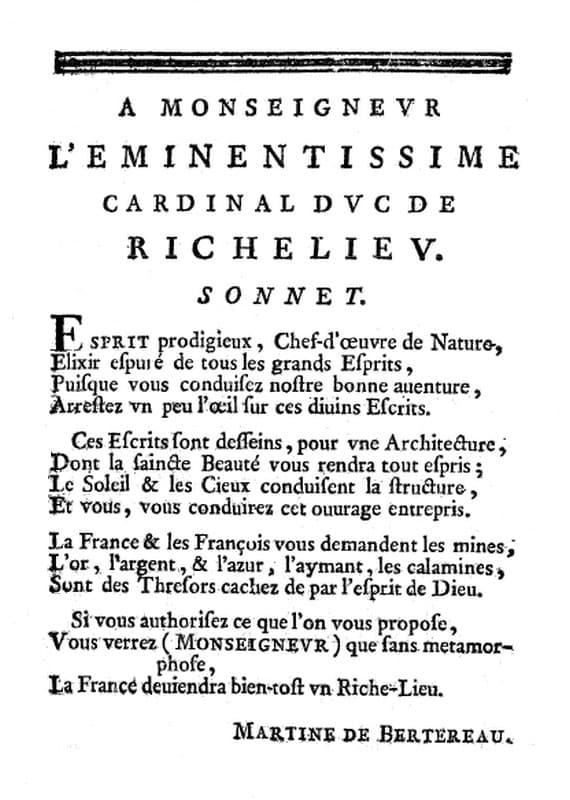
French · Science · Exploration
Martine Bertereau
1590 – 1642
Early life and background
Martine de Bertereau, later known as the Baroness de Beausoleil, was born around 1590 in the French region of Touraine or Berry, into a noble family involved in mining enterprises.[5][7][15][16] Her exact birth date is unknown, but multiple scholarly and encyclopedic sources converge on a birth "vers 1590" or "c. 1590" in central France.[1][4][5][7] Her family owned mines, and she grew up in an environment where discussions of metals, ores, alchemy, and hydraulics were part of daily life.[7][15][16] This early exposure is thought to have shaped her interest in mineralogy and mining engineering.
Little is documented about her formal education, but contemporary accounts and later analyses suggest she received an unusually technical education for a woman of her time, likely through private tutoring and practical experience in family mining operations.[7][14][16] In the context of early seventeenth‑century France, scientific learning—particularly in the applied sciences of geology, mineralogy, and hydraulics—was overwhelmingly reserved for men and often embedded in courtly or artisanal circles. The mining profession itself combined empirical knowledge, alchemical theories, and emerging natural philosophy, placing Bertereau at the intersection of several intellectual traditions.
Marriage and entry into professional mining
Around 1610, Martine de Bertereau married Jean du Châtelet (often written Jean de Chastelet), Baron de Beausoleil, a mining engineer and noted specialist in mineral exploration.[5][7][11][13][16] Through this marriage she acquired the title Baronne de Beausoleil and later also the title of baroness of Auffembach.[5][14][15] Her husband was already recognized as one of the leading mining engineers and "rabdomantes" (dowsers) of his time, employing divining rods and other methods to locate mineral deposits and groundwater.[7][11][13]
The marriage marked the beginning of an intense collaborative professional life. Rather than remaining in a purely domestic or decorative role, Bertereau worked alongside her husband, participating in surveys, prospecting campaigns, and technical evaluations across Europe.[1][5][7][13][16] This partnership was highly unusual in an era when women were largely excluded from technical fields, and it gave her the opportunity to apply and deepen her knowledge of mineralogy, geology, and hydrology.
Career beginnings and European travels
From the 1610s onward, Bertereau and Beausoleil undertook extensive travels throughout Europe to search for mineral deposits, fresh groundwater, and other subterranean resources.[1][5][7][13][16] They are reported to have visited regions in Germany, Hungary, and other parts of Central Europe, as well as South America according to some later accounts, though those transatlantic travels are less securely documented.[6][7][13] In France, they traversed major mining districts, including Brittany, Touraine, and other provinces, identifying veins of metals such as silver, copper, and iron, and mapping potential mining sites.
The couple worked under the patronage of nobles and royal authorities, including commissions from Henry IV of France and later from officials serving Louis XIII.[7][13][14][15] In 1626, they were reportedly commissioned to carry out a systematic survey of sites of mining interest in France, establishing a base in Brittany while conducting reconnaissance in multiple regions.[13][14][15] These assignments positioned Bertereau as a practicing engineer of mines—a role rarely, if ever, formally attributed to women at the time. Contemporary and later historians have stressed her active involvement rather than a merely auxiliary role, citing both her own writings and the technical quality of her work.[1][7][14][16]
Methods, techniques, and scientific practice
Bertereau’s work combined practical mining engineering with elements of alchemy and what contemporaries understood as "natural magic." She used and described a range of techniques for identifying ores and water, including:
- Observation of geological formations and surface indicators of ore veins.[7][13][16]
- Examination of vapors and mists emerging from valleys and mountains at sunrise.[16]
- Use of a divining rod (rabdomancy) and other instruments to detect subterranean resources.[6][7][11][16]
- Application of hydraulic and metallic instruments—she referred to sixteen such instruments in her writings—to analyze subsurface conditions.[16]
While some of these methods were later dismissed as pseudo‑scientific, in her own time they were integral to the evolving practice of mining, which mixed empiricism, technical skill, and esoteric knowledge. Her ability to interpret geological signs, combined with her command of contemporary alchemical theories, made her a sought‑after expert for courts seeking to exploit mineral wealth.
Bertereau’s writings show a sophisticated understanding of ore distribution, mine ventilation, and the economic benefits of renewed mining activity. Several historians argue that her work contributed to the revival of mining in France after a decline during the later Middle Ages, helping to re‑establish mineral exploitation as an important component of the kingdom’s economy.[3][7][14][15]
Major works and publications
Martine de Bertereau is known for several significant works published in the 1630s and early 1640s, which document her discoveries and argue for the value of mining to the French crown. These texts, sometimes partly poetic, are also politically charged, as they form part of her efforts to secure payment and official recognition for her work.
Among her principal works are:
- "Véritable déclaration de la découverte des mines et minières de France" (1632), a mineralogical report summarizing discoveries of mines and mineral deposits across France.[9][14][15] In this text, Bertereau outlines the locations and potential yields of various sites, aiming to demonstrate the economic benefits of exploiting them.
- "Véritable déclaration des riches & inestimables thresors, nouvellement descouverts dans le Royaume de France" (1632), another report in which she emphasizes the "rich and inestimable treasures" that her explorations have brought to light.[9][14] This work is framed as both a scientific account and a petition to the crown for reimbursement of expenses incurred during their surveys.
- "La restitution de Pluton" (1640), a more elaborate work that combines mineralogical description, poetic language, and political appeal.[9][14][15] The title invokes Pluto, the Roman god of the underworld, symbolizing the return of subterranean riches to the kingdom. The text includes discussions of her methods, defenses of her expertise as a woman, and criticisms of officials who failed to support mining development.
These publications are important both for the history of mining and for women’s scientific authorship. In them, Bertereau explicitly defends her authority as a female mineralogist and mining engineer. She invokes classical heroines and learned women to argue that competence is not limited by gender, positioning herself within a lineage of women who have contributed to knowledge and public life.[13][14][16] The works are addressed to powerful figures such as Cardinal Richelieu and other royal officials, reflecting her strategy of using print to appeal over the heads of local administrators.
Conflict with authorities and accusations of witchcraft
Bertereau’s attempts to secure payment and official support ultimately brought her into conflict with the French authorities. Her letters and publications, which sharply criticized the failure of officials to reimburse her and her husband for their work, were perceived as a challenge to the government’s authority.[13][14][15] In a climate of religious tension and suspicion of occult practices, her use of divining rods, alchemical language, and "natural magic" attracted denunciations.
According to later accounts and scholarly reconstructions, Bertereau and her husband were accused of witchcraft and engaging in illicit magical practices.[1][6][13][14] Enemies or rivals framed their mining techniques as sorcery, and the political authorities responded by initiating proceedings against them. They were eventually arrested and imprisoned—sources differ on the precise chronology, but the arrests appear to have taken place in the early 1640s, following the publication of "La restitution de Pluton".[14][18]
In prison, Bertereau’s technical expertise counted for little. She became one of many victims of early modern prosecutions that conflated unconventional scientific practice with heresy or witchcraft. The details of her trial are poorly documented, but the outcome was tragic: multiple sources state that she died in prison at Vincennes around 1642 or shortly thereafter.[1][4][5][7][14][18] Her husband is also reported to have died in captivity.[13][18]
Personal life
Martine de Bertereau’s personal life was closely entwined with her professional activities. Her marriage to Jean de Chastelet created a working partnership in which both spouses shared responsibilities for prospecting, surveying, and advising patrons.[1][5][7][13][16] While detailed records of her children, if any, are scarce or absent in major sources, some later writers suggest that the couple had a family that may have accompanied them during parts of their travels.[7][11] However, such claims are not consistently documented and remain uncertain.
Her social position as a baroness gave her access to aristocratic patronage and courtly networks, yet it also subjected her to expectations of female domesticity that she clearly defied by taking on the role of engineer and mineralogist. In her writings, she occasionally alludes to the difficulties of pursuing scientific work as a woman, highlighting prejudice and lack of recognition.[13][14][16] She navigated these constraints by emphasizing her noble status and framing her expertise as a service to the king and kingdom.
Later life and death
The final phase of Bertereau’s life is marked by increasing tension with the authorities and the decline of her fortunes. By the late 1630s, she and her husband had spent years traveling, surveying, and promoting mining projects, often at their own expense.[7][13][14] Their petitions for reimbursement, including printed works sent to powerful officials, failed to secure adequate compensation.
After "La restitution de Pluton" appeared around 1640, hostility intensified. Her blending of alchemical and mineralogical discourse with pointed political criticism made her vulnerable in a period when Cardinal Richelieu’s regime was sensitive to challenges.[14][18] The couple was arrested, charged with witchcraft and related offenses, and imprisoned. Different sources give slightly different dates for her death: some place it around 1642, others 1643, and still others say only "after 1642".[1][4][5][7][8][14][18] Most agree that she died in prison, likely at Vincennes, a fortress that also served as a state prison.[1][4][5][10][18] The exact date of her death remains unknown, reflecting both the marginalization of women in historical records and the secrecy surrounding state prosecutions.
Legacy and historical impact
Martine de Bertereau is widely regarded as the first recorded female mineralogist and mining engineer.[1][7][13][16] Her pioneering role is emphasized in scientific histories, feminist biographies, and encyclopedic entries. In a field dominated by men and closely tied to state and princely power, she not only practiced mineralogy and mine engineering but also published technical and political works under her own name.
Her contributions include the identification and documentation of numerous mining sites across France, the promotion of systematic mining surveys, and the articulation of mining’s importance to national prosperity.[3][7][13][14][15] Scholars credit her with helping to revitalize French mining after a period of decline, as her reports drew attention to neglected resources and argued for investment in infrastructure.[3][7][14][15] Her use of print to advocate for scientific and economic policies anticipates later forms of technical lobbying and public science.
Bertereau’s case also illuminates the precarious position of early modern women in science. Her eventual persecution for alleged witchcraft exemplifies how female expertise in domains associated with "hidden" forces—such as subterranean resources, alchemy, and natural magic—could be reinterpreted as dangerous or heretical.[6][13][14][18] The accusations against her reflect the broader social anxieties surrounding women who transgressed gender norms and claimed authority in technical fields.
Modern historians and writers have recovered her story through archival research, critical editions, and popular narratives. Scholarly articles have analyzed her as a "femme ingénieur des mines" (woman mining engineer) in the seventeenth century, highlighting her exceptional status and her methodological sophistication.[14][15] Contemporary authors in geology, women’s history, and science communication have further popularized her life, portraying her as a "magic mineralogist" whose blend of empirical skill and esoteric practice symbolizes the transitional nature of early modern science.[7][13][16]
Her memory is also preserved in planetary nomenclature: a crater on the planet Venus, De Beausoleil, bears her title in recognition of her contributions to mineralogy and mining.[6] This naming places her among a select group of women whose names mark features on other worlds, underlining her international scientific significance.
Although the gaps in the documentary record mean that some aspects of her life remain uncertain—exact birth and death dates, full details of her family, and the precise extent of her travels—what is known establishes Martine de Bertereau as a central figure in the history of geology, mining engineering, and women’s participation in science. Her career demonstrates both the possibilities and the dangers faced by women who pursued knowledge in an age when science, magic, and politics were deeply intertwined.
Dated achievements
0 indexed.