← All women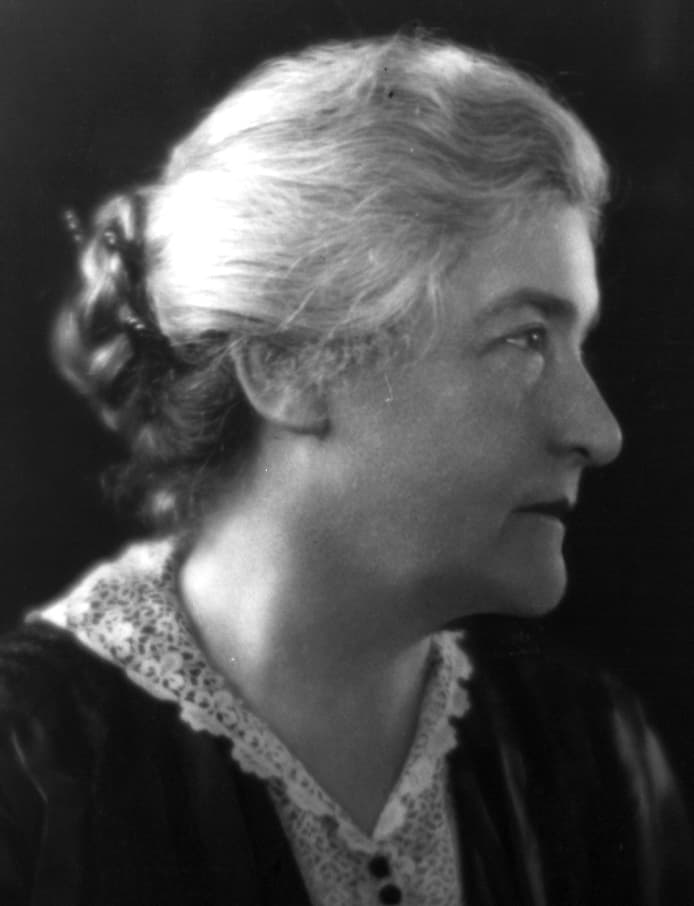
American · Activism · Literature
Martha Carey Thomas
January 2, 1857 – December 18, 1935
Early Life and Family Background
Martha Carey Thomas—who would later be known professionally and personally as M. Carey Thomas—was born on January 2, 1857, in Baltimore, Maryland. She was the eldest of ten children born to Dr. James Carey Thomas, a physician, and Mary Whitall Thomas, both members of prominent Quaker families with strong traditions of intellectual engagement and social reform. The Thomas and Whitall families were deeply embedded in Quaker networks that stretched across Philadelphia and Baltimore, and many of her relatives were active in the abolitionist movement and early women's rights campaigns, including her aunt, the well-known suffragist and temperance activist Hannah Whitall Smith.
From an early age, Thomas exhibited an intense intellectual ambition that defied the conventional expectations placed on girls of her era. She suffered a severe accident as a child—badly burned in a kitchen fire—which left her house-bound for an extended recovery period, during which she immersed herself in reading. This early period of enforced study may have reinforced her natural inclination toward voracious intellectual engagement. She was educated first at home and then at the Howland Institute, a Quaker girls' school in Union Springs, New York, where she excelled academically.
Determined to pursue higher education despite the barriers facing women, Thomas enrolled at Cornell University, one of the few coeducational institutions of the time willing to admit women, and graduated in 1877. She then pursued graduate study at Johns Hopkins University but was permitted to attend classes only under restrictive conditions that barred her from full participation because of her sex—an experience that fueled her lifelong determination to secure genuine educational equality for women.
European Education and the Ph.D. at Zurich
Frustrated by the limitations imposed on women seeking advanced degrees in the United States, Thomas traveled to Europe to continue her studies, first in Germany at Leipzig University, where—again—she was not permitted to earn a degree despite completing the requisite coursework, purely because of her gender. Undeterred, she moved to the University of Zurich in Switzerland, one of the few European universities willing to grant doctoral degrees to women on equal terms with men.
In 1882, Thomas earned her Ph.D. summa cum laude from the University of Zurich, specializing in English philology—an extraordinary achievement that placed her among the small handful of American women to hold a doctorate at that time. This accomplishment became a cornerstone of her later insistence that women could meet, and exceed, the same academic standards required of men, and it directly informed the rigorous academic model she would later implement at Bryn Mawr College.
Bryn Mawr College: Dean and President
In 1884, Thomas was recruited to help establish Bryn Mawr College, a new women's college being founded near Philadelphia under the auspices of the Religious Society of Friends. When the college opened in 1885, she was appointed its first Dean, and she used this position to design an academic program modeled on the rigorous graduate seminar system she had experienced in Europe. She insisted on high admissions standards, recruited an accomplished faculty (including several women scholars with European doctorates), and structured the curriculum to be comparable in depth and difficulty to that of elite men's institutions such as Harvard and Johns Hopkins.
In 1894, Thomas succeeded James E. Rhoads as the second President of Bryn Mawr College, a position she held until her retirement in 1922. As president, she expanded the college's graduate programs, established Bryn Mawr as one of the first American institutions to grant Ph.D.s to women, and built a reputation for the college as one of the "Seven Sisters," a group of elite women's colleges considered academic counterparts to the Ivy League. She was known for her formidable, sometimes autocratic leadership style, and for her uncompromising belief that women's intellectual capacities were equal to men's—a belief she pursued with missionary zeal throughout her career.
Thomas also played an instrumental role in founding the graduate school at Bryn Mawr, one of the earliest and most rigorous graduate programs for women in the country, and she was a co-founder of Bryn Mawr's summer school for women workers, an initiative aimed at extending educational opportunity to working-class women.
Advocacy for Women's Suffrage and Higher Education
Beyond her work at Bryn Mawr, Thomas was a prominent activist in the broader women's rights and suffrage movements. She served as president of the National College Equal Suffrage League and worked closely with prominent suffragists to advance the cause of women's voting rights. She viewed access to rigorous higher education as inseparable from the broader project of women's political and social emancipation, arguing forcefully that intellectual equality was the foundation upon which all other rights must be built.
She was also involved in efforts to open medical and other professional education to women, and she used her position and reputation to advocate nationally for the expansion of opportunities for women in higher education, frequently lecturing and writing on the subject. Thomas helped organize and fund the establishment of the Johns Hopkins University School of Medicine on the condition that it admit women on equal terms with men—a landmark achievement that helped open the medical profession to women in the United States.
Personal Life
Thomas never married and lived for many years in a close domestic partnership with Mary Elizabeth Garrett, a wealthy philanthropist and heiress who provided significant financial support to Bryn Mawr College and to Thomas personally. Their relationship, along with other close friendships Thomas maintained with women throughout her life—including with Mamie Gwinn, with whom she lived for many years before her relationship with Garrett—has been the subject of considerable historical interest and scholarly discussion regarding the "Boston marriages" and romantic friendships common among educated, unmarried women of the era.
Thomas's personal wealth and connections, combined with Garrett's philanthropy, allowed her considerable independence and resources to pursue her educational and reform agendas without the financial constraints that limited many of her contemporaries.
Controversies and Complexities
Thomas's legacy is not without significant controversy. She held and expressed racist and antisemitic views that were not uncommon among elite white Americans of her era but that stand in stark contrast to her progressive advocacy for women's rights. She supported restrictive admissions policies at Bryn Mawr that excluded or limited the enrollment of Jewish students and students of color, reflecting the exclusionary eugenicist thinking prevalent in certain elite academic circles at the time. Modern historical assessments of Thomas grapple with reconciling her genuine trailblazing contributions to women's education with these deeply troubling prejudices, which she expressed both in private correspondence and in institutional policy.
Later Life, Retirement, and Death
Thomas retired from the presidency of Bryn Mawr College in 1922, having served in top leadership roles at the institution for nearly four decades. She remained connected to the college in her retirement, living at the Deanery, a residence on the Bryn Mawr campus that she had occupied for much of her career and that she filled with art and artifacts collected during her extensive travels.
She died on December 18, 1935, at the Deanery on the Bryn Mawr campus, at the age of 78. Her death was widely covered in the press and mourned within academic and reform circles as the loss of one of the most influential figures in the history of American women's higher education.
Legacy
M. Carey Thomas's legacy rests primarily on her transformative role in establishing rigorous, research-oriented higher education for women in the United States. Under her leadership, Bryn Mawr College became a model for what women's education could achieve when held to the same standards as men's education, and her insistence on academic excellence helped pave the way for greater opportunities for women in graduate study and the professions. Her advocacy also contributed to the broader suffrage and women's rights movements of the late nineteenth and early twentieth centuries.
At the same time, historians today view her legacy through a more critical lens, acknowledging both her genuine achievements in advancing women's education and the exclusionary, prejudiced views she held and enacted through institutional policy. This dual legacy makes her a complex figure whose life illuminates both the progress and the limitations of the progressive movements of her era. Bryn Mawr College continues to honor her institutional contributions while also engaging critically with this more troubling aspect of her historical record.
Dated achievements
3 indexed.
- Jan021857Activism
Birth of Martha Carey Thomas
Born in Baltimore, Maryland, into a prominent Quaker family that would shape her lifelong commitment to education and reform.
View details M. Carey Thomas - Wikipedia - Sep231885Activism
Appointed first Dean of Bryn Mawr College
Thomas became the first Dean of Bryn Mawr College, helping shape it into a rigorous institution for women's higher education.