← All women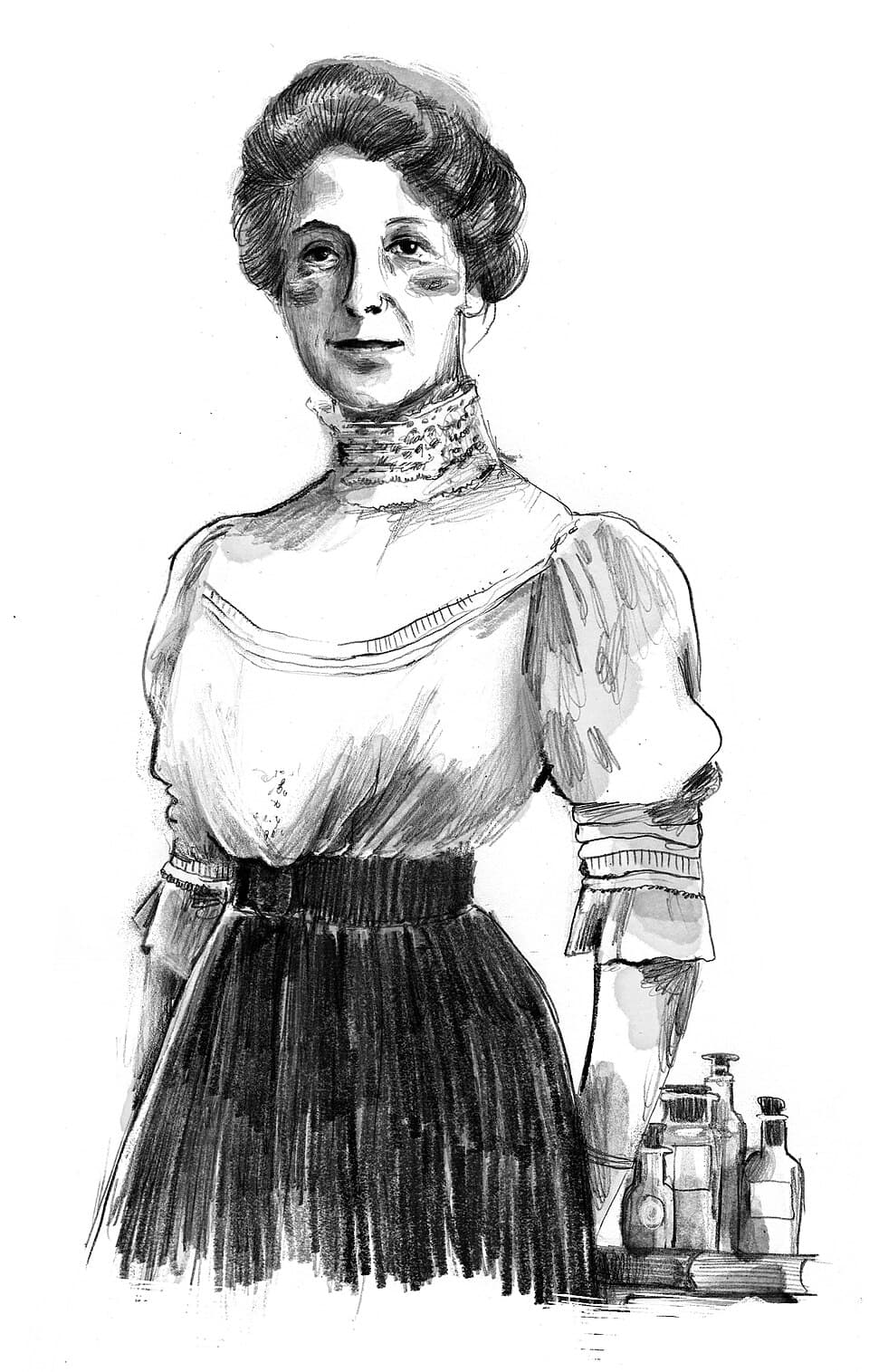
British · Science
Martha Annie Whiteley
November 11, 1866 – May 24, 1956
Early Life and Background
Martha Annie Whiteley, OBE, FCS, was born on 11 November 1866, in the Chelsea/Hammersmith area of London, England.[1][3][6] She was the second daughter of William Sedgewick Whiteley, a clerk or minor professional, and his wife Hannah (or Mary) Barghworking‑class or modest background, with limited family resources for education.[11][13] Growing up in late‑Victorian London, she faced the double barrier of class and gender at a time when secondary and higher education for girls was only just beginning to expand.
Whiteley’s academic promise was evident early. Sources note that she attended good schools on scholarships, demonstrating strong aptitude in mathematics and science despite the expectation that girls would be steered toward more traditionally “feminine” pursuits.[11] Her experiences as a scholarship student shaped both her appreciation for education and her later commitment to mentoring younger women scientists who faced similar constraints.
For higher education, Whiteley enrolled at Royal Holloway College, one of the pioneering institutions for women in Britain.[8][13] There she studied chemistry, at a time when women were rarely admitted to university science courses. She obtained a BSc in Chemistry from the University of London, completed when she was about 24 years old (c. 1890), making her one of a small number of women with a formal university qualification in chemistry.[8][12][13] She also earned an honours mathematical moderation from the University of Oxford, reflecting dual strength in mathematics and chemistry.[5] These achievements placed her among the earliest generation of British women to secure serious scientific training.
Career Beginnings and Development
Despite her degrees, Whiteley’s early career options were tightly constrained by gender and finances. After graduating, she lacked the private means or supportive husband that typically underwrote research careers for women in this era.[12][13] Consequently, she spent about eleven years in school teaching, beginning in the early 1890s.[5][12][13] Between roughly 1891 and 1900 she taught at a high school, and then moved to a women’s teacher‑training college.[5] Teaching provided a living wage but left little institutional support for research.
Nevertheless, Whiteley pursued chemical research in her spare time, an arrangement noted repeatedly in later accounts.[11][12][13] In 1898 she began working toward a doctorate in organic chemistry at the Royal College of Science, then a separate institution that would later become part of Imperial College London.[5][8][9] She carried out investigations into organic acids and related compounds, research demanding substantial laboratory access and intellectual independence.[7][9]
In 1902, she was awarded a Doctor of Science (DSc) degree in chemistry by the University of London, based on this research.[5][7][8][11][12] The DSc was a high‑level research degree, and Whiteley’s achievement is notable both because few women held doctorates in chemistry at the time and because she earned it while supporting herself through teaching. Her success demonstrated that women could produce original research despite significant structural obstacles.
Parallel to her doctoral studies, Whiteley’s association with the Royal College of Science developed into an academic appointment. By 1898, she was appointed a demonstrator in chemistry, responsible for assisting with teaching and laboratory instruction.[9] This role marked the beginning of a long career at the institution that would become Imperial College London. When the Royal College of Science merged into Imperial College in 1907, Whiteley was among the very few women on the academic staff of a co‑educational university.[9][10]
Over subsequent years she was promoted through the ranks. She became a lecturer in chemistry, and eventually an assistant professor, although she was never appointed to a full professorship.[8][9] Having an independent academic post in a co‑educational institution was rare for women scientists at this time; most women scientists worked either in women’s colleges, in schools, or as assistants to male professors. Whiteley’s ability to carry out research of her own choosing as a member of Imperial’s staff has been highlighted by historians as a distinctive achievement.[9]
Major Works, Research, and Accomplishments
Whiteley’s career encompassed several major areas of impact: chemical research and teaching, wartime contributions, professional activism, and editorial leadership in reference works.
Chemical Research and Teaching
Before World War I, Whiteley’s research focused on organic acids and related compounds, a field with relevance to both fundamental chemistry and emerging pharmaceutical applications.[7][9] Working with groups of students and junior researchers, she developed expertise in organic analysis and synthetic methods.[7][11] She also co‑authored an influential textbook on organic analysis, which served both students and practicing chemists; this text is cited in later assessments of her scientific work as a widely used teaching resource.[9][11]
As a lecturer and assistant professor at Imperial College, Whiteley taught generations of chemistry students, including women who were beginning to enter the field in small numbers. She played a major role in mentoring younger women scientists and encouraging their research ambitions, reflecting her own experience of navigating a male‑dominated profession.[9][11]
World War I Contributions
During World War I (1914–1918), chemistry was central to military strategy and medicine, and Whiteley became deeply involved in this work. As the British government launched a crash programme to produce synthetic and naturally occurring pharmaceuticals, dyes, anaesthetics, and explosives previously imported from Germany, she assembled a team of women chemists at Imperial College.[7][9][10]
The group collaborated closely with Jocelyn Field Thorpe, professor of organic chemistry at Imperial, on the synthesis of local anaesthetics and other critical drugs needed by military hospitals.[7] They worked on compounds such as beta‑eucaine and novocaine, as well as the analgesic phenacetin, helping to ensure adequate supplies for wartime medical care.[7] This work both advanced pharmaceutical chemistry and provided a rare example of an all‑female research team contributing directly to national defence.
Whiteley also undertook hazardous analytical work on mustard gas, a devastating chemical weapon first used on a large scale in the war.[7][10][11][13] According to several accounts, she investigated the composition of the first mustard gas sample sent to London, reportedly testing it on her own arm, which caused a painful sore.[10][11][13][15] Although this self‑experiment is described in biographical narratives rather than formal reports, it illustrates the risks she accepted in the course of chemical warfare research.
Her war work extended beyond mustard gas: some sources mention her contribution to developing an explosive known as “DW”, named for her initials, as part of the wider effort in munitions chemistry.[11][15] Collectively, her wartime research demonstrated both scientific skill and a willingness to apply chemistry to urgent national needs, while also showcasing the capacity of women chemists to perform high‑stakes technical work.
In recognition of her contributions, Whiteley was awarded the Order of the British Empire (OBE) in 1917 or 1920 (sources differ slightly on the exact date, but agree on the honour and its association with her war work).[2][7][9][10][11] The OBE was a significant distinction for a woman scientist at the time, publicly acknowledging her role in chemical research for the war effort.
Professional Activism and the Chemical Society
Beyond laboratory work, Whiteley played a crucial role in changing the professional status of women chemists in Britain. The Chemical Society (precursor to today’s Royal Society of Chemistry) had long restricted fellowship to men, effectively excluding women from formal recognition as research chemists.[10]
In 1904, Whiteley and fellow chemist Ida Smedley organized and presented a petition to the Chemical Society’s Council, signed by 19 women chemists, requesting that women be admitted as Fellows of the society.[2][8][10][11] The petition was a coordinated, collective challenge to institutional misogyny in chemistry. Although the Council did not immediately grant the request, the action marked a turning point in the campaign for women’s professional recognition.
The eventual breakthrough came after the Sex Disqualification (Removal) Act of 1919, which prohibited discrimination on the basis of sex in various professional contexts, including scientific societies.[2][8][10] After this legislation, the Chemical Society began admitting women as Fellows. In 1920, Whiteley became one of the first women Fellows of the Chemical Society, a milestone that acknowledged her scientific standing and the justice of the earlier petition.[2][4][10][11]
During the 1920s, she went further, becoming the first woman elected to the Council of the Chemical Society, a barrier‑breaking institutional first.[2][4][8][10][13] This position placed her in the governing body of one of Britain’s key scientific organizations and allowed her to influence policy and direction from within. Her election represented a visible rupture in the assumption that leadership in chemistry belonged exclusively to men.
Whiteley also served as president of the Imperial College Women Students’ Association during the 1920s, reflecting her continued engagement with women’s education and advocacy within her own institution.[9][15] Through these roles she mentored and supported younger women, helped secure equal treatment, and shaped the culture of science education.
Editorial Leadership: Thorpe’s Dictionary of Applied Chemistry
Another major dimension of Whiteley’s career was her work as an editor and author of chemical reference works. She became co‑editor and later editor‑in‑chief of the fourth edition of Thorpe’s Dictionary of Applied Chemistry, an eleven‑volume encyclopedia of applied chemical science published between 1937 and 1954
Whiteley’s involvement in the multi‑volume project began in the 1920s and 1930s, when she joined the editorial team and gradually assumed greater responsibility.[3][9] Eventually she became senior editor, overseeing contributions from numerous experts and ensuring the accuracy and coherence of the work.[3][9] As historians of chemistry have noted, women were rarely given such editorial authority over major scientific reference works; Whiteley’s role stands out as an exception.[3] In addition to the Dictionary, she co‑authored at least one influential organic analysis textbook, which summarized methods for identifying and characterizing organic compounds.[9][11] Together, these publications helped standardize knowledge in applied and analytical chemistry, and they contributed to her reputation as both a practicing chemist and a knowledgeable editor. Whiteley’s scientific and advocacy work earned her several forms of recognition. The most prominent contemporary honour was her appointment as an Officer of the Order of the British Empire (OBE), awarded for her World War I chemical research, particularly on pharmaceuticals and mustard gas.[2][7][9][10][11] This state honour signaled official acknowledgment of the importance of her contributions. Her peers also recognized her through professional offices and memberships. Becoming one of the first female Fellows of the Chemical Society and then the first woman elected to its Council marked her acceptance into the governing elite of British chemistry.[2][4][8][10][13] These positions were not only personal honours but institutional milestones for women scientists. Her editorial work on Thorpe’s Dictionary of Applied Chemistry established her reputation as a leading authority in applied chemistry; later commentators have identified her as an exception to the usual exclusion of women from major reference‑book editorships.[3] In the early twenty‑first century, the Royal Society of Chemistry listed her among its “175 Faces of Chemistry”, celebrating influential figures in the discipline and explicitly highlighting her role in advocating for women’s inclusion.[6] Imperial College London further honoured her legacy by naming a suite in its conference centre after Martha Whiteley in 2007, recognizing her historical significance to the institution and to women in science more broadly.[9] Relatively little is recorded about Whiteley’s personal life outside her professional activities. Available biographical accounts focus primarily on her education, teaching, research, and activism, and do not provide definitive evidence of marriage or children.[3][9][11][13] This absence of information may reflect either a private personal life or the tendency of contemporary records to foreground women’s family roles only when they intersected directly with professional narratives. What can be inferred from the sources is that she lived for many years on a teacher’s salary while undertaking research in her spare time, and that she did not possess the independent wealth that often enabled male academics to pursue full‑time research careers.[8][12][13] This financial independence, coupled with the demands of teaching and research, suggests a life organized around professional commitments rather than domestic ones. Her mentoring of younger women, her leadership in the Imperial College Women Students’ Association, and her sustained activism for women’s rights in chemistry indicate strong personal dedication to community and institutional change.[9][10][11] These activities formed a central part of her identity as remembered by later historians and commentators. Whiteley’s academic career at Imperial College extended into the early 1920s. She officially retired from her post as lecturer/demonstrator in 1921, although some sources suggest that she remained involved in teaching and institutional activities beyond that date.[9] Other accounts note that she retired from Imperial in 1934, reflecting possible differences in the description of formal versus practical retirement.[5] Regardless of the precise institutional date, her later life was far from inactive. During the 1920s and 1930s, she devoted increasing energy to editorial projects, most notably the fourth edition of Thorpe’s Dictionary of Applied Chemistry.[3][9] The multi‑volume work required sustained effort and coordination over many years, and Whiteley continued to work on it well into her seventies and eighties. She also maintained her involvement in professional societies and in mentoring younger chemists. Her recognition as a Fellow and Council member of the Chemical Society and as a prominent figure in the Royal Society of Chemistry’s historical narratives indicates continued visibility in the field.[2][4][6][10] Whiteley died on 24 May 1956, in her ninetieth year, not long after the completion of the revised Dictionary.[1][3] Her death marked the end of a life that had traversed tremendous changes in chemistry—from Victorian laboratory practice to mid‑twentieth‑century industrial science—and in women’s access to scientific careers. Martha Annie Whiteley’s legacy rests on both her scientific work and her transformation of the professional landscape for women chemists. Historians of chemistry have described her as one of the most important women chemists in the United Kingdom in the first half of the twentieth century.[9] Her research on organic acids, pharmaceuticals, and chemical warfare agents demonstrated technical skill and adaptability across different areas of chemistry.[7][9][11] Equally important, she insisted that women be recognized as full participants in the scientific community. The 1904 petition to the Chemical Society, her role in securing women’s fellowship after the 1919 Sex Disqualification (Removal) Act, and her own election as the first woman Council member collectively mark a sustained campaign against institutional misogyny in chemistry.[2][4][8][10][13] These actions helped ensure that future generations of women could join the society, present papers, and hold office on equal terms with men. Whiteley’s wartime leadership of a team of women chemists at Imperial College also carries symbolic and practical significance.[7][9][10] By demonstrating that women could contribute directly to national defence through high‑level research, she challenged stereotypes about women’s suitability for technical and military‑related work. Her OBE recognized this contribution and provided a visible example of a woman scientist honoured for applied chemical research.[2][7][9][11] Her editorial stewardship of Thorpe’s Dictionary of Applied Chemistry ensured that generations of chemists had access to reliable, comprehensive information about applied chemical science.[3][9] As senior editor of the eleven‑volume fourth edition, she played a central role in shaping the reference literature of her field, an area from which women were often excluded. This work reinforced her reputation as a chemist who combined meticulous scholarship with broad oversight. In the early twenty‑first century, institutions have continued to commemorate her contributions. The Royal Society of Chemistry’s “175 Faces of Chemistry” initiative includes Whiteley as an influential figure, emphasizing her activism and editorial work.[6] Imperial College London’s decision to name a conference‑centre suite after her further embeds her memory in the physical and institutional fabric of the university.[9] Educational and advocacy initiatives such as WISE (Women in Science and Engineering) and various online profiles now cite her as a historical role model.[5][11] From the perspective of women’s history, Martha Annie Whiteley exemplifies how individual persistence and collective action can reshape professional structures. She navigated a career built on scholarships, long years of school teaching, and research carried out against the odds, yet she achieved a doctorate, held an academic post with significant autonomy, conducted high‑impact wartime research, edited a major reference work, and changed the rules governing scientific societies. Her life demonstrates that the history of chemistry is not only about discoveries and theories but also about the struggle for inclusion and recognition. As such, Whiteley stands as both a pioneering chemist and a pivotal figure in the story of women’s integration into mainstream scientific institutions in Britain. Her work and activism laid groundwork that later women chemists, academics, and students continue to build upon.Awards, Honours, and Recognition
Personal Life
Later Life and Retirement
Legacy and Historical Impact
Dated achievements
2 indexed.
- Nov111866Science
Birth of Martha Annie Whiteley
Martha Annie Whiteley was born in London, laying the groundwork for her future as a pioneering chemist.
View details Wikipedia Article on Martha Annie Whiteley - May241956Science
Death of Martha Annie Whiteley
Martha Whiteley passed away at age 89, leaving behind a legacy in chemistry.