← All women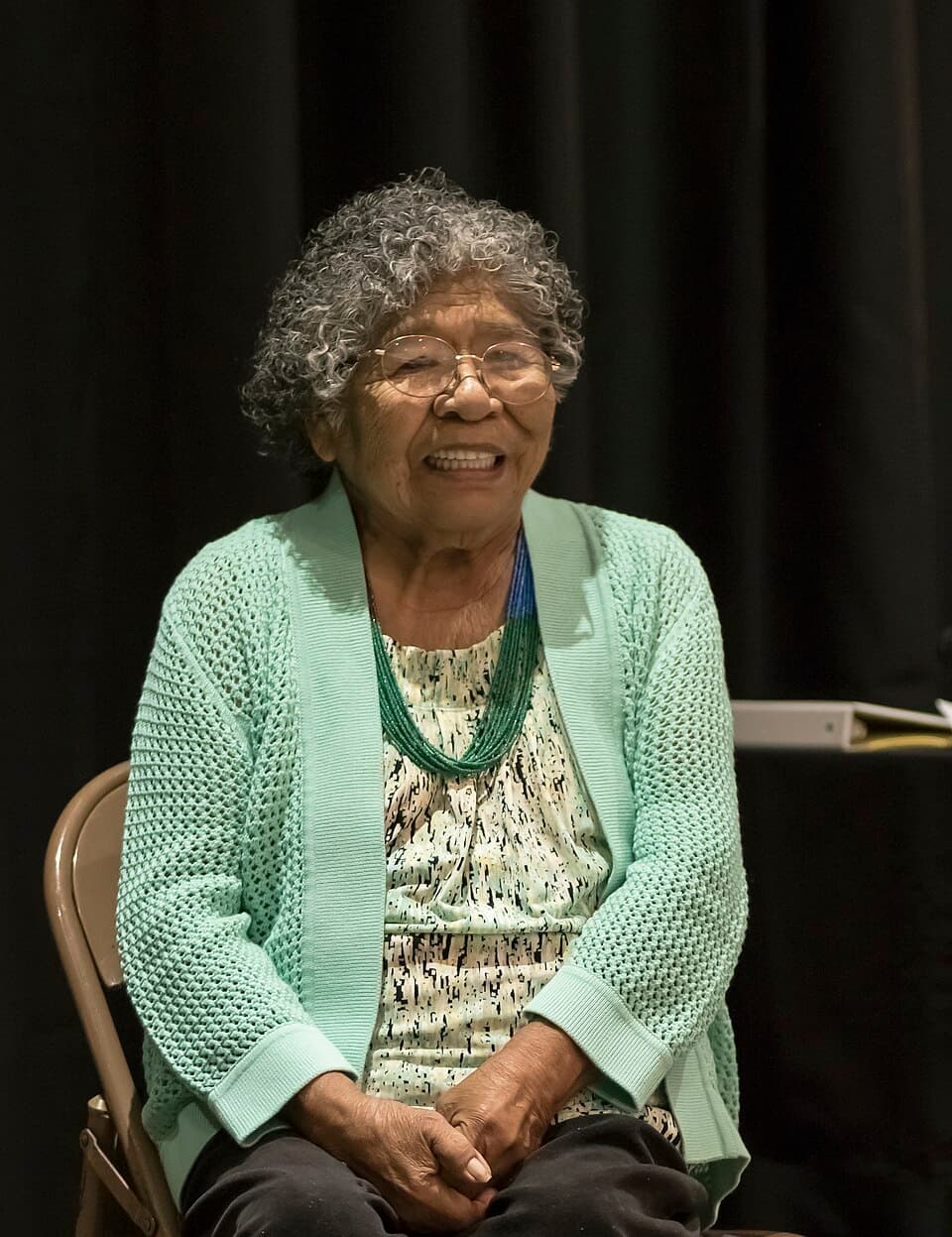
American · Activism · Arts
Marie Wilcox
November 24, 1933 – September 25, 2021
Early Life and Background
Marie Desma Wilcox was born on November 24, 1933, in California’s San Joaquin Valley, an area that has long been home to the Yokuts tribal groups, including the Tule‑Kaweah and Wukchumni people.[1][6] She was a member of the Tule‑Kaweah Yokuts and is most often identified specifically with the Wukchumni community, a small, non‑federally recognized tribe whose traditional territory lies near the Tule and Kaweah Rivers.[1][4][6]
Wilcox grew up in a family where Wukchumni, a dialect of the Tule‑Kaweah language within the broader Yokutsan language family, was spoken by her grandparents.[1][2][6] As a young girl, she listened to them conversing and telling stories in the language, absorbing vocabulary, cadence, and oral traditions. Like many Indigenous children in twentieth‑century California, she also experienced the pressures of English‑dominant schooling and discrimination that discouraged the use of Native languages.[5][6] Over time, Wukchumni retreated from everyday use, and many community members stopped speaking it.
Her early immersion, however, meant that Wilcox retained a deep, if partially dormant, command of Wukchumni. The Celebrate California project notes that she later decided, as an adult, to re‑learn the language intentionally so she could pass it on to her children.[6] This decision would prove pivotal in the history of the language: without her childhood exposure and later recommitment, there would likely have been no fluent speaker left by the early twenty‑first century.
Wilcox’s youth coincided with decades of federal Indian policy that promoted assimilation, relocation, and, at times, the suppression of Native cultural practices. Against this backdrop, her grandparents’ insistence on speaking Wukchumni at home preserved a fragile linguistic lifeline. The memory of their speech, and the eventual loss she felt when elders passed away, became a major emotional driver in her later work to honor them by documenting the language.[1][2][4]
Life, Work, and Community Involvement
Details of Wilcox’s formal education and early employment are sparsely documented in public sources, reflecting both the marginalization of Native women’s histories and Wilcox’s own quiet demeanor. Obituaries and profiles describe her as living a largely ordinary life in Tulare County, California, before she assumed a more visible role as a language activist later in life.[3][4][6] She was a mother and grandmother, embedded in extended family networks that would later form the core of Wukchumni revitalization efforts.
Wilcox’s turning point came with the realization that she was becoming, and then had become, the last fluent speaker of Wukchumni.[1][3][7][13] According to multiple accounts, this recognition emerged in her seventies and early eighties, as older relatives died and younger generations grew up speaking primarily English.[3][7][11][13] One source notes that after the death of an elderly relative about eight years before the 2021 obituary, she found herself the only person fluent in Wukchumni.[3] Social‑media tributes and educational write‑ups emphasize that at approximately age 82 she fully grasped that the language might disappear with her.[7][11][13]
Confronted with this possibility, Wilcox decided that she could not allow Wukchumni to vanish. She began writing down words she remembered on envelopes, slips of paper, and notebooks, gradually assembling an informal lexicon.[1][4][11] Her work intensified in the early 2000s, when, as several sources describe, she resolved to create a dictionary of the language and taught herself to use a computer for the first time.[4][7][11][13]
Creating the Wukchumni Dictionary
Wilcox’s most significant achievement was her creation of a comprehensive Wukchumni–English dictionary, a project she pursued over more than two decades.[1][3][4] Various accounts estimate that she worked for "more than twenty years" on the dictionary and spent approximately seven of those years typing it into her computer.[1][3][4][7][11][13] Her labor was largely self‑directed and self‑funded, undertaken in the margins of everyday life.
To produce the dictionary, Wilcox first compiled vocabulary from memory, from stories, and from conversations with elders while they were still alive. She wrote on any available paper, capturing words, phrases, and cultural references.[1][4][11] Later, she decided that the material needed to be organized systematically and stored in a more durable format. Despite never having used a computer before, she taught herself basic typing and file management. Social‑media tributes emphasize that she sat down at a computer at around age 70 and, at about age 82, began in earnest to type out thousands of words, learning "hunt‑and‑peck" typing techniques.[5][7][11][13]
Wilcox did not work entirely alone. She received assistance from Nicholas Luna, an Apache friend who helped her with computer operations and layout.[1][2][4] Together, they designed the dictionary to include not only written entries but also audio recordings of each word, allowing learners to hear pronunciation. The Spanish‑language Wikipedia article notes that she "included sound recordings of each word in the dictionary" and that this multimedia approach became a key feature of her documentation.[2]
After "twenty years of labor, of hunting and pecking on her keyboard," as one obituary puts it, Wilcox produced what the New York Times described as the first known complete compendium of Wukchumni.[3] Various sources report slightly different figures for the dictionary’s size, but many widely circulated posts and articles linked to the Marie’s Dictionary film describe it as containing approximately 6,000 words.[4][7][11][13]
The dictionary was more than a bilingual wordlist. It represented the first written record of Wukchumni as a coherent language system, establishing orthographic conventions, semantic categories, and a body of recorded pronunciation.[4][10][13] In doing so, Wilcox transformed Wukchumni from a purely oral tradition into a documented language that could be studied, taught, and revitalized even after the loss of its last native speaker.
Marie's Dictionary and Public Recognition
Wilcox’s work remained largely within her family and local community until the early 2010s, when it caught the attention of filmmakers and educators. In 2014, as part of the Global Oneness Project, filmmaker Emmanuel Vaughan‑Lee created a ten‑minute documentary titled Marie’s Dictionary, which tells the story of Wilcox as the last fluent Wukchumni speaker and chronicles her creation of the dictionary.[4][10][12]
The film shows Wilcox typing at her kitchen table, teaching her grandson, and speaking about the emotional weight of being the only person who can fully speak her language.[10] It also portrays her traveling with her daughter, Jennifer Malone, to conferences across California, where they meet members of other tribes struggling with language loss and share their experiences of documentation and teaching.[4][8]
Released online in September 2014, the documentary reached a global audience through educational platforms and social media.[4][12] It was later discussed in a New York Times Op‑Ed and featured in pieces by PBS SoCal and other outlets that focus on environmental and cultural issues.[2][12] These features emphasized Wilcox’s dedication and the broader context of Yokuts language decline: before European contact, an estimated 50,000 Yokuts lived in Central California, but numbers fell dramatically, and by the time of the film’s release, fewer than 200 Wukchumni remained.[4]
The visibility generated by Marie’s Dictionary created a surge of interest in Wukchumni. According to Spanish‑language Wikipedia, after the documentary appeared and was highlighted in the New York Times, Wilcox’s relatives and other tribal members became more interested in reviving the language.[2] Educational projects such as PBS SoCal’s Tending the Wild series later revisited her story, framing it within broader themes of ecological knowledge and Indigenous resilience.[12]
Teaching and Language Revitalization
Parallel to her documentation work, Wilcox devoted significant time to teaching Wukchumni. The Global Oneness Project’s "Language Keepers: Wukchumni" profile describes how, at age 85, she was the sole fluent speaker, yet she and her daughter Jennifer were "embarking on an ambitious project of language revitalization".[8]
Wilcox taught weekly classes, often in her home, where she worked with her daughter, grandchildren, and other community members to pronounce words, practice conversation, and learn the stories embedded in the language.[4][5][8] A YouTube feature and social‑media posts note that she and Jennifer held classes around Tulare County, extending beyond family to interested learners.[5][8][9] Her role was not only linguistic but also cultural: she used the language to convey traditional knowledge, place‑names, and values connected to the land.
The Celebrate California project records that Wilcox continued to teach through local programs such as the Tulare County Nüümü Yadoha program, which supports Indigenous language learning.[6] Her teaching style blended patience with insistence on accuracy, and learners often remarked on the emotional significance of hearing Wukchumni spoken by its last fluent elder.
These classes, combined with the dictionary and recordings, meant that by the late 2010s Wilcox was no longer the only person learning Wukchumni, even if she remained the only fully fluent speaker.[3][4][8] Her work allowed the language to move from a state of near extinction to one of cautious revitalization, centered in family and community rather than in external institutions.
Awards, Honors, and Recognition
While there is limited documentation of formal awards or titles given to Wilcox by governments or large organizations, she received significant symbolic recognition through media coverage, educational projects, and tributes from Indigenous and ally communities.
The New York Times obituary, reprinted by outlets such as eKathimerini, characterized her as the woman "who saved her native language from extinction," underscoring the historical scale of her achievement.[3] The Global Oneness Project and PBS SoCal framed her as a central figure in their series on language, culture, and environmental stewardship, effectively canonizing her as an exemplar of Indigenous resilience.[4][12]
Numerous online tributes—from Native news sites to platforms like PowWows.com and A Mighty Girl—celebrate Wilcox as a cultural hero, highlighting her status as the last fluent speaker and her decision to devote her late life to documentation and teaching.[7][11] Social‑media posts, often inspired by the documentary, describe her as "the woman who saved a language" and share her story as an inspirational example of elder activism.[5][7][13]
In academic and activist contexts, Wilcox is referenced in discussions of language justice, community‑driven archiving, and the role of Indigenous women elders in sustaining knowledge systems. Her dictionary is cited as a "first known complete compendium" and the "first written record" of Wukchumni, recognitions that place her work alongside professional linguistic documentation while emphasizing that it was created from within the community.[3][4][10]
Personal Life
Public sources provide only partial glimpses into Wilcox’s personal life, reflecting both her private character and the tendency of media accounts to focus on her linguistic work. She was a mother and grandmother; her daughter, Jennifer Malone, appears prominently in the documentary and subsequent profiles as a collaborator and co‑teacher.[4][8][10]
Family played a central role in Wilcox’s language work. She often described her dictionary as a tribute to her grandmother, who had spoken Wukchumni with her in childhood.[1][2][4] The impulse to honor this ancestor’s voice motivated Wilcox’s decision to begin writing the language down after her grandmother’s death.[1][2] Later, her classes became a way to engage her descendants in cultural continuity; the film shows her teaching her grandson and expresses her hope that he and others will continue speaking Wukchumni after she is gone.[10]
There is limited public information about a spouse or additional children, and no widely cited details about formal marital status. Instead, the narrative emphasizes intergenerational ties—grandparents, Marie herself, her daughter, and younger relatives—as the primary framework of her life. These relationships structured her daily routines and created the supportive environment in which she could devote many hours to typing, recording, and teaching.
Legacy and Historical Impact
Marie Wilcox’s legacy is profound both within her own community and for global conversations about Indigenous language preservation. She is widely recognized as the last fluent speaker of Wukchumni and the creator of its first complete dictionary, achievements that prevented her language from disappearing entirely.[1][3][4]
Her work illustrates the critical role of Native women elders in maintaining and transmitting cultural knowledge. Wilcox combined traditional oral memory with modern technology, teaching herself computing skills in late life to ensure that her language could be archived and shared.[4][7][11] This challenges stereotypes about elders and technology, showing that innovation in digital humanities can emerge from community kitchens rather than academic labs.
In the broader field of language revitalization, Wilcox’s dictionary and the story captured in Marie’s Dictionary have become a touchstone. The Global Oneness Project notes that Marie and Jennifer met other tribes dealing with language loss and that their work helped inspire similar efforts.[4][8] Educational materials and museum programs frequently use her story to illustrate concepts such as language extinction, community empowerment, and the importance of documentation before the loss of fluent speakers.
Her impact is also felt in discussions about recognition and sovereignty. The Wukchumni are not federally recognized, meaning they lack the legal status that can facilitate funding and institutional support for language programs.[4] Wilcox’s achievements therefore highlight the capacity of unrecognized tribes to assert cultural sovereignty through archival and pedagogical work, even in the absence of formal state acknowledgment.
From a women’s‑history perspective, Wilcox stands as an example of how an Indigenous woman with no formal academic training became, through persistence and care, the primary authority on her people’s language. Her story complicates conventional narratives of "great linguists" by foregrounding community‑embedded, gendered labor: the patient, repetitive tasks of typing, recording, and teaching over years are revalued as world‑historical contributions.
Later Life and Death
In her later years, Wilcox continued to refine the dictionary, expand recordings, and teach classes, even as her health declined. The "Language Keepers: Wukchumni" profile describes her at age 85 as still deeply engaged in documenting words and collaborating with her daughter on revitalization efforts.[8] She remained an active presence in community gatherings and educational events, often traveling within California to speak about language and culture.[4][8]
On September 25, 2021, Wilcox died at the age of 87.[1][3][13] The New York Times obituary, widely reproduced, framed her passing in terms of both loss and survival: "after 20 years of labor" she had produced a dictionary that ensured Wukchumni would live on in written and recorded form.[3] Her death meant that there were no longer any fully fluent native speakers of the dialect, but her work had already seeded a new generation of learners.[2][3][4]
Local news outlets such as the Fresno Bee and online tributes from Indigenous organizations marked her death as the loss of a beloved elder and cultural leader, emphasizing the gratitude of family and community for her dedication.[3][6] Social‑media posts recalled her life story—her realization at 82 that she was the last fluent speaker, her self‑taught computer skills, and her seven years of typing—and reiterated that Wukchumni’s survival in documented form was her gift to future generations.[7][11][13]
After her death, the dictionary and recordings remain in the custody of her family and community, serving as the basis for ongoing classes and possible future collaborations with linguists and cultural institutions. The continued sharing of Marie’s Dictionary and related materials ensures that Wilcox’s voice is heard not only in her own valley but around the world, where it stands as a testament to the power of one woman’s commitment to language and memory.
Dated achievements
6 indexed.
- Nov241933Activism
Birth of Marie Desma Wilcox
Marie Desma Wilcox was born on November 24, 1933; she was a member of the Tule-Kaweah Yokuts and would become the last native speaker of the Wukchumni dialect in California.
View details Wikipedia - Sep012014Arts
Release of "Marie's Dictionary" film
The short film "Marie's Dictionary" was released, documenting Wilcox’s creation of the first written Wukchumni dictionary.