← All women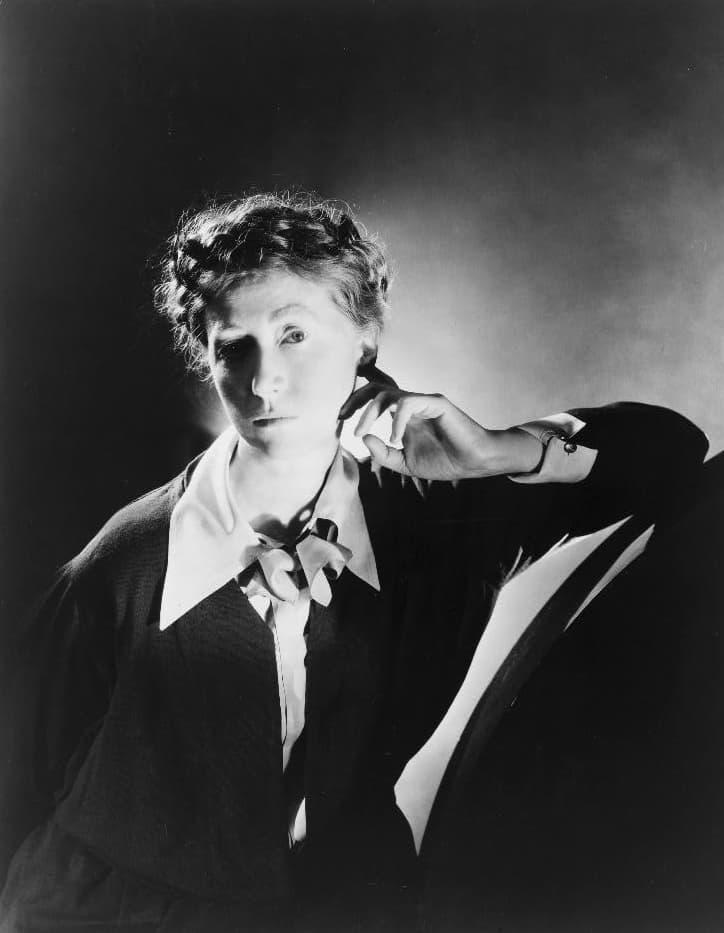
American · Literature
Marianne Moore
November 15, 1887 – February 5, 1972
Early Life and Background
Marianne Craig Moore was born on November 15, 1887, in Kirkwood, near St. Louis, Missouri, in the Presbyterian manse where her maternal grandfather, the Reverend John Riddle Warner, served as pastor.[1][4][5][10][11] Her parents were John Milton Moore, an engineer and inventor, and Mary Warner MooreJohn Warner Moore, in a close-knit, female-led household.[5][6][11]
Moore’s early years were shaped by the religious, intellectual, and ethical atmosphere of her grandfather’s home. After his death in 1894, the family stayed with various relatives before settling in Carlisle, Pennsylvania, in 1896.[4][10] Carlisle, a small town with strong educational institutions, provided Moore with stability and access to schooling. She was raised in the Presbyterian tradition, and her mother’s strict but supportive guidance encouraged both moral reflection and literary ambition.[4][11]
From a young age Moore showed an aptitude for languages, observation, and writing. Family and friends later recalled her habit of carefully noting details of animals, objects, and people—an impulse toward precise description that would become a hallmark of her poetry.[1][3][6] Her early education included attendance at the Carlisle High School and exposure to women teachers who modeled professional lives outside the home, subtly widening her sense of possibility.[6][11]
Education and Formative Influences
In 1905 Moore entered Bryn Mawr College in Pennsylvania, one of the premier women’s colleges of the era.[1][3][4][12] She majored in biology and histology and graduated with a B.A. in 1909.[1][3][4] The choice of a scientific field is striking for a future poet: it trained her in close observation, classification, and factual accuracy, all of which deeply informed her later poetic practice.[1][3][6]
Bryn Mawr also exposed Moore to a vibrant literary culture. She contributed early poems, including “A Jelly-Fish,” to the college’s literary magazines, gaining first experience of publication and editorial scrutiny.[3][4] Among her classmates was Hilda Doolittle (H.D.), who would become a key figure in Imagist poetry and later a crucial supporter of Moore’s career.[4][12] The college’s rigorous curriculum, combined with contact with ambitious, intellectually engaged women, reinforced Moore’s sense that literary work could be a serious vocation for women despite prevailing social norms.[4][6]
After graduation, Moore studied typing and commercial subjects at Carlisle Commercial College, reflecting the practical pressures facing educated women who still needed steady employment.[1][3][4][6] From 1911 to 1915, she taught commercial subjects—including typing and bookkeeping—at the Carlisle Indian Industrial School, a federal boarding school for Indigenous children.[1][3][4][6] This experience, though constrained by the assimilationist policies of the institution, broadened her awareness of cultural difference and institutional power, themes that would surface indirectly in her ethical concerns and satirical edge as a poet.[6][11]
Career Beginnings and Development
While teaching in Carlisle, Moore wrote poems and began to submit them to journals. Her first professionally published poems appeared in the English modernist magazine The Egoist and the Chicago-based journal Poetry in 1915.[4][7] These venues were central to early twentieth-century modernism; her inclusion signaled that she had quickly entered the inner circles of experimental poetry.
In 1918, Moore and her mother moved to New York City, settling eventually in Brooklyn.[3][4][6] New York offered richer literary connections and employment opportunities. In 1921 she became an assistant at the New York Public Library, a position that provided financial security and constant access to books, periodicals, and research materials.[3][4][12] During this period she met and corresponded with major modernist writers, including William Carlos Williams and Wallace Stevens, and became part of the transatlantic network shaped by Ezra Pound and H.D.[3][4][11][12]
Moore’s poems, with their unusual lineation, quotations from diverse sources, and precise descriptive detail, were increasingly recognized as distinctive contributions to modernist experimentation. She contributed regularly to The Dial, a leading American literary magazine.[1][3][12] In 1925 she was appointed acting editor of The Dial, serving until 1929.[3][4][12] In that role she exercised significant influence over modernist taste, publishing and reviewing the work of contemporaries such as T. S. Eliot, James Joyce, and Hart Crane, while shaping the magazine’s editorial voice.[3][11]
Her editorial work was especially notable for a woman in the 1920s, when prestigious literary positions were overwhelmingly held by men. Moore’s decisions helped canonize particular strands of modernism and demonstrated that women could occupy central curatorial roles in the literary field.[6][11]
Major Works and Literary Accomplishments
Moore’s first book, Poems, was published in 1921 in London by The Egoist Press, edited by H.D. and Winifred Ellerman (Bryher), without Moore’s prior knowledge.[4][6][12] Although she had reservations about the volume, its appearance marked her entrance into book-length publication, gathering poems that had already drawn attention in avant-garde journals.
Her next major collection, Observations, appeared in 1924 and solidified her reputation as a leading modernist poet.[1][3][6] The volume included some of her best-known works and was praised for its intellectual complexity, formal innovation, and moral seriousness. Critics have highlighted the way Moore constructs poems from intricate syllabic patterns and extended stanzas, often combining quotation, paraphrase, and commentary.[3][6][11]
Subsequent collections such as Selected Poems (1935), edited with an introduction by T. S. Eliot, The Pangolin and Other Verse (1936), and Like a Bulwark (1956) further expanded her audience.[12] Eliot’s introduction, in particular, underscored her importance to the modernist movement and helped bring her work to readers who might otherwise have overlooked a woman poet in a male-dominated field.[3][11]
Moore’s Collected Poems, published in 1951, became her most celebrated work and a focal point for critical recognition.[4][8][12] The volume gathers key poems from across her career and showcases her mature style, including pieces such as “The Fish,” “The Paper Nautilus,” and “The Steeple-Jack,” which exemplify her use of animals and landscapes as vehicles for ethical reflection.[1][3][6]
Beyond poetry, Moore produced influential prose, including essays and reviews on literature, painting, performance, and sports. She also undertook translations, such as her version of La Fontaine’s fables, demonstrating her interest in traditional narrative forms and their adaptation for modern readers.[3][6][11] Her nonfiction further confirmed her reputation as a critic of great acuity and wide cultural range.
Awards, Honors, and Recognition
Moore’s work, initially admired in relatively small modernist circles, eventually received extensive institutional recognition. She was awarded the prestigious Bollingen Prize for Poetry in 1951, acknowledging her sustained contribution to American letters.[4][12] The Bollingen Prize, administered by Yale University, is among the highest honors for a poet writing in English; Moore’s selection signaled that a woman could stand alongside the most celebrated male poets of the time.[12]
Her Collected Poems (1951) earned both the National Book Award and the Pulitzer Prize for Poetry, with the awards conferred in 1952.[4][8][12] Winning these two major American literary honors for the same book constituted a "triple crown" when combined with the Bollingen Prize, a designation often used by later commentators.[15] These accolades cemented her status as one of the preeminent poets of the mid-twentieth century.
Moore also received honorary degrees and fellowships, participated in public readings, and held roles in cultural institutions. She served on prize juries, including for the National Book Awards, and became an important public advocate for poetry.[6][11] Her increasing visibility, including appearances in mainstream media, made her one of the few poets whose image—a small figure with a distinctive tricorn hat and long braid of white hair—was recognizable even to people who did not regularly read poetry.[11]
Personal Life and Relationships
Moore never married and had no children.[5][11] She lived for most of her adult life with her mother, Mary, with whom she maintained a close, complex, and mutually dependent relationship.[5][6][11] Their shared household, first in Carlisle and later in Brooklyn, provided emotional support and practical assistance but also demanded that Moore balance familial obligations with her writing and editorial work.
Her letters and diaries reveal rich friendships and intellectual partnerships with other writers, including H.D., Ezra Pound, William Carlos Williams, Wallace Stevens, and younger poets who sought her guidance.[3][4][11] She corresponded widely and was known for carefully composed replies that combined encouragement with meticulous criticism.
Moore’s religious background remained important, though her faith evolved over time. Raised Presbyterian, she maintained a strong ethical sensibility and a fascination with moral questions about discipline, self-restraint, and justice.[4][11] These concerns permeate her poetry, where animals, artifacts, and historical anecdotes frequently serve as lenses for examining ethical conduct.
In later decades, Moore became an increasingly public figure, attending baseball games, arts events, and civic ceremonies. Her enthusiasm for sports—particularly baseball—was well known, and her persona as a witty, erudite, yet approachable poet appealed to audiences beyond academic and literary circles.[11][15]
Later Life: Public Persona and Continuing Work
By the 1950s and 1960s, Moore was both a canonical modernist and a living cultural celebrity. She continued to write and revise poems, publish essays, and participate in readings. Her collections O to Be a Dragon (1959) and The Arctic Fox (1964) show her ongoing experimentation and engagement with contemporary issues, even as age and health gradually limited her activity.[12]
In 1968, Moore threw the ceremonial first pitch at a New York Yankees game, an event often cited as emblematic of her quirky public presence and her love of baseball.[15] The gesture symbolized the degree to which a serious modernist poet could enter popular culture while retaining her artistic integrity, challenging assumptions about the separation of "high" and "mass" culture.
Though her creative pace slowed, Moore remained involved in literary life, mentoring younger writers and approving new editions of her work.[6][11] She also became the subject of scholarly attention; critics began to publish essays and books that treated her poetry as central to understanding modernism, rather than as a minor adjunct to more famous male figures.
Death and Posthumous Publications
Moore died on February 5, 1972, in New York City.[1][4][5][6][13][14] She had lived in the city for more than half a century and spent the last decades of her life in Brooklyn’s Fort Greene neighborhood.[13] Her death prompted memorial pieces in major journals and newspapers, highlighting her role as a "mother of modernism" and as a model of intellectual independence for women writers.[13][15]
Later in 1972, Poetry magazine published some of her last work and commentary about her career, underscoring the enduring relevance of her poems.[6] Posthumous editions, including collected letters and critical studies, expanded access to her writing and provided new tools for understanding her aesthetic and ethical commitments.
Legacy and Historical Impact
Marianne Moore is now widely regarded as one of the central figures of Anglo-American modernist poetry.[1][3][6][11] Her work is distinguished by formal innovation, including complex syllabic stanzas and intricate line breaks; precise diction that often draws on scientific, legal, and technical vocabulary; and a distinctive mixture of irony and moral seriousness.[1][3][6] She frequently builds poems around animals, artifacts, or historical episodes, using detailed description as a springboard for reflections on courage, integrity, humility, and resilience.
Historically, Moore’s career challenges narratives that treat modernism as a male-dominated movement. As a poet, critic, translator, and editor, she contributed both creative work and institutional leadership. Her tenure at The Dial placed her at the center of modernist publishing, while her later awards—Bollingen, National Book Award, Pulitzer—demonstrated that a woman could achieve the highest levels of recognition in American poetry.[3][4][6][12]
Moore’s impact is particularly significant for women’s literary history. She navigated structural barriers in higher education, employment, and publishing at a time when women’s artistic labor was often marginalized or framed as secondary. By sustaining a demanding editorial job, supporting her mother, and producing a body of work now seen as canonical, she exemplified the possibility of combining domestic responsibilities with artistic and intellectual ambitions.[6][11]
Subsequent generations of poets have cited Moore as an influence, especially in her use of collage, quotation, and nontraditional forms. Her poems’ engagement with ethical themes and their refusal to separate aesthetic questions from moral ones have appealed to writers interested in the intersection of art, politics, and everyday life.[3][6] Scholars have increasingly emphasized her role in expanding the range of what subjects and voices could appear in serious poetry, including animals, minor historical figures, and women’s experiences.
Biographical and critical works, such as Linda Leavell’s studies and numerous articles, have further secured Moore’s status in literary scholarship.[9][11][17][19] Recent institutional profiles, including those by the National Book Foundation, the Bollingen Prize program, and the Presbyterian Historical Society, continue to present her as a "triple-crowned" poet whose life and work illuminate broader questions about gender, modernism, and American culture.[8][12][15]
Today, Marianne Moore’s writing is widely taught in university courses on modernism, women’s literature, and American poetry. Her careful description, moral complexity, and formal inventiveness remain a touchstone for readers and writers seeking models of how art can engage the world’s particulars without sacrificing intellectual rigor or ethical depth.[1][3][6]
Dated achievements
3 indexed.
- Nov151887Literature
Birth of Marianne Moore
Marianne Craig Moore was born in Kirkwood, Missouri.
View details Marianne Moore | Biography & Facts - Britannica - May011915Literature
Debut in Poetry Magazine
Made her first appearance in Poetry magazine in May 1915.
View details