← All women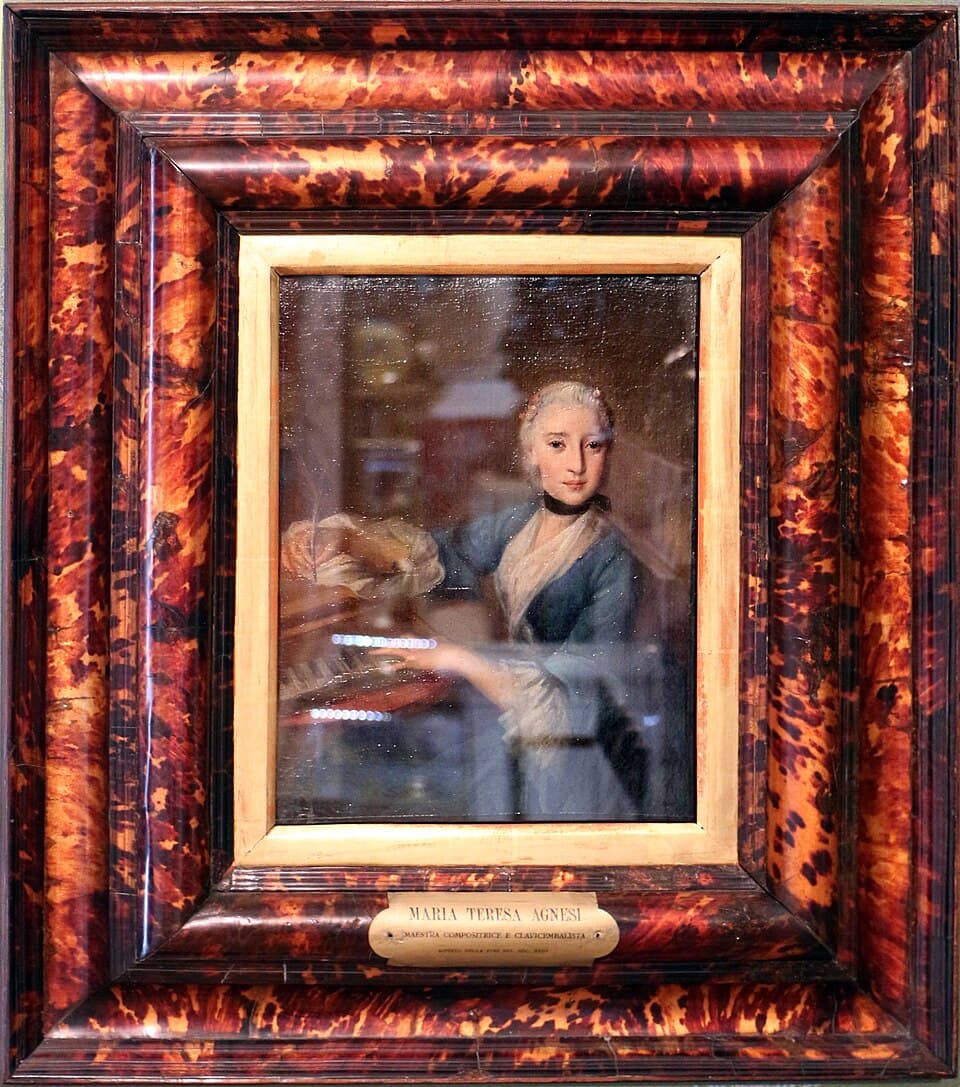
Italian · Arts
Maria Teresa Agnesi
October 17, 1720 – January 19, 1795
Early life and family background
Maria Teresa Agnesi Pinottini was born in Milan on 17 October 1720 into a prominent family. Her father, Pietro Agnesi, was a member of the lesser nobility and a wealthy merchant; her household belonged to the cultivated urban elite of Habsburg Milan. She was the sister of the celebrated mathematician Maria Gaetana Agnesi, and the two sisters are frequently mentioned together in later biographical writing because the family became unusually associated with female intellectual accomplishment.
Agnesi’s early environment mattered greatly for her development. In eighteenth-century Italy, women with social standing were more likely than others to receive instruction in music, languages, and polite learning, even if formal professional pathways remained limited. Her later career suggests that she received a well-rounded education that included music and the arts. That training helped her become an accomplished harpsichordist and singer as well as a composer. The Agnesi household therefore represents one of the many aristocratic and mercantile families in which daughters could cultivate artistic skill, but Maria Teresa’s life shows that talent could also be translated into a public artistic identity.
It is important not to confuse Maria Teresa Agnesi with her sister Maria Gaetana, the mathematician. Maria Teresa’s historical importance lies in music, especially in the development of her career as a composer in a period when women were rarely recognized in large-scale musical genres. Her life belongs to the history of women’s professional authorship in the arts, rather than to the history of science and mathematics associated with her sister.
Training and early musical career
Maria Teresa Agnesi came of age in a cultural world shaped by courtly patronage, aristocratic salons, and public theatrical life. Milan in the early eighteenth century was a city in which music could be a route to prestige, but female participation was constrained by gendered expectations about performance and composition. Agnesi nevertheless established herself first as a performer. Biographical accounts consistently describe her as a talented harpsichordist and singer, and those accomplishments likely provided the practical foundation for her later work as a composer.
Her professional reputation grew within circles that valued musical accomplishment among the elite. Sources note that she gained patronage and recognition in Europe, including support from the Habsburg imperial court. That patronage was significant because women composers often depended on aristocratic sponsorship to have their music heard, copied, and performed. In this sense, Agnesi’s early musical career reflects both her personal skill and the social networks that made women’s artistic careers possible under restrictive conditions.
Like many women musicians of her time, she did not enter a conservatory or public institution on equal terms with men. Instead, her career unfolded through household education, elite sociability, and patronage. The evidence suggests that she transformed a private cultivation of music into a public artistic identity, a transition that was still uncommon for women in the eighteenth century.
Composer and librettist
Agnesi is remembered today as one of the first female opera composers in Italy. That label is historically meaningful because opera was among the most public, prestigious, and institutionally complex musical genres of the time. To compose opera required not only musical fluency but also access to librettists, theaters, patrons, and performers. For a woman to participate in this sphere was unusual and noteworthy.
Her earliest major work is often identified as the cantata Il ristoro d’Arcadia, composed in 1747 and now lost. Sources indicate that it was dedicated to Gian Luca Pallavicini, an imperial delegate. Even though the work does not survive, its dedication shows how Agnesi already moved in patronage circles important to a serious composer. The dedication also reveals the ways women composers negotiated visibility: association with powerful patrons could legitimize their work in a society that often treated women’s composition as exceptional rather than normal.
Her first opera, Nitocri, was composed in 1752 and survives. That same year she married Pier Antonio Pinottini on 13 June 1752. The coincidence of these events is revealing: marriage did not end her musical life, and her identity as a composer remained intact. Her second opera, Ciro in Armenia, was composed in 1753 and was produced at the ducal theater in Milan for the king of Poland. This production demonstrates the level of recognition she had achieved. Operatic composition of this kind was a demanding and public achievement, especially for a woman.
Biographical sources indicate that she may have written six operas in total, though not all are fully documented or extant. In addition to operas, she composed cantatas, keyboard works, and pieces for voice. The majority of her surviving compositions are for keyboard or for voice with keyboard accompaniment. This survival pattern is common for women composers of the period, whose larger works were often lost or less systematically preserved than those of male contemporaries.
Style, repertory, and musical significance
Agnesi’s output is especially important because it shows the range of women’s composition in the mid-eighteenth century. She was not limited to salon miniatures or amateur domestic pieces; rather, she engaged with the genres that carried professional weight. Her keyboard works and vocal music reflect the practical realities of eighteenth-century musical life, where composers often wrote for the instruments and voices most readily available in elite settings. The fact that she also wrote libretti shows that her literary and musical skills intersected, allowing her to participate in the broader theatrical culture of her day.
Her collections of arias were reportedly widely known in Italy and German-speaking Europe, suggesting a reputation that crossed regional boundaries. That reach is significant because circulation beyond a single city or court implied that a composer’s music could travel through manuscript copying, performance, and patronage networks. For a woman composer, this degree of recognition was a notable achievement in an era when publication and dissemination were especially difficult to control.
Agnesi’s musical importance also lies in the historical context of women’s authorship. Eighteenth-century Europe produced a number of gifted women performers and composers, but later canons often overlooked them. Agnesi’s surviving reputation has helped modern scholars recover the breadth of women’s contributions to Classical-era music. Her work is part of a larger effort to restore women to narratives of operatic and keyboard history that long centered men almost exclusively.
Marriage and personal life
On 13 June 1752, Agnesi married Pier Antonio Pinottini. After the marriage she is commonly referred to as Maria Teresa Agnesi Pinottini. The marriage appears in biographical sources as a stable identifying fact, but the record also notes that the couple eventually suffered severe financial ruin. This detail matters because it places her artistic life within the economic instability that could affect even socially connected families.
In eighteenth-century Europe, a woman’s career was often inseparable from her domestic status. Marriage could provide protection or support, but it could also bring obligations and financial vulnerability. Agnesi’s life reflects those tensions. Rather than disappearing from musical history after marriage, she continued to be remembered for her work as a composer and performer. Her story therefore complicates any assumption that marriage necessarily ended women’s professional activity.
Available sources do not consistently document children or a large private household narrative, and the safest historical account is to note what is clearly supported: her marriage, her professional identity, and the financial difficulties that shaped her later life. Those facts are enough to show that she lived at the intersection of artistic production and the social realities of eighteenth-century family life.
Patronage, recognition, and later career
Agnesi gained recognition in elite circles, and sources associate her with the patronage of Maria Theresa of Austria, the Habsburg empress. Such patronage mattered enormously for women musicians, since access to court or aristocratic support could determine whether their compositions were performed and remembered. In a musical culture built around performance opportunities, copying, and publication, patronage functioned as a key form of validation.
Her recognition as a harpsichordist and composer placed her among a small but important group of women who became known across European musical networks. Although many of her works are lost, the surviving documentation is enough to demonstrate that she was not a marginal figure. Instead, she was part of a broader eighteenth-century movement in which women increasingly participated in the arts as creators as well as performers, even when institutional equality remained distant.
Her surviving reputation also shows the fragility of women’s musical legacies. The loss of many compositions makes her reconstruction difficult, yet the available sources preserve the outline of a career that was respected in its own time. Modern scholarship has increasingly emphasized that the absence of surviving scores should not be mistaken for lack of importance.
Legacy and historical impact
Maria Teresa Agnesi Pinottini’s historical importance lies in her position as one of the early women to compose opera in Italy and in the broader fact that she achieved public recognition in a field that largely excluded women from professional authorship. Her legacy is not based on a single famous masterpiece but on the cumulative significance of a career that crossed several barriers at once: class expectations, gender norms, and the institutional constraints of eighteenth-century musical life.
She is especially valuable to women’s history because she shows how talent could be supported by family background and patronage, yet still require extraordinary effort to become visible. Her life helps historians understand that women’s musical history is not only the history of a few isolated prodigies; it is also the history of artists who worked within and against the structures of their time. Agnesi’s example is thus part of the recovered canon of women composers whose reputations are now being reexamined.
Her legacy also extends to the modern effort to document women in music more fully. Because many of her works were lost, later generations have had to reconstruct her career from scattered references, printed notices, and surviving pieces. That process itself has become part of her historical meaning: she stands for the many women composers whose achievements were once under-recorded and are now being restored to view.
Death and remembrance
Maria Teresa Agnesi Pinottini died in Milan on 19 January 1795. Her death ended a life that had spanned most of the eighteenth century and had unfolded during a period of significant change in European musical culture. Though she is not among the most widely known composers of the Classical era, she is now recognized as an important figure in the history of women’s composition.
Modern biographical resources and women’s music projects continue to preserve her name, her dates, and the outlines of her career. That continued attention is historically meaningful because it reflects a wider shift in music history: women composers are increasingly studied not as exceptions, but as integral participants in the artistic life of their age. Agnesi’s career, especially her role as an early female opera composer, remains a useful case study in how women could create, publish, and gain patronage despite the obstacles of their time.
Dated achievements
3 indexed.
- Oct171720Arts
Birth of Maria Teresa Agnesi in Milan
Maria Teresa Agnesi Pinottini was born in Milan into a wealthy and intellectually vibrant family that would nurture her musical talents from an early age.
View details Maria Teresa Agnesi Pinottini - Wikipedia - Jun131752Arts
Marriage to Pier Antonio Pinottini
Maria Teresa Agnesi married Pier Antonio Pinottini on June 13, 1752, a union that allowed her to continue her musical career under her married name.