← All women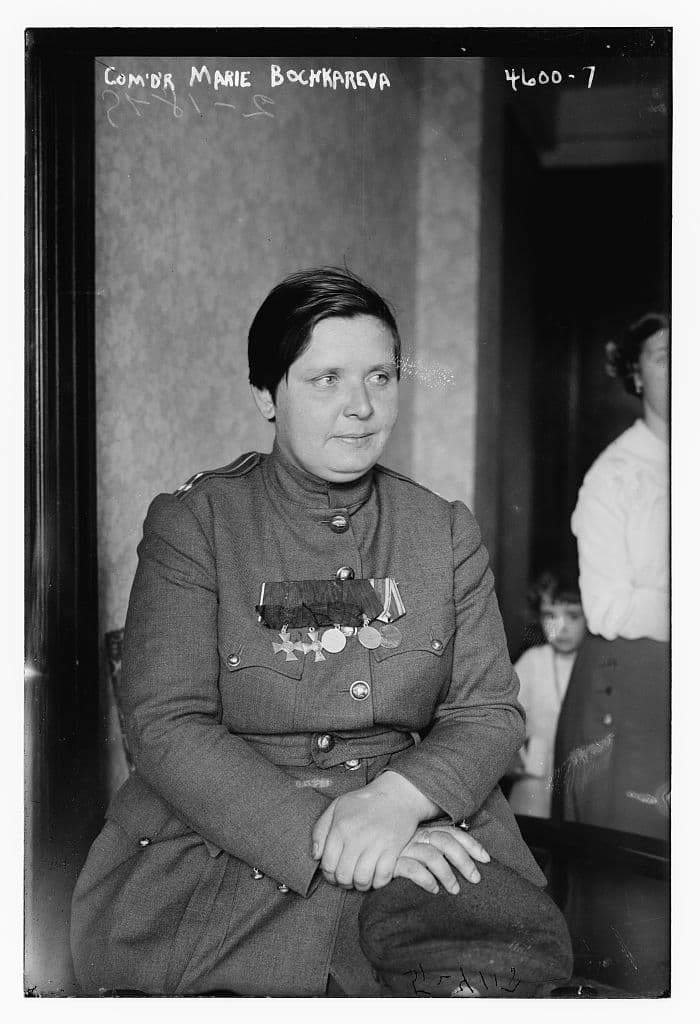
Russian · Politics · Activism · Science
Maria Bochkareva
July 1, 1889 – May 16, 1920
Early life and background
Maria Leontievna Bochkareva was born in July 1889 in the village of Nikolskoye, in the Russian Empire, to a peasant family. Sources consistently describe her as a woman of humble rural origins who entered adulthood in a society shaped by rigid class hierarchy, patriarchal expectations, and limited opportunities for peasant women. Her family name was Frolkova before marriage, and she later became known by her married surname, Bochkareva, as well as by the nickname Yashka.
Little is securely documented about her formal education, but she was described in later accounts as semi-literate. That detail is important historically because it places her achievements in sharp relief: she rose from a background in which women of her class were rarely expected to write, speak publicly, or participate directly in military life. Her later prominence therefore represented not only personal determination but also a broader challenge to the social order of late imperial Russia.
Bochkareva married Afanasi Bochkarev in 1905, though the marriage did not bring stability. Biographical accounts describe difficult personal circumstances before the war, including domestic hardship and a search for independence. These experiences helped shape the self-presentation she later adopted as a soldier and leader: practical, defiant, and willing to risk ostracism in order to define her own future.
Entry into military service
When the First World War began, Bochkareva sought permission to serve in the Imperial Russian Army. In 1914 she achieved something extraordinary for the period: she entered combat service as a woman in an army that was overwhelmingly male and governed by deeply conservative norms about women’s public roles. Her enlistment was itself a barrier-breaking act, made possible only through persistence and exceptional circumstances.
Bochkareva fought on the Eastern Front and earned a reputation for courage under fire. Accounts of her service note that she was wounded more than once and that her conduct impressed officers and soldiers alike. Her wartime experience provided the foundation for her later fame, but it also exposed her to the brutal realities of trench warfare and the collapse of morale within the Russian military as the war dragged on.
In a society where peasant women were expected to remain outside the military sphere, her presence in combat was politically and culturally significant. She was not simply a woman wearing a uniform; she was a living challenge to assumptions about discipline, bravery, and the gendering of war. That significance became even greater after the revolutions of 1917 transformed Russia’s political order.
The Women’s Battalion of Death
In 1917, Bochkareva organized what became known as the Women’s Battalion of Death, the first Russian women’s battalion. The unit was created in the aftermath of the February Revolution, when military discipline was crumbling and political leaders hoped that a women’s volunteer formation might shame demoralized men into renewed commitment. Bochkareva’s battalion was intended to embody sacrifice, patriotism, and the will to continue the war.
Her role in forming and leading the battalion made her the first Russian woman to command a military unit. This was a genuine first in Russian military history and one of the most striking examples of a woman assuming command authority in wartime Europe. The battalion’s existence reflected both the desperation of the Russian Provisional Government and Bochkareva’s own determination to turn military service into a public argument about women’s capability.
The unit’s members trained under harsh conditions and were expected to uphold unusually strict standards of behavior and appearance. Their very name, “Death Battalion,” signaled an ethic of sacrifice and discipline designed to shock contemporaries into noticing them. When the battalion went into action in 1917, it became internationally famous as a symbol of both women’s patriotism and the limits of symbolic reform in a collapsing state.
At the same time, the battalion faced hostility and skepticism from many male soldiers and officers. Bochkareva had to overcome not only battlefield danger but also entrenched resistance to women in armed service. The battalion’s story therefore belongs to the history of women’s activism as much as to military history, because it demonstrated how a woman could use wartime mobilization to claim command authority in public life.
Recognition, travel, and public profile
Bochkareva’s wartime fame extended beyond Russia. After the battalion became known, she traveled abroad in 1918 and was received in the United States, where she met President Woodrow Wilson. That journey helped transform her from a local military figure into an international symbol of women’s wartime service and Russian anti-Bolshevik loyalty. She also became the subject of speeches, newspaper stories, and later memoir-based retellings that cast her in quasi-legendary terms.
Her service was also recognized within the Russian military tradition. Biographical sources note that she was awarded the Cross of St. George, one of the most respected decorations for bravery in the imperial Russian system. Such recognition mattered because it marked her as a combat veteran whose courage was acknowledged within a male military culture that had initially excluded women.
Yet Bochkareva’s fame was always unstable. The same revolutionary period that enabled her battalion also produced shifting loyalties, political purges, and violent reversals. Her public role rested on the fragile authority of wartime necessity, and once the political climate changed, the protection that had allowed her to rise largely disappeared.
Arrest, trial, and death
After the Bolsheviks consolidated power, Bochkareva fell under suspicion. She was arrested and eventually sentenced as an enemy of the working class. On 16 May 1920, she was executed by firing squad in Krasnoyarsk. Reports differ on some procedural details, but the date of her execution is consistently recorded.
Her death closed a life that had moved from peasant obscurity to extraordinary public visibility and then back into state violence. In the context of the Russian Civil War, her execution reflected the harsh logic of revolutionary justice, where former imperial servicemen and politically inconvenient figures could be eliminated without mercy. For Bochkareva, the consequences were especially stark because she had aligned herself with patriotic service rather than with a stable political faction capable of protecting her.
The execution also reveals the precariousness of women’s wartime authority. During moments of emergency, a woman could be granted command, celebrated as patriotic, and used as a symbol of national renewal; in peacetime or under new regimes, the same woman could be condemned as dangerous or expendable. Bochkareva’s fate illustrates that contradiction with unusual clarity.
Personal life
Bochkareva’s personal life was marked by hardship, unstable relationships, and the demands of survival in a rural and militarized world. She married in 1905, but biographies generally emphasize that her later life was defined less by domestic stability than by independence and conflict. Some accounts describe abusive relationships and a difficult family background, though the most securely documented facts concern her peasant origins, marriage, and later military career.
She is generally reported not to have had children. That absence is historically notable only because later accounts often cast her life as one oriented toward public action rather than family continuity. Her identity in the historical record comes primarily through military service, political symbolism, and the memoir-like self-fashioning associated with her public career.
Legacy and historical impact
Bochkareva remains significant as a pioneering woman soldier and as the organizer of the first Russian women’s battalion. Her life intersects with several major historical themes: the collapse of imperial authority, the mobilization of women during total war, the limits of liberal reform in revolutionary Russia, and the violent backlash that followed political upheaval. She is remembered not because she won a lasting institutional victory, but because she forced contemporaries to confront the fact that women could train, lead, and fight in combat roles.
Her story has also become important in women’s history because it complicates simple narratives of emancipation. Bochkareva did not act as a modern feminist reformer in the conventional sense; rather, she used military service, patriotism, and discipline to carve out authority in a hostile environment. Even so, her example widened the historical imagination of what women could do in war and public life.
In later years, her reputation was revisited by historians, activists, and biographers interested in the gender politics of World War I. The continued attention to her life reflects both the dramatic nature of her career and the enduring appeal of a figure who crossed nearly every boundary available to a Russian peasant woman of her generation.
Posthumous rehabilitation
Bochkareva was later rehabilitated by the Russian government in 1992, a post-Soviet acknowledgment that helped restore her place in public memory. Although the exact administrative details of that rehabilitation are not part of the core biographical record here, the event matters because it signaled a changed political assessment of figures once condemned under Soviet rule.
Her rehabilitation was also symbolically important for women’s history. It encouraged renewed attention to a woman who had not fit comfortably into Soviet heroic narratives or imperial military tradition, yet whose life embodied courage, contradiction, and institutional breakthrough. Today, she is remembered as one of the most distinctive female military figures of early twentieth-century Russia.
Dated achievements
2 indexed.
- Jul011917Politics
Formation of the Women's Battalion of Death
Bochkareva formed the first women's battalion in July 1917, a genuine first in Russia.
View details Mariya Bochkareva’s Women’s Death Battalion – Helen Rappaport - May161920