← All women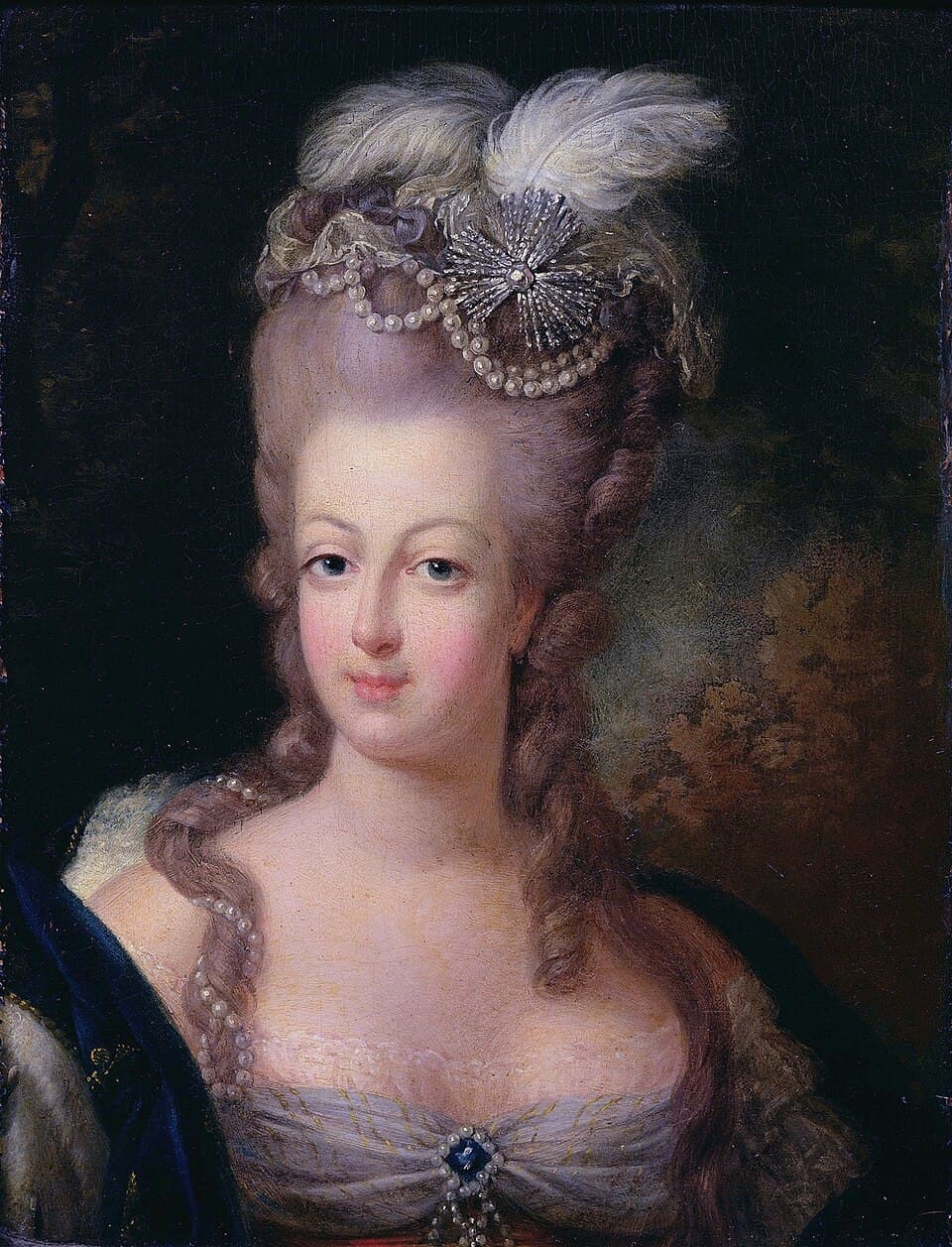
Austrian, French · Politics
Maria Antoinette
November 2, 1755 – October 16, 1793
Early Life and Background
Marie Antoinette, born Maria Antonia Josepha Johanna on 2 November 1755 in Vienna, was an archduchess of Austria and the fifteenth child of Empress Maria Theresa and Holy Roman Emperor Francis I. Her birth into the Habsburg-Lorraine dynasty placed her at the heart of European power politics. She grew up in a large, closely managed royal family in the Hofburg and Schönbrunn palaces, where her mother exercised strict oversight over her children’s education and marriages.
Marie Antoinette’s early education was less rigorous than that of some elder siblings. Tutors instructed her in religion, music, dance, and basic literacy, but she was not trained deeply in political theory or history. Sources note that she showed aptitude in music, particularly singing and playing the harp, and enjoyed court entertainments. The Viennese court’s rich musical culture and ceremonial life shaped her tastes and expectations for aristocratic leisure.
Her childhood unfolded amid major geopolitical shifts. The War of the Austrian Succession and, later, diplomatic realignments leading to the Seven Years’ War influenced Maria Theresa’s strategy of using marriages to secure alliances. Marie Antoinette, as a younger daughter, became a key element in these plans, even before adolescence. Her brother, Emperor Joseph II, would later describe her as “honest and lovable,” reflecting a family view of her as affectionate and personable rather than politically astute.
Dynastic Diplomacy and Move to France
In the 1750s and 1760s, Austria and France moved from long-standing rivalry to a new alliance, engineered largely by Maria Theresa and her chancellor Kaunitz. To cement this rapprochement, Maria Theresa arranged for her daughter to marry the French dauphin, Louis-Auguste, grandson of Louis XV. The betrothal was agreed in the 1760s as part of a broader diplomatic strategy.
Before the formal wedding, a proxy marriage took place in Vienna, after which the young archduchess journeyed to France. On the border, in a carefully staged ritual, she was symbolically stripped of her Austrian clothes and re-dressed in French attire, signifying her transition from Habsburg princess to future French queen. She arrived at the court of Versailles in 1770 at about fourteen or fifteen, entering a sophisticated but faction-ridden environment where etiquette and appearance carried political weight.
On 16 May 1770, Marie Antoinette married the dauphin Louis-Auguste at Versailles, becoming Dauphine of France. The elaborate ceremony was attended by courtiers and dignitaries and presented to the public as a symbol of peace between two former enemy powers. Initially, the young couple were popular; the French public and pamphleteers greeted the Austrian princess with curiosity and optimism, hoping the union would stabilize European relations and rejuvenate the monarchy.
Becoming Queen Consort of France
On 10 May 1774, Louis XV died, and the dauphin ascended the throne as Louis XVI. By his accession, Marie Antoinette automatically became Queen consort of France. She was only eighteen, and her husband twenty, when they inherited a kingdom deeply burdened by debt, social tensions, and the intellectual ferment of the Enlightenment.
At first, Marie Antoinette enjoyed considerable popularity. She appeared charming and youthful in contrast to the scandals of the previous reign. Her taste for fashion and theater made her a cultural trendsetter at court. She patronized designers and hairdressers, popularizing elaborate hairstyles and gowns, and supported performances at the royal theaters. She also gathered a circle of close companions, including the princesse de Lamballe and the duchesse de Polignac, forming a private sociability that sometimes clashed with broader court expectations.
Over time, however, her behavior drew criticism. She preferred small, intimate gatherings to formal state ceremonies, and her frequent presence at the Petit Trianon, a small retreat on the grounds of Versailles, was interpreted by some as disdain for traditional etiquette. While her personal expenditures were only one component of royal finances, pamphlets and satirical works began to portray her as a symbol of waste and excess—earning her the derisive nickname "Madame Déficit." Historical scholarship generally agrees that France’s fiscal crisis stemmed primarily from structural issues and war debts, but popular opinion increasingly linked it to her lifestyle.
Family Life and Heirs to the Throne
One of Marie Antoinette’s central dynastic responsibilities was to produce heirs. The royal couple’s marriage remained unconsummated for several years, fueling gossip and political concern. Medical and personal factors contributed to the delay; eventually, intervention by her brother Joseph II and royal physicians helped resolve the issue.
Marie Antoinette and Louis XVI ultimately had four children: Marie-Thérèse-Charlotte (born 1778), Louis-Joseph (born 1781), Louis-Charles, later styled Louis XVII by royalists (born 1785), and Sophie (born 1786). Two of the children, Louis-Joseph and Sophie, died in childhood before the Revolution’s most violent phase, losses that deeply affected the queen. Her surviving daughter, Marie-Thérèse, would later play a role in post-revolutionary royal politics, while Louis-Charles became a tragic figure, dying in captivity in 1795.
Accounts from courtiers and observers emphasize Marie Antoinette’s devotion to her children. She sought to provide them with a more intimate upbringing than traditional French royal practice, spending time with them at Trianon and insisting on maternal involvement in their education. This approach, while praised in some circles, was sometimes perceived as further withdrawal from formal court duties.
Court Influence and Political Image
Historians debate the extent of Marie Antoinette’s direct political influence. She did not hold official office, yet her position as queen, her foreign origin, and her personal networks gave her informal influence over appointments and court favoritism. She supported certain ministers and courtiers, but evidence suggests that her role in high policy was limited and episodic rather than systematic.
Nonetheless, she became a focal point for political anxiety. Libelous pamphlets—part of a broader "pornographic" political culture in late eighteenth-century France—attacked her character, alleging sexual promiscuity, corruption, and conspiracies. These texts often exaggerated or invented allegations, yet they shaped public perception. Her Austrian birth was exploited by critics, who accused her of being an "Austrian agent" undermining French interests.
The Affair of the Diamond Necklace dramatically intensified these perceptions. On 15 August 1785, Cardinal Louis de Rohan was arrested at Versailles in connection with a fraudulent scheme involving an expensive diamond necklace. Fraudsters had used forged letters and a woman impersonating the queen to make it appear that Marie Antoinette desired the necklace in secret. Although she had previously refused to purchase it and was innocent of the scheme, the public largely blamed her. The Parlement of Paris later acquitted Rohan, a decision interpreted as a rebuke to the crown. The scandal reinforced the image of the queen as extravagant and morally compromised, even as historical evidence exonerates her from direct involvement.
The French Revolution and Marie Antoinette’s Role
The French Revolution began in 1789, driven by fiscal crisis, social inequality, and political conflict. From its outset, Marie Antoinette became a central symbolic figure. Revolutionary cartoons and texts portrayed her as the embodiment of aristocratic excess and foreign influence, often exaggerating her spending and political role.
As the Revolution advanced, the royal family’s position deteriorated. In October 1789, Parisian crowds marched to Versailles, bringing the king, queen, and their children to live under tighter surveillance in the Tuileries Palace in Paris. For several years, they existed in a fraught situation as constitutional monarchs with limited power. Marie Antoinette attempted to navigate this environment by communicating with moderate politicians and foreign relatives, hoping to preserve the monarchy in some form.
Her efforts increasingly focused on foreign diplomacy. She communicated with her brother Emperor Leopold II and other European monarchs, encouraging coordinated pressure on revolutionary France. These contacts, combined with her perceived influence over Louis XVI, fueled accusations that she was a central figure in counter‑revolutionary conspiracy. Whether she pursued a constitutional compromise or full restoration varied with circumstances, but sources agree she sought to protect her family and preserve monarchical authority.
The Flight to Varennes and Collapse of the Monarchy
A critical turning point came with the Flight to Varennes on 20 June 1791. With the help of royalist officers and supporters, the royal family attempted to escape Paris and join loyal troops near the northeastern frontier. They traveled in disguise, but delays and recognition by locals led to their arrest at Varennes. Revolutionary authorities escorted them back to Paris under guard, while crowds along the route expressed anger and disillusionment.
The flight profoundly damaged the monarchy’s legitimacy. It suggested that the king and queen did not accept the constitutional framework emerging from the Revolution. For many, it confirmed suspicions that Marie Antoinette sought foreign intervention and counter‑revolution. The event accelerated the radicalization of politics, strengthening republican sentiment and weakening moderate monarchists.
Tensions culminated on 10 August 1792, when insurgents and fédérés from the provinces attacked the Tuileries Palace. The Swiss Guard defending the palace suffered heavy casualties, and the king’s authority was effectively destroyed. The Legislative Assembly suspended Louis XVI, and the royal family was taken into custody. This insurrection marked the de facto overthrow of the monarchy and opened the way for the proclamation of the republic later that year.
Imprisonment in the Temple and Family Separation
On 13 August 1792, the royal family was transferred to the Temple, a medieval fortress in Paris used as a state prison. Marie Antoinette, Louis XVI, and their two surviving children were confined under close surveillance. Initially, their conditions allowed some limited comforts, but restrictions tightened over time. The queen endeavored to maintain religious practices and maternal care within the confined space, offering lessons and prayers to her children.
The abolition of the monarchy in 1792 and the subsequent execution of Louis XVI on 21 January 1793 further isolated Marie Antoinette. After the king’s death, she remained in the Temple with her daughter Marie‑Thérèse and son Louis‑Charles. In mid‑1793, revolutionary authorities separated her from her son, who was placed under the control of a revolutionary guardian. Reports of his later mistreatment and illness would contribute to royalist martyr narratives.
Transfer to the Conciergerie and Trial
On 2 August 1793, Marie Antoinette was moved from the Temple to the Conciergerie, a prison attached to the Palais de la Cité that served as a holding facility for those awaiting trial before the Revolutionary Tribunal. This transfer marked a shift from political detention to prosecution. She was housed in a small, damp cell, under near-constant watch, with limited contact even with her legal counsel.
The Revolutionary Tribunal was established to judge political crimes during the increasingly radical phase of the Revolution. Marie Antoinette faced an atmosphere of hostility and pre‑determined suspicion. On 14 October 1793, her trial opened, drawing intense public and journalistic attention. The indictment accused her of treason, conspiracy with foreign powers, and attempts to undermine the Revolution.
One of the most notorious accusations alleged that she had sexually abused her young son, Louis‑Charles. When confronted with this charge, she reportedly appealed to the mothers present in the courtroom, denying the allegation and highlighting its cruelty. Contemporary accounts suggest that this moment elicited some sympathy, though it did not alter the outcome. The trial proceeded swiftly, with limited opportunity for defense; after two days, the Tribunal pronounced her guilty.
Execution and Immediate Aftermath
On 16 October 1793, Marie Antoinette was executed by guillotine at the Place de la Révolution in Paris. She was thirty‑seven years old. Transported in a common cart, she wore a simple white garment, her hair cut short. Witnesses describe a composed demeanor. According to later reports, her last words were an apology to the executioner for stepping on his foot.
Her body was buried in an unmarked grave in the Madeleine cemetery. During the Bourbon Restoration, in the early nineteenth century, the remains of Louis XVI and Marie Antoinette were exhumed and reinterred in the royal basilica of Saint‑Denis, where their tombs contribute to the memorialization of the pre‑revolutionary monarchy.
Contested Quotes, Myths, and Reputation
Marie Antoinette’s reputation has long been entangled with myth. The most famous phrase attributed to her, "Let them eat cake," is widely regarded by historians as apocryphal. The expression appears in earlier texts, including writings by Jean‑Jacques Rousseau, and there is no contemporary evidence that she said it. Nevertheless, the quote has been used to symbolize aristocratic indifference to popular suffering.
During her lifetime, hostile pamphlets accused her of numerous improprieties—from lavish spending to alleged affairs with courtiers and even incest. Many of these claims lack credible evidence and are now understood as part of a broader political culture that attacked royal authority through sexualized and gendered imagery. Her foreignness, gender, and visibility made her particularly vulnerable to such attacks.
Modern scholarship tends to portray Marie Antoinette as a complex figure: personally generous and devoted to her family, but politically inexperienced and sometimes imprudent. Her patronage of fashion and leisure at Trianon, while not the primary cause of France’s fiscal problems, contributed to the perception of a court insulated from economic hardship. Her attempts at diplomacy and negotiation, though aimed at preserving the monarchy, often appeared indecisive or ill‑timed in the rapidly changing revolutionary context.
Legacy and Historical Impact
Marie Antoinette’s historical impact lies less in formal political achievements than in her symbolic role during the collapse of the French ancien régime. As queen consort from 1774 to 1792, she became the personification of perceived royal extravagance and foreign influence. Her image helped mobilize revolutionary resentment and shaped debates about monarchy, gender, and public opinion.
Her life illustrates the vulnerabilities of women in dynastic politics. Married as a teenager to secure an alliance, she entered a foreign court with limited preparation, faced scrutiny over fertility and comportment, and was later blamed for policies largely driven by structural factors and male decision‑makers. Revolutionary propaganda often focused more intensely on her body, morality, and "foreignness" than on the king’s political failures, revealing gendered dimensions of political discourse.
In the nineteenth and twentieth centuries, interpretations of Marie Antoinette evolved. Royalist and conservative writers emphasized her courage in adversity and maternal devotion, casting her as a martyr of the Revolution. Literary works, biographies, and later films contributed to a romanticized image of her tragic fate. Scholarly studies, including detailed biographies and archival analyses, have sought to disentangle myth from evidence, presenting a more nuanced portrait that situates her within the broader context of Habsburg and Bourbon politics.
Culturally, she remains a powerful figure in art, film, fashion, and popular memory. Paintings and portraits from her lifetime, such as those by Élisabeth Vigée Le Brun, shape how she is visually remembered—as a stylish, poised queen. Modern representations often explore the contrast between her luxurious surroundings and the poverty of many French subjects, using her story to interrogate themes of privilege, responsibility, and revolutionary justice.
Assessment in Women’s History
Within the field of women’s history, Marie Antoinette is a significant case study in the intersection of gender, power, and public opinion. Her life demonstrates how queens consort could be both influential and constrained: she had access to the king, shaped court culture, and engaged in informal diplomacy, yet lacked formal constitutional authority.
Her vilification shows how political conflicts can be gendered—turning a foreign-born consort into a scapegoat for systemic crises. At the same time, her story reveals the emotional dimensions of political upheaval: a mother coping with the deaths of two children, the execution of her husband, and her own imprisonment and separation from her surviving son and daughter.
Marie Antoinette did not pioneer legal reforms, scientific discoveries, or artistic movements, but her life and death had enduring consequences. The symbolic destruction of the queen, alongside the king, helped legitimize the revolutionary transformation of France and influenced later debates over constitutional monarchy and republicanism. She continues to be studied not only as an individual but as a lens through which to understand the dynamics of late eighteenth-century European politics and the gendered nature of revolutionary discourse.
Later Representations and Memory
In the centuries since her execution, Marie Antoinette has inspired an extensive body of literature, historical analysis, and artistic representation. Biographies ranging from sympathetic to critical have examined her upbringing, marriage, and actions during the Revolution. Works like Antonia Fraser’s "Marie Antoinette: The Journey" and various scholarly articles have helped popularize a more nuanced view of her character and context.
Film and television portrayals have similarly contributed to her modern image. Productions often emphasize her youth, fashion, and tragic end, sometimes at the expense of political detail. Nonetheless, these portrayals have kept her story in public consciousness, particularly in discussions about the responsibilities of elites and the consequences of social inequality.
Today, sites associated with her life—such as the Palace of Versailles, the Petit Trianon, and the Conciergerie—serve as historical landmarks visited by millions. Exhibitions and museum programs frequently include her as a central figure in narratives about the fall of the monarchy and the French Revolution. Through these physical spaces and ongoing scholarship, Marie Antoinette remains a pivotal figure in understanding both the vulnerabilities of dynastic women and the radical transformations that reshaped France at the end of the eighteenth century.
Dated achievements
10 indexed.
- Nov021755Science
Birth of Maria Antonia in Vienna
Born as Archduchess of Austria, youngest daughter of Empress Maria Theresa and Emperor Francis I.
View details Marie-Antoinette | Biography, Facts, Death, & Significance | Britannica - May161770Science
Marriage to the Dauphin Louis-Auguste
Married the future Louis XVI at Versailles at age 14, sealing the Franco-Austrian alliance.