← All women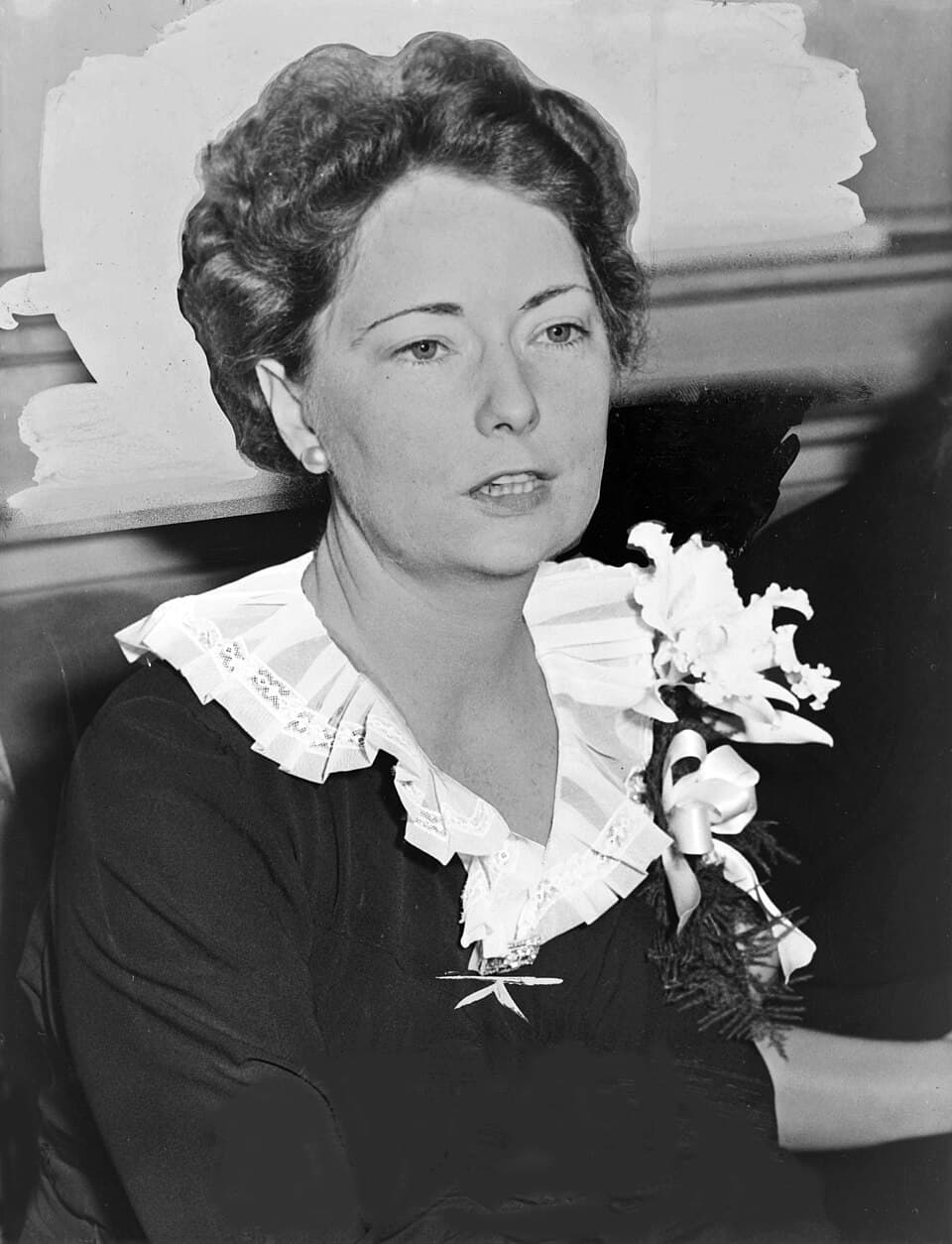
American · Literature
Margaret Mitchell
November 8, 1900 – August 16, 1949
Early Life and Background
Margaret Munnerlyn Mitchell was born on November 8, 1900, in Atlanta, Georgia, the second child of Eugene Muse Mitchell and Maybelle Stephens Mitchell.[2][3][11] Her father was a prominent lawyer and president of the Atlanta Historical Society, while her mother was an active suffragist and civic reformer.[11][19] The family was comfortably middle‑class and deeply rooted in Southern history and culture, conditions that would profoundly shape Margaret’s imagination.
Mitchell grew up hearing extensive oral narratives about the American Civil War and Reconstruction from relatives and older Atlantans who had lived through those years.[11][15] Weekend drives to battlefields and ruined plantations, combined with stories of loss and endurance, created in her mind a vivid, romanticized vision of the Old South and its destruction. These tales were typically told from a white, ex‑Confederate perspective, a bias that later informed the narrative viewpoint and racial politics of her fiction.[2][11]
Nicknamed Peggy by her family, Mitchell was an avid reader from childhood. She wrote short stories and plays and reportedly entertained school friends with dramatic tales of adventure.[11][19] Her upbringing also exposed her to the contrasting influences of a historically minded father and a politically engaged mother; the combination encouraged both an interest in the past and an awareness of contemporary social issues such as women’s rights.
Mitchell attended local schools in Atlanta and moved in the social circles of the city’s white professional class. In 1917, she enrolled at Smith College in Massachusetts, one of the leading women’s colleges in the United States.[2][3][15] Her time there was brief. When her mother died of influenza in 1919, Mitchell left Smith and returned to Atlanta to manage household responsibilities and support her father.[2][7][11] The early loss of her mother, who had modeled independence and activism, had a lasting emotional impact and contributed to Mitchell’s later focus on strong, willful female characters.
Career Beginnings and Development
After returning to Atlanta, Mitchell became increasingly involved in local social life. She reportedly caused mild scandal by performing a provocative dance at a charity ball, signaling a willingness to challenge some expectations placed on respectable young Southern women.[19] In the early 1920s she began writing freelance pieces and soon secured a position at the Atlanta Journal Sunday Magazine.[2][7][11]
In 1922, Mitchell formally joined the staff of the magazine as a reporter and feature writer.[19] Over the next several years she produced dozens of human‑interest stories, celebrity profiles, and historical sketches, including interviews with figures such as Rudolph Valentino.[19] Her journalism work honed skills in dialogue, pacing, and characterization that would later serve her fiction. It also familiarized her with deadlines, editorial expectations, and the mechanics of publication.
Mitchell’s early adulthood included significant personal upheaval. On September 2, 1922, she married Berrien "Red" Upshaw, a former bootlegger whose drinking and instability soon strained the marriage.[19] The relationship ended in divorce in 1924, a socially unusual step for a white Southern woman and one that reflected Mitchell’s determination to leave an untenable situation.[19] Her experience with Upshaw deepened her understanding of the complexities of romantic relationships and disillusionment, themes that later appear in Gone With the Wind.[19]
On July 4, 1925, Mitchell married John Marsh, a more stable and supportive partner who worked at the Atlanta Journal and had previously helped her secure her reporting job.[19][5] Marsh encouraged her reading and writing and later played a crucial role in shepherding her novel toward publication. Their marriage provided the emotional and financial stability that helped make possible her long, demanding fiction project.
By 1923, Mitchell’s health problems, including a serious ankle injury, forced her to leave full‑time reporting.[7][11][19] Confined at home for extended periods, she turned intensively to reading history and novels. It was during this convalescence, beginning around 1926, that she started writing the manuscript that would become Gone With the Wind.[7][11][15]
Creation of Gone With the Wind
Mitchell wrote Gone With the Wind over roughly a decade, working largely in secret.[2][3][11] She drafted chapters out of sequence, beginning famously with what would become the ending and then filling in earlier episodes.[11] She wrote on a Remington typewriter in her small Atlanta apartment, storing chapters in envelopes under the bed or in closets. Friends knew she was "writing something" but few grasped the scale of the project.
The novel traces the life of Scarlett O’Hara, a headstrong plantation daughter, through the disintegration of the antebellum world, the trauma of war, and the hardships of Reconstruction. Mitchell wove together romance, survival narrative, domestic detail, and historical events drawn from both archival research and family stories.[2][11] Her portrayal of Scarlett and the equally vivid Rhett Butler created some of the most recognizable characters in American popular fiction.
Mitchell’s depiction of the Old South and enslaved people relied heavily on the "Lost Cause" mythology prevalent among many white Southerners in the early 20th century.[2][11] The novel presents slavery as relatively benign, portrays many Black characters in stereotyped ways, and treats Reconstruction as a time of Northern and Black misrule. These elements would later make the book a focal point for criticism and re‑evaluation.
In the mid‑1930s, a visiting Macmillan editor, Harold Latham, heard of the manuscript and persuaded Mitchell, who was initially hesitant and self‑conscious, to show him parts of it.[11][19] Encouraged by Latham and Marsh, she prepared the sprawling pages for submission. Macmillan acquired the book, anticipating strong regional interest but not the extraordinary national response that followed.
Publication, Popular Reception, and Major Awards
Gone With the Wind was first published by Macmillan on June 30, 1936.[3][5][11] The initial print run sold out rapidly, and within six months the novel reportedly sold over a million copies, making it one of the most spectacular commercial successes in U.S. publishing history.[3][5][15] It topped American bestseller lists in 1936 and 1937 and was translated into multiple languages, widening its international reach.[5][11]
Readers responded strongly to the book’s emotional intensity, detailed setting, and focus on a flawed but indomitable female protagonist. In the context of the Great Depression, Scarlett’s relentless drive to survive resonated with readers facing economic hardship, even as the novel offered escapist glamour and nostalgic visions of plantation life.[11][15]
Mitchell’s debut brought her a cascade of honors. In addition to dominating bestseller lists, Gone With the Wind received the National Book Award for Fiction as the most distinguished novel of 1936.[2][10][15] On February 27, 1937, Columbia University’s trustees announced that Mitchell had been awarded the Pulitzer Prize for Novel (now Fiction) for the same work, formally recognizing it as the outstanding American work of fiction for that year.[2][3][5] The Pulitzer placed her, as a woman author, at the center of the American literary establishment at a time when most canonized novelists were men.
Mitchell, who was naturally shy and wary of publicity, found the sudden fame overwhelming.[7][11] She granted interviews and corresponded with readers but largely avoided public appearances, preferring to remain in Atlanta rather than relocate to New York or Hollywood. Her reluctance to embrace celebrity contributed to an aura of mystery surrounding her and fueled public fascination.
Film Adaptation and Cultural Impact
The enormous success of the novel quickly attracted Hollywood. Producer David O. Selznick purchased film rights and undertook what became one of the most ambitious production efforts of the studio era.[2][11] After a widely publicized search for an actress to play Scarlett O’Hara, British performer Vivien Leigh was cast in the role, opposite Clark Gable as Rhett Butler.[2][14]
The film, directed primarily by Victor Fleming, premiered in 1939 and rapidly became a box‑office phenomenon.[2][11][14] It reinforced many of the novel’s romanticized depictions of the Old South and controversial racial stereotypes, while adding visual spectacle and iconic scenes that would imprint themselves on popular culture. Mitchell did not write the screenplay, but she received official story credit as the author of the source material.[17]
At the 11th Academy Awards ceremony on February 29, 1940, the film adaptation of Gone With the Wind won the Oscar for Best Picture, along with multiple other awards, including Best Actress for Vivien Leigh and a historic Supporting Actress award for Hattie McDaniel, the first Black performer to win an Academy Award.[17] As the credited story author, Mitchell’s name was closely tied to the triumph. The film went on to become, adjusted for inflation, one of the highest‑grossing films of all time.[5][17]
The combined impact of the novel and film entrenched Gone With the Wind in American and global cultural consciousness. The story shaped popular perceptions of the Civil War, Reconstruction, and Southern womanhood, and it influenced later depictions of the South in literature, film, and television.[2][11][15] At the same time, the work became increasingly controversial for its racialized portrayals and its nostalgia for the slaveholding order.
Personal Life and Later Years
Despite her extraordinary success, Mitchell did not publish another full‑length novel during her lifetime. The reasons remain debated. Some biographers suggest she was exhausted by the effort and publicity; others point to her perfectionism and anxiety about matching or surpassing her debut.[11][12][19] She also experienced recurring health problems and devoted significant time to correspondence and civic work.
During World War II, Mitchell engaged in various charitable activities, including support for the American Red Cross and war relief efforts.[11][19] She anonymously funded scholarships for medical students from Georgia and contributed to local causes, often insisting that her name not be publicized.[11] These actions reflected both a sense of social responsibility and a desire to separate her private life from her celebrity as an author.
Mitchell and John Marsh remained married until her death, living in Atlanta apartments that later became tourist sites associated with Gone With the Wind.[11][19] Friends described her as witty, sharp‑tongued, and intellectually curious, with a strong sense of privacy. She continued to read widely in history and fiction and maintained a large correspondence, but she consistently deflected questions about whether she was working on another major book.
In 1949, Mitchell’s relatively quiet life was abruptly interrupted. On the evening of August 11, 1949, while crossing Peachtree Street at 13th Street with her husband, she was struck by a speeding taxi, reportedly driven by a man who had been drinking.[2][7][11] She suffered severe head and internal injuries and was taken to Grady Memorial Hospital, where she remained unconscious.
Death
Margaret Mitchell died at Grady Memorial Hospital in Atlanta on August 16, 1949, five days after the accident, at the age of 48.[2][3][7][11] Her death generated widespread news coverage and public mourning, particularly in Atlanta, which had come to see her as a civic symbol as well as a literary figure.
Mitchell was buried in Oakland Cemetery in Atlanta, a historic resting place for many of the city’s notable citizens.[11][19] Her passing definitively ended speculation about further large‑scale works from her pen and fixed her reputation around a single, controversial masterpiece.
Posthumously, previously unknown writings came to light. In 1996, her earlier novella Lost Laysen, written in the 1910s and preserved by a friend, was published and became a New York Times bestseller.[5][19] The work offered glimpses of her developing style but did not alter the central fact that Mitchell remained primarily a one‑novel author in the public imagination.
Legacy and Historical Impact
Mitchell’s legacy is multifaceted and often contested. On one hand, Gone With the Wind is widely considered one of the most commercially successful novels in U.S. history and a landmark of popular fiction.[2][3][15] Its sweeping narrative, complex heroine, and memorable dialogue influenced generations of storytellers, and its film adaptation became a cornerstone of classic Hollywood cinema.[2][11][14]
From the perspective of women’s literary history, Mitchell stands as a striking example of a woman whose single novel achieved extraordinary institutional and popular recognition. She won the National Book Award and the Pulitzer Prize, dominated bestseller lists, and saw her work drive one of the most decorated films of the Academy’s early decades.[2][3][5][17] Her success demonstrated that a woman author could command both mass readership and high‑status critical prizes with a historically oriented narrative centered on female experience.
At the same time, scholars and activists have emphasized the problematic aspects of her work, particularly its romanticization of slavery, its endorsement of "Lost Cause" myths, and its reliance on racist caricatures.[2][11][15] In the late 20th and early 21st centuries, Gone With the Wind has been the subject of intense re‑evaluation in academic studies, public debates, and discussions about how cultural institutions handle works with offensive content. Some libraries and streaming platforms have contextualized the novel and film with critical introductions, while others have questioned their continued prominence.
Mitchell’s own views on race and politics are difficult to reconstruct fully, and biographers caution against simple extrapolation from the text.[11][12] Nonetheless, her work unambiguously reflects and amplifies the racial attitudes prevalent among many white Southerners of her era. As such, it has become a key primary source for understanding how 1930s America remembered and mythologized the Civil War and Reconstruction.
In Atlanta and Georgia more broadly, Mitchell is commemorated through museums, historical markers, and cultural tourism. The apartment where she wrote much of Gone With the Wind has been preserved as part of the Margaret Mitchell House, a museum that interprets her life and the creation of the novel, while also increasingly engaging with the work’s problematic legacy.[11][20] Literary and historical organizations continue to use her story to explore questions about gender, authorship, and regional identity.
For many readers, Scarlett O’Hara remains one of the most memorable heroines in popular fiction: ambitious, resilient, morally conflicted, and often unsympathetic. Mitchell’s ability to sustain reader interest in such a complex female protagonist over a massive narrative has been widely admired, even by critics who reject the novel’s politics.[2][11] The enduring popularity of Scarlett and Rhett, and of lines such as "Tomorrow is another day," underscores the book’s deep emotional resonance and narrative power.
Overall, Margaret Mitchell occupies a paradoxical place in women’s and literary history. She is simultaneously a pioneering example of spectacular female authorship and a central figure in the propagation of deeply flawed historical myths. Her life story—from Atlanta childhood steeped in Civil War memory, through brief journalism, a single monumental novel, global fame, and tragic early death—continues to fascinate readers, scholars, and critics seeking to understand how stories about the past shape cultural identities in the present.
Dated achievements
8 indexed.
- Nov081900Science
Birth of Margaret Mitchell
Margaret Munnerlyn Mitchell was born in Atlanta, Georgia, into a family steeped in Southern history and storytelling.
View details Margaret Mitchell | Britannica - Sep021922Science
Marriage to Berrien "Red" Upshaw
Mitchell married Berrien 'Red' Upshaw in Atlanta; the tempestuous marriage ended in divorce in 1924.