← All women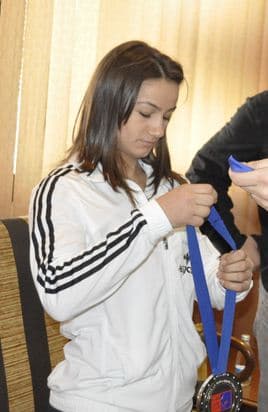
Kosovar · Sports
Majlinda Kelmendi
May 9, 1991 – present
Early Life and Background
Majlinda Kelmendi was born on 9 May 1991 in Peć (Peja), a town in western Kosovo that was then part of the Socialist Federal Republic of Yugoslavia.[1][2][11][16] She grew up in a Kosovo Albanian family; sources identify her parents as Ismet and Fikrete Kelmendi, and she has at least one older sister who played an important role in her early sporting life.[10][13] Her childhood coincided with rising ethnic tensions in Kosovo, the disintegration of Yugoslavia, and the Kosovo War of the late 1990s, events that were profoundly destabilizing for everyday life in Peja.[13]
In this environment, sport offered a constructive outlet. Multiple accounts note that Kelmendi began practicing judo in 1999, at about eight years old, at the local Ippon Judo Club (also known as the Peja judo club).[2][7][11][18] According to French and Albanian sources, she was introduced to judo under the influence of her older sister, who encouraged her to try the sport at the local dojo.[3][7] Her long‑term coach, Driton Kuka, quickly recognized her talent and work ethic, guiding her through an intensive training program even as facilities and resources in post‑war Kosovo remained modest.[7][13][18]
Growing up in a town still recovering from conflict, Kelmendi’s formative years were marked by limited infrastructure and few opportunities to compete internationally. Nevertheless, her aptitude became clear in national and regional competitions, and she began to attract attention beyond her home club. Her early development in Peja would later be frequently cited as an example of how world‑class athletes can emerge from small clubs in economically and politically challenging contexts.[5][13][18]
Career Beginnings and Development
Kelmendi’s international career started in the late 2000s. Judofanatics and judo databases record that she entered the European Cup in Lucerne in 2008, competing at −48 kg and winning a bronze medal, an early sign that she could contend with established European judoka.[14][18] By 2009, she had progressed to junior elite level, capturing gold at the Junior European Judo ChampionshipsJunior World Judo Championships title in the −52 kg category shortly thereafter.[5][7] These results established her as one of the most promising young athletes from Kosovo and the broader Balkan region.
Sources emphasize that her junior world title made her the first Kosovan‑born athlete to win a judo world title, albeit at junior level, reflecting the rapid ascent of both Kelmendi and Kosovo’s judo scene.[7][12] Throughout this period, she trained primarily in Peja under Kuka, combining demanding conditioning and technical work with occasional training camps abroad to access higher‑level competition.[13][18]
Because Kosovo lacked full recognition by many international sports federations, Kelmendi initially faced barriers representing her homeland. To attend the London 2012 Olympic Games, she competed under the flag of Albania in the women’s −52 kg category.[1][8][11] Although she was eliminated in the second round and finished joint ninth, this first Olympic appearance gave her invaluable experience and underlined the complexities faced by athletes from partially recognized states.[1][11][13]
Rise to World Champion
The turning point in Kelmendi’s senior career came in 2013. At the World Judo Championships in Rio de Janeiro, she entered the women’s −52 kg division as one of the favorites, having risen to the top echelon of the International Judo Federation (IJF) rankings.[1][5][18] On 27 August 2013, she won the final to secure her first senior world title, becoming the first senior world judo champion from Kosovo, even though she still competed under the Albanian flag due to Kosovo’s limited recognition.[1]
This achievement was widely recognized as a breakthrough for Kosovo and for athletes from newly independent or partially recognized states. Kelmendi’s world title elevated her to the status of global judo star; she was ranked number one in the IJF list for −52 kg and began to be described in media as one of the sport’s most dominant competitors.[1][5][7][18]
In 2014, she confirmed her supremacy by defending her world title. At the World Judo Championships in Chelyabinsk, Russia, she again won gold in the −52 kg category on 26 August 2014, becoming a two‑time senior world champion.[1] That year, she also took the European Judo Championships title, and the IJF recognized her performances by awarding her a financial prize, acknowledging her as one of the outstanding judoka of the year.[3][5]
Her dominance during the mid‑2010s extended across the IJF World Tour, where she captured numerous Grand Slam and Grand Prix titles. Judofanatics notes that she ultimately amassed 18 gold medals on the IJF World Tour, an exceptional tally in the women’s half‑lightweight division.[14][18] By 2014, she was frequently referred to as the world’s best judoka across all categories, a reflection of her consistency and tactical mastery.[4][5]
European Success and Road to Rio
Kelmendi continued to build her record in the years leading up to the Rio Olympics. She claimed multiple European Championships titles, including continental crowns in 2014, 2016, and 2017, as well as gold at the 2019 European Games in Minsk.[3][5][8][18] These victories reinforced her reputation as the dominant European judoka at −52 kg and helped secure favorable seeding in global events.
After Kosovo was accepted as a member of the International Olympic Committee (IOC) in 2014, Kelmendi gained the opportunity to finally represent her homeland officially at the Olympic Games.[1][13] Her participation in Rio 2016 thus carried both athletic and symbolic weight: she was not only a favorite for gold but also a representative of a nation attending the Olympics for the first time.
On 5 August 2016, during the Rio opening ceremony, she was chosen as flag bearer for Kosovo, leading the country’s inaugural Olympic delegation into the Maracanã Stadium.[1][8] This role reflected her status as Kosovo’s most accomplished athlete and underscored the centrality of judo to the nation’s sporting identity.
Olympic Triumph in Rio 2016
Kelmendi’s most celebrated achievement came on 7 August 2016 at the Rio 2016 Olympic Games. Competing in the women’s −52 kg judo event at Carioca Arena 2, she advanced through her bracket with a series of controlled, strategic fights.[1][6][18] In the final, she faced Odette Giuffrida of Italy and secured a decisive victory to win the gold medal.[1][3][6]
This gold made Kelmendi the first athlete from Kosovo to win an Olympic medal and the first to win Olympic gold, as Kosovo was making its Olympic debut in Rio.[1][6][8][11] International outlets such as the BBC and CNN highlighted the historical nature of the moment, framing her as "Kosovo’s golden girl" and emphasizing how her triumph placed the young nation on the Olympic medal table for the first time.[6]
Following the final, she appeared on the podium where IOC President Thomas Bach presented her with the gold medal, a gesture that underscored the IOC’s recognition of Kosovo as a full member of the Olympic community.[6] As Kosovo’s flag was raised and its anthem played, images of Kelmendi became emblematic of national pride and international acceptance.
On 8 August 2016, global and regional media continued to report on the victory, emphasizing that Kelmendi had delivered Kosovo’s first and, at that time, only Olympic medal.[6] The Olympics.com profile and Balkan Insight coverage stressed how her success gave Kosovans "a reason to dream" and united people across ethnic and political divides.[6]
Continued Success and Later Competitive Career
After Rio, Kelmendi maintained her status among the sport’s elite. She won further major titles, including the 2017 European Judo Championships2019 European Games in Minsk, where she took gold at −52 kg.[3][8][18] At the 2019 World Judo Championshipsbronze medal to her collection, demonstrating longevity at the top level.[3][5][8]
She represented Kosovo at the Tokyo 2020 Olympic Games (held in 2021 due to the COVID‑19 pandemic), again serving as flag bearer, as noted in Spanish sources.[8] In Tokyo, she did not replicate her Rio success and finished tied 17th, facing strong competition and the cumulative impact of injuries and years of high‑intensity performance.[8][11]
Despite not medalling in Tokyo, Kelmendi remained a central figure in Kosovo’s national narrative. International media, including CNN’s "Legends of Judo" coverage, continued to present her as the country’s first Olympic champion and a trailblazer who had transformed judo into a major sport in Kosovo.[15]
Awards, Honors, and Recognition
Kelmendi’s contributions have been formally recognized by national institutions and international organizations. On 24 December 2014, she was decorated by the President of Kosovo, Atifete Jahjaga, with the Presidential Medal of Merits, acknowledging her world titles and the pride she brought to the country.[7] She has also received financial awards and distinctions from the IJF for being among the best judoka of the year, notably in 2014 following her world and European triumphs.[5]
Beyond formal medals, she is widely celebrated as one of the most successful judoka of her generation. Judofanatics notes that she achieved 18 IJF World Tour gold medals, while judo databases document her multiple European and world podiums.[14][18] She is frequently cited in encyclopedic resources and sports databases such as Olympedia, Pantheon, and Wikipedia as a benchmark figure in women’s judo.[1][8][9][11][16]
Her impact extends into broader cultural recognition. International media portray her as a symbol of national unity; Radio France Internationale, for example, described her as a "judo superstar who unites Kosovo," emphasizing her ability to transcend ethnic divisions and gender stereotypes.[13] Her story has been featured in documentary and highlight formats, including IJF and Olympic video content dedicated to her career.[12][15][19]
Personal Life
Details of Kelmendi’s personal life are relatively limited in public sources, reflecting her focus on athletic performance rather than media exposure. Her parents’ names, Ismet and Fikrete, are recorded in biographical notes, and she has spoken about her family’s support, particularly in the difficult years of Kosovo’s post‑war recovery.[10][13] She remains closely associated with her hometown of Peja, where she trained throughout her career and where her home club is based.[11][18]
Publicly available sources do not provide verified information on marriage or children, and Kelmendi herself has tended to keep such aspects private. Her public identity is rooted mainly in her role as an athlete, national icon, and increasingly as a coach and mentor. She has maintained strong ties to the Ippon Judo Club and to coach Driton Kuka, both of whom are central to her personal and professional narrative.[11][13][18]
Transition to Coaching and Later Life
Following her competitive peak and the Tokyo Olympics, Kelmendi began to shift her focus toward coaching and development of younger athletes. Sources note that she has worked alongside her longtime coach Driton Kuka in preparing the next generation of Kosovan judoka, drawing on her extensive experience at the highest levels of the sport.[13][14][18]
On 7 December 2021, she officially announced her retirement from international competition.[14] Judofanatics and other outlets summarized her career at that point: one Olympic gold, two senior world titles, a junior world title, four European championships, and 18 IJF World Tour gold medals.[14] The announcement marked the end of an era for Kosovo’s judo team, which had been built in large part around Kelmendi’s presence.
In the years following her retirement, Kelmendi’s role as a coach and role model became more prominent. She continues to be referenced in IJF and Olympic narratives as a standard for excellence and as an example of how athletes from small or newly recognized nations can reshape their country’s global image.[6][13][18]
Legacy and Historical Impact
Majlinda Kelmendi’s legacy is multifaceted, spanning sport, national identity, and women’s history. She is widely acknowledged as Kosovo’s most successful judoka and its first Olympic champion, a distinction that has lasting symbolic power.[1][6][8][11] Her Rio 2016 gold and multiple world and European titles position her among the greatest women’s half‑lightweight judoka of the early 21st century.
For Kosovo, her achievements have had outsized impact. Coming from a small, recently independent country with limited resources, Kelmendi turned judo into a national flagship sport and provided a narrative of resilience and success that contrasts with the region’s history of conflict.[5][6][13] International media frequently highlight her role in “uniting Kosovo,” showing how her victories are celebrated across ethnic and political lines.[13]
Her story is also significant within women’s sports history. As a woman competing in a combat sport, she challenges traditional gender expectations and demonstrates that female athletes can be central icons of national pride. Her prominence in global coverage, from the BBC to CNN and RFI, positions her as a visible exemplar of female athletic excellence.[3][6][13][15]
The International Judo Federation has further solidified her legacy. On 28 June 2023, it profiled her in its "The Olympic Champions" series, emphasizing her status as Kosovo’s first Olympic champion and her broader influence on the sport.[6] Such institutional recognition ensures that her contributions will remain part of the official narrative of judo and the Olympic Movement.
Beyond medals and titles, Kelmendi’s legacy lies in the athletes she inspires and mentors. Young judoka in Kosovo and beyond look to her career as proof that world‑class success is possible regardless of origin or resources. By moving into coaching and development roles, she is helping to translate that inspiration into tangible opportunities for future generations.
Historical Profile
Majlinda Kelmendi stands as a key figure in contemporary women’s sports history and in the broader history of the Balkans. Born in Peja in 1991, she rose from modest circumstances to become a junior world champion, a double senior world champion, a multiple European champion, and Olympic gold medallist at Rio 2016.[1][3][5][7][8][11][14][18] Her career illustrates the intersection of sport and geopolitics: early on, she competed under Albania’s flag due to Kosovo’s contested status, but later she became the face of Kosovo’s formal entry into the Olympic community.
Her achievements have been documented across multiple languages and platforms—English, German, French, Croatian, Spanish, and Albanian Wikipedias; Olympedia; Pantheon; national Kosovo information sites; and IJF and Olympic media—attesting to her broad recognition.[1][2][3][4][7][8][9][11][16] As such, she is an indispensable subject for any editorial almanac of women’s history focusing on sport, national representation, and the transformative potential of female athletes.
Dated achievements
9 indexed.
- May091991Sports
Birth in Peć/Peja
Majlinda Kelmendi is born in Peć (Peja), then part of SFR Yugoslavia, in present-day Kosovo.
View details Wikipedia: Majlinda Kelmendi - Aug272013Sports
First senior World Judo Championship title (Kosovo's first)
Kelmendi wins gold in women's −52kg at the 2013 World Judo Championships in Rio, becoming Kosovo's first senior world judo champion.