← All women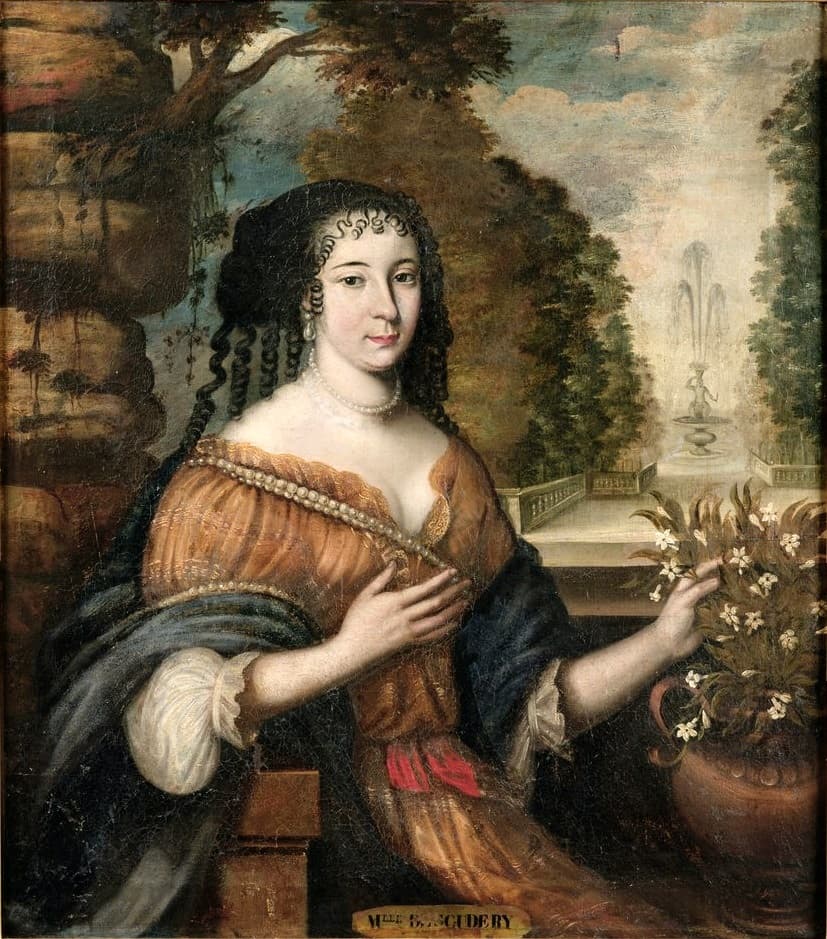
French · Literature
Madeleine de Scudéry
November 15, 1607 – June 2, 1701
Early Life and Background
Madeleine de Scudéry was born on November 15, 1607, in the Norman port city of Le Havre, France, into a family of minor provincial nobility. Her father, Georges de Scudéry, was a naval officer, and her mother, Madeleine de Goustimesnil, came from a family of similar rank. Her uncle, Jean de Scudéry, served as lieutenant of the port of Le Havre, lending the family a modest degree of local standing. Madeleine was the younger sister of Georges de Scudéry, who himself would become a noted playwright and poet, closely associated with the early French theatrical scene and a rival, however briefly, of Pierre Corneille.
Orphaned in early childhood — she lost both parents by around the age of six — Madeleine was taken in and raised by relatives, chiefly an uncle in Normandy who took an unusually progressive view of female education. Rather than confining her to the domestic accomplishments typically prescribed for young women of her class, he ensured she received training in a remarkably broad curriculum: Italian and Spanish languages, drawing, dance, horticulture, cooking, and, most significantly, moral philosophy, history, and rhetoric. This eclectic and rigorous education, unusual for a woman in early seventeenth-century France, would prove foundational to her later intellectual authority and her extraordinary literary output.
Move to Paris and the Salon World
Around 1630s, Madeleine de Scudéry moved to Paris to join her brother Georges, who was carving out a reputation in the capital's literary and theatrical circles. It was in Paris that Madeleine began to frequent the famous salon of Catherine de Vivonne, Marquise de Rambouillet, one of the most influential intellectual gathering places of the era, where nobility, writers, and philosophers mingled to discuss literature, love, manners, and language. This exposure placed her at the very heart of the emerging culture of the précieuses — women who cultivated refined language, elevated conversation, and elaborate codes of courtship and sentiment, partly as a means of asserting intellectual agency within a patriarchal society.
By the 1640s, Scudéry had established her own salon, known as the Société du samedi (Saturday Society), which met at her home and attracted a cross-section of Parisian literary, aristocratic, and intellectual figures. Unlike many salons of the period, which were often hosted by titled aristocratic women, Scudéry's gathering was notable for being led by a woman of relatively modest means who had built her reputation and social position almost entirely through her intellectual and literary talents rather than her birth or marriage.
Literary Career and Major Works
Scudéry's literary career began in earnest in the 1640s, though for many years she published her novels either anonymously or under her brother Georges's name, a common strategy for women writers seeking to navigate a literary marketplace and critical establishment dominated by men. Her first major work, Ibrahim ou l'Illustre Bassa (1641), set in the Ottoman world, established the template she would use for her subsequent novels: sprawling, multi-volume heroic romances set in exotic or classical historical settings, populated by idealized lovers whose adventures allegorically mirrored the personalities and relationships of contemporary Parisian society.
Her most famous and influential work, Artamène ou le Grand Cyrus, was published in ten volumes between 1649 and 1653. An immense romance ostensibly set in ancient Persia, the novel was widely understood by contemporary readers as a roman à clef depicting real figures from the French court and salons, including a flattering portrait of the military commander known as the Grand Condé. The novel became a sensation across Europe, translated into English, German, and other languages, and it established Scudéry as one of the most widely-read authors of her generation, male or female.
She followed this success with another multi-volume masterpiece, Clélie, histoire romaine (1654–1660), set in ancient Rome. It was in this work that Scudéry introduced the celebrated Carte de Tendre ("Map of Tenderness"), an allegorical map charting the geography of love and courtship — from villages named "Billet Doux" (love letter) to the "Lake of Indifference" — that became one of the most iconic images of the précieux culture and remains widely reproduced and studied by literary historians today as an emblem of seventeenth-century French sentimental and social codes.
Later major works included Almahide ou l'esclave reine (1660–1663) and a series of moral and conversational essays published under titles such as Conversations sur divers sujets (1680) and Conversations morales (1686), in which she moved away from pure romance toward direct philosophical and moral discourse on topics including friendship, glory, conversation, and the nature of love — subjects that had always underpinned her fiction but which she now addressed explicitly and in her own authorial voice, no longer hiding behind her brother's name.
Recognition and Honors
Scudéry's growing reputation brought with it significant institutional recognition, remarkable for a woman writer of her era. She received a royal pension in acknowledgment of her literary contributions, a mark of high favor at a court that rarely extended such patronage to women. Most notably, in 1671, she became the first woman ever awarded the Prix d'éloquence by the Académie française, for her Discours de la gloire. Although the Académie did not admit women as members, this award represented an unprecedented acknowledgment of a woman's mastery of classical rhetoric and eloquence, domains almost exclusively coded as male within the institutional culture of French letters.
She also corresponded with and was admired by prominent contemporaries, including Queen Christina of Sweden, and she maintained close intellectual relationships with philosophers and writers associated with the broader querelle des femmes (debate on the nature and status of women), a recurring intellectual controversy in early modern Europe regarding women's moral and intellectual capacities.
Personal Life
Madeleine de Scudéry never married, a choice that was itself significant and somewhat radical for a woman of her time and station. She maintained close, possibly romantic, relationships with several men over her lifetime, most notably the writer and academician Paul Pellisson, with whom she carried on a decades-long intimate friendship and correspondence, though the exact nature of their relationship remains a subject of historical debate. Her choice to remain unmarried allowed her the legal and social independence to manage her own finances, publish her own works (eventually under her own name), and preside over her own salon — an autonomy rarely available to married women of the period, who were legally subordinate to their husbands.
Later Life, Death, and Legacy
Scudéry continued writing and participating in Parisian intellectual life well into old age, publishing her conversational essays into her seventies and eighties. She died in Paris on June 2, 1701, at the extraordinary age of 93, having outlived nearly all of her contemporaries from the golden age of the salon culture she had helped to define.
Her legacy is complex and has undergone significant reappraisal over the centuries. In the eighteenth and nineteenth centuries, her sprawling romances fell out of literary fashion, and she was sometimes mocked, including by Molière, whose satirical play Les Précieuses ridicules (1659) is often understood as a caricature of the précieuse culture with which she was closely associated, though scholars debate whether Scudéry herself was a direct target. Nonetheless, in the twentieth and twenty-first centuries, feminist literary historians and scholars of the early modern novel have re-evaluated her work, recognizing her as a foundational figure in the development of the European novel, a pioneering woman of letters who achieved fame, financial independence, and institutional recognition through her writing alone, and an important voice in early modern debates about gender, love, and women's intellectual capacities. Her Carte de Tendre remains a widely cited and reproduced artifact of French cultural history, and her novels are studied today as key texts in the history of the novel form and of women's writing in the early modern period.
Dated achievements
1 indexed.
- Nov151607Literature
Birth of Madeleine de Scudéry
Madeleine de Scudéry was born on November 15, 1607, in Le Havre, France.
View details Wikipedia