← All women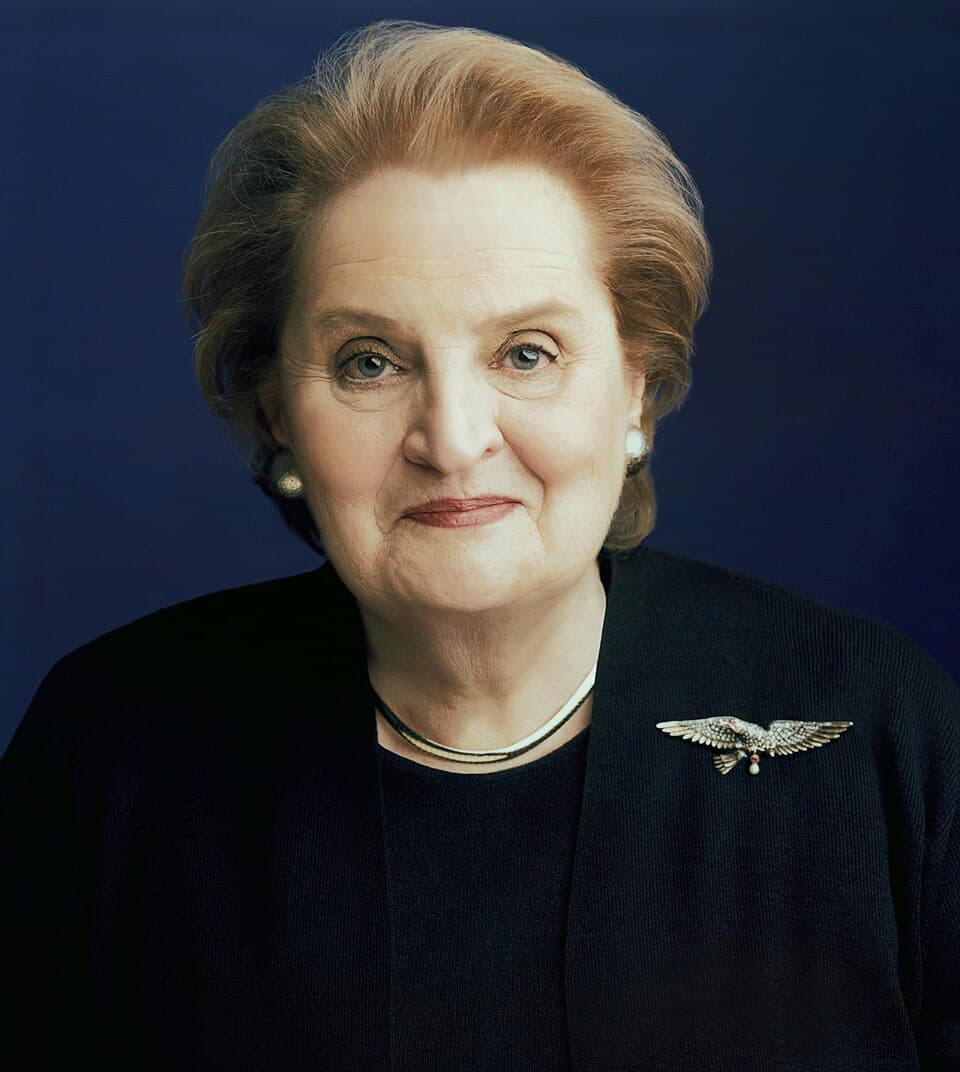
American, Czechoslovak (by birth) · Politics · Law
Madeleine Albright
May 15, 1937 – March 23, 2022
Early Life and Background
Madeleine Jana Korbel Albright (born Marie Jana Körbelová on May 15, 1937) entered the world in Prague, Czechoslovakia, in a family deeply embedded in diplomacy and public service.[1][3][5] Her father, Josef Korbel, was a Czechoslovak diplomat and member of the foreign service, while her mother, Mandula Korbel, managed the household and supported his career.[5][9] Raised initially in the Roman Catholic faith, she would later convert to Episcopalianism as an adult.[5]
Albright’s childhood was shaped by the upheavals of twentieth‑century Europe. During World War II, her family fled Nazi persecution, spending years in exile in London before returning to Czechoslovakia after the war.[1][7] The postwar communist takeover of Czechoslovakia again forced the family into exile, this time to the United States in 1948, where they arrived as political refugees.[1][4][7] These experiences of displacement, authoritarian rule, and international negotiation profoundly influenced her later commitment to democracy, collective security, and human rights.
Settling in the U.S., Albright attended schools in Colorado and later in the Northeast, excelling academically and developing strong interests in politics and international affairs. Her father’s subsequent academic career—he became a professor of international relations and a mentor to future statesman Condoleezza Rice—reinforced an environment in which global politics were a constant topic of conversation.[2][7] This background helped lay the intellectual foundations for her own career in foreign policy.
Education and Intellectual Formation
Albright became a U.S. citizen by naturalization in 1957, solidifying her adopted identity as an American and opening the way to future government service.[2][5] She attended Wellesley College, a leading women’s college in Massachusetts, where she studied political science and graduated with a bachelor’s degree with honors in 1959.[2][5] Wellesley exposed her to rigorous intellectual training and to a network of women who saw public service and professional achievement as attainable goals.
She later pursued graduate studies at Columbia University, in its Department of Public Law and Government and the Russian Institute, focusing on international relations and Soviet studies.[2][5] She earned a Master of Arts degree in 1968 and a Doctor of Philosophy (Ph.D.) in 1976, specializing in public law and government.[2][5] Her academic work sharpened her expertise in Eastern European politics, communist systems, and the mechanics of international organizations—knowledge that would prove vital in her later diplomatic roles.
Alongside her degrees, Albright developed a reputation as a meticulous researcher and clear writer on foreign policy issues. Her scholarly background distinguished her among many political appointees in Washington, adding academic depth to her later policy positions and helping her bridge the worlds of university scholarship and practical diplomacy.[2][7]
Career Beginnings and Entry into Politics
Albright’s career in politics began in the early 1970s. In 1972, she became a legislative assistant to U.S. Senator Edmund Muskie, a prominent Democrat, giving her hands‑on experience with congressional processes, legislation, and foreign policy debates.[4][7] This role introduced her to the practical side of policymaking and allowed her to build relationships in Washington.
During the administration of President Jimmy Carter, Albright joined the National Security Council staff as a congressional liaison in 1978.[1][4] In this capacity, she served as a bridge between the White House’s national security apparatus and Congress, working on issues that linked foreign policy to domestic political considerations. Her work further entrenched her reputation as a skilled analyst and communicator able to navigate complex institutional environments.
After leaving government service in 1981, Albright moved into academia, joining Georgetown University as a professor of international relations.[1][7] She later became head of a program at the Center for Strategic and International Studies (CSIS), training future diplomats and foreign‑policy professionals.[1][7] Her teaching and mentoring at Georgetown, particularly in its School of Foreign Service, contributed to the education of many future public servants and expanded her influence beyond formal government roles.
Rise to National Prominence: Ambassador to the United Nations
Albright’s transition from academic and advisory roles to frontline diplomacy came with the election of President Bill Clinton. In 1993, Clinton nominated her as U.S. Ambassador to the United Nations, and she was confirmed and sworn into the position on January 27, 1993.[2][3] This appointment made her a member of the President’s Cabinet and placed her at the center of multilateral diplomacy during a pivotal post–Cold War period.
As U.N. ambassador from 1993 to 1997, Albright confronted crises such as the wars in the former Yugoslavia and the genocide in Rwanda, as well as debates over sanctions, peacekeeping, and the role of the U.N. in enforcing international norms.[1][2][7] She advocated a firm stance against aggression, supported the use of NATO and U.N. mechanisms in conflict management, and argued for active U.S. engagement in multilateral institutions. Her tenure was marked by a sometimes tough rhetorical style; she was known for direct, forceful statements defending U.S. positions.
Albright’s service at the U.N. also highlighted her skill in coalition‑building and public diplomacy. She frequently used the Security Council as a platform to articulate human‑rights concerns and the need for collective responses to atrocities, even as she faced criticism when international responses fell short, particularly in Rwanda.[1][7] Her performance nevertheless established her as a leading figure in U.S. foreign policy and positioned her for further advancement.
Secretary of State: Major Policies and Achievements
On December 5, 1996, President Clinton nominated Albright to be U.S. Secretary of State, explicitly intending to make her the first woman to hold the post.[2] The U.S. Senate unanimously confirmed her on January 22, 1997, and she was formally sworn in as the 64th Secretary of State on January 23, 1997.[2][3] This appointment made her the first female Secretary of State and, at that time, the highest‑ranking woman in U.S. government.[1][6][9]
As Secretary of State from 1997 to 2001, Albright played a central role in shaping U.S. foreign policy in the post–Cold War era. She strongly supported the eastward expansion of NATO into former Soviet bloc nations, including Poland, Hungary, and the Czech Republic.[1][2] This policy aimed to consolidate democratic reforms, provide security guarantees, and deter potential Russian revanchism. She argued that incorporating Central and Eastern European states into Western security structures would stabilize the region and honor commitments made after the collapse of communism.
Albright was also deeply involved in efforts to prevent the spread of nuclear weapons from former Soviet republics to "rogue" states, working on nonproliferation initiatives and supporting programs to secure nuclear materials.[2] She engaged in diplomacy related to Russia, Ukraine, and other post‑Soviet states to ensure compliance with arms‑control agreements and reduce nuclear risks.
One of the defining episodes of her tenure was the Kosovo crisis. In 1999, Albright played a key role in pressing for NATO military intervention in response to Serbian actions and humanitarian abuses in Kosovo.[1][2] She argued that the international community had a responsibility to act in the face of ethnic cleansing and that U.S. credibility was at stake after failures in Bosnia and Rwanda. Under her leadership, the U.S. backed NATO airstrikes against Yugoslav forces, contributing to an eventual settlement and withdrawal of Serbian troops.
Albright’s approach combined strong support for democracy promotion and human rights with a belief in the strategic use of American power. She backed efforts to foster free‑market democratization and civil society in developing countries, supported the Kyoto Protocol on global climate change, and sought to normalize relations with Vietnam after years of estrangement.[2] These initiatives reflected her conviction that U.S. foreign policy should blend national interest with normative commitments to global cooperation.
She became widely known for her distinctive use of brooches and pins as a form of nonverbal political messaging, choosing particular designs to signal approval, anger, or resolve in diplomatic encounters. This practice, later highlighted in her book about her pins, reinforced her public persona as both symbolic and substantive in her communication style.[5]
Books, Writings, and Public Voice
Beyond her government roles, Albright developed a significant career as an author and public intellectual. She wrote multiple books on foreign policy, international relations, and her own life, including "Madam Secretary: A Memoir", published in 2003, which became a New York Times bestseller.[6] The memoir offered a detailed account of her experiences as a refugee, scholar, U.N. ambassador, and Secretary of State, and has been widely used in courses on diplomacy and women’s leadership.
She also authored or co‑authored works addressing broader global challenges, such as the nature of tyranny, the responsibilities of the United States in world affairs, and the tension between security and liberty. These books reinforced her status as a leading commentator on international issues and extended her influence beyond formal office.[7] Her writing combined historical narrative with policy analysis, often drawing on her own experiences in Czechoslovakia and the United States to illustrate broader themes.
Awards, Honors, and Recognition
Albright received numerous honors in recognition of her public service and pioneering achievements. Among the most notable was the Presidential Medal of Freedom, the highest civilian award in the United States, which she was awarded in 2012.[1] This honor acknowledged her decades of contributions to American foreign policy, her role as the first woman Secretary of State, and her continued engagement as a public voice on international affairs.
In 1997, she was inducted into the National Women’s Hall of Fame, which highlighted her trailblazing status as the first female Secretary of State and, at the time, the highest‑ranking woman in the U.S. government.[6][7] Various universities awarded her honorary degrees, and international organizations recognized her advocacy for democracy and human rights.
Albright was frequently cited in media and scholarly literature as a role model for women in diplomacy and politics. Profiles by outlets such as the BBC, CNN, NPR, and others emphasized her combination of intellectual rigor, personal resilience, and political toughness, framing her as a central figure in the history of women’s leadership in foreign policy.[5][9][12]
Personal Life
In 1957, while at Wellesley, Albright met Joseph Medill Patterson Albright, a journalist from a prominent media family, and the couple married in 1959.[4][5] They had three daughters: Anne Korbel Albright, and twins Alice Patterson Albright and Katherine Medill Albright.[4][5] CNN notes that Katherine was born in 1967, and the twins Anne and Alice in 1961.[5] Their family life unfolded alongside her academic pursuits and increasing involvement in policy advising.
The marriage ended in divorce in 1982, after which Albright continued to use the surname Albright professionally.[4] Balancing motherhood with careers in academia and politics, she became an example of a woman managing both family responsibilities and demanding public roles at a time when such paths remained challenging.
Religiously, Albright’s journey was complex. Raised as a Roman Catholic, she later became Episcopalian.[5] In the 1990s, she learned that members of her extended family were of Jewish origin and had perished in the Holocaust, a discovery that deepened her reflections on identity, memory, and the responsibilities of power in the face of genocide.
Later Career and Ongoing Influence
After leaving office in 2001 at the end of the Clinton administration, Albright remained active in public life. She founded Albright Stonebridge Group, a global strategy firm, and continued teaching and writing on foreign policy.[7] She served on boards, advised international organizations, and regularly commented on current events, including the wars in Iraq and Afghanistan, the evolution of NATO, and democratic backsliding in various regions.
Albright also acted as a mentor to younger diplomats and political leaders, particularly women, encouraging their participation in foreign policy and international institutions.[9] She supported initiatives aimed at increasing women’s representation in peace processes and political decision‑making and spoke often about the importance of diversity for effective diplomacy.
Her cultural presence extended into popular media; she made cameo appearances in television series such as "Gilmore Girls," "Parks and Recreation," and "Madam Secretary," reflecting her recognizable public profile and willingness to engage light‑heartedly with her status as a former Secretary of State.[11]
Legacy and Historical Impact
Madeleine Albright’s legacy rests above all on her status as the first woman to serve as U.S. Secretary of State and, at the time, the highest‑ranking woman in the history of the U.S. government.[1][3][6][9] By occupying and performing effectively in such a pivotal role, she helped normalize women’s leadership in foreign policy and national security, challenging assumptions that these domains required male leadership.
Her career also illustrates the trajectory of a refugee who became a central figure in the politics of her adopted country. Albright drew explicitly on her experiences of exile, war, and authoritarianism to argue for robust international institutions, human‑rights protections, and preventive action against mass atrocities.[7][9] Whether in advocating NATO intervention in Kosovo or supporting democracy promotion in post‑communist states, she linked policy choices to the lessons of twentieth‑century European history.
In women’s history, Albright stands as a key breakthrough figure in diplomacy, comparable to pioneering women in other fields such as law, science, and military leadership. Her combination of academic scholarship, bureaucratic skill, and public communication set a template for later women in high office. Her distinctive use of symbolic communication—such as diplomatic pins—underscored the ways in which women leaders could craft visible, personal styles while engaging in serious policy work.[5]
Albright’s legacy is reinforced by ongoing references to her in educational materials, research starters, and institutional biographies from organizations such as Britannica, the U.S. Department of State, and women’s history institutions.[1][2][6][7] She is frequently invoked as an example of how one individual can both navigate and reshape the structures of international power.
Later Life and Death
In her later years, Albright continued to write, lecture, and participate in policy debates, maintaining a high public profile well into her eighties. She remained engaged with issues such as authoritarian resurgence, populism, and the future of the liberal international order, warning of the dangers posed by new forms of tyranny and the erosion of democratic norms.[7][9]
On March 23, 2022, Albright died from cancer in Washington, D.C., at the age of 84.[1][3][5][9] Her family and representatives announced her death, noting her "courageous battle" with the disease.[5] Major news organizations and institutions quickly published obituaries and tributes, emphasizing her role as a trailblazing diplomat, mentor, and advocate for democracy.
Her death sparked reflections on the transformation of women’s roles in U.S. government during her lifetime and the particular contributions she made to that change. For many, Albright’s life came to symbolize both the possibilities open to refugees who settle in new countries and the capacity of women to lead in the highest echelons of global politics. Her influence continues through her writings, the institutions she helped shape, and the many individuals she mentored.
Dated achievements
6 indexed.
- May151937Science
Birth in Prague, Czechoslovakia
Born Marie Jana Körbelová in Prague, Czechoslovakia, to diplomat Josef Körbel and his wife Anna.
View details Madeleine Albright - Britannica - Jan271993Science
Sworn in as U.S. Ambassador to the United Nations
Sworn in as U.S. Ambassador to the UN after nomination by President Bill Clinton, her first diplomatic posting.