← All women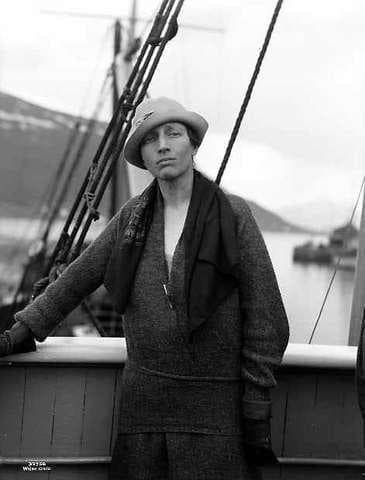
American · Exploration · Activism
Louise Boyd
September 16, 1887 – September 14, 1972
Early Life and Background
Louise Arner Boyd was born on September 16, 1887, in San Rafael, California, to a wealthy family. Growing up in a privileged environment, she had the opportunity to travel extensively from a young age. Her fascination with the Arctic was sparked during a trip to Norway, leading her to dedicate her life to the exploration of these remote and icy regions.
Career Beginnings and Development
Initially, Boyd entered the realm of Arctic exploration not as a professional scientist but as an enthusiast seeking adventure. Her first major expedition took place in 1926 when she organized a trip aboard the ship Hobby to photograph the landscapes and icebergs of the Arctic. The venture marked her commitment to contributing to the scientific understanding and documentation of the area.
Major Works, Discoveries, or Accomplishments
Boyd achieved a significant milestone in 1928 when she headed an important rescue mission in search of the missing explorer Roald Amundsen. By 1931, she had herself financed and led her first purely scientific expedition to East Greenland, becoming the first woman to do so. Her expeditions during the 1930s were groundbreaking, producing some of the first aerial photographs of the Arctic, which proved invaluable for cartography and scientific research.
Awards, Honors, and Recognition Received
Over her lifetime, Boyd received numerous accolades for her contributions to polar exploration. In 1934, Norway awarded her the Chevalier Cross of the Order of St. Olav. The American Geographical Society also honored her in 1949 with its prestigious Charles P. Daly Medal, recognizing her scientific contributions to geography and exploration.
Personal Life
Louise Boyd never married, dedicating her life to her expeditions and scientific endeavors. Her status as a wealthy heiress allowed her to fund her work independently, ensuring her explorations were conducted with the utmost rigor and freedom.
Legacy and Historical Impact
Boyd's legacy lies in her innovative use of technology in exploration, particularly aerial photography, which paved the way for precise mapping of uncharted territories. Her contributions extended beyond exploration to advocacy for women in science and exploration during a time when such fields were predominantly male-dominated. She broke significant barriers, providing inspiration for future generations of women explorers.
Later Life and Death
In her later years, Boyd remained active in the scientific community, though she retired from leading expeditions. She passed away on September 14, 1972, leaving behind a legacy immortalized in numerous geographical and scientific records. Her collection of photographs and exploratory documents continues to serve as a resource for researchers to this day.
Dated achievements
2 indexed.
- Sep161887Exploration
Birth of Louise Arner Boyd
Louise Arner Boyd was born on September 16, 1887, in San Rafael, California.
View details Louise Arner Boyd: The First Woman to Lead Arctic Expeditions - Sep141972