← All women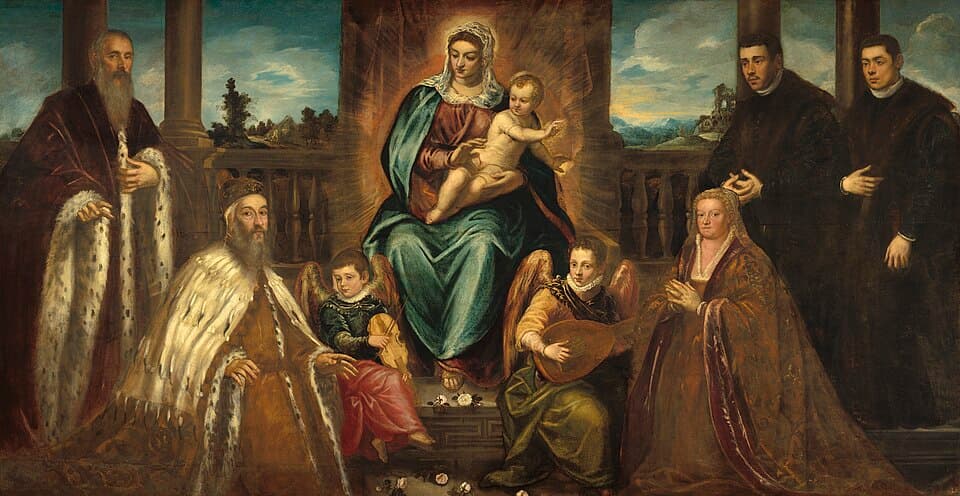
Venetian · Politics
Loredana Marcello
1518 – December 12, 1572
Early life and family background
Loredana Marcello was born in Venice in 1518, into a patrician family of the Venetian Republic. She was the daughter of Giovanni Alvise Marcello, a member of one of Venice’s prominent noble lineages. The surviving biographical record is sparse on the details of her childhood, education, and daily life, which is typical for elite women of the early modern period. Even so, later accounts consistently present her as a woman of uncommon cultivation, suggesting that she benefited from the education available within elite Venetian circles.
Venice in the early sixteenth century was a republic in which noblewomen rarely occupied formal political authority, yet they could exercise social influence through marriage, patronage, household management, and literary culture. Marcello’s later reputation reflects this environment. She became known not simply as a noble consort, but as a woman associated with letters, poetry, and botanical learning. These qualities would become central to her historical memory.
Marriage and entrance into public life
In 1533, Marcello married Alvise I Mocenigo, who later became Doge of Venice. The marriage linked her to one of the most powerful families in the republic and placed her within the ceremonial world of Venetian elite politics. The couple is described in later sources as having had no children. This fact mattered in the context of dynastic household continuity, since noble marriages were often expected to produce heirs who could extend family influence.
Although Marcello did not hold office in a formal sense, marriage to a future Doge gave her a position of visibility within the republic’s symbolic order. Venetian public life was intensely ceremonial, and the Doge’s wife occupied a role that combined courtly presence, moral exemplarity, and social representation. Marcello’s later fame rests partly on the unusual combination of these expectations with her reputation for learning.
Dogaressa of Venice
Marcello became Dogaressa of Venice when her husband was elected Doge on 15 May 1570. Her tenure was brief, lasting only about two and a half years, because she died in 1572. Still, the role mattered historically because it placed her among the very small number of women who served as consorts of Venetian rulers in the sixteenth century. Later biographical traditions describe her as one of only four Dogaresse of that century.
As Dogaressa, Marcello belonged to a ceremonial culture that was highly attentive to rank, appearance, and public conduct. Women in her position were expected to embody virtue and dignity rather than to wield overt power. Yet Renaissance Venice also prized eloquence and learning, and Marcello’s name was preserved precisely because she was considered an educated woman. She was described as a writer of letters and poetry and as someone who studied botany, including the use of herbs and remedies with a teacher connected to the botanical garden at Padua.
This combination of status and intellect helped turn Marcello into a model of the cultivated Renaissance woman in later memory. Unlike many women whose influence remained informal and undocumented, her reputation was strong enough to survive in several later reference traditions. Her significance therefore lies not in legislation or office, but in the way she embodied elite female learning within a patriarchal republic.
Intellectual life, letters, poetry, and botany
Marcello is remembered as an author of letters and poetry and as a student of botany. These interests were not incidental ornaments of aristocratic life; they were forms of learned culture that enhanced a woman’s standing among educated elites. In Renaissance Italy, botany was closely tied to medicine, the study of simples, and the practical use of plants. For a noblewoman to engage seriously with the subject suggests both access to instruction and an unusually strong intellectual curiosity.
Later descriptions connect Marcello with Melchiorre Giuliandino and the Botanical Garden of Padua, indicating that her learning was linked to one of the period’s most important centers for the study of plants. This association also helps explain why later writers associated her with remedies for plague victims. Whether or not one accepts every later attribution in full, the repeated emphasis on her botanical knowledge shows that contemporaries and later compilers saw her as a woman whose interests extended beyond conventional aristocratic accomplishment.
Her literary output, especially letters and poetry, has not survived in a large body, at least not in the readily accessible record. Nonetheless, the consistency with which biographical summaries mention writing indicates that she participated in the broader Renaissance culture of learned correspondence and poetic expression. In a society where women’s education was often limited by custom and expectation, Marcello represents a noble exception whose intellectual reputation became part of her historical identity.
Plague, remedies, and medical reputation
One of the most distinctive traditions about Marcello is that she compiled or developed remedies for plague sufferers. Later accounts report that these treatments were put to use during the devastating Venetian plague outbreak of 1575, after her death. The precise details are difficult to verify in primary documentation, but the recurring association between Marcello and practical medical knowledge is historically revealing.
In sixteenth-century Venice, plague was not only a public health crisis but also a social and religious event that strained institutions and family life alike. Remedies circulated through households, physicians, apothecaries, and learned circles. Women played important roles in caregiving and the transmission of medicinal knowledge, even when official medical authority remained male-dominated. Marcello’s botanical interests made her a plausible figure in this world, and her later reputation as a provider of useful treatments reflects the broader place of learned women in domestic and civic medicine.
The tradition that her remedies were used in 1575 gives her a kind of posthumous medical significance. Even if the exact provenance of those treatments cannot be established with certainty, the persistence of the story suggests that Marcello came to symbolize cultivated, practical female knowledge in a time of epidemic crisis. That legacy is especially important in women’s history, where intellectual contribution was often recorded only indirectly.
Reputation and recognition
Marcello’s reputation rests on the way later sources describe her as a model of an educated and cultivated Renaissance woman. She was also characterized as beautiful, learned, and socially distinguished. One later tradition refers to her as Giantessa di merito, a formulation that underscores her admired talents and merits. Such language reveals how her contemporaries and subsequent compilers framed her not merely as the wife of a Doge, but as a woman of exceptional accomplishment within the constraints of her era.
She is further remembered as one of the few Dogaresses of the sixteenth century and as the only one of that century said to have died while her husband remained Doge. That distinction gives her a special place in Venetian court history. In addition, some accounts say she was the first Dogaressa to receive a sculptural representation on the shared tomb or burial monument associated with the Marcello and Mocenigo families. While the precise details of this memorial tradition should be treated cautiously, the broader point is clear: Marcello was commemorated in ways that suggest lasting family and civic esteem.
Death and burial
Marcello died in Venice in December 1572. The exact date varies by source tradition: German-language biographical material gives 11 December 1572, while English- and Spanish-language summaries, along with DBpedia, give 12 December 1572. In either case, her death came only a short time after she had become Dogaressa. The divergence is a reminder that early modern biographical chronology is often reconstructed from later records rather than preserved in a single authoritative document.
According to later summaries, she was buried in the Basilica of Saints John and Paul, the traditional burial place of Venice’s doges. Burial in that setting reflects her association with the highest ceremonial rank in the republic, even though her office was social and dynastic rather than governmental. Her death during the plague era also strengthens the impression of a life shaped by the vulnerabilities and rituals of elite Venetian society.
Legacy
Loredana Marcello’s legacy is one of learning, courtly status, and posthumous memory. She did not leave behind a large corpus of surviving writings or a record of formal office, but she remains significant because she illustrates how a Renaissance woman could acquire lasting renown through education, correspondence, poetry, and associations with botanical and medical knowledge. In women’s history, that is important evidence of the forms of influence available to elite women even when they were excluded from official political power.
Her story also matters because it connects several histories at once: the ceremonial world of the Venetian republic, the cultural authority of noblewomen, the study of plants and remedies, and the social memory of plague. For modern readers, Marcello stands as an example of how a woman’s life could be preserved through fragmentary references that nonetheless reveal real intellectual presence. She remains remembered not simply as a consort of power, but as a cultivated figure who helped define the Renaissance ideal of the educated woman.
Dated achievements
3 indexed.
- May151570Politics
Becomes Dogaressa of Venice
Loredana Marcello became Dogaressa of Venice when her husband Alvise I Mocenigo was elected Doge on 15 May 1570.
View details Loredana Marcello - Wikipedia - Dec111572Politics
Death of Loredana Marcello (German source date)
According to German-language sources, Loredana Marcello died in Venice on 11 December 1572, ending her tenure as Dogaressa.