← All women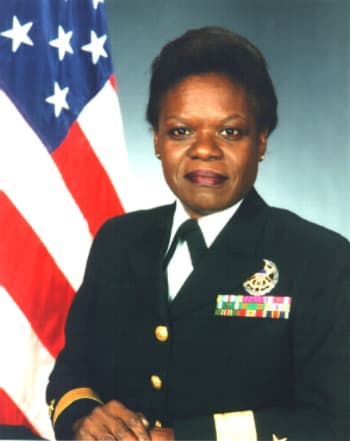
American · Activism · Exploration
Lillian E Fishburne
March 25, 1949 – present
Early Life and Background
Lillian Elaine Fishburne was born on March 25, 1949, at Patuxent River, Maryland, home to a major U.S. naval air station.[1] She was raised in Rockville, Maryland, in a period when both American society and the armed forces were still marked by racial segregation and strict gender roles.[1] Growing up in proximity to a naval installation exposed her early to the culture of military service, though leadership opportunities for African-American women in the Navy were extremely limited at the time.
Fishburne attended local schools in Maryland and developed an interest in social sciences and public service. She enrolled at Lincoln University in Oxford, Pennsylvania—one of the United States’ historically Black colleges and universities (HBCUs)—where she studied sociology.[1] Lincoln University had a long tradition of producing African-American leaders in many fields, and its intellectual and activist environment provided Fishburne with a formative context in which questions of race, gender, and social change were central.
In 1971, she graduated from Lincoln University with a Bachelor of Arts in Sociology.[1] Her undergraduate work gave her a foundation in understanding complex social systems and organizations, knowledge that would later prove valuable in navigating and influencing institutional dynamics within the Navy. The combination of her upbringing near a naval base and education at an HBCU positioned her to enter military service with a strong sense of both discipline and social responsibility.
Education and Professional Development
Fishburne’s career is marked by a sustained commitment to advanced education, particularly in management and technical fields. After entering the Navy, she pursued graduate study to deepen her expertise. In 1980, she earned a Master of Arts in Management from Webster College (now Webster University) in St. Louis, Missouri.[1] This program provided her with formal training in organizational leadership, planning, and administration, all of which were crucial skills for officers tasked with managing complex operations.
Recognizing the increasing importance of telecommunications and information systems to modern warfare, Fishburne sought further specialization. In 1982, she was awarded a Master of Science in Telecommunications Systems Management from the Naval Postgraduate School in Monterey, California.[1] The Naval Postgraduate School is a key institution for educating technical specialists within the armed services, and her degree placed her at the forefront of emerging trends in military communications.
Fishburne continued to invest in her professional development at senior levels. In 1993, she graduated from the Industrial College of the Armed Forces at Fort McNair in Washington, D.C. (now part of the National Defense University).[1] This program focuses on national security strategy, resource management, and joint operations, preparing mid- to senior-level officers for high-level command and staff responsibilities. Her completion of this course indicated that she was being groomed for broader leadership roles in the Navy’s upper echelons.
Career Beginnings in the U.S. Navy
Fishburne’s entry into the Navy occurred at a pivotal time for women in the armed forces. She was commissioned as an ensign upon completion of Women Officers School at Newport, Rhode Island, in February 1973.[1] Women Officers School was a separate training pipeline created before full integration of women into the larger officer corps. Her commissioning came just as the Navy was beginning to expand the roles available to female officers.
As an ensign, Fishburne began her career in areas related to communications and information management—fields that were gaining importance as the military modernized. Details of her early assignments include work in naval communications infrastructures and support roles that required technical proficiency and organizational ability.[1] While many of her contemporaries in the officer corps followed more traditional line or combat-oriented paths, Fishburne moved into highly specialized, technology-driven domains that were critical but often underappreciated.
In these early years, she had to navigate both racial and gender-based barriers. African-American officers were still underrepresented, particularly in the Navy’s higher ranks, and women were often regarded as experimental additions to roles historically reserved for men. Her performance in these initial positions helped build a record of competence that allowed her to advance despite structural obstacles.
Advancement, Commands, and Senior Roles
Over the next two decades, Fishburne rose steadily through the officer ranks, taking on positions of increasing responsibility in communications, logistics, and information systems.[1] Her career encompassed both operational and staff assignments, reflecting the evolving importance of information management in naval operations.
Among her notable roles, Fishburne held command of units with responsibilities for communications and support services, though specific commands are summarized generally in available sources rather than documented in detail.[1] She served in positions related to naval telecommunications, information systems, and logistics, blending technical expertise with leadership and administration.
Her trajectory was shaped by broader changes in the Navy during the 1970s and 1980s, including the abolition of the Women Officers School as a separate institution, the integration of women into a wider range of occupational specialties, and increased attention to diversity in the officer corps. Fishburne’s continued advancement during this period demonstrated that African-American women could succeed in technically demanding fields and assume leadership in areas critical to modern warfare such as command-and-control and communications.
By the early 1990s, Fishburne had reached senior officer ranks and was identified as a potential flag officer. Her completion of the Industrial College of the Armed Forces in 1993 reinforced her credentials for high-level strategic roles, integrating her technical background with a broader understanding of national defense policy and resource management.[1]
Historic Promotion to Rear Admiral
The defining milestone of Fishburne’s career came in 1998, when she was appointed to the rank of rear admiral (lower half) by President Bill Clinton and officially promoted on February 1, 1998.[1][2] With this promotion, she became the first African-American woman to hold the rank of rear admiral in the United States Navy.[1][2][3] The achievement was widely noted in military and public discourse as a breakthrough in both race and gender representation at flag rank.
Her promotion was not symbolic alone; it reflected decades of substantive work in communications and information systems. As a rear admiral, Fishburne served in senior positions linked to the Navy’s growing emphasis on information warfare, telecommunications, and command-and-control infrastructure.[2] These areas were central to the transformation of military operations in the late twentieth century, as advanced technology and networked systems became integral to defense planning and execution.
Fishburne’s elevation to flag rank challenged prevailing assumptions about who could lead at the highest levels in the Navy. At a time when African-American women remained rare in senior officer roles, her promotion broadened the visible spectrum of leadership and created new expectations for diversity. It also underscored the critical role of technical expertise in modern military leadership, as she was recognized not for combat command alone but for mastery of complex information systems.
Senior Leadership in Information Warfare and Command-and-Control
Following her promotion, Fishburne held a key role related to the Navy’s information infrastructure. She served as director of the information transfer division for the Space, Information Warfare, Command and Control Directorate on the staff of the Chief of Naval Operations (CNO) in Washington, D.C.[2] In this capacity, she oversaw initiatives and systems concerned with how information was transmitted, shared, and protected across naval platforms and commands.
This directorate was responsible for shaping the Navy’s approach to space-based assets, information warfare capabilities, and command-and-control networks, all of which were increasingly central to U.S. defense strategy. Fishburne’s leadership in the information transfer division meant she influenced policies and systems that affected the Navy’s operational effectiveness worldwide.[2]
Her work in information warfare and command-and-control occurred during a period when the U.S. military was integrating digital communications, satellite systems, and advanced networks into nearly every aspect of operations. Fishburne’s expertise in telecommunications systems management, honed at the Naval Postgraduate School, positioned her to understand both the technical and strategic dimensions of these changes.[1]
Awards, Honors, and Recognition
Across her career, Fishburne received multiple honors and recognitions from the Navy, though available public sources emphasize her trailblazing promotion rather than listing all of her individual awards.[1][2] As a senior officer and flag officer, she was eligible for and likely received awards commensurate with her rank and responsibilities, such as commendation or meritorious service medals, though specific decorations are not consistently detailed in major biographical references.
Her most widely recognized distinction is her status as the first African-American woman rear admiral in the U.S. Navy, highlighted in institutional and educational materials focusing on diversity and women’s history.[1][2][3] Organizations such as the Armed Forces Benefit Association and educational platforms on military service have profiled her career as an example of barrier-breaking service.[2][3]
Fishburne’s achievements have been featured in narratives celebrating African-American contributions to the military and the history of women in the armed forces. Her biography in The HistoryMakers, a project dedicated to documenting African-American lives, further underscores the significance of her career and ensures that her story is preserved for future generations.[1]
Personal Life
Major public biographical sources on Fishburne focus primarily on her professional accomplishments and do not provide detailed information about her personal life, including marital status or children.[1][2][3] This emphasis reflects both privacy norms for living individuals and the historical focus of many military biographies on rank, assignments, and institutional impact rather than family details.
What can be said with confidence is that Fishburne navigated a demanding career at a time when support structures for women and minorities in the military were still developing. Her ability to undertake advanced education, hold complex leadership positions, and remain in service through multiple decades suggests a strong personal commitment to the Navy and to public service more broadly.[1]
In the absence of widely documented personal information, assessments of her life center on her professional trajectory and the broader historical importance of her career in the context of civil rights, gender equality, and military transformation.
Legacy and Historical Impact
Lillian E. Fishburne’s legacy is defined most clearly by her role in expanding the possibilities for African-American women in the U.S. Navy. Her 1998 promotion to rear admiral is a landmark in the history of military integration, following earlier breakthroughs such as the desegregation of the armed forces and the gradual opening of more occupational specialties to women.[1][2][3]
By reaching flag rank in a technical domain—telecommunications and information systems—Fishburne reinforced the idea that leadership in modern militaries depends on mastery of complex, often invisible infrastructures. Her career shows that contributions in communications and information warfare are as central to national defense as more visible combat roles.
Fishburne’s story has been used in educational and commemorative contexts, particularly during Black History Month and women-in-the-military observances, to illustrate the intersection of race, gender, and professional excellence in the armed forces.[2][3] As younger generations of officers look for role models who reflect their own identities, her example offers both inspiration and a concrete demonstration of what can be achieved within historically exclusive institutions.
Beyond the Navy, Fishburne’s achievements contribute to the broader narrative of African-American and women’s advancement in STEM-related fields. Her graduate education in telecommunications systems and her leadership in information warfare place her within the history of Black participation in technical and scientific domains, which has often been underdocumented.
Later Life and Retirement
Fishburne retired from the U.S. Navy in February 2001, after completing her tenure as director of the information transfer division for the space, information warfare, command and control directorate on the CNO’s staff in Washington, D.C.[1][2] Her retirement marked the close of nearly three decades of continuous service, from her commissioning as an ensign in 1973 to her role as a rear admiral in the information warfare community.
In the years following her retirement, Fishburne has been recognized in various profiles and articles highlighting her trailblazing role. Sources such as the Armed Forces Benefit Association and Black Engineer publications have included her among notable women in military service.[2][3] Her biography in The HistoryMakers ensures ongoing access to information about her life and career for researchers and the general public.[1]
As of the information available in major biographical references, Fishburne is living, and her post-retirement activities are not extensively documented in the public record.[1] The emphasis remains on her historic career within the Navy and her significance as a pioneering African-American woman at flag rank. Her path from a birth at Patuxent River in 1949 to retirement as a rear admiral in 2001 encapsulates a period of profound change in the U.S. military and exemplifies how individual dedication and expertise can transform longstanding institutions.
Dated achievements
2 indexed.
- Mar251949Politics
Birth in Patuxent River, Maryland
Lillian Elaine Fishburne was born on March 25, 1949, in Patuxent River, Maryland, the daughter of a naval officer.
View details Remembering the Trailblazing Service of Rear Adm. Lillian E. Fishburne - Feb011998