← All women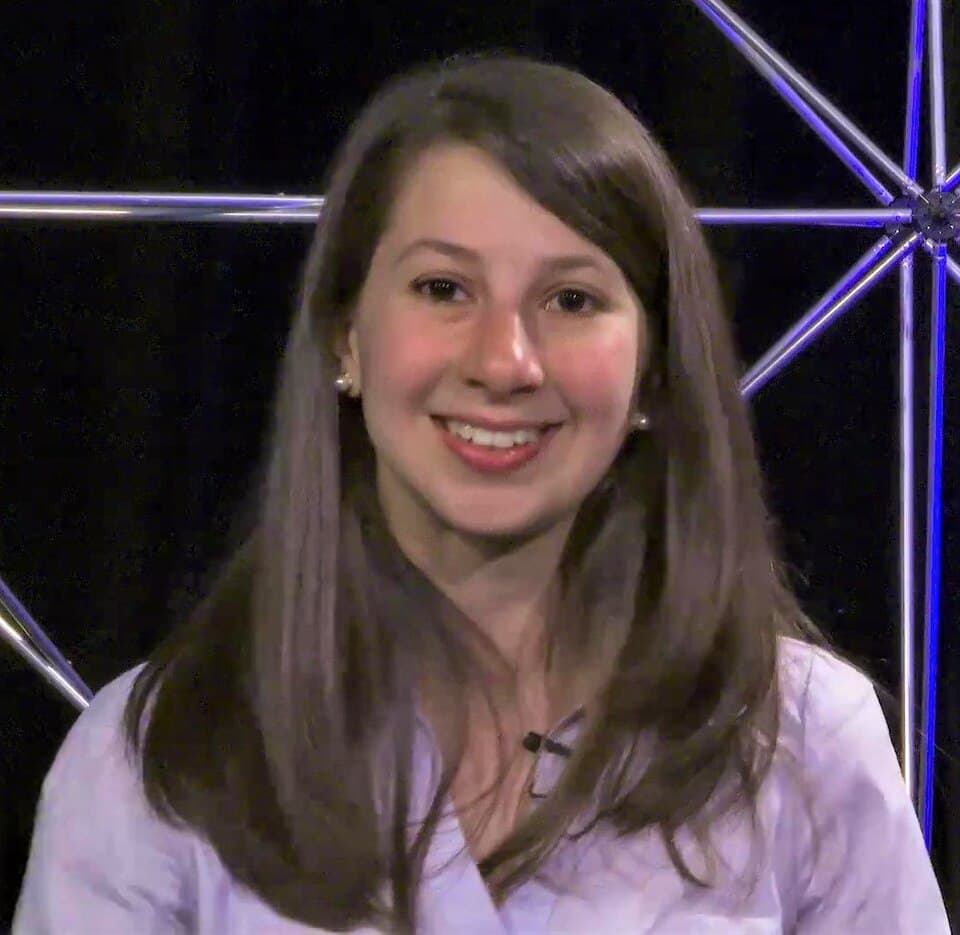
American · Science
Katie Bouman
July 9, 1989 – present
Early life and background
Katherine Louise "Katie" Bouman was born on July 9, 1989, in West Lafayette, Indiana, United States. She grew up in an academic environment shaped by the presence of Purdue University, which fostered an early interest in science and engineering.[1] Her exposure to scientific culture and access to educational opportunities in a university town helped lay the foundation for a career at the intersection of electrical engineering, computer science, and physics.
As a student, Bouman showed an early aptitude for research and experimentation. She participated in science competitions organized by what is now the Society for Science, competing in the International Science and Engineering Fair (ISEF) in 2005 and in the Discovery Channel Young Scientist Challenge in 2001, experiences that connected her to a community of young researchers and reinforced her interest in scientific inquiry.[4] These formative activities demonstrated both her technical curiosity and her comfort working on complex problems from an early age.
Bouman’s high school years strengthened her trajectory toward engineering and computing. Growing up during a period of rapid development in digital technology and imaging, she encountered both the practical and conceptual aspects of how computers could be used to interpret and reconstruct visual information. This technological backdrop would later make her receptive to computational approaches for solving challenging imaging problems, including those in astronomy.
Education and formative influences
Following high school, Bouman enrolled in the University of Michigan in Ann Arbor, where she studied electrical engineering.[1][12] She graduated summa cum laude with a B.S. in electrical engineering in 2011, an academic distinction reflecting her strong performance and deep engagement with her coursework.[1][12] At Michigan, she was exposed to core topics in circuits, signal processing, and electromagnetics, gaining the mathematical and technical toolkit that would underpin her later research.
During her undergraduate years, Bouman became particularly interested in signal processing and image reconstruction. These fields focus on extracting meaningful information from incomplete, noisy, or indirect measurements, an intellectual challenge that would become central to her career. Faculty mentorship and research opportunities at Michigan helped steer her toward graduate study, highlighting the possibilities of combining engineering methods with physical models to push the boundaries of what can be observed.
In 2011, Bouman moved to the Massachusetts Institute of Technology (MIT) to pursue graduate work in Electrical Engineering and Computer Science (EECS) within the Computer Science and Artificial Intelligence Laboratory (CSAIL).[1][12] She earned her master’s degree in 2013 and completed her Ph.D. in 2017
Bouman’s doctoral thesis, titled “Extreme imaging via physical model inversion: seeing around corners and imaging black holes”, explored how to reconstruct images in situations where direct observation is impossible or severely limited.[13] This included methods for "seeing around corners" using scattered light and techniques for imaging regions near black holes, where conventional sensors cannot directly capture light. The thesis integrated physical models of light propagation with sophisticated statistical priors, exemplifying her philosophy of tightly coupling algorithms with an understanding of the underlying physics. While still at MIT, Bouman became involved with the Event Horizon Telescope (EHT) project, an international collaboration linking radio telescopes across the globe to form an Earth-sized virtual observatory capable of imaging black holes.[1] She worked with MIT’s Haystack Observatory and others to develop computational methods for reconstructing images from the interferometric data produced by this unconventional telescope network.[7] Her role centered on designing algorithms that could handle sparse, noisy measurements and avoid bias in the resulting images. Bouman led the development of an algorithm known as CHIRP (Continuous High-resolution Image Reconstruction using Patch priors), which uses statistical models of image patches and cross-validation strategies to infer reliable images from limited data.[1][6] CHIRP and related methods were crucial for the EHT’s task: synthesizing petabytes of radio-frequency observations into a coherent visual representation of regions near a black hole’s event horizon. The algorithms helped ensure that the reconstructed images reflected genuine features in the data rather than artifacts from the reconstruction process. On June 6, 2016, MIT News published a feature article, "How to Take a Picture of a Black Hole," highlighting Bouman’s work and explaining to a general audience how the EHT aimed to overcome the enormous technical challenges of black-hole imaging.[0] In the article, she outlined the need to combine data from multiple telescopes distributed around the Earth and the importance of rigorous validation to avoid seeing what researchers expected rather than what the data supported. This piece was one of the earliest public introductions to the computational imaging methods that would underpin the EHT’s later success. In October 2016, Bouman delivered a widely watched TED talk titled "How to take a picture of a black hole," where she further explained the conceptual and algorithmic challenges of the EHT project and the broader idea of using computation to make the invisible visible.[0][7] The talk reached a global audience and helped demystify ideas such as interferometry, imaging priors, and model inversion, presenting them in accessible terms and emphasizing the collaborative nature of the work. After completing her Ph.D. in 2017, Bouman became a postdoctoral fellow at the Harvard-Smithsonian Center for Astrophysics and joined Harvard’s Black Hole Initiative.[1][2][7] There, she continued her contributions to the EHT Imaging team, working closely with astronomers, physicists, and other computational scientists. This postdoctoral period allowed her to refine the imaging pipelines and to participate in the final stages of the effort to produce the first image of a black hole. Bouman’s most widely recognized contribution is her role in the first direct image of a black hole. On April 10, 2019, the Event Horizon Telescope collaboration announced that it had successfully imaged the supermassive black hole at the center of the galaxy M87 (M87*), revealing a bright ring of emission surrounding a central shadow.[8][9] This result provided striking visual confirmation of predictions from Einstein’s general theory of relativity in the strong-field regime and offered unprecedented insight into accretion and jet physics near event horizons. Bouman was a member of the EHT imaging team and played a key role in developing the algorithms that transformed raw telescope data into the published image.[1][8] Her work on CHIRP and related computational methods helped ensure that the image was robust, reproducible, and free from undue influence by preconceived expectations. Across the collaboration, multiple independent imaging pipelines were applied and cross-compared to validate the final visualization, and Bouman contributed significantly to this methodological framework. On the same day as the announcement, a photograph of Bouman smiling in front of a stack of hard drives containing the EHT data circulated widely online, becoming an iconic image of the discovery.[8] Media outlets including the BBC and Time highlighted her contributions, though she consistently emphasized that the black-hole image was the product of a team of roughly 200 scientists and engineers working together.[8] While public attention sometimes overstated her individual role, she used the spotlight to reinforce the collaborative nature of the achievement. Beyond the M87* image, Bouman has continued to serve as a co-leader of the EHT Imaging Working Group, helping guide the development of new algorithms and strategies for imaging other black holes.[2][9] On May 12, 2022, the EHT collaboration released the first image of Sagittarius A*, the supermassive black hole at the center of the Milky Way.[9] Imaging Sgr A* posed unique challenges: it is smaller and more variable than M87*, meaning that the source changes on timescales comparable to the observation period. The imaging algorithms therefore had to account for temporal variability and avoid averaging away important physical behavior. Bouman’s ongoing research extends beyond black holes. At Caltech, she focuses on computational imaging broadly defined: designing systems that tightly integrate sensor hardware and algorithms to enable observation of phenomena that are difficult or impossible to measure using conventional approaches.[12] Her work draws on ideas from signal processing, machine learning, computer vision, and physics, and has potential applications in areas such as medical imaging, remote sensing, and other forms of scientific measurement. In June 2019, Bouman joined the California Institute of Technology (Caltech) as an assistant professor in the Computing and Mathematical Sciences department.[11][12] Caltech’s announcement noted that she joined the faculty at the beginning of June, reflecting the institution’s recognition of computational imaging as a key frontier of engineering and applied science. At Caltech, Bouman holds joint appointments in Computing and Mathematical Sciences, Electrical Engineering, and Astronomy, highlighting the interdisciplinary nature of her work.[2][10][12] Her positions evolved over time: according to Caltech’s Division of Engineering and Applied Science, she served as a visiting associate from 2018–2019, assistant professor from 2019–2024, associate professor from 2024–2025, and professor from 2025 onward.[12] These promotions reflect her growing stature in her field and her contributions to both research and teaching. In addition to her faculty roles, Bouman serves as a Rosenberg Scholar and Heritage Medical Research Institute Investigator at Caltech, positions that provide support for high-impact research.[2][12] She continues to co-lead the EHT Imaging Working Group, coordinating papers and analysis related to the first images of M87* and Sagittarius A* and guiding future imaging efforts.[2][9] Through these leadership roles, she shapes the scientific agenda of a major international collaboration. Bouman’s work has also been disseminated through public talks, interviews, and educational materials. Her TED talk and other presentations have become widely used resources for explaining the role of algorithms in modern astronomy and for demonstrating how interdisciplinary approaches can unlock new forms of observation. In the wake of the first black-hole image and her broader research contributions, Bouman has received numerous awards and honors. She has been recognized as the Electronic Imaging Scientist of the Year, received the Royal Photographic Society Progress Medal, and earned the University of Michigan Outstanding Recent Alumni Award, among other distinctions.[2][4] She is also a co-recipient of the Breakthrough Prize in Fundamental Physics, awarded to the Event Horizon Telescope collaboration for the M87* image.[2][4] These honors reflect both her technical achievements and her role in shaping emerging fields of study. The Royal Photographic Society’s Progress Medal, for example, acknowledges significant advances in the science or technology of imaging, placing Bouman’s work in a lineage of innovators who have transformed how images are produced and understood. The Breakthrough Prize recognizes the EHT collaboration’s contribution to fundamental physics, situating the black-hole image among the most important recent advances in our understanding of the universe. Institutional profiles, including those from Harvard’s Black Hole Initiative, Caltech, and the Society for Science, repeatedly emphasize Bouman’s status as a leading figure in computational imaging and a key contributor to the EHT’s successes.[2][4][11] She has also been featured in major media outlets and science magazines, such as the BBC and Astronomy, which describe her as a "rising star" of astronomy with a unique interdisciplinary expertise.[8][9] Publicly available biographical profiles focus primarily on Bouman’s professional and academic achievements rather than her private life. Sources identify her as an American engineer and computer scientist based in California, where she works at Caltech.[1][2][10][12] While some media coverage includes anecdotal details, such as photographs of her reaction to the M87* image, her personal relationships and family life are generally treated as private and are not a central part of authoritative scientific biographies. This emphasis on professional contributions reflects both Bouman’s own focus on her research and the norms of academic biography, which prioritize educational background, institutional affiliations, and scientific outputs. From a women’s-history perspective, the limited discussion of her private life may be seen as part of a broader shift toward evaluating women scientists primarily on their intellectual and professional achievements rather than on domestic roles or personal narratives. Although still in mid-career, Bouman has already had a substantial historical impact. Her work on the Event Horizon Telescope’s imaging algorithms helped enable the first direct visual evidence of a black hole, an achievement widely recognized as a milestone in astronomy and physics.[8][9][13] The M87* image and the later Sagittarius A* image have become iconic representations of otherwise invisible cosmic objects, appearing in textbooks, lectures, and popular science media. From a methodological perspective, Bouman’s contributions illustrate the transformative power of computational imaging. By demonstrating that sophisticated algorithms, informed by physical models and statistical priors, can reconstruct meaningful images from limited data, she has helped redefine what counts as an "observation" in 21st-century science. Her research shows that many future discoveries will depend as much on algorithm design as on telescope or detector hardware. Historically, Bouman’s visibility has also influenced narratives about gender and representation in STEM. Her prominence in media coverage of the black-hole image challenged traditional stereotypes about who leads cutting-edge research in astrophysics and engineering.[8] As a young woman in a leadership role within a large international collaboration, she serves as a role model for students who may not previously have seen themselves reflected in such positions. At the institutional level, Bouman’s appointment and rapid promotion at Caltech underscore the growing importance of interdisciplinary fields that bridge engineering, computer science, and fundamental physics.[11][12] Her work contributes to a broader trend in which universities and research organizations increasingly recognize the need for experts who can translate between the languages of data science and the physical sciences. Bouman remains an active researcher and educator. As of the mid-2020s, she is a professor of Computing and Mathematical Sciences, Electrical Engineering, and Astronomy at Caltech.[10][12] She continues to investigate new approaches to extreme imaging, including methods that may one day produce movies of black holes rather than static images, allowing scientists to study how accretion flows and other phenomena evolve over time.[9] Her current work also explores broader applications of computational imaging, such as improving the performance of imaging systems in medical or industrial contexts by jointly optimizing sensor design and reconstruction algorithms.[12] Through teaching, mentoring, and collaboration, she is training a new generation of scientists and engineers to think across disciplinary boundaries and to view algorithm design as an integral part of scientific instrumentation. Bouman’s career exemplifies the trajectory of a modern scientist whose impact depends on both deep technical expertise and the ability to work within large, diverse teams. As the Event Horizon Telescope continues to observe new targets and refine its methods, and as computational imaging finds new applications, her contributions are likely to remain central to the evolving story of how humans see—literally and figuratively—into previously inaccessible realms of the universe.Career beginnings and development
Major works, discoveries, and accomplishments
Academic positions and leadership roles
Awards, honors, and recognition
Personal life
Legacy and historical impact
Later life and ongoing work
Dated achievements
8 indexed.
- Jul091989Science
Birth of Katherine Louise Bouman
Katherine Louise Bouman was born in West Lafayette, Indiana. She is best known as Katie Bouman, a key contributor to the black hole imaging project.
View details Katie Bouman - Wikipedia - Oct012016Science
TED talk on black-hole imaging
Bouman gave a TED talk, "How to take a picture of a black hole," laying out the computational imaging approach behind EHT.