← All women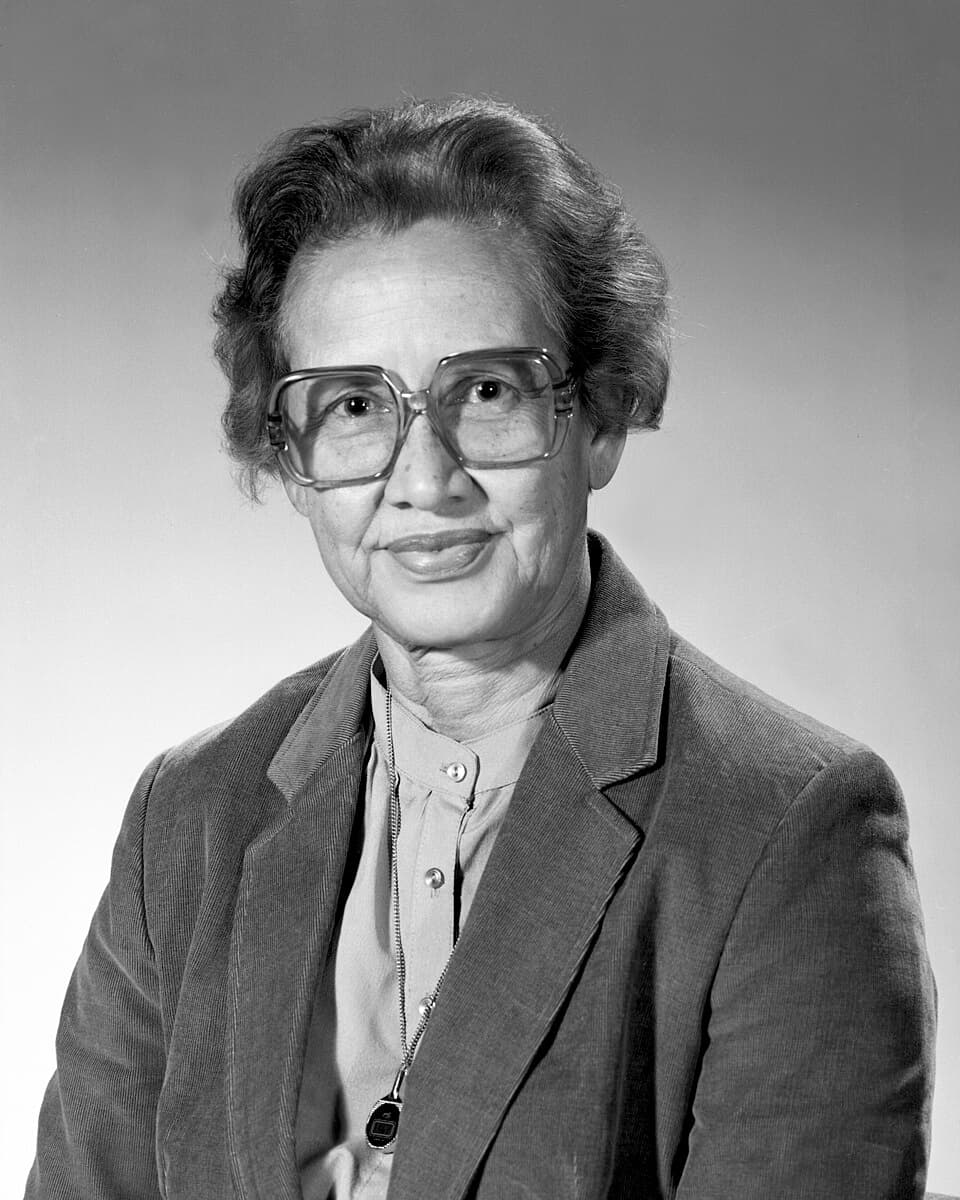
American · Science
Katherine Johnson
August 26, 1918 – February 24, 2020
Early Life and Background
Creola Katherine Coleman, later known as Katherine Johnson, was born on 26 August 1918 in White Sulphur Springs, Greenbrier County, West Virginia.4 She was the youngest of four children of Joylette Roberta (Lowell) and Joshua McKinley Coleman, who worked as a lumberman, farmer, and handyman.4 From an early age, Johnson showed an exceptional aptitude for mathematics, describing herself as having "counted everything" as a child.9
Because Greenbrier County did not provide schooling for Black children beyond the eighth grade, the Coleman family made significant sacrifices to support their daughter’s education.4 Each year, they moved to the town of Institute, near Charleston, so that their children could attend the high school associated with West Virginia State College (then a historically Black institution).4 Johnson advanced rapidly, skipping several grades and starting high school at the age of ten, an early sign of her extraordinary academic abilities.9
At West Virginia State College’s high school and later its undergraduate program, Johnson encountered mentors who recognized and nurtured her talent. Among them was the mathematician W. W. Schieffelin Claytor, the third African American to earn a Ph.D. in mathematics.10 Claytor created special advanced courses for Johnson, including one on analytic geometry of space, to prepare her for a potential career in mathematical research.10 This combination of family support, institutional opportunity at a historically Black college, and individual mentoring laid the foundation for her later work at NASA.
Education and Early Teaching Career
Johnson enrolled as an undergraduate at West Virginia State College, majoring in mathematics and French.1 She excelled academically and graduated with a B.S. in Mathematics and French in 1937, at age 18, with highest honors.1 During her studies, she was selected to join the college’s mathematics faculty in research projects, further deepening her familiarity with advanced topics such as space geometry and differential equations.10
After graduation, limited opportunities for Black women in mathematics led Johnson to begin her career as a teacher. She taught mathematics at public schools for African American students in West Virginia and Virginia, helping to raise educational standards in segregated classrooms while continuing to pursue her own intellectual interests.7 Teaching offered financial stability and professional respect, but Johnson remained determined to work directly with mathematics in a research or technical setting.
In 1939, she achieved a major educational milestone when she was chosen as one of the first three Black students to integrate the graduate program at West Virginia University, following a lawsuit that opened the university’s doors to Black graduate students.8 Johnson enrolled in graduate-level mathematics courses, making her one of the first African American women to attend the institution’s graduate school.12 However, family responsibilities took precedence when she became pregnant, and she left the program to focus on raising her children.8 This episode illustrates both her ambition and the gendered constraints facing women scholars in the era.
Entering the U.S. Space Program: NACA and NASA
Johnson’s route into the U.S. space program began in the early 1950s. In 1953, after hearing from a relative about job openings for mathematicians, she applied to the National Advisory Committee for Aeronautics (NACA), the predecessor to NASA.7 That year she was hired at the Langley Memorial Aeronautical Laboratory in Hampton, Virginia, as a member of the all-Black female computing section of the West Area Computing Unit, supervised by engineer Dorothy Vaughan.4
At Langley, Johnson worked as a "human computer," performing complex hand calculations for engineers and researchers. The West Area computers were segregated by race and gender, working in separate offices and using segregated facilities, including bathrooms and cafeterias.4 Despite this discriminatory environment, Johnson quickly distinguished herself through her grasp of analytic geometry and her willingness to ask probing questions about the engineering problems she was assigned.11
Her skill and initiative led to a pivotal reassignment in 1958, when she joined the Flight Research Division (later the Space Task Group) and began working directly on the mathematics of spacecraft trajectories.4 This move effectively desegregated her daily working environment; Johnson later recalled simply "being where the work was" and not returning to the segregated computing pool.11 Her transition from human computer to research mathematician mirrored the broader evolution of NACA into NASA and the shift from aeronautics to spaceflight.
Major Contributions to Spaceflight: Mercury, Gemini, and Apollo
Johnson’s most celebrated work came during the Space Race, when her calculations underpinned some of the earliest and most risky U.S. crewed missions. In 1960, she coauthored a research report titled "Determination of Azimuth Angle at Burnout for Placing a Satellite Over a Selected Earth Position", which described the equations governing orbital trajectories with specified landing positions.8 This paper marked the first time a woman in NASA’s Flight Research Division received author credit on a technical report, a significant professional and gender barrier-breaker.
In 1961, Johnson played a key role in calculating the trajectory for Alan Shepard’s Freedom 7 mission, the first U.S. human spaceflight.11 Working as a technologist for the spacecraft controls branch, she computed the flight path and splashdown location, ensuring that Shepard’s suborbital flight would be both feasible and safe.11 Her work included verifying the launch window and plotting the trajectory in a way that accounted for Earth’s rotation and the dynamics of re-entry.
The following year, in 1962, Johnson’s expertise became indispensable to John Glenn’s Friendship 7 mission, the first American orbital flight.4 As NASA introduced electronic computers to calculate flight trajectories, Glenn—concerned about relying solely on machine computations—famously requested that Johnson personally verify the results. "If she says they’re good," he reportedly said, "then I’m ready to go."5 Johnson checked the computer-generated numbers against her own calculations for the orbital trajectory and re-entry, providing crucial reassurance that helped secure the mission’s success.
Johnson continued to contribute trajectory work throughout the 1960s. She was involved in calculations for Project Apollo, including the Apollo 11 mission that landed the first humans on the Moon in 1969.4 She helped determine the rendezvous paths that allowed the Apollo Lunar Module and Command and Service Module to meet in lunar orbit.1 Johnson later identified her contributions to synchronizing these spacecraft as among her proudest achievements, because they required precise understanding of celestial mechanics and orbital dynamics.1
Her work extended beyond Apollo. Johnson contributed to the Apollo 13 mission, assisting in calculations that supported the safe return of the damaged spacecraft in 1970.11 She later worked on the Space Shuttle program and the Earth Resources Technology Satellite, applying her mathematical expertise to increasingly complex missions as NASA’s focus shifted from short-duration flights to long-term orbital operations and Earth observation.11
Professional Role, Methods, and Influence
Throughout her 33-year career at NACA and NASA, Johnson earned a reputation for mastering complex manual calculations and for helping pioneer the use of electronic computers in flight trajectory analysis.4 She specialized in analytic geometry of space, solving systems of equations that described the motion of spacecraft under varying gravitational and atmospheric conditions.10 Her calculations involved iterative methods, approximations, and checks that were essential in an era when many problems could not yet be efficiently handled by computers.
Johnson’s role shifted over time from being a human computer to functioning as a research mathematician and technologist. She participated actively in design discussions, asking engineers to explain the physical meaning of the problems so that she could model them correctly.11 Her insistence on understanding "why" rather than simply computing "what" helped change perceptions of women in technical roles and demonstrated that human computers could be key intellectual contributors rather than passive calculators.
As NASA missions grew more complex, Johnson also became involved in developing procedures and standards for trajectory calculations. Her work aided in establishing reliable methods for computing launch windows, orbital insertion parameters, and emergency return paths.4 These procedures were critical in mission planning and risk mitigation and influenced how subsequent generations of flight dynamics specialists approached spaceflight problems.
Awards, Honors, and Public Recognition
For many years, Johnson’s contributions were known primarily within NASA and select scientific circles. Wider recognition came later, as historians and journalists revisited the stories of Black women in the space program. In 2015, at age 97, she received one of the United States’ highest civilian honors: the Presidential Medal of Freedom.3 President Barack Obama cited her for refusing "to be limited by society’s expectations of her gender and race while expanding the boundaries of humanity’s reach," acknowledging both her technical achievements and her role as a trailblazer.11
Johnson’s story reached a global audience with the publication of Margot Lee Shetterly’s book Hidden Figures (2016) and its film adaptation (2016), in which she was portrayed by actor Taraji P. Henson.10 The book and movie highlighted the work of Johnson and her colleagues Dorothy Vaughan and Mary Jackson, emphasizing the intersection of race, gender, and scientific labor at NASA during the mid-twentieth century.
In addition to the Presidential Medal of Freedom, Johnson received numerous honors from professional and educational institutions. She was recognized with awards such as the IEEE President’s Award for her contributions to engineering and computing.11 NASA named a new facility, the Katherine G. Johnson Computational Research Facility, in her honor at the Langley Research Center, underscoring her lasting impact on the agency’s scientific work.1 In 2020, after her death, the National Geographic Society awarded her the Hubbard Medal, its highest honor, for a lifetime of achievement in research and exploration.12
Johnson also became the subject of numerous biographies, museum exhibits, and educational programs designed to inspire students—particularly girls and underrepresented minorities—to pursue careers in science, technology, engineering, and mathematics (STEM).9
Personal Life
Johnson’s personal life intertwined with her career in ways typical of mid-century women academics and professionals. She married her first husband, James Goble, in the late 1930s.4 The couple had three daughters: Joylette, Katherine, and Constance.4 During this period, Johnson balanced her teaching and graduate studies with family responsibilities, eventually leaving her graduate program to focus on raising her children when she became pregnant.8
Her husband’s illness and eventual death in the 1950s posed significant emotional and economic challenges. Johnson continued working to support her family, which influenced her decision to pursue the more stable and better-paid position at NACA.4 Later, she married Lieutenant Colonel James A. Johnson, a veteran of the U.S. Army, and became known professionally and publicly as Katherine Johnson.4 Her second marriage provided companionship and support through the demanding years of her NASA career and into retirement.
Outside of work, Johnson was deeply involved in community and church activities. She participated in civic organizations, mentored young people interested in science and mathematics, and often spoke about the importance of education.6 She emphasized that her achievements were not solely individual but built on the sacrifices of her parents, the opportunities provided by historically Black institutions, and the collaborative efforts of colleagues within NASA.
Later Life, Retirement, and Death
Johnson retired from NASA in 1986, after 33 years of service spanning the NACA era, Mercury, Gemini, Apollo, and the early Space Shuttle program.1 In retirement, she remained active as a speaker and advocate for education, frequently visiting schools and universities to discuss her experiences and to encourage students to pursue STEM fields.6 Her story began to attract broader attention in the 1990s and 2000s as historians studied the contributions of Black women in science.
She celebrated her 100th birthday in 2018, an event marked by tributes from NASA, the Computer History Museum, and other institutions that recognized her as a pioneer of the space age.8 By this time, she had become a symbol of resilience and excellence, particularly for African American women in scientific careers.
On 24 February 2020, Johnson died at age 101 at her home in Newport News, Virginia.2 NASA and many scientific organizations publicly mourned her passing, highlighting her role in "enlarging the frontiers of space" and opening doors for women and people of color in STEM disciplines.3 Obituaries in major scientific journals, including Nature, described her as the most recognized of the African American human computers and emphasized that her trajectory calculations for John Glenn’s 1962 flight had established her professional reputation.5
Legacy and Historical Impact
Katherine Johnson’s legacy rests on both her technical contributions and her role as a barrier-breaking figure in science. Mathematically, her work was central to some of the most significant milestones in U.S. crewed spaceflight: the first American in space, the first American in orbit, and the first human landing on the Moon.4 Her ability to translate physical problems into solvable systems of equations and to check the reliability of early computers underpinned mission safety at a time when failures could have been catastrophic.
Historically, Johnson’s career illustrates how Black women navigated and reshaped segregated scientific institutions. Starting in a racially segregated computing pool, she moved into integrated research groups and became a trusted colleague to white male engineers and astronauts in an era when both racism and sexism were pervasive.11 Her insistence on attending key meetings, asking questions, and claiming intellectual ownership of her work challenged norms that sought to confine women—especially Black women—to subordinate roles.
Johnson also stands as a symbol in ongoing conversations about representation in STEM. Her life story has been used by educators, activists, and policymakers to argue for improving access to quality education, combating discrimination, and recognizing hidden figures whose contributions have historically been marginalized.7 The naming of buildings and scholarships in her honor, alongside the popularity of Hidden Figures, has helped inspire a new generation of students who see in Johnson a model of excellence that looks like them.
In scholarly terms, her career has prompted broader research into the history of human computers, the gendered division of labor in scientific organizations, and the racial dynamics of the Cold War science establishment. Johnson’s presence in these narratives ensures that the story of the Space Race includes the mathematicians and computers whose work made rockets fly safely, not merely the astronauts and engineers who were more visible at the time.
Today, Katherine Johnson is remembered as a mathematician, a pioneering Black woman in science, and a key figure in the expansion of human activity into space. Her life illustrates how precise mathematical reasoning, combined with courage and persistence, can have world-changing consequences—from the classroom in West Virginia to orbit around Earth and the surface of the Moon.
Dated achievements
2 indexed.
- Aug261918Science
Birth of Creola Katherine Johnson
Katherine Johnson was born in White Sulphur Springs, West Virginia, on August 26, 1918.
View details Katherine Johnson - Wikipedia - Feb242020Science
Death of Katherine Johnson
Katherine Johnson died on February 24, 2020, at age 101, leaving behind a transformative legacy in American spaceflight and civil rights history.