← All women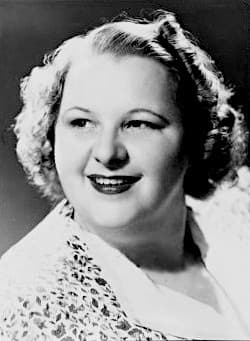
American · Arts
Kate Smith
May 1, 1907 – June 17, 1986
Early life and background
Kate Smith was born Kathryn Elizabeth Smith on May 1, 1907, in Greenville, Virginia, according to standard reference works. Some later sources give 1909, but the scholarly consensus and most biographical references support 1907. She grew up in a family of modest means and spent much of her childhood in Washington, D.C. Her parents were William and Charlotte Smith, and she had one sister, Helena. Biographical accounts describe her as having attended local schools rather than pursuing extended formal education.
From an early age, Smith showed an aptitude for singing and dancing. She performed at church socials and in local settings, and during World War I she sang in and around military camps in the Washington area. Those early experiences helped shape the straightforward, direct style that later made her appealing on radio. Her voice was not trained in the conservatory sense, but it had emotional immediacy and a strong contralto quality that listeners found memorable.
The world Smith entered was one in which women’s public performance opportunities were expanding, but still constrained by gender expectations. Popular entertainment offered paths for ambitious women, yet those paths often required persistence, flexibility, and a capacity to connect with broad audiences. Smith’s childhood performances and early public appearances provided the foundation for a career that would eventually reach national prominence.
Career beginnings
Smith’s first major step into professional entertainment came in 1926, when she appeared in her first vaudeville musical. Vaudeville was still a major proving ground for performers in the 1920s, and it allowed her to develop stage confidence, timing, and audience rapport. By the end of the decade she had established enough of a reputation to attract attention in New York City theatrical circles.
Her career changed decisively when she was discovered by Ted Collins, a Columbia Records vice president who became her manager and longtime partner. Under Collins’s guidance, Smith moved into radio, the medium that would make her a national celebrity. Radio transformed entertainment by bringing voices directly into American homes, and Smith’s warm, expressive style was ideally suited to it. By the early 1930s she was performing on the air and building a reputation as a major broadcast personality.
She became widely associated with the title “The First Lady of Radio”, a description that reflected both her popularity and the central place she occupied in the medium’s golden age. She also hosted programs that mixed music, conversation, and audience-friendly commentary, helping shape a kind of radio persona that was intimate, approachable, and highly recognizable. Her rise coincided with radio’s maturation into a dominant national medium, and she became one of its defining female stars.
Breakthrough and national fame
Smith’s breakthrough came with her broadcast introduction of Irving Berlin’s “God Bless America” on November 9, 1938. The song quickly became identified with her and was widely embraced as a patriotic anthem. Its success was amplified by the political and emotional climate of the late 1930s, when Americans were still recovering from the Depression and watching events in Europe with increasing concern. Smith’s performance offered reassurance, continuity, and a sense of national unity.
In 1939, she reinforced that patriotic image with a popular recording of “The Star-Spangled Banner” and a command performance at the White House for King George VI and Queen Elizabeth. These milestones placed her at the center of public ceremonial life. By this period, Smith was one of the most famous voices in the country, and her voice had become associated with emotional uplift, patriotism, and dependable familiarity.
Smith’s success was part of a broader transformation in American entertainment. As radio became the dominant mass medium, a singer could gain nationwide fame without the traditional gates of theater or opera. Smith used that system masterfully. Her manner on the air, described as friendly and conversational, broadened her appeal and helped create an enduring bond with listeners.
Wartime popularity and recording career
During World War II, Smith became a major patriotic figure. Biographical sources note that her on-air appeals for war bonds raised more than $600 million, an extraordinary sum that underscored both her popularity and her ability to mobilize audiences for national causes. In a period when entertainment and civic duty were closely linked, Smith’s broadcasts helped turn radio into a tool of morale-building and public service.
Her recording career was equally extensive. She made more than 2,000 recordings, and many were widely popular. She was especially associated with songs that balanced sentiment, religious feeling, and patriotism, but she also recorded lighter popular material. Her versatility helped sustain her fame across changing musical tastes. Though later generations often remember her mainly for one anthem, her catalogue was broad and commercially significant.
Smith’s work during the war years also reveals the complicated position of women performers in the public sphere. She was celebrated as a voice of national reassurance, yet that authority was rooted in a carefully maintained public image. Her success depended not only on talent but on the cultural meanings attached to femininity, sincerity, and domestic familiarity in the radio age.
Television, later career, and public honors
Smith continued working into the television era, but her most powerful cultural presence remained tied to radio and recording. Her career stretched across roughly five decades, and she remained a recognizable figure even as popular music changed dramatically after World War II. Her later years included selective public appearances and continuing recognition for her earlier achievements.
In 1966, she won a Grammy Award for How Great Thou Art, showing that her work still commanded respect in the recording industry. Much later, in 1982, President Ronald Reagan awarded her the Presidential Medal of Freedom, a major national honor recognizing her cultural contribution. In 1985, she received the Women’s International Center Living Legacy Award. These honors reflected a late-life reassessment of her place in American history and of the influence she had exercised for decades.
Smith was also remembered through institutional recognition after her death. She was inducted into the National Radio Hall of Fame in 1999, and in 2010 the U.S. Postal Service honored her with a commemorative stamp. In 2011, NASA used her version of “God Bless America” for the final wake-up call of the Space Shuttle program, a symbolic testament to the durability of her patriotic association. These later tributes show that her public image remained powerful long after the era of live radio had passed.
Personal life
Smith never married and had no children, according to major biographical references. That fact is notable in a period when women in public life were often measured against domestic expectations. Her career and public identity were instead organized around performance, recording, and broadcasting. She also worked closely with Ted Collins, who served as her manager and business partner for many years; their professional relationship was central to her rise and long-term success.
As a public figure, Smith cultivated a persona of warmth and accessibility. Her manner on air suggested a kind of maternal or neighborly intimacy that resonated with mass audiences. That persona was part of her appeal, but it also shows how women in media could gain authority by embodying forms of familiarity and reassurance. Her life demonstrates the interplay between personal image and professional power in twentieth-century entertainment.
Legacy and historical impact
Kate Smith occupies a central place in the history of American radio, popular song, and patriotic performance. She was one of the medium’s most powerful female stars, and her success helped define the emotional possibilities of broadcast entertainment. Her voice became inseparable from “God Bless America”, a song that came to function as a national anthem-like expression in American civic culture.
Her legacy also lies in what she represented for women in public life. Smith achieved enormous fame in a competitive industry that often limited women’s artistic authority. She did so through consistency, vocal strength, and an ability to speak to mass audiences in a direct and comforting way. Her career illustrates how women could shape national feeling without holding formal political power.
At the same time, her life reflects the broader history of twentieth-century media, in which radio voices became a shared part of domestic and public life. Smith helped show that a single performer, working through a new technology, could become a national symbol. That is why her career remains significant not just in music history, but in the history of American culture more broadly.
Later life and death
In her later years, Smith’s public appearances became less frequent as health problems affected her activity. Nonetheless, recognition for her achievements continued to accumulate. She remained an iconic figure in American memory, especially among audiences who had grown up with radio in the 1930s and 1940s.
Smith died on June 17, 1986, in Raleigh, North Carolina. Her death closed a remarkable career that had made her one of the best-known voices in the United States. Even after her passing, honors continued to affirm her enduring importance. The long afterlife of her most famous song, and the repeated use of her recording in ceremonial contexts, show that her voice remained part of the country’s cultural soundtrack long after the golden age of radio had ended.
Dated achievements
11 indexed.
- May011907Arts
Birth of Kate Smith
Kathryn Elizabeth "Kate" Smith was born in Greenville, Virginia, later becoming one of America's most beloved singers.
View details Kate Smith - Wikipedia - Nov091938Arts
First radio performance of "God Bless America"
Smith premiered Irving Berlin's "God Bless America" on her radio program, forever linking her name to the patriotic anthem.